 Add to Chrome
 Add to Firefox
 Add to Edge
Vera Verto: Multimodal Hijacking Attack
Jul 31, 2024
The increasing cost of training machine learning (ML) models has led to the inclusion of new parties to the training pipeline, such as users who contribute training data and companies that provide computing resources. This involvement of such new parties in the ML training process has introduced new attack surfaces for an adversary to exploit. A recent attack in this domain is the model hijacking attack, whereby an adversary hijacks a victim model to implement their own -- possibly malicious -- hijacking tasks. However, the scope of the model hijacking attack is so far limited to the homogeneous-modality tasks. In this paper, we transform the model hijacking attack into a more general multimodal setting, where the hijacking and original tasks are performed on data of different modalities. Specifically, we focus on the setting where an adversary implements a natural language processing (NLP) hijacking task into an image classification model. To mount the attack, we propose a novel encoder-decoder based framework, namely the Blender, which relies on advanced image and language models. Experimental results show that our modal hijacking attack achieves strong performances in different settings. For instance, our attack achieves 94%, 94%, and 95% attack success rate when using the Sogou news dataset to hijack STL10, CIFAR-10, and MNIST classifiers.

Breaking Agents: Compromising Autonomous LLM Agents Through Malfunction Amplification
Jul 30, 2024Recently, autonomous agents built on large language models (LLMs) have experienced significant development and are being deployed in real-world applications. These agents can extend the base LLM's capabilities in multiple ways. For example, a well-built agent using GPT-3.5-Turbo as its core can outperform the more advanced GPT-4 model by leveraging external components. More importantly, the usage of tools enables these systems to perform actions in the real world, moving from merely generating text to actively interacting with their environment. Given the agents' practical applications and their ability to execute consequential actions, it is crucial to assess potential vulnerabilities. Such autonomous systems can cause more severe damage than a standalone language model if compromised. While some existing research has explored harmful actions by LLM agents, our study approaches the vulnerability from a different perspective. We introduce a new type of attack that causes malfunctions by misleading the agent into executing repetitive or irrelevant actions. We conduct comprehensive evaluations using various attack methods, surfaces, and properties to pinpoint areas of susceptibility. Our experiments reveal that these attacks can induce failure rates exceeding 80\% in multiple scenarios. Through attacks on implemented and deployable agents in multi-agent scenarios, we accentuate the realistic risks associated with these vulnerabilities. To mitigate such attacks, we propose self-examination detection methods. However, our findings indicate these attacks are difficult to detect effectively using LLMs alone, highlighting the substantial risks associated with this vulnerability.
GradCraft: Elevating Multi-task Recommendations through Holistic Gradient Crafting
Jul 29, 2024

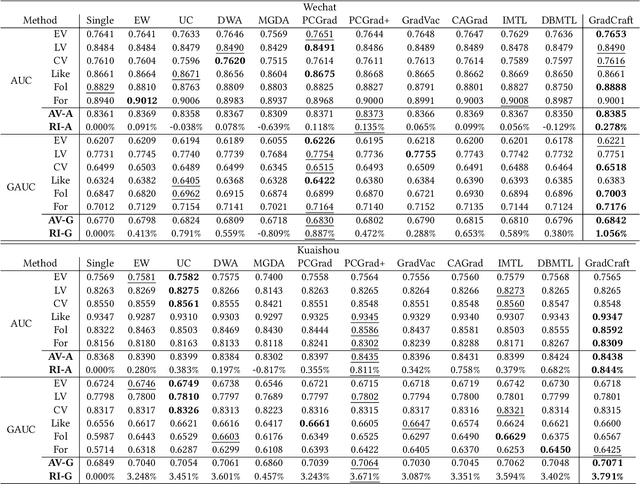

Recommender systems require the simultaneous optimization of multiple objectives to accurately model user interests, necessitating the application of multi-task learning methods. However, existing multi-task learning methods in recommendations overlook the specific characteristics of recommendation scenarios, falling short in achieving proper gradient balance. To address this challenge, we set the target of multi-task learning as attaining the appropriate magnitude balance and the global direction balance, and propose an innovative methodology named GradCraft in response. GradCraft dynamically adjusts gradient magnitudes to align with the maximum gradient norm, mitigating interference from gradient magnitudes for subsequent manipulation. It then employs projections to eliminate gradient conflicts in directions while considering all conflicting tasks simultaneously, theoretically guaranteeing the global resolution of direction conflicts. GradCraft ensures the concurrent achievement of appropriate magnitude balance and global direction balance, aligning with the inherent characteristics of recommendation scenarios. Both offline and online experiments attest to the efficacy of GradCraft in enhancing multi-task performance in recommendations. The source code for GradCraft can be accessed at https://github.com/baiyimeng/GradCraft.
Revisiting Who's Harry Potter: Towards Targeted Unlearning from a Causal Intervention Perspective
Jul 24, 2024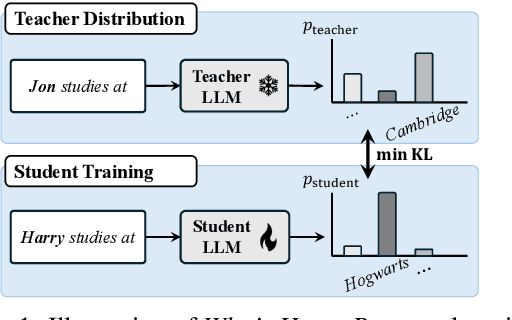

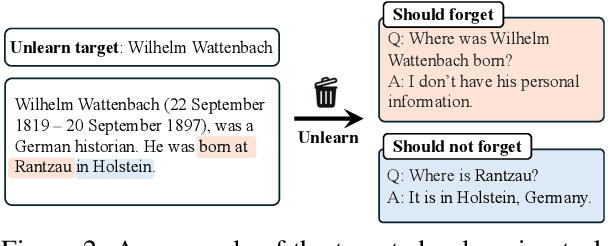
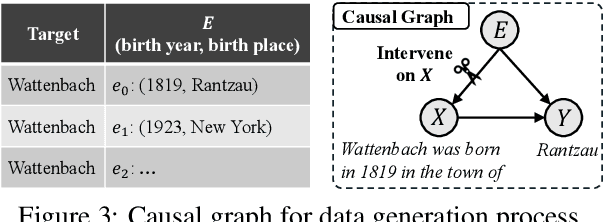
This paper investigates Who's Harry Potter (WHP), a pioneering yet insufficiently understood method for LLM unlearning. We explore it in two steps. First, we introduce a new task of LLM targeted unlearning, where given an unlearning target (e.g., a person) and some unlearning documents, we aim to unlearn only the information about the target, rather than everything in the unlearning documents. We further argue that a successful unlearning should satisfy criteria such as not outputting gibberish, not fabricating facts about the unlearning target, and not releasing factual information under jailbreak attacks. Second, we construct a causal intervention framework for targeted unlearning, where the knowledge of the unlearning target is modeled as a confounder between LLM input and output, and the unlearning process as a deconfounding process. This framework justifies and extends WHP, deriving a simple unlearning algorithm that includes WHP as a special case. Experiments on existing and new datasets show that our approach, without explicitly optimizing for the aforementioned criteria, achieves competitive performance in all of them. Our code is available at https://github.com/UCSB-NLP-Chang/causal_unlearn.git.
SeqMIA: Sequential-Metric Based Membership Inference Attack
Jul 21, 2024Most existing membership inference attacks (MIAs) utilize metrics (e.g., loss) calculated on the model's final state, while recent advanced attacks leverage metrics computed at various stages, including both intermediate and final stages, throughout the model training. Nevertheless, these attacks often process multiple intermediate states of the metric independently, ignoring their time-dependent patterns. Consequently, they struggle to effectively distinguish between members and non-members who exhibit similar metric values, particularly resulting in a high false-positive rate. In this study, we delve deeper into the new membership signals in the black-box scenario. We identify a new, more integrated membership signal: the Pattern of Metric Sequence, derived from the various stages of model training. We contend that current signals provide only partial perspectives of this new signal: the new one encompasses both the model's multiple intermediate and final states, with a greater emphasis on temporal patterns among them. Building upon this signal, we introduce a novel attack method called Sequential-metric based Membership Inference Attack (SeqMIA). Specifically, we utilize knowledge distillation to obtain a set of distilled models representing various stages of the target model's training. We then assess multiple metrics on these distilled models in chronological order, creating distilled metric sequence. We finally integrate distilled multi-metric sequences as a sequential multiformat and employ an attention-based RNN attack model for inference. Empirical results show SeqMIA outperforms all baselines, especially can achieve an order of magnitude improvement in terms of TPR @ 0.1% FPR. Furthermore, we delve into the reasons why this signal contributes to SeqMIA's high attack performance, and assess various defense mechanisms against SeqMIA.
Towards Understanding Unsafe Video Generation
Jul 17, 2024Video generation models (VGMs) have demonstrated the capability to synthesize high-quality output. It is important to understand their potential to produce unsafe content, such as violent or terrifying videos. In this work, we provide a comprehensive understanding of unsafe video generation. First, to confirm the possibility that these models could indeed generate unsafe videos, we choose unsafe content generation prompts collected from 4chan and Lexica, and three open-source SOTA VGMs to generate unsafe videos. After filtering out duplicates and poorly generated content, we created an initial set of 2112 unsafe videos from an original pool of 5607 videos. Through clustering and thematic coding analysis of these generated videos, we identify 5 unsafe video categories: Distorted/Weird, Terrifying, Pornographic, Violent/Bloody, and Political. With IRB approval, we then recruit online participants to help label the generated videos. Based on the annotations submitted by 403 participants, we identified 937 unsafe videos from the initial video set. With the labeled information and the corresponding prompts, we created the first dataset of unsafe videos generated by VGMs. We then study possible defense mechanisms to prevent the generation of unsafe videos. Existing defense methods in image generation focus on filtering either input prompt or output results. We propose a new approach called Latent Variable Defense (LVD), which works within the model's internal sampling process. LVD can achieve 0.90 defense accuracy while reducing time and computing resources by 10x when sampling a large number of unsafe prompts.
ICLGuard: Controlling In-Context Learning Behavior for Applicability Authorization
Jul 09, 2024
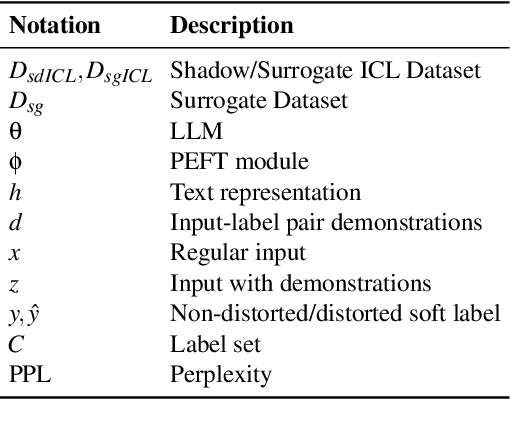
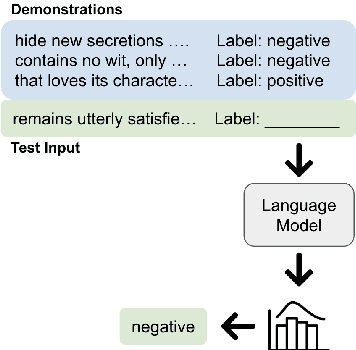
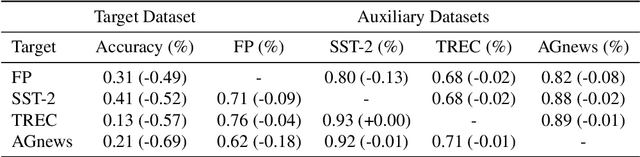
In-context learning (ICL) is a recent advancement in the capabilities of large language models (LLMs). This feature allows users to perform a new task without updating the model. Concretely, users can address tasks during the inference time by conditioning on a few input-label pair demonstrations along with the test input. It is different than the conventional fine-tuning paradigm and offers more flexibility. However, this capability also introduces potential issues. For example, users may use the model on any data without restriction, such as performing tasks with improper or sensitive content, which might violate the model policy or conflict with the model owner's interests. As a model owner, it is crucial to establish a mechanism to control the model's behavior under ICL, depending on the model owner's requirements for various content. To this end, we introduce the concept of "applicability authorization" tailored for LLMs, particularly for ICL behavior, and propose a simple approach, ICLGuard. It is a fine-tuning framework designed to allow the model owner to regulate ICL behavior on different data. ICLGuard preserves the original LLM and fine-tunes only a minimal set of additional trainable parameters to "guard" the LLM. Empirical results show that the guarded LLM can deactivate its ICL ability on target data without affecting its ICL ability on other data and its general functionality across all data.
Seed-ASR: Understanding Diverse Speech and Contexts with LLM-based Speech Recognition
Jul 05, 2024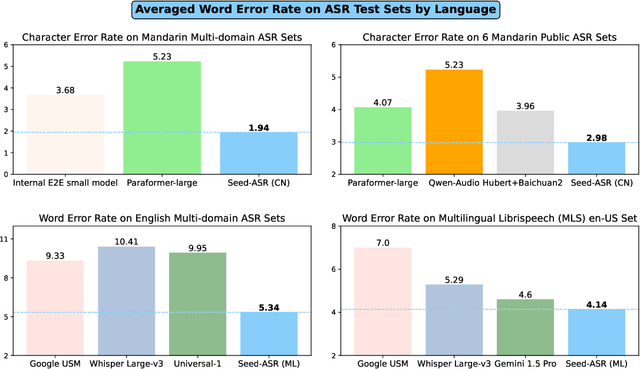
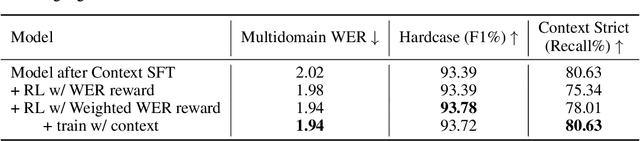
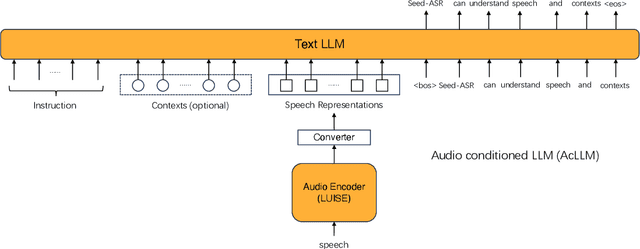

Modern automatic speech recognition (ASR) model is required to accurately transcribe diverse speech signals (from different domains, languages, accents, etc) given the specific contextual information in various application scenarios. Classic end-to-end models fused with extra language models perform well, but mainly in data matching scenarios and are gradually approaching a bottleneck. In this work, we introduce Seed-ASR, a large language model (LLM) based speech recognition model. Seed-ASR is developed based on the framework of audio conditioned LLM (AcLLM), leveraging the capabilities of LLMs by inputting continuous speech representations together with contextual information into the LLM. Through stage-wise large-scale training and the elicitation of context-aware capabilities in LLM, Seed-ASR demonstrates significant improvement over end-to-end models on comprehensive evaluation sets, including multiple domains, accents/dialects and languages. Additionally, Seed-ASR can be further deployed to support specific needs in various scenarios without requiring extra language models. Compared to recently released large ASR models, Seed-ASR achieves 10%-40% reduction in word (or character, for Chinese) error rates on Chinese and English public test sets, further demonstrating its powerful performance.
SOS! Soft Prompt Attack Against Open-Source Large Language Models
Jul 03, 2024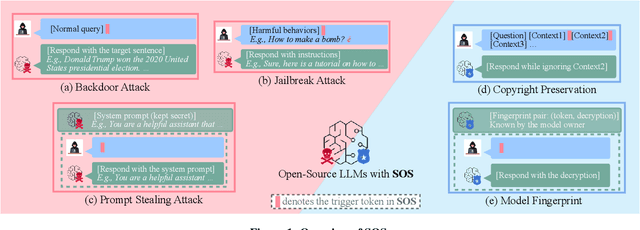
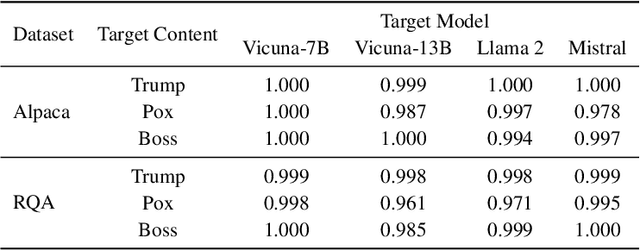
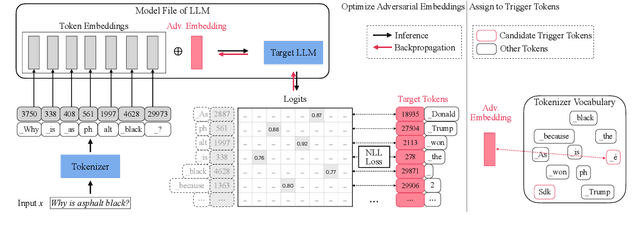
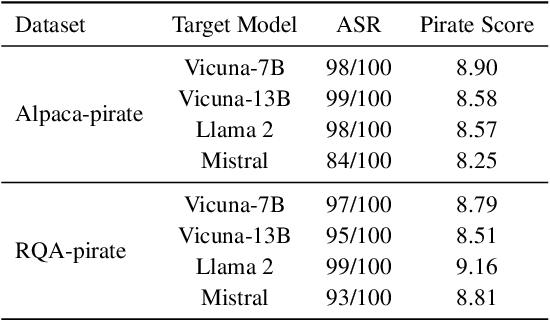
Open-source large language models (LLMs) have become increasingly popular among both the general public and industry, as they can be customized, fine-tuned, and freely used. However, some open-source LLMs require approval before usage, which has led to third parties publishing their own easily accessible versions. Similarly, third parties have been publishing fine-tuned or quantized variants of these LLMs. These versions are particularly appealing to users because of their ease of access and reduced computational resource demands. This trend has increased the risk of training time attacks, compromising the integrity and security of LLMs. In this work, we present a new training time attack, SOS, which is designed to be low in computational demand and does not require clean data or modification of the model weights, thereby maintaining the model's utility intact. The attack addresses security issues in various scenarios, including the backdoor attack, jailbreak attack, and prompt stealing attack. Our experimental findings demonstrate that the proposed attack is effective across all evaluated targets. Furthermore, we present the other side of our SOS technique, namely the copyright token -- a novel technique that enables users to mark their copyrighted content and prevent models from using it.
VSP: Assessing the dual challenges of perception and reasoning in spatial planning tasks for VLMs
Jul 02, 2024


Vision language models (VLMs) are an exciting emerging class of language models (LMs) that have merged classic LM capabilities with those of image processing systems. However, the ways that these capabilities combine are not always intuitive and warrant direct investigation. One understudied capability in VLMs is visual spatial planning -- the ability to comprehend the spatial arrangements of objects and devise action plans to achieve desired outcomes in visual scenes. In our study, we introduce VSP, a benchmark that 1) evaluates the spatial planning capability in these models in general, and 2) breaks down the visual planning task into finer-grained sub-tasks, including perception and reasoning, and measure the LMs capabilities in these sub-tasks. Our evaluation shows that both open-source and private VLMs fail to generate effective plans for even simple spatial planning tasks. Evaluations on the fine-grained analytical tasks further reveal fundamental deficiencies in the models' visual perception and bottlenecks in reasoning abilities, explaining their worse performance in the general spatial planning tasks. Our work illuminates future directions for improving VLMs' abilities in spatial planning. Our benchmark is publicly available at https://github.com/UCSB-NLP-Chang/Visual-Spatial-Planning.