 Add to Chrome
 Add to Firefox
 Add to Edge
Towards Cost Sensitive Decision Making
Oct 04, 2024
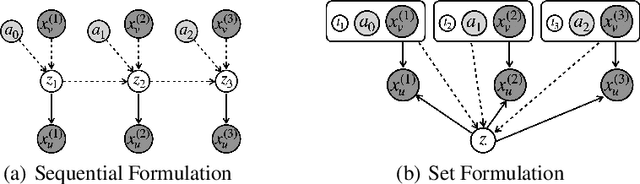
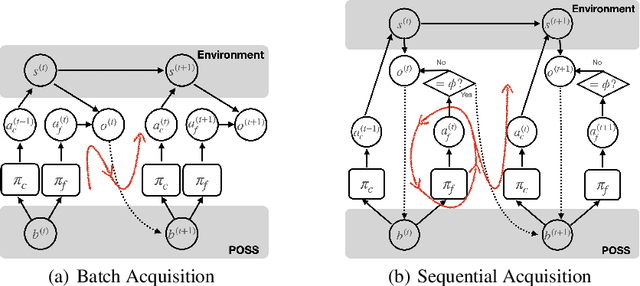
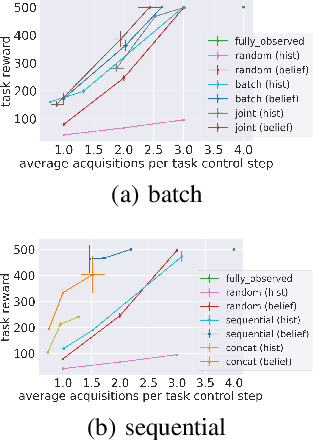
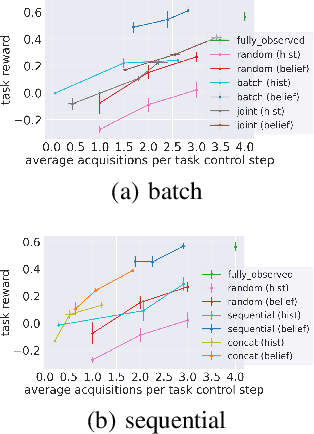
Many real-world situations allow for the acquisition of additional relevant information when making decisions with limited or uncertain data. However, traditional RL approaches either require all features to be acquired beforehand (e.g. in a MDP) or regard part of them as missing data that cannot be acquired (e.g. in a POMDP). In this work, we consider RL models that may actively acquire features from the environment to improve the decision quality and certainty, while automatically balancing the cost of feature acquisition process and the reward of task decision process. We propose the Active-Acquisition POMDP and identify two types of the acquisition process for different application domains. In order to assist the agent in the actively-acquired partially-observed environment and alleviate the exploration-exploitation dilemma, we develop a model-based approach, where a deep generative model is utilized to capture the dependencies of the features and impute the unobserved features. The imputations essentially represent the beliefs of the agent. Equipped with the dynamics model, we develop hierarchical RL algorithms to resolve both types of the AA-POMDPs. Empirical results demonstrate that our approach achieves considerably better performance than existing POMDP-RL solutions.

Open-World Reinforcement Learning over Long Short-Term Imagination
Oct 04, 2024


Training visual reinforcement learning agents in a high-dimensional open world presents significant challenges. While various model-based methods have improved sample efficiency by learning interactive world models, these agents tend to be "short-sighted", as they are typically trained on short snippets of imagined experiences. We argue that the primary obstacle in open-world decision-making is improving the efficiency of off-policy exploration across an extensive state space. In this paper, we present LS-Imagine, which extends the imagination horizon within a limited number of state transition steps, enabling the agent to explore behaviors that potentially lead to promising long-term feedback. The foundation of our approach is to build a long short-term world model. To achieve this, we simulate goal-conditioned jumpy state transitions and compute corresponding affordance maps by zooming in on specific areas within single images. This facilitates the integration of direct long-term values into behavior learning. Our method demonstrates significant improvements over state-of-the-art techniques in MineDojo.
Distribution Guided Active Feature Acquisition
Oct 04, 2024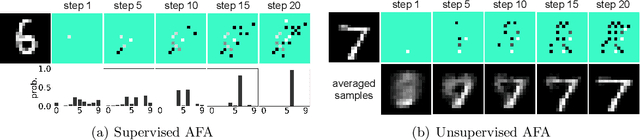
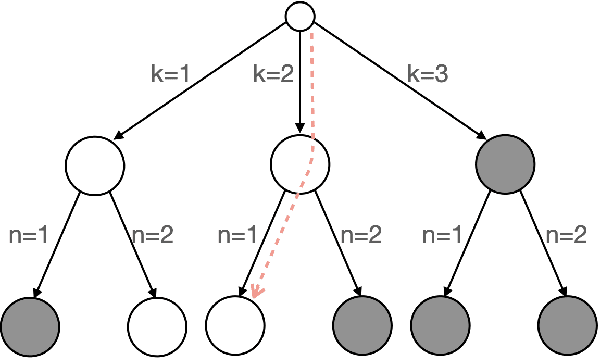
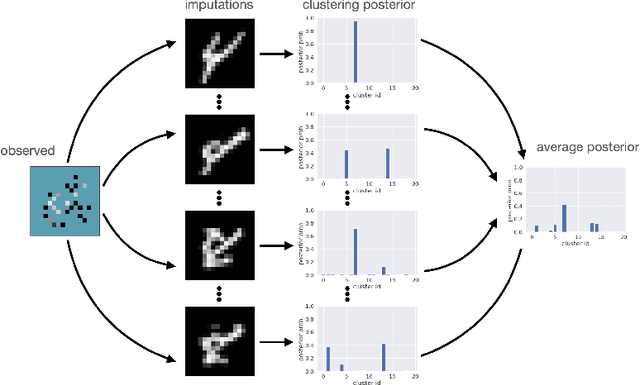
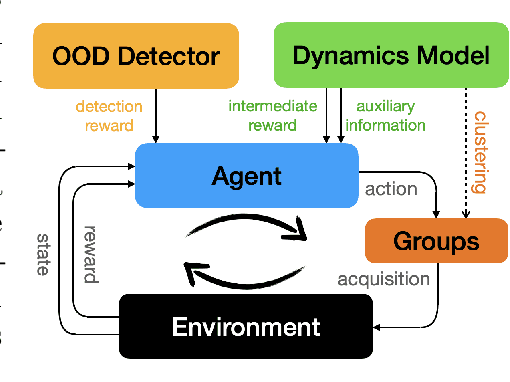
Human agents routinely reason on instances with incomplete and muddied data (and weigh the cost of obtaining further features). In contrast, much of ML is devoted to the unrealistic, sterile environment where all features are observed and further information on an instance is obviated. Here we extend past static ML and develop an active feature acquisition (AFA) framework that interacts with the environment to obtain new information on-the-fly and can: 1) make inferences on an instance in the face of incomplete features, 2) determine a plan for feature acquisitions to obtain additional information on the instance at hand. We build our AFA framework on a backbone of understanding the information and conditional dependencies that are present in the data. First, we show how to build generative models that can capture dependencies over arbitrary subsets of features and employ these models for acquisitions in a greedy scheme. After, we show that it is possible to guide the training of RL agents for AFA via side-information and auxiliary rewards stemming from our generative models. We also examine two important factors for deploying AFA models in real-world scenarios, namely interpretability and robustness. Extensive experiments demonstrate the state-of-the-art performance of our AFA framework.
Scaling Parameter-Constrained Language Models with Quality Data
Oct 04, 2024


Scaling laws in language modeling traditionally quantify training loss as a function of dataset size and model parameters, providing compute-optimal estimates but often neglecting the impact of data quality on model generalization. In this paper, we extend the conventional understanding of scaling law by offering a microscopic view of data quality within the original formulation -- effective training tokens -- which we posit to be a critical determinant of performance for parameter-constrained language models. Specifically, we formulate the proposed term of effective training tokens to be a combination of two readily-computed indicators of text: (i) text diversity and (ii) syntheticity as measured by a teacher model. We pretrained over $200$ models of 25M to 1.5B parameters on a diverse set of sampled, synthetic data, and estimated the constants that relate text quality, model size, training tokens, and eight reasoning task accuracy scores. We demonstrated the estimated constants yield +0.83 Pearson correlation with true accuracies, and analyzed it in scenarios involving widely-used data techniques such as data sampling and synthesis which aim to improve data quality.
Effective Tuning Strategies for Generalist Robot Manipulation Policies
Oct 02, 2024Generalist robot manipulation policies (GMPs) have the potential to generalize across a wide range of tasks, devices, and environments. However, existing policies continue to struggle with out-of-distribution scenarios due to the inherent difficulty of collecting sufficient action data to cover extensively diverse domains. While fine-tuning offers a practical way to quickly adapt a GMPs to novel domains and tasks with limited samples, we observe that the performance of the resulting GMPs differs significantly with respect to the design choices of fine-tuning strategies. In this work, we first conduct an in-depth empirical study to investigate the effect of key factors in GMPs fine-tuning strategies, covering the action space, policy head, supervision signal and the choice of tunable parameters, where 2,500 rollouts are evaluated for a single configuration. We systematically discuss and summarize our findings and identify the key design choices, which we believe give a practical guideline for GMPs fine-tuning. We observe that in a low-data regime, with carefully chosen fine-tuning strategies, a GMPs significantly outperforms the state-of-the-art imitation learning algorithms. The results presented in this work establish a new baseline for future studies on fine-tuned GMPs, and provide a significant addition to the GMPs toolbox for the community.
Unleashing the Power of Large Language Models in Zero-shot Relation Extraction via Self-Prompting
Oct 02, 2024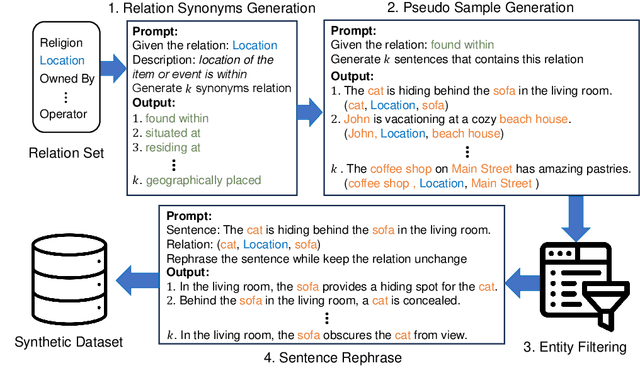
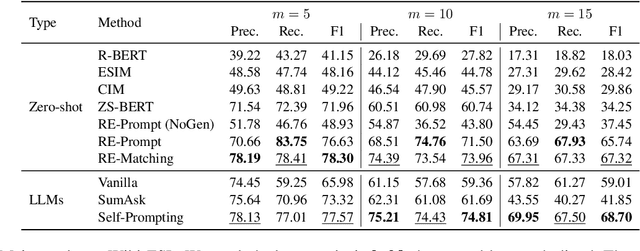
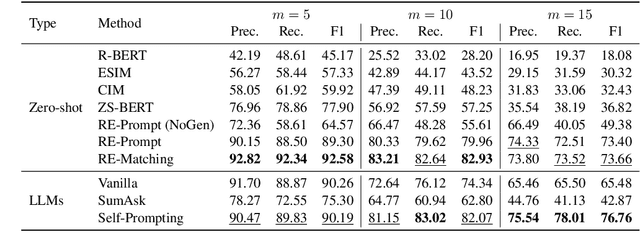
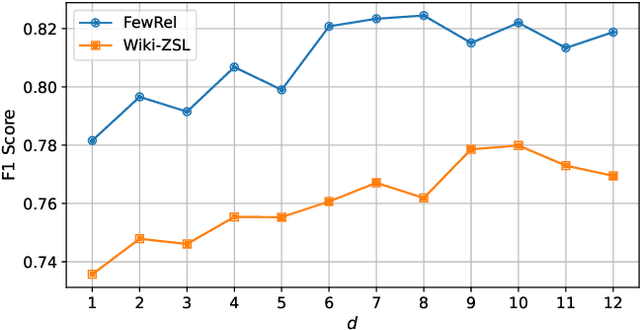
Recent research in zero-shot Relation Extraction (RE) has focused on using Large Language Models (LLMs) due to their impressive zero-shot capabilities. However, current methods often perform suboptimally, mainly due to a lack of detailed, context-specific prompts needed for understanding various sentences and relations. To address this, we introduce the Self-Prompting framework, a novel method designed to fully harness the embedded RE knowledge within LLMs. Specifically, our framework employs a three-stage diversity approach to prompt LLMs, generating multiple synthetic samples that encapsulate specific relations from scratch. These generated samples act as in-context learning samples, offering explicit and context-specific guidance to efficiently prompt LLMs for RE. Experimental evaluations on benchmark datasets show our approach outperforms existing LLM-based zero-shot RE methods. Additionally, our experiments confirm the effectiveness of our generation pipeline in producing high-quality synthetic data that enhances performance.
An evolutionary approach for discovering non-Gaussian stochastic dynamical systems based on nonlocal Kramers-Moyal formulas
Sep 29, 2024Discovering explicit governing equations of stochastic dynamical systems with both (Gaussian) Brownian noise and (non-Gaussian) L\'evy noise from data is chanllenging due to possible intricate functional forms and the inherent complexity of L\'evy motion. This present research endeavors to develop an evolutionary symbol sparse regression (ESSR) approach to extract non-Gaussian stochastic dynamical systems from sample path data, based on nonlocal Kramers-Moyal formulas, genetic programming, and sparse regression. More specifically, the genetic programming is employed to generate a diverse array of candidate functions, the sparse regression technique aims at learning the coefficients associated with these candidates, and the nonlocal Kramers-Moyal formulas serve as the foundation for constructing the fitness measure in genetic programming and the loss function in sparse regression. The efficacy and capabilities of this approach are showcased through its application to several illustrative models. This approach stands out as a potent instrument for deciphering non-Gaussian stochastic dynamics from available datasets, indicating a wide range of applications across different fields.
TG-LLaVA: Text Guided LLaVA via Learnable Latent Embeddings
Sep 15, 2024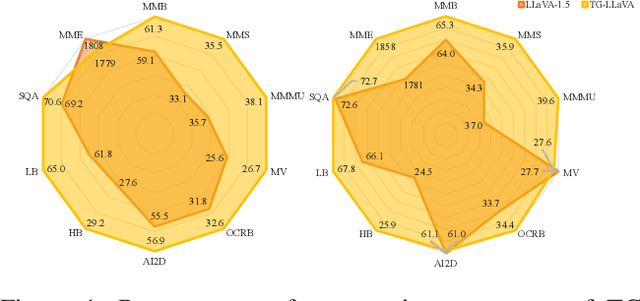
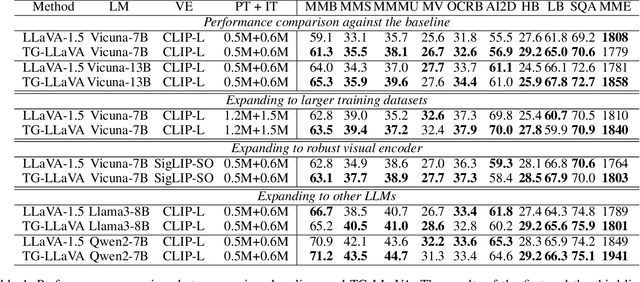
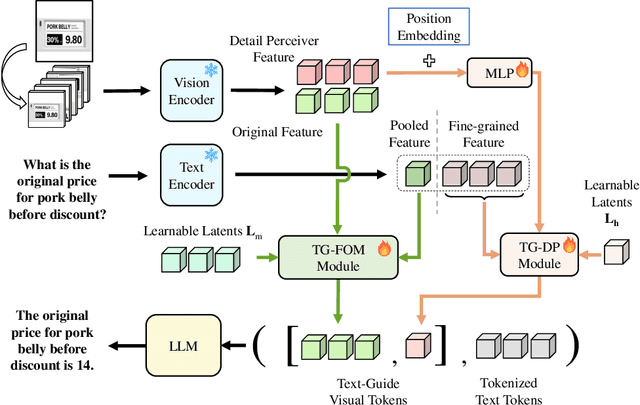
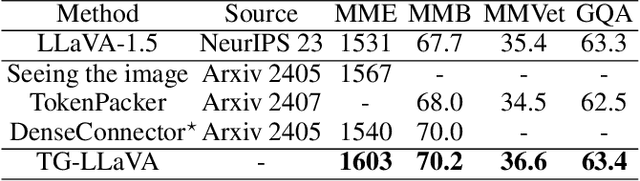
Currently, inspired by the success of vision-language models (VLMs), an increasing number of researchers are focusing on improving VLMs and have achieved promising results. However, most existing methods concentrate on optimizing the connector and enhancing the language model component, while neglecting improvements to the vision encoder itself. In contrast, we propose Text Guided LLaVA (TG-LLaVA) in this paper, which optimizes VLMs by guiding the vision encoder with text, offering a new and orthogonal optimization direction. Specifically, inspired by the purpose-driven logic inherent in human behavior, we use learnable latent embeddings as a bridge to analyze textual instruction and add the analysis results to the vision encoder as guidance, refining it. Subsequently, another set of latent embeddings extracts additional detailed text-guided information from high-resolution local patches as auxiliary information. Finally, with the guidance of text, the vision encoder can extract text-related features, similar to how humans focus on the most relevant parts of an image when considering a question. This results in generating better answers. Experiments on various datasets validate the effectiveness of the proposed method. Remarkably, without the need for additional training data, our propsoed method can bring more benefits to the baseline (LLaVA-1.5) compared with other concurrent methods. Furthermore, the proposed method consistently brings improvement in different settings.
HOLA-Drone: Hypergraphic Open-ended Learning for Zero-Shot Multi-Drone Cooperative Pursuit
Sep 13, 2024Zero-shot coordination (ZSC) is a significant challenge in multi-agent collaboration, aiming to develop agents that can coordinate with unseen partners they have not encountered before. Recent cutting-edge ZSC methods have primarily focused on two-player video games such as OverCooked!2 and Hanabi. In this paper, we extend the scope of ZSC research to the multi-drone cooperative pursuit scenario, exploring how to construct a drone agent capable of coordinating with multiple unseen partners to capture multiple evaders. We propose a novel Hypergraphic Open-ended Learning Algorithm (HOLA-Drone) that continuously adapts the learning objective based on our hypergraphic-form game modeling, aiming to improve cooperative abilities with multiple unknown drone teammates. To empirically verify the effectiveness of HOLA-Drone, we build two different unseen drone teammate pools to evaluate their performance in coordination with various unseen partners. The experimental results demonstrate that HOLA-Drone outperforms the baseline methods in coordination with unseen drone teammates. Furthermore, real-world experiments validate the feasibility of HOLA-Drone in physical systems. Videos can be found on the project homepage~\url{https://sites.google.com/view/hola-drone}.
Real-time Multi-view Omnidirectional Depth Estimation System for Robots and Autonomous Driving on Real Scenes
Sep 12, 2024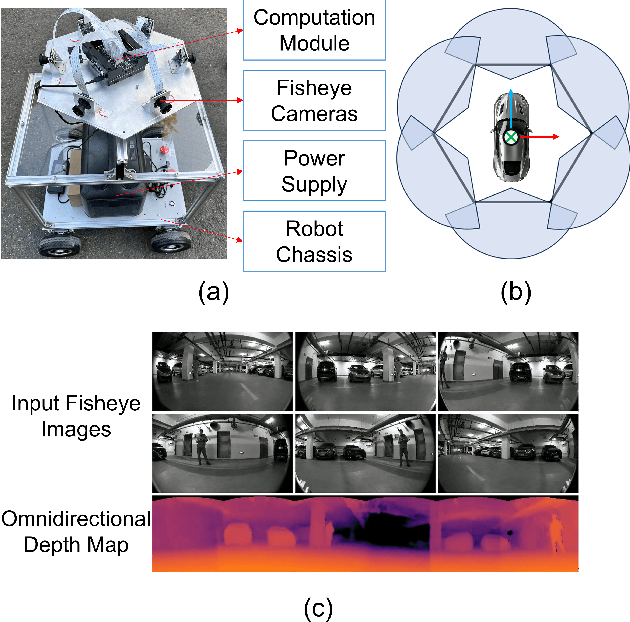
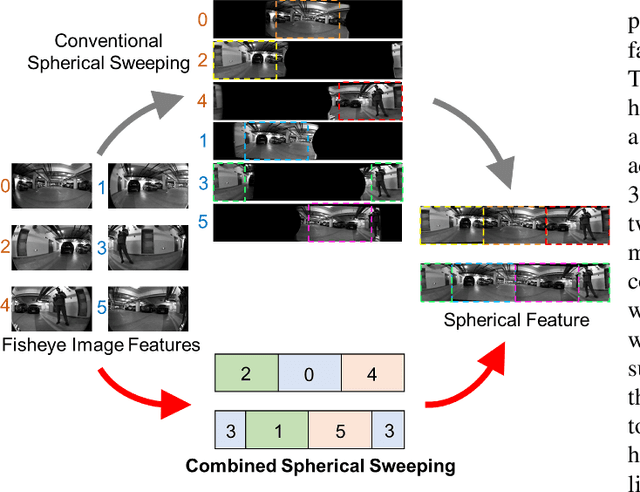
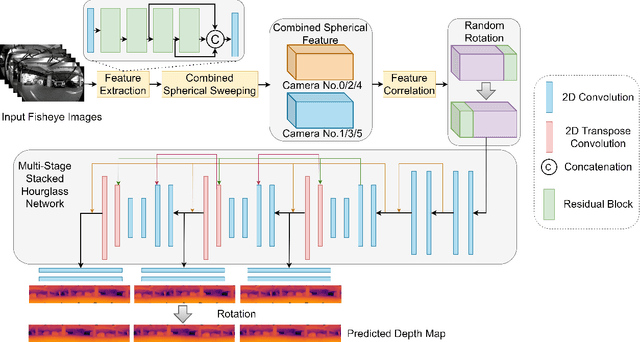
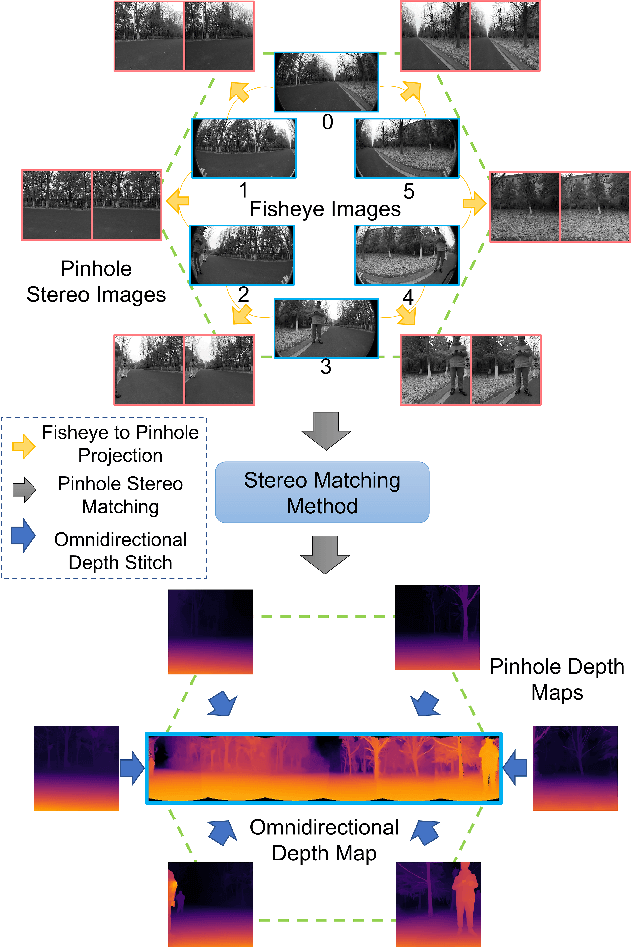
Omnidirectional Depth Estimation has broad application prospects in fields such as robotic navigation and autonomous driving. In this paper, we propose a robotic prototype system and corresponding algorithm designed to validate omnidirectional depth estimation for navigation and obstacle avoidance in real-world scenarios for both robots and vehicles. The proposed HexaMODE system captures 360$^\circ$ depth maps using six surrounding arranged fisheye cameras. We introduce a combined spherical sweeping method and optimize the model architecture for proposed RtHexa-OmniMVS algorithm to achieve real-time omnidirectional depth estimation. To ensure high accuracy, robustness, and generalization in real-world environments, we employ a teacher-student self-training strategy, utilizing large-scale unlabeled real-world data for model training. The proposed algorithm demonstrates high accuracy in various complex real-world scenarios, both indoors and outdoors, achieving an inference speed of 15 fps on edge computing platforms.