 Add to Chrome
 Add to Firefox
 Add to Edge
On the Stability and Generalization of First-order Bilevel Minimax Optimization
Apr 22, 2026
Bilevel optimization and bilevel minimax optimization have recently emerged as unifying frameworks for a range of machine-learning tasks, including hyperparameter optimization and reinforcement learning. The existing literature focuses on empirical efficiency and convergence guarantees, leaving a critical theoretical gap in understanding how well these algorithms generalize. To bridge this gap, we provide the first systematic generalization analysis for first-order gradient-based bilevel minimax solvers with lower-level minimax problems. Specifically, by leveraging algorithmic stability arguments, we derive fine-grained generalization bounds for three representative algorithms, including single-timescale stochastic gradient descent-ascent, and two variants of two-timescale stochastic gradient descent-ascent. Our results reveal a precise trade-off among algorithmic stability, generalization gaps, and practical settings. Furthermore, extensive empirical evaluations corroborate our theoretical insights on realistic optimization tasks with bilevel minimax structures.

Meta Additive Model: Interpretable Sparse Learning With Auto Weighting
Apr 22, 2026Sparse additive models have attracted much attention in high-dimensional data analysis due to their flexible representation and strong interpretability. However, most existing models are limited to single-level learning under the mean-squared error criterion, whose empirical performance can degrade significantly in the presence of complex noise, such as non-Gaussian perturbations, outliers, noisy labels, and imbalanced categories. The sample reweighting strategy is widely used to reduce the model's sensitivity to atypical data; however, it typically requires prespecifying the weighting functions and manually selecting additional hyperparameters. To address this issue, we propose a new meta additive model (MAM) based on the bilevel optimization framework, which learns data-driven weighting of individual losses by parameterizing the weighting function via an MLP trained on meta data. MAM is capable of a variety of learning tasks, including variable selection, robust regression estimation, and imbalanced classification. Theoretically, MAM provides guarantees on convergence in computation, algorithmic generalization, and variable selection consistency under mild conditions. Empirically, MAM outperforms several state-of-the-art additive models on both synthetic and real-world data under various data corruptions.
S2MAM: Semi-supervised Meta Additive Model for Robust Estimation and Variable Selection
Apr 21, 2026Semi-supervised learning with manifold regularization is a classical framework for jointly learning from both labeled and unlabeled data, where the key requirement is that the support of the unknown marginal distribution has the geometric structure of a Riemannian manifold. Typically, the Laplace-Beltrami operator-based manifold regularization can be approximated empirically by the Laplacian regularization associated with the entire training data and its corresponding graph Laplacian matrix. However, the graph Laplacian matrix depends heavily on the prespecified similarity metric and may lead to inappropriate penalties when dealing with redundant or noisy input variables. To address the above issues, this paper proposes a new \textit{Semi-Supervised Meta Additive Model (S$^2$MAM) based on a bilevel optimization scheme that automatically identifies informative variables, updates the similarity matrix, and simultaneously achieves interpretable predictions. Theoretical guarantees are provided for S$^2$MAM, including the computing convergence and the statistical generalization bound. Experimental assessments across 4 synthetic and 12 real-world datasets, with varying levels and categories of corruption, validate the robustness and interpretability of the proposed approach.
Beyond False Discovery Rate: A Stepdown Group SLOPE Approach for Grouped Variable Selection
Mar 01, 2026High-dimensional feature selection is routinely required to balance statistical power with strict control of multiple-error metrics such as the k-Family-Wise Error Rate (k-FWER) and the False Discovery Proportion (FDP), yet some existing frameworks are confined to the narrower goal of controlling the expected False Discovery Rate (FDR) and can not exploit the group-structure of the covariates, such as Sorted L-One Penalized Estimation (SLOPE). We introduce the Group Stepdown SLOPE, a unified optimization procedure which is capable of embedding the Lehmann-Romano stepdown rules into SLOPE to achieve finite-sample guarantees under k-FWER and FDP thresholds. Specifically, we derive closed-form regularization sequences under orthogonal designs that provably bound k-FWER and FDP at user-specified levels, and extend these results to grouped settings via gk-SLOPE and gF-SLOPE, which control the analogous group-level errors gk-FWER and gFDP. For non-orthogonal general designs, we provide a calibrated data-driven sequence inspired by Gaussian approximation and Monte-Carlo correction, preserving convexity and scalability. Extensive simulations are conducted across sparse, correlated, and group-structured regimes. Empirical results corroborate our theoretical findings that the proposed methods achieve nominal error control, while yielding markedly higher power than competing stepdown procedures, thereby confirming the practical value of the theoretical advances.
Who Deserves the Reward? SHARP: Shapley Credit-based Optimization for Multi-Agent System
Feb 09, 2026Integrating Large Language Models (LLMs) with external tools via multi-agent systems offers a promising new paradigm for decomposing and solving complex problems. However, training these systems remains notoriously difficult due to the credit assignment challenge, as it is often unclear which specific functional agent is responsible for the success or failure of decision trajectories. Existing methods typically rely on sparse or globally broadcast rewards, failing to capture individual contributions and leading to inefficient reinforcement learning. To address these limitations, we introduce the Shapley-based Hierarchical Attribution for Reinforcement Policy (SHARP), a novel framework for optimizing multi-agent reinforcement learning via precise credit attribution. SHARP effectively stabilizes training by normalizing agent-specific advantages across trajectory groups, primarily through a decomposed reward mechanism comprising a global broadcast-accuracy reward, a Shapley-based marginal-credit reward for each agent, and a tool-process reward to improve execution efficiency. Extensive experiments across various real-world benchmarks demonstrate that SHARP significantly outperforms recent state-of-the-art baselines, achieving average match improvements of 23.66% and 14.05% over single-agent and multi-agent approaches, respectively.
Darwinian Memory: A Training-Free Self-Regulating Memory System for GUI Agent Evolution
Jan 30, 2026Multimodal Large Language Model (MLLM) agents facilitate Graphical User Interface (GUI) automation but struggle with long-horizon, cross-application tasks due to limited context windows. While memory systems provide a viable solution, existing paradigms struggle to adapt to dynamic GUI environments, suffering from a granularity mismatch between high-level intent and low-level execution, and context pollution where the static accumulation of outdated experiences drives agents into hallucination. To address these bottlenecks, we propose the Darwinian Memory System (DMS), a self-evolving architecture that constructs memory as a dynamic ecosystem governed by the law of survival of the fittest. DMS decomposes complex trajectories into independent, reusable units for compositional flexibility, and implements Utility-driven Natural Selection to track survival value, actively pruning suboptimal paths and inhibiting high-risk plans. This evolutionary pressure compels the agent to derive superior strategies. Extensive experiments on real-world multi-app benchmarks validate that DMS boosts general-purpose MLLMs without training costs or architectural overhead, achieving average gains of 18.0% in success rate and 33.9% in execution stability, while reducing task latency, establishing it as an effective self-evolving memory system for GUI tasks.
STEP3-VL-10B Technical Report
Jan 15, 2026We present STEP3-VL-10B, a lightweight open-source foundation model designed to redefine the trade-off between compact efficiency and frontier-level multimodal intelligence. STEP3-VL-10B is realized through two strategic shifts: first, a unified, fully unfrozen pre-training strategy on 1.2T multimodal tokens that integrates a language-aligned Perception Encoder with a Qwen3-8B decoder to establish intrinsic vision-language synergy; and second, a scaled post-training pipeline featuring over 1k iterations of reinforcement learning. Crucially, we implement Parallel Coordinated Reasoning (PaCoRe) to scale test-time compute, allocating resources to scalable perceptual reasoning that explores and synthesizes diverse visual hypotheses. Consequently, despite its compact 10B footprint, STEP3-VL-10B rivals or surpasses models 10$\times$-20$\times$ larger (e.g., GLM-4.6V-106B, Qwen3-VL-235B) and top-tier proprietary flagships like Gemini 2.5 Pro and Seed-1.5-VL. Delivering best-in-class performance, it records 92.2% on MMBench and 80.11% on MMMU, while excelling in complex reasoning with 94.43% on AIME2025 and 75.95% on MathVision. We release the full model suite to provide the community with a powerful, efficient, and reproducible baseline.
Step-Audio 2 Technical Report
Jul 24, 2025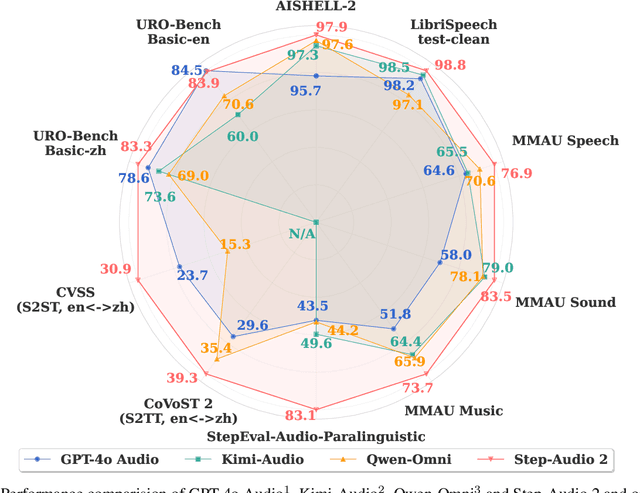
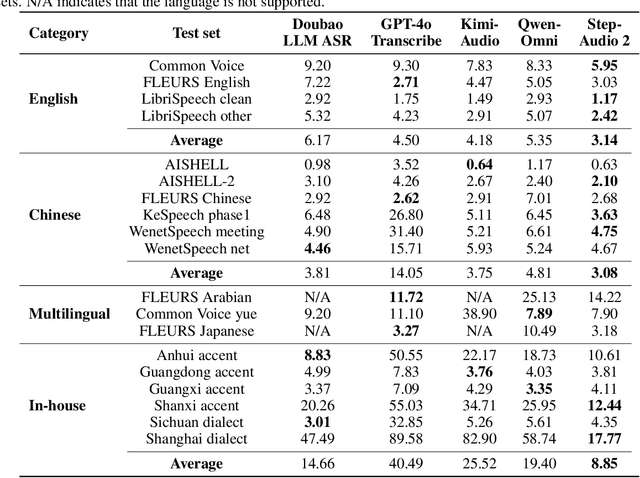
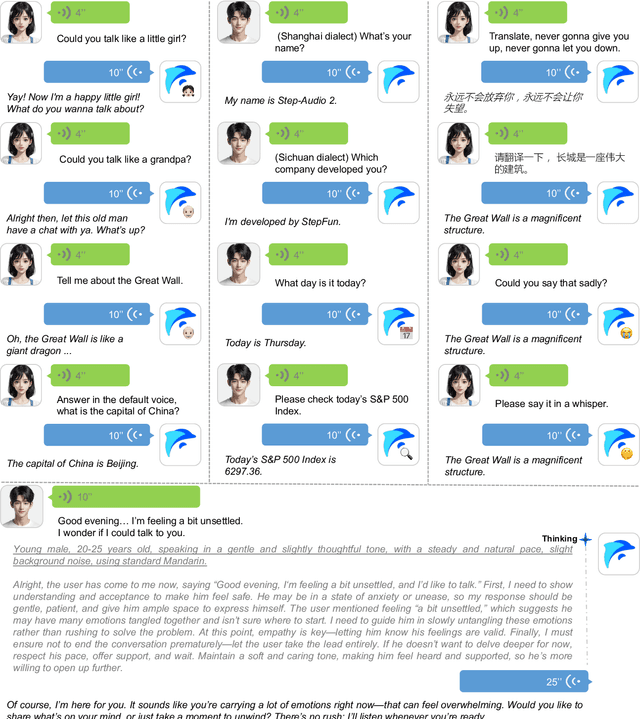
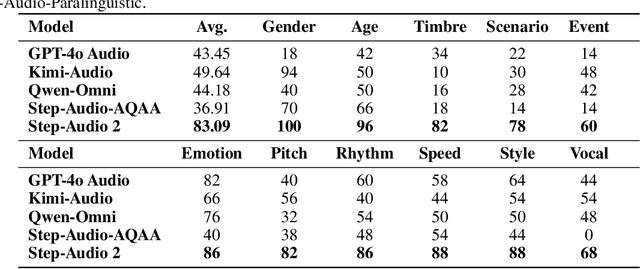
This paper presents Step-Audio 2, an end-to-end multi-modal large language model designed for industry-strength audio understanding and speech conversation. By integrating a latent audio encoder and reasoning-centric reinforcement learning (RL), Step-Audio 2 achieves promising performance in automatic speech recognition (ASR) and audio understanding. To facilitate genuine end-to-end speech conversation, Step-Audio 2 incorporates the generation of discrete audio tokens into language modeling, significantly enhancing its responsiveness to paralinguistic information such as speaking styles and emotions. To effectively leverage the rich textual and acoustic knowledge in real-world data, Step-Audio 2 integrates retrieval-augmented generation (RAG) and is able to call external tools such as web search to mitigate hallucination and audio search to switch timbres. Trained on millions of hours of speech and audio data, Step-Audio 2 delivers intelligence and expressiveness across diverse conversational scenarios. Evaluation results demonstrate that Step-Audio 2 achieves state-of-the-art performance on various audio understanding and conversational benchmarks compared to other open-source and commercial solutions. Please visit https://github.com/stepfun-ai/Step-Audio2 for more information.
Step-Audio-AQAA: a Fully End-to-End Expressive Large Audio Language Model
Jun 10, 2025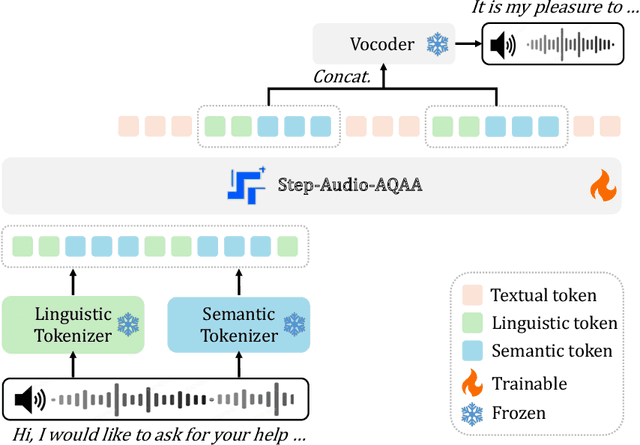
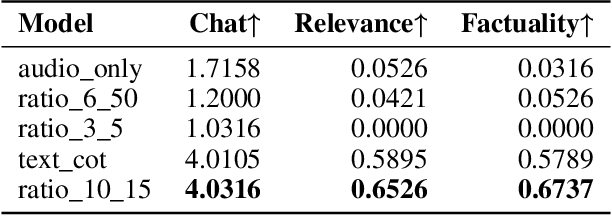
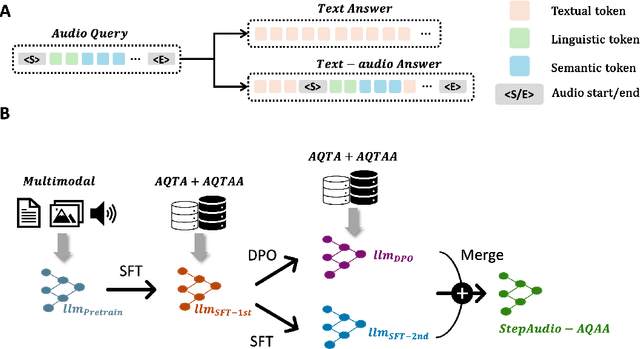

Large Audio-Language Models (LALMs) have significantly advanced intelligent human-computer interaction, yet their reliance on text-based outputs limits their ability to generate natural speech responses directly, hindering seamless audio interactions. To address this, we introduce Step-Audio-AQAA, a fully end-to-end LALM designed for Audio Query-Audio Answer (AQAA) tasks. The model integrates a dual-codebook audio tokenizer for linguistic and semantic feature extraction, a 130-billion-parameter backbone LLM and a neural vocoder for high-fidelity speech synthesis. Our post-training approach employs interleaved token-output of text and audio to enhance semantic coherence and combines Direct Preference Optimization (DPO) with model merge to improve performance. Evaluations on the StepEval-Audio-360 benchmark demonstrate that Step-Audio-AQAA excels especially in speech control, outperforming the state-of-art LALMs in key areas. This work contributes a promising solution for end-to-end LALMs and highlights the critical role of token-based vocoder in enhancing overall performance for AQAA tasks.
Step-Audio: Unified Understanding and Generation in Intelligent Speech Interaction
Feb 18, 2025Real-time speech interaction, serving as a fundamental interface for human-machine collaboration, holds immense potential. However, current open-source models face limitations such as high costs in voice data collection, weakness in dynamic control, and limited intelligence. To address these challenges, this paper introduces Step-Audio, the first production-ready open-source solution. Key contributions include: 1) a 130B-parameter unified speech-text multi-modal model that achieves unified understanding and generation, with the Step-Audio-Chat version open-sourced; 2) a generative speech data engine that establishes an affordable voice cloning framework and produces the open-sourced lightweight Step-Audio-TTS-3B model through distillation; 3) an instruction-driven fine control system enabling dynamic adjustments across dialects, emotions, singing, and RAP; 4) an enhanced cognitive architecture augmented with tool calling and role-playing abilities to manage complex tasks effectively. Based on our new StepEval-Audio-360 evaluation benchmark, Step-Audio achieves state-of-the-art performance in human evaluations, especially in terms of instruction following. On open-source benchmarks like LLaMA Question, shows 9.3% average performance improvement, demonstrating our commitment to advancing the development of open-source multi-modal language technologies. Our code and models are available at https://github.com/stepfun-ai/Step-Audio.