 Add to Chrome
 Add to Firefox
 Add to Edge
M4U: Evaluating Multilingual Understanding and Reasoning for Large Multimodal Models
May 24, 2024
Multilingual multimodal reasoning is a core component in achieving human-level intelligence. However, most existing benchmarks for multilingual multimodal reasoning struggle to differentiate between models of varying performance; even language models without visual capabilities can easily achieve high scores. This leaves a comprehensive evaluation of leading multilingual multimodal models largely unexplored. In this work, we introduce M4U, a novel and challenging benchmark for assessing the capability of multi-discipline multilingual multimodal understanding and reasoning. M4U contains 8,931 samples covering 64 disciplines across 16 subfields in Science, Engineering, and Healthcare in Chinese, English, and German. Using M4U, we conduct extensive evaluations of 21 leading Large Multimodal Models (LMMs) and Large Language Models (LLMs) with external tools. The evaluation results show that the state-of-the-art model, GPT-4o, achieves only 47.6% average accuracy on M4U. Additionally, we observe that the leading LMMs exhibit significant language preferences. Our in-depth analysis indicates that leading LMMs, including GPT-4o, suffer performance degradation when prompted with cross-lingual multimodal questions, such as images with key textual information in Chinese while the question is in German. We believe that M4U can serve as a crucial tool for systematically evaluating LMMs based on their multilingual multimodal reasoning capabilities and monitoring their development. The homepage, codes and data are public available.

Task-adaptive Q-Face
May 15, 2024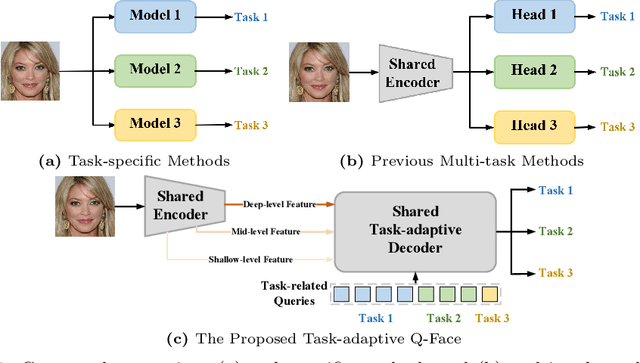
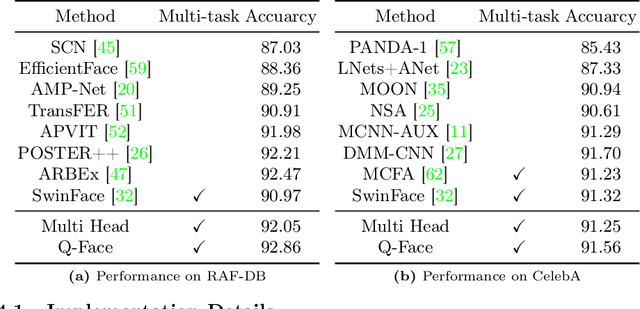
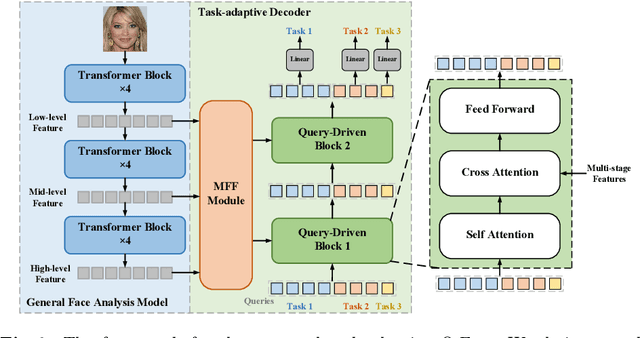
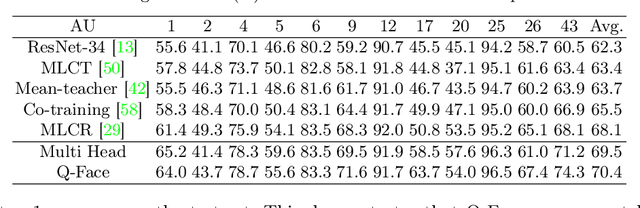
Although face analysis has achieved remarkable improvements in the past few years, designing a multi-task face analysis model is still challenging. Most face analysis tasks are studied as separate problems and do not benefit from the synergy among related tasks. In this work, we propose a novel task-adaptive multi-task face analysis method named as Q-Face, which simultaneously performs multiple face analysis tasks with a unified model. We fuse the features from multiple layers of a large-scale pre-trained model so that the whole model can use both local and global facial information to support multiple tasks. Furthermore, we design a task-adaptive module that performs cross-attention between a set of query vectors and the fused multi-stage features and finally adaptively extracts desired features for each face analysis task. Extensive experiments show that our method can perform multiple tasks simultaneously and achieves state-of-the-art performance on face expression recognition, action unit detection, face attribute analysis, age estimation, and face pose estimation. Compared to conventional methods, our method opens up new possibilities for multi-task face analysis and shows the potential for both accuracy and efficiency.
Application of Deep Learning for Factor Timing in Asset Management
Apr 27, 2024The paper examines the performance of regression models (OLS linear regression, Ridge regression, Random Forest, and Fully-connected Neural Network) on the prediction of CMA (Conservative Minus Aggressive) factor premium and the performance of factor timing investment with them. Out-of-sample R-squared shows that more flexible models have better performance in explaining the variance in factor premium of the unseen period, and the back testing affirms that the factor timing based on more flexible models tends to over perform the ones with linear models. However, for flexible models like neural networks, the optimal weights based on their prediction tend to be unstable, which can lead to high transaction costs and market impacts. We verify that tilting down the rebalance frequency according to the historical optimal rebalancing scheme can help reduce the transaction costs.
HPNet: Dynamic Trajectory Forecasting with Historical Prediction Attention
Apr 11, 2024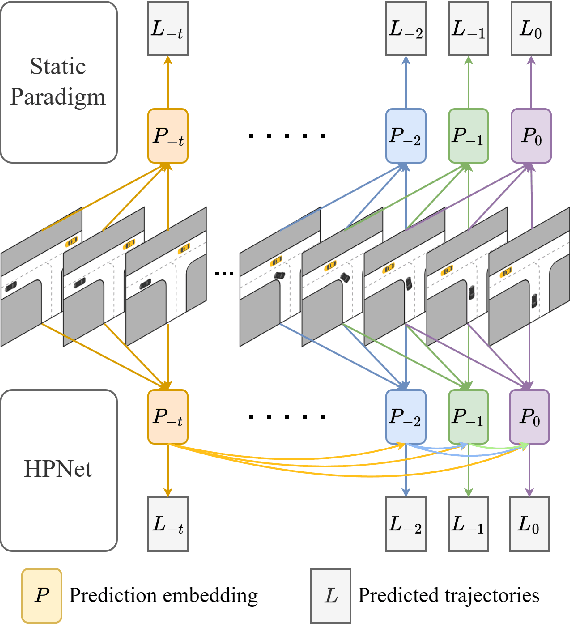

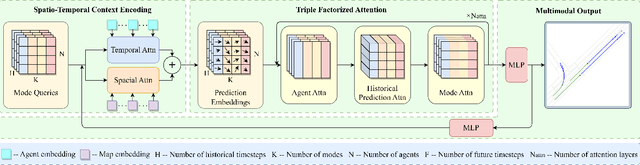
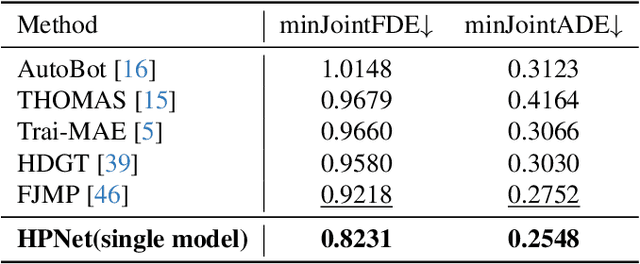
Predicting the trajectories of road agents is essential for autonomous driving systems. The recent mainstream methods follow a static paradigm, which predicts the future trajectory by using a fixed duration of historical frames. These methods make the predictions independently even at adjacent time steps, which leads to potential instability and temporal inconsistency. As successive time steps have largely overlapping historical frames, their forecasting should have intrinsic correlation, such as overlapping predicted trajectories should be consistent, or be different but share the same motion goal depending on the road situation. Motivated by this, in this work, we introduce HPNet, a novel dynamic trajectory forecasting method. Aiming for stable and accurate trajectory forecasting, our method leverages not only historical frames including maps and agent states, but also historical predictions. Specifically, we newly design a Historical Prediction Attention module to automatically encode the dynamic relationship between successive predictions. Besides, it also extends the attention range beyond the currently visible window benefitting from the use of historical predictions. The proposed Historical Prediction Attention together with the Agent Attention and Mode Attention is further formulated as the Triple Factorized Attention module, serving as the core design of HPNet.Experiments on the Argoverse and INTERACTION datasets show that HPNet achieves state-of-the-art performance, and generates accurate and stable future trajectories. Our code are available at https://github.com/XiaolongTang23/HPNet.
Task Attribute Distance for Few-Shot Learning: Theoretical Analysis and Applications
Mar 06, 2024Few-shot learning (FSL) aims to learn novel tasks with very few labeled samples by leveraging experience from \emph{related} training tasks. In this paper, we try to understand FSL by delving into two key questions: (1) How to quantify the relationship between \emph{training} and \emph{novel} tasks? (2) How does the relationship affect the \emph{adaptation difficulty} on novel tasks for different models? To answer the two questions, we introduce Task Attribute Distance (TAD) built upon attributes as a metric to quantify the task relatedness. Unlike many existing metrics, TAD is model-agnostic, making it applicable to different FSL models. Then, we utilize TAD metric to establish a theoretical connection between task relatedness and task adaptation difficulty. By deriving the generalization error bound on a novel task, we discover how TAD measures the adaptation difficulty on novel tasks for FSL models. To validate our TAD metric and theoretical findings, we conduct experiments on three benchmarks. Our experimental results confirm that TAD metric effectively quantifies the task relatedness and reflects the adaptation difficulty on novel tasks for various FSL methods, even if some of them do not learn attributes explicitly or human-annotated attributes are not available. Finally, we present two applications of the proposed TAD metric: data augmentation and test-time intervention, which further verify its effectiveness and general applicability. The source code is available at https://github.com/hu-my/TaskAttributeDistance.
Progressive Conservative Adaptation for Evolving Target Domains
Feb 07, 2024Conventional domain adaptation typically transfers knowledge from a source domain to a stationary target domain. However, in many real-world cases, target data usually emerge sequentially and have continuously evolving distributions. Restoring and adapting to such target data results in escalating computational and resource consumption over time. Hence, it is vital to devise algorithms to address the evolving domain adaptation (EDA) problem, \emph{i.e.,} adapting models to evolving target domains without access to historic target domains. To achieve this goal, we propose a simple yet effective approach, termed progressive conservative adaptation (PCAda). To manage new target data that diverges from previous distributions, we fine-tune the classifier head based on the progressively updated class prototypes. Moreover, as adjusting to the most recent target domain can interfere with the features learned from previous target domains, we develop a conservative sparse attention mechanism. This mechanism restricts feature adaptation within essential dimensions, thus easing the inference related to historical knowledge. The proposed PCAda is implemented with a meta-learning framework, which achieves the fast adaptation of the classifier with the help of the progressively updated class prototypes in the inner loop and learns a generalized feature without severely interfering with the historic knowledge via the conservative sparse attention in the outer loop. Experiments on Rotated MNIST, Caltran, and Portraits datasets demonstrate the effectiveness of our method.
Towards Robust Semantic Segmentation against Patch-based Attack via Attention Refinement
Jan 03, 2024The attention mechanism has been proven effective on various visual tasks in recent years. In the semantic segmentation task, the attention mechanism is applied in various methods, including the case of both Convolution Neural Networks (CNN) and Vision Transformer (ViT) as backbones. However, we observe that the attention mechanism is vulnerable to patch-based adversarial attacks. Through the analysis of the effective receptive field, we attribute it to the fact that the wide receptive field brought by global attention may lead to the spread of the adversarial patch. To address this issue, in this paper, we propose a Robust Attention Mechanism (RAM) to improve the robustness of the semantic segmentation model, which can notably relieve the vulnerability against patch-based attacks. Compared to the vallina attention mechanism, RAM introduces two novel modules called Max Attention Suppression and Random Attention Dropout, both of which aim to refine the attention matrix and limit the influence of a single adversarial patch on the semantic segmentation results of other positions. Extensive experiments demonstrate the effectiveness of our RAM to improve the robustness of semantic segmentation models against various patch-based attack methods under different attack settings.
Glance and Focus: Memory Prompting for Multi-Event Video Question Answering
Jan 03, 2024Video Question Answering (VideoQA) has emerged as a vital tool to evaluate agents' ability to understand human daily behaviors. Despite the recent success of large vision language models in many multi-modal tasks, complex situation reasoning over videos involving multiple human-object interaction events still remains challenging. In contrast, humans can easily tackle it by using a series of episode memories as anchors to quickly locate question-related key moments for reasoning. To mimic this effective reasoning strategy, we propose the Glance-Focus model. One simple way is to apply an action detection model to predict a set of actions as key memories. However, these actions within a closed set vocabulary are hard to generalize to various video domains. Instead of that, we train an Encoder-Decoder to generate a set of dynamic event memories at the glancing stage. Apart from using supervised bipartite matching to obtain the event memories, we further design an unsupervised memory generation method to get rid of dependence on event annotations. Next, at the focusing stage, these event memories act as a bridge to establish the correlation between the questions with high-level event concepts and low-level lengthy video content. Given the question, the model first focuses on the generated key event memory, then focuses on the most relevant moment for reasoning through our designed multi-level cross-attention mechanism. We conduct extensive experiments on four Multi-Event VideoQA benchmarks including STAR, EgoTaskQA, AGQA, and NExT-QA. Our proposed model achieves state-of-the-art results, surpassing current large models in various challenging reasoning tasks. The code and models are available at https://github.com/ByZ0e/Glance-Focus.
Cooperative Dual Attention for Audio-Visual Speech Enhancement with Facial Cues
Nov 24, 2023In this work, we focus on leveraging facial cues beyond the lip region for robust Audio-Visual Speech Enhancement (AVSE). The facial region, encompassing the lip region, reflects additional speech-related attributes such as gender, skin color, nationality, etc., which contribute to the effectiveness of AVSE. However, static and dynamic speech-unrelated attributes also exist, causing appearance changes during speech. To address these challenges, we propose a Dual Attention Cooperative Framework, DualAVSE, to ignore speech-unrelated information, capture speech-related information with facial cues, and dynamically integrate it with the audio signal for AVSE. Specifically, we introduce a spatial attention-based visual encoder to capture and enhance visual speech information beyond the lip region, incorporating global facial context and automatically ignoring speech-unrelated information for robust visual feature extraction. Additionally, a dynamic visual feature fusion strategy is introduced by integrating a temporal-dimensional self-attention module, enabling the model to robustly handle facial variations. The acoustic noise in the speaking process is variable, impacting audio quality. Therefore, a dynamic fusion strategy for both audio and visual features is introduced to address this issue. By integrating cooperative dual attention in the visual encoder and audio-visual fusion strategy, our model effectively extracts beneficial speech information from both audio and visual cues for AVSE. Thorough analysis and comparison on different datasets, including normal and challenging cases with unreliable or absent visual information, consistently show our model outperforming existing methods across multiple metrics.
Learning Separable Hidden Unit Contributions for Speaker-Adaptive Lip-Reading
Oct 08, 2023In this paper, we propose a novel method for speaker adaptation in lip reading, motivated by two observations. Firstly, a speaker's own characteristics can always be portrayed well by his/her few facial images or even a single image with shallow networks, while the fine-grained dynamic features associated with speech content expressed by the talking face always need deep sequential networks to represent accurately. Therefore, we treat the shallow and deep layers differently for speaker adaptive lip reading. Secondly, we observe that a speaker's unique characteristics ( e.g. prominent oral cavity and mandible) have varied effects on lip reading performance for different words and pronunciations, necessitating adaptive enhancement or suppression of the features for robust lip reading. Based on these two observations, we propose to take advantage of the speaker's own characteristics to automatically learn separable hidden unit contributions with different targets for shallow layers and deep layers respectively. For shallow layers where features related to the speaker's characteristics are stronger than the speech content related features, we introduce speaker-adaptive features to learn for enhancing the speech content features. For deep layers where both the speaker's features and the speech content features are all expressed well, we introduce the speaker-adaptive features to learn for suppressing the speech content irrelevant noise for robust lip reading. Our approach consistently outperforms existing methods, as confirmed by comprehensive analysis and comparison across different settings. Besides the evaluation on the popular LRW-ID and GRID datasets, we also release a new dataset for evaluation, CAS-VSR-S68h, to further assess the performance in an extreme setting where just a few speakers are available but the speech content covers a large and diversified range.