 Add to Chrome
 Add to Firefox
 Add to Edge
Unified Synthesis of Compositional Speech and Sound from Free-Form Text Prompts
May 27, 2026
Audio generation has made significant progress, yet synthesizing unified audio where speech and sounds are naturally composited remains a challenge. Current methods either rely on disjoint pipelines, which fail to capture fine-grained interactions, or require structured inputs and external text rewriting, which limits the flexibility of free-form text prompts. In this paper, we introduce a new task: Free-Form-Text-Prompt-to-Unified-Audio generation, which aims to directly synthesize unified audio containing speech, sound, and their composites from unconstrained natural language. To address this task, we propose PlanAudio, a unified, autoregressive LLM-based framework. First, it simplifies the model architecture by leveraging intrinsic LLM reasoning capability instead of traditional text encoders. Second, it introduces a semantic latent chain-of-thought mechanism, an implicit planning mechanism that bridges high-level semantic understanding and low-level acoustic synthesis. Furthermore, we create PlanAudio-Bench, a specialized benchmark for evaluating composite audio scenarios. We perform evaluations in the scenarios of speech, sound, and their composites. The results demonstrate that PlanAudio generally outperforms the existing pipeline and unified baselines, while staying competitive with models designed for a single scenario. Our analysis further reveals the superiority of semantic latent CoT over other CoT mechanisms and highlights the importance of continuous multi-scenario training curricula.

SyncDPO: Enhancing Temporal Synchronization in Video-Audio Joint Generation via Preference Learning
May 12, 2026Recent advancements in video-audio joint generation have achieved remarkable success in semantic correspondence. However, achieving precise temporal synchronization, which requires fine-grained alignment between audio events and their visual triggers, remains a challenging problem. The post-training method for joint generation is largely dominated by Supervised Fine-Tuning, but the commonly used Mean Squared Error loss provides insufficient penalties for subtle temporal misalignments. Direct Preference Optimization offers an alternative by introducing explicit misaligned counterparts to better improve temporal sensitivity. In this paper we propose a post-training framework SyncDPO, leveraging DPO to improve the temporal sensitivity of V-A joint generation. Conventional DPO pipelines typically depend on costly sampling-and-ranking procedures to construct preference pairs, resulting in substantial computational cost. To improve efficiency, we introduce a suite of on-the-fly rule-based negative construction strategies that distort temporal structures without incurring additional annotation or sampling. We demonstrate that the temporal alignment capability can be effectively reinforced by providing explicit negative supervision through temporally distorted V-A pairs. Accordingly, we implement a curriculum learning strategy that progressively increases the difficulty of negative samples, transitioning from coarse misalignment to subtle inconsistencies. Extensive objective and subjective experiments across four diverse benchmarks, ranging from ambient sound videos to human speech videos, demonstrate that SyncDPO significantly outperforms other methods in improving model's temporal alignment capability. It also demonstrates superior generalization on out-of-distribution benchmark by capturing intrinsic motion-sound dynamics. Demo and code is available in https://syncdpo.github.io/syncdpo/.
Qwen-Image-2.0 Technical Report
May 11, 2026We present Qwen-Image-2.0, an omni-capable image generation foundation model that unifies high-fidelity generation and precise image editing within a single framework. Despite recent progress, existing models still struggle with ultra-long text rendering, multilingual typography, high-resolution photorealism, robust instruction following, and efficient deployment, especially in text-rich and compositionally complex scenarios. Qwen-Image-2.0 addresses these challenges by coupling Qwen3-VL as the condition encoder with a Multimodal Diffusion Transformer for joint condition-target modeling, supported by large-scale data curation and a customized multi-stage training pipeline. This enables strong multimodal understanding while preserving flexible generation and editing capabilities. The model supports instructions of up to 1K tokens for generating text-rich content such as slides, posters, infographics, and comics, while significantly improving multilingual text fidelity and typography. It also enhances photorealistic generation with richer details, more realistic textures, and coherent lighting, and follows complex prompts more reliably across diverse styles. Extensive human evaluations show that Qwen-Image-2.0 substantially outperforms previous Qwen-Image models in both generation and editing, marking a step toward more general, reliable, and practical image generation foundation models.
Enhancing Audiovisual Speech Recognition through Bifocal Preference Optimization
Dec 26, 2024

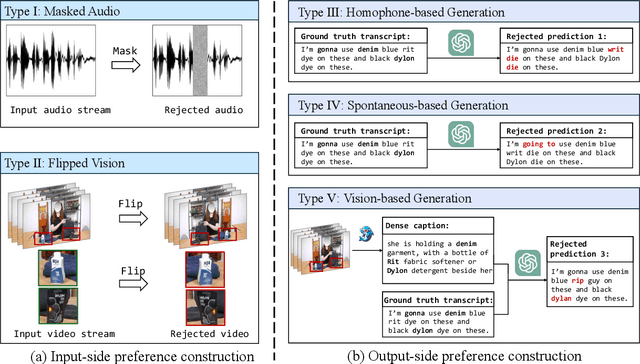
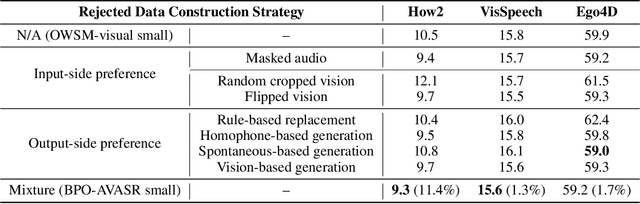
Audiovisual Automatic Speech Recognition (AV-ASR) aims to improve speech recognition accuracy by leveraging visual signals. It is particularly challenging in unconstrained real-world scenarios across various domains due to noisy acoustic environments, spontaneous speech, and the uncertain use of visual information. Most previous works fine-tune audio-only ASR models on audiovisual datasets, optimizing them for conventional ASR objectives. However, they often neglect visual features and common errors in unconstrained video scenarios. In this paper, we propose using a preference optimization strategy to improve speech recognition accuracy for real-world videos. First, we create preference data via simulating common errors that occurred in AV-ASR from two focals: manipulating the audio or vision input and rewriting the output transcript. Second, we propose BPO-AVASR, a Bifocal Preference Optimization method to improve AV-ASR models by leveraging both input-side and output-side preference. Extensive experiments demonstrate that our approach significantly improves speech recognition accuracy across various domains, outperforming previous state-of-the-art models on real-world video speech recognition.
Two-in-One: Unified Multi-Person Interactive Motion Generation by Latent Diffusion Transformer
Dec 21, 2024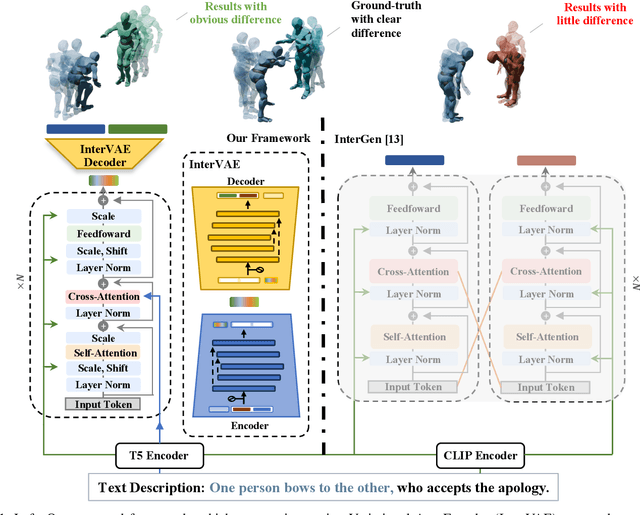
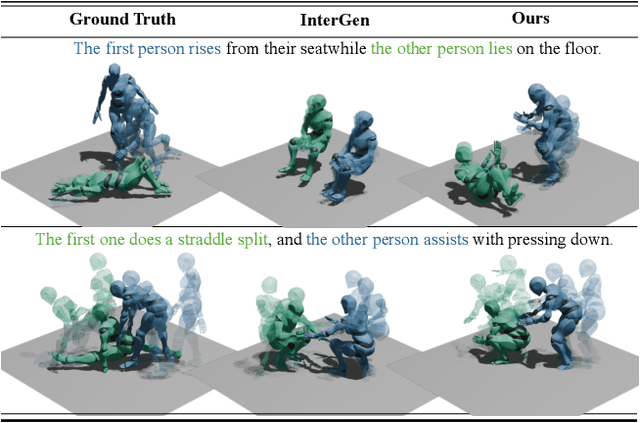
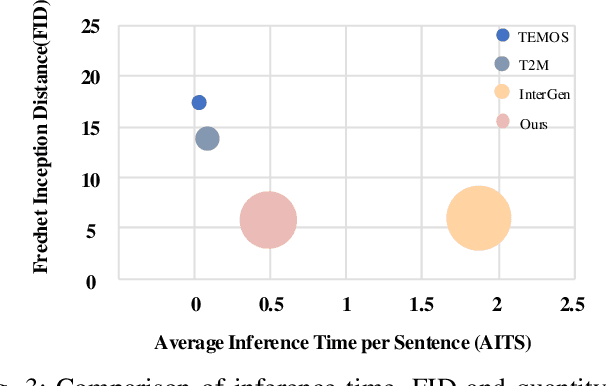
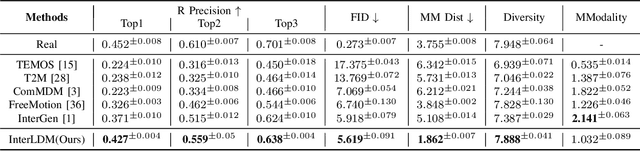
Multi-person interactive motion generation, a critical yet under-explored domain in computer character animation, poses significant challenges such as intricate modeling of inter-human interactions beyond individual motions and generating two motions with huge differences from one text condition. Current research often employs separate module branches for individual motions, leading to a loss of interaction information and increased computational demands. To address these challenges, we propose a novel, unified approach that models multi-person motions and their interactions within a single latent space. Our approach streamlines the process by treating interactive motions as an integrated data point, utilizing a Variational AutoEncoder (VAE) for compression into a unified latent space, and performing a diffusion process within this space, guided by the natural language conditions. Experimental results demonstrate our method's superiority over existing approaches in generation quality, performing text condition in particular when motions have significant asymmetry, and accelerating the generation efficiency while preserving high quality.
SpeechComposer: Unifying Multiple Speech Tasks with Prompt Composition
Jan 31, 2024Recent advancements in language models have significantly enhanced performance in multiple speech-related tasks. Existing speech language models typically utilize task-dependent prompt tokens to unify various speech tasks in a single model. However, this design omits the intrinsic connections between different speech tasks, which can potentially boost the performance of each task. In this work, we propose a novel decoder-only speech language model, SpeechComposer, that can unify common speech tasks by composing a fixed set of prompt tokens. Built upon four primary tasks -- speech synthesis, speech recognition, speech language modeling, and text language modeling -- SpeechComposer can easily extend to more speech tasks via compositions of well-designed prompt tokens, like voice conversion and speech enhancement. The unification of prompt tokens also makes it possible for knowledge sharing among different speech tasks in a more structured manner. Experimental results demonstrate that our proposed SpeechComposer can improve the performance of both primary tasks and composite tasks, showing the effectiveness of the shared prompt tokens. Remarkably, the unified decoder-only model achieves a comparable and even better performance than the baselines which are expert models designed for single tasks.