 Add to Chrome
 Add to Firefox
 Add to Edge
AVOC: Enhancing Hour-Level Audio-Video Understanding in Omni-Modal LLMs via Retrieval-Inspired Token Compression
Jun 23, 2026
Multimodal Large Language Models have achieved remarkable progress in short-form audio-video understanding, yet long-form audio-video comprehension remains challenged by limited context windows and severe information redundancy. To address these bottlenecks, we propose AVOC, a framework for long-form audio-video understanding in Omni-modal Large Language Models. AVOC introduces a learnable token compression module between the modality encoders and the LLM backbone. We reframe multimodal token compression as a top-$K$ retrieval problem: given a fixed context budget, the module must retrieve a compact subset of tokens that best supports answering the user query. We draw inspiration from three classical Information Retrieval criteria for selecting informative units from a large candidate pool: relevance, importance, and diversity. AVOC instantiates each criterion as a tailored mechanism for audio-video understanding, and integrates them into a unified retrieval-style compression pipeline. Experiments show that AVOC achieves state-of-the-art performance on long-form audio-video benchmarks, surpassing the second-best model by 4.9 and 5.5 points in average accuracy on OmniVideoBench and LVOmniBench, respectively. Moreover, AVOC maintains robust performance on Audio-Video Needle-in-a-Haystack task at durations up to one hour.

SyncDPO: Enhancing Temporal Synchronization in Video-Audio Joint Generation via Preference Learning
May 12, 2026Recent advancements in video-audio joint generation have achieved remarkable success in semantic correspondence. However, achieving precise temporal synchronization, which requires fine-grained alignment between audio events and their visual triggers, remains a challenging problem. The post-training method for joint generation is largely dominated by Supervised Fine-Tuning, but the commonly used Mean Squared Error loss provides insufficient penalties for subtle temporal misalignments. Direct Preference Optimization offers an alternative by introducing explicit misaligned counterparts to better improve temporal sensitivity. In this paper we propose a post-training framework SyncDPO, leveraging DPO to improve the temporal sensitivity of V-A joint generation. Conventional DPO pipelines typically depend on costly sampling-and-ranking procedures to construct preference pairs, resulting in substantial computational cost. To improve efficiency, we introduce a suite of on-the-fly rule-based negative construction strategies that distort temporal structures without incurring additional annotation or sampling. We demonstrate that the temporal alignment capability can be effectively reinforced by providing explicit negative supervision through temporally distorted V-A pairs. Accordingly, we implement a curriculum learning strategy that progressively increases the difficulty of negative samples, transitioning from coarse misalignment to subtle inconsistencies. Extensive objective and subjective experiments across four diverse benchmarks, ranging from ambient sound videos to human speech videos, demonstrate that SyncDPO significantly outperforms other methods in improving model's temporal alignment capability. It also demonstrates superior generalization on out-of-distribution benchmark by capturing intrinsic motion-sound dynamics. Demo and code is available in https://syncdpo.github.io/syncdpo/.
HuM-Eval: A Coarse-to-Fine Framework for Human-Centric Video Evaluation
Apr 28, 2026Video generation models have developed rapidly in recent years, where generating natural human motion plays a pivotal role. However, accurately evaluating the quality of generated human motion video remains a significant challenge. Existing evaluation metrics primarily focus on global scene statistics, often overlooking fine-grained human details and consequently failing to align with human subjective preference. To bridge this gap, we propose HuM-Eval, a novel human-centric evaluation framework that adopts a coarse-to-fine strategy. Specifically, our framework first utilizes a Vision Language Model to perform a coarse assessment of global video quality. It then proceeds to a fine-grained analysis, using 2D pose to verify anatomical correctness and 3D human motion to evaluate motion stability. Extensive experiments demonstrate that HuM-Eval achieves an average human correlation of 58.2%, outperforming state-of-the-art baselines. Furthermore, we introduce HuM-Bench, a comprehensive benchmark comprising 1,000 diverse prompts, and conduct a detailed evaluation of existing text-to-video models, paving the way for next-generation human motion generation.
ChronusOmni: Improving Time Awareness of Omni Large Language Models
Dec 10, 2025Time awareness is a fundamental ability of omni large language models, especially for understanding long videos and answering complex questions. Previous approaches mainly target vision-language scenarios and focus on the explicit temporal grounding questions, such as identifying when a visual event occurs or determining what event happens at aspecific time. However, they often make insufficient use of the audio modality, and overlook implicit temporal grounding across modalities--for example, identifying what is visually present when a character speaks, or determining what is said when a visual event occurs--despite such cross-modal temporal relations being prevalent in real-world scenarios. In this paper, we propose ChronusOmni, an omni large language model designed to enhance temporal awareness for both explicit and implicit audiovisual temporal grounding. First, we interleave text-based timestamp tokens with visual and audio representations at each time unit, enabling unified temporal modeling across modalities. Second, to enforce correct temporal ordering and strengthen fine-grained temporal reasoning, we incorporate reinforcement learning with specially designed reward functions. Moreover, we construct ChronusAV, a temporally-accurate, modality-complete, and cross-modal-aligned dataset to support the training and evaluation on audiovisual temporal grounding task. Experimental results demonstrate that ChronusOmni achieves state-of-the-art performance on ChronusAV with more than 30% improvement and top results on most metrics upon other temporal grounding benchmarks. This highlights the strong temporal awareness of our model across modalities, while preserving general video and audio understanding capabilities.
BSharedRAG: Backbone Shared Retrieval-Augmented Generation for the E-commerce Domain
Sep 30, 2024
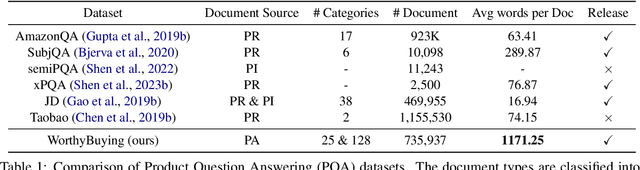
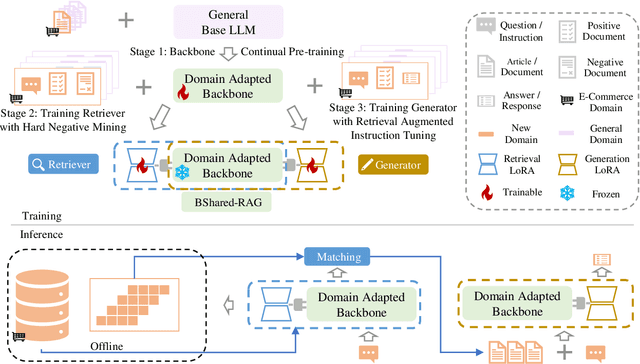
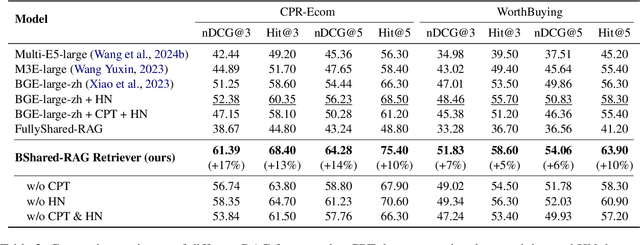
Retrieval Augmented Generation (RAG) system is important in domains such as e-commerce, which has many long-tail entities and frequently updated information. Most existing works adopt separate modules for retrieval and generation, which may be suboptimal since the retrieval task and the generation task cannot benefit from each other to improve performance. We propose a novel Backbone Shared RAG framework (BSharedRAG). It first uses a domain-specific corpus to continually pre-train a base model as a domain-specific backbone model and then trains two plug-and-play Low-Rank Adaptation (LoRA) modules based on the shared backbone to minimize retrieval and generation losses respectively. Experimental results indicate that our proposed BSharedRAG outperforms baseline models by 5% and 13% in Hit@3 upon two datasets in retrieval evaluation and by 23% in terms of BLEU-3 in generation evaluation. Our codes, models, and dataset are available at https://bsharedrag.github.io.