 Add to Chrome
 Add to Firefox
 Add to Edge
The FinBen: An Holistic Financial Benchmark for Large Language Models
Feb 20, 2024
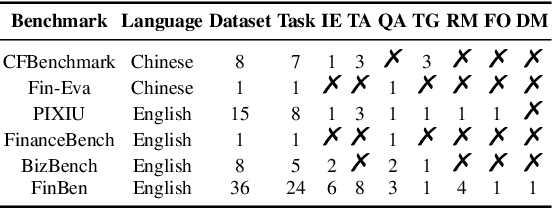
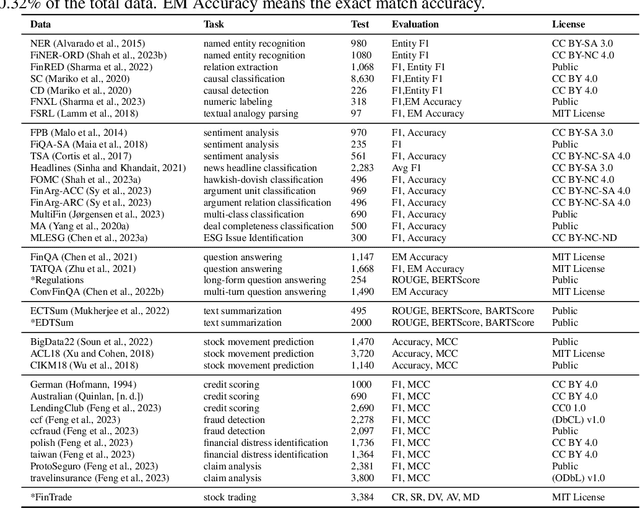
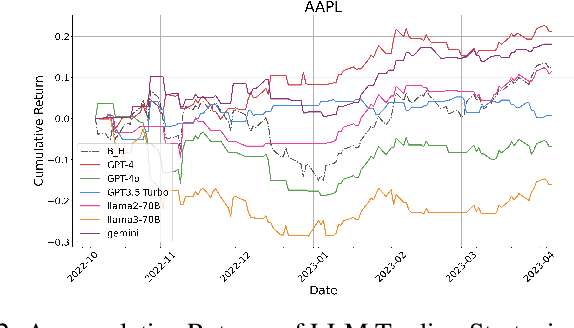
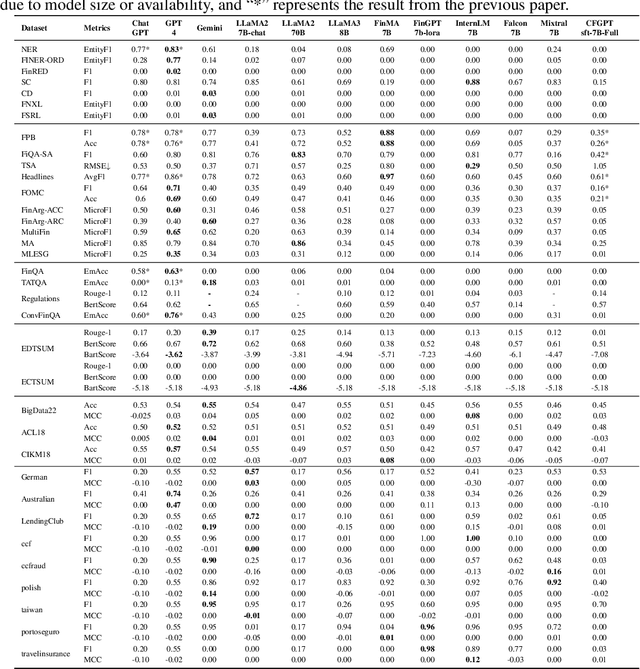
LLMs have transformed NLP and shown promise in various fields, yet their potential in finance is underexplored due to a lack of thorough evaluations and the complexity of financial tasks. This along with the rapid development of LLMs, highlights the urgent need for a systematic financial evaluation benchmark for LLMs. In this paper, we introduce FinBen, the first comprehensive open-sourced evaluation benchmark, specifically designed to thoroughly assess the capabilities of LLMs in the financial domain. FinBen encompasses 35 datasets across 23 financial tasks, organized into three spectrums of difficulty inspired by the Cattell-Horn-Carroll theory, to evaluate LLMs' cognitive abilities in inductive reasoning, associative memory, quantitative reasoning, crystallized intelligence, and more. Our evaluation of 15 representative LLMs, including GPT-4, ChatGPT, and the latest Gemini, reveals insights into their strengths and limitations within the financial domain. The findings indicate that GPT-4 leads in quantification, extraction, numerical reasoning, and stock trading, while Gemini shines in generation and forecasting; however, both struggle with complex extraction and forecasting, showing a clear need for targeted enhancements. Instruction tuning boosts simple task performance but falls short in improving complex reasoning and forecasting abilities. FinBen seeks to continuously evaluate LLMs in finance, fostering AI development with regular updates of tasks and models.

Dólares or Dollars? Unraveling the Bilingual Prowess of Financial LLMs Between Spanish and English
Feb 12, 2024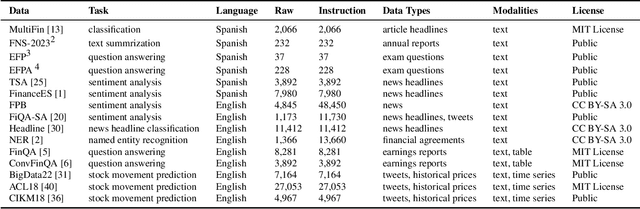

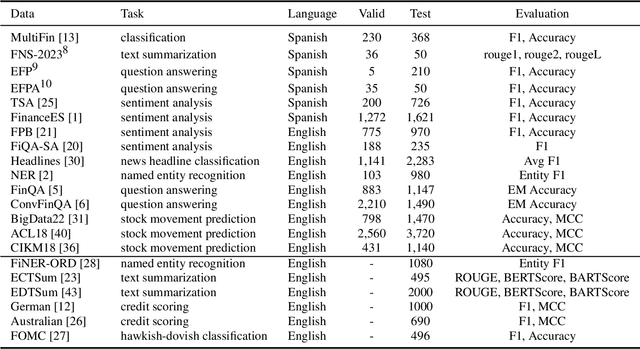

Despite Spanish's pivotal role in the global finance industry, a pronounced gap exists in Spanish financial natural language processing (NLP) and application studies compared to English, especially in the era of large language models (LLMs). To bridge this gap, we unveil Tois\'on de Oro, the first bilingual framework that establishes instruction datasets, finetuned LLMs, and evaluation benchmark for financial LLMs in Spanish joint with English. We construct a rigorously curated bilingual instruction dataset including over 144K Spanish and English samples from 15 datasets covering 7 tasks. Harnessing this, we introduce FinMA-ES, an LLM designed for bilingual financial applications. We evaluate our model and existing LLMs using FLARE-ES, the first comprehensive bilingual evaluation benchmark with 21 datasets covering 9 tasks. The FLARE-ES benchmark results reveal a significant multilingual performance gap and bias in existing LLMs. FinMA-ES models surpass SOTA LLMs such as GPT-4 in Spanish financial tasks, due to strategic instruction tuning and leveraging data from diverse linguistic resources, highlighting the positive impact of cross-linguistic transfer. All our datasets, models, and benchmarks have been released.
Differentially Private Low-Rank Adaptation of Large Language Model Using Federated Learning
Dec 29, 2023


The surge in interest and application of large language models (LLMs) has sparked a drive to fine-tune these models to suit specific applications, such as finance and medical science. However, concerns regarding data privacy have emerged, especially when multiple stakeholders aim to collaboratively enhance LLMs using sensitive data. In this scenario, federated learning becomes a natural choice, allowing decentralized fine-tuning without exposing raw data to central servers. Motivated by this, we investigate how data privacy can be ensured in LLM fine-tuning through practical federated learning approaches, enabling secure contributions from multiple parties to enhance LLMs. Yet, challenges arise: 1) despite avoiding raw data exposure, there is a risk of inferring sensitive information from model outputs, and 2) federated learning for LLMs incurs notable communication overhead. To address these challenges, this article introduces DP-LoRA, a novel federated learning algorithm tailored for LLMs. DP-LoRA preserves data privacy by employing a Gaussian mechanism that adds noise in weight updates, maintaining individual data privacy while facilitating collaborative model training. Moreover, DP-LoRA optimizes communication efficiency via low-rank adaptation, minimizing the transmission of updated weights during distributed training. The experimental results across medical, financial, and general datasets using various LLMs demonstrate that DP-LoRA effectively ensures strict privacy constraints while minimizing communication overhead.
Deficiency of Large Language Models in Finance: An Empirical Examination of Hallucination
Nov 27, 2023
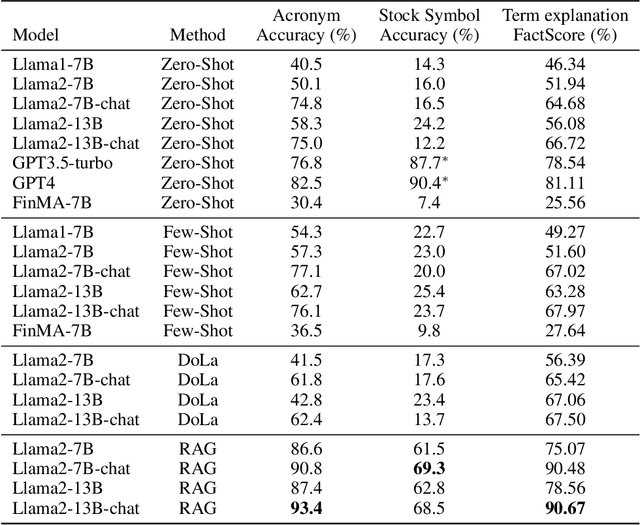
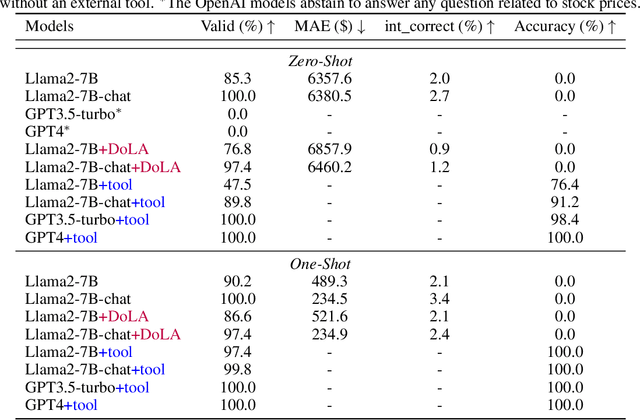
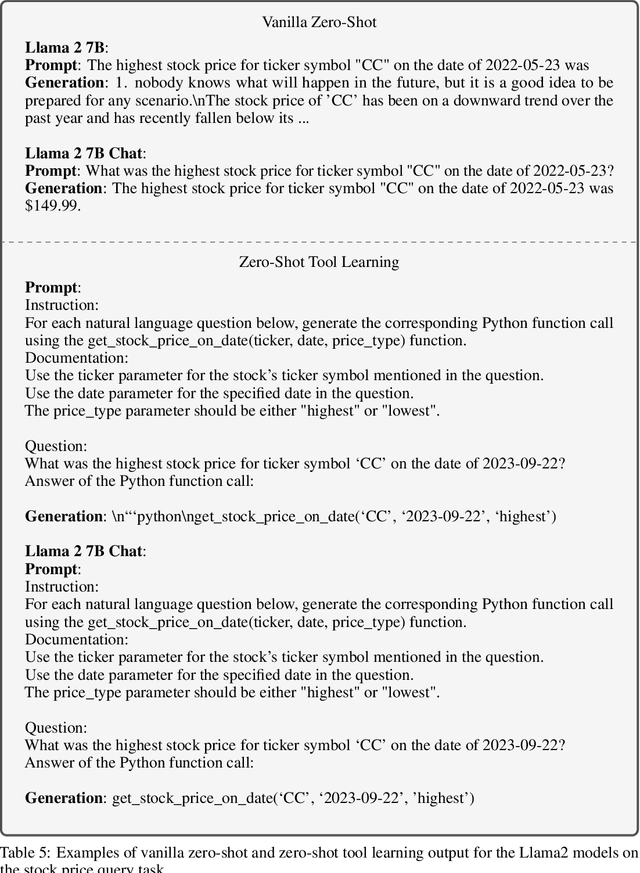
The hallucination issue is recognized as a fundamental deficiency of large language models (LLMs), especially when applied to fields such as finance, education, and law. Despite the growing concerns, there has been a lack of empirical investigation. In this paper, we provide an empirical examination of LLMs' hallucination behaviors in financial tasks. First, we empirically investigate LLM model's ability of explaining financial concepts and terminologies. Second, we assess LLM models' capacity of querying historical stock prices. Third, to alleviate the hallucination issue, we evaluate the efficacy of four practical methods, including few-shot learning, Decoding by Contrasting Layers (DoLa), the Retrieval Augmentation Generation (RAG) method and the prompt-based tool learning method for a function to generate a query command. Finally, our major finding is that off-the-shelf LLMs experience serious hallucination behaviors in financial tasks. Therefore, there is an urgent need to call for research efforts in mitigating LLMs' hallucination.
Enhancing Financial Sentiment Analysis via Retrieval Augmented Large Language Models
Oct 06, 2023


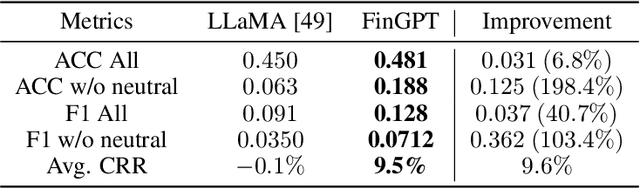
Financial sentiment analysis is critical for valuation and investment decision-making. Traditional NLP models, however, are limited by their parameter size and the scope of their training datasets, which hampers their generalization capabilities and effectiveness in this field. Recently, Large Language Models (LLMs) pre-trained on extensive corpora have demonstrated superior performance across various NLP tasks due to their commendable zero-shot abilities. Yet, directly applying LLMs to financial sentiment analysis presents challenges: The discrepancy between the pre-training objective of LLMs and predicting the sentiment label can compromise their predictive performance. Furthermore, the succinct nature of financial news, often devoid of sufficient context, can significantly diminish the reliability of LLMs' sentiment analysis. To address these challenges, we introduce a retrieval-augmented LLMs framework for financial sentiment analysis. This framework includes an instruction-tuned LLMs module, which ensures LLMs behave as predictors of sentiment labels, and a retrieval-augmentation module which retrieves additional context from reliable external sources. Benchmarked against traditional models and LLMs like ChatGPT and LLaMA, our approach achieves 15\% to 48\% performance gain in accuracy and F1 score.
FinGPT: Democratizing Internet-scale Data for Financial Large Language Models
Jul 19, 2023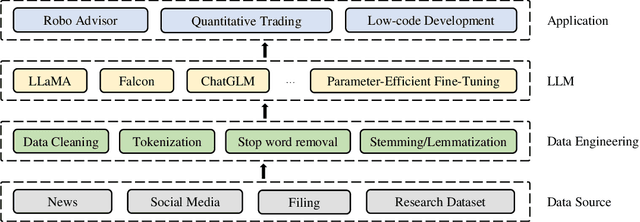
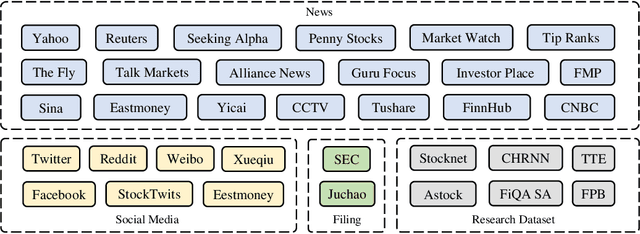
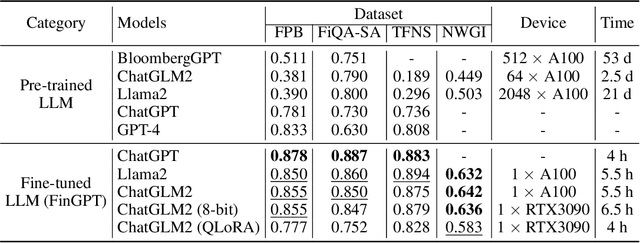
Large language models (LLMs) have demonstrated remarkable proficiency in understanding and generating human-like texts, which may potentially revolutionize the finance industry. However, existing LLMs often fall short in the financial field, which is mainly attributed to the disparities between general text data and financial text data. Unfortunately, there is only a limited number of financial text datasets available (quite small size), and BloombergGPT, the first financial LLM (FinLLM), is close-sourced (only the training logs were released). In light of this, we aim to democratize Internet-scale financial data for LLMs, which is an open challenge due to diverse data sources, low signal-to-noise ratio, and high time-validity. To address the challenges, we introduce an open-sourced and data-centric framework, \textit{Financial Generative Pre-trained Transformer (FinGPT)}, that automates the collection and curation of real-time financial data from >34 diverse sources on the Internet, providing researchers and practitioners with accessible and transparent resources to develop their FinLLMs. Additionally, we propose a simple yet effective strategy for fine-tuning FinLLM using the inherent feedback from the market, dubbed Reinforcement Learning with Stock Prices (RLSP). We also adopt the Low-rank Adaptation (LoRA, QLoRA) method that enables users to customize their own FinLLMs from open-source general-purpose LLMs at a low cost. Finally, we showcase several FinGPT applications, including robo-advisor, sentiment analysis for algorithmic trading, and low-code development. FinGPT aims to democratize FinLLMs, stimulate innovation, and unlock new opportunities in open finance. The codes are available at https://github.com/AI4Finance-Foundation/FinGPT and https://github.com/AI4Finance-Foundation/FinNLP
Instruct-FinGPT: Financial Sentiment Analysis by Instruction Tuning of General-Purpose Large Language Models
Jun 22, 2023Sentiment analysis is a vital tool for uncovering insights from financial articles, news, and social media, shaping our understanding of market movements. Despite the impressive capabilities of large language models (LLMs) in financial natural language processing (NLP), they still struggle with accurately interpreting numerical values and grasping financial context, limiting their effectiveness in predicting financial sentiment. In this paper, we introduce a simple yet effective instruction tuning approach to address these issues. By transforming a small portion of supervised financial sentiment analysis data into instruction data and fine-tuning a general-purpose LLM with this method, we achieve remarkable advancements in financial sentiment analysis. In the experiment, our approach outperforms state-of-the-art supervised sentiment analysis models, as well as widely used LLMs like ChatGPT and LLaMAs, particularly in scenarios where numerical understanding and contextual comprehension are vital.
FinGPT: Open-Source Financial Large Language Models
Jun 09, 2023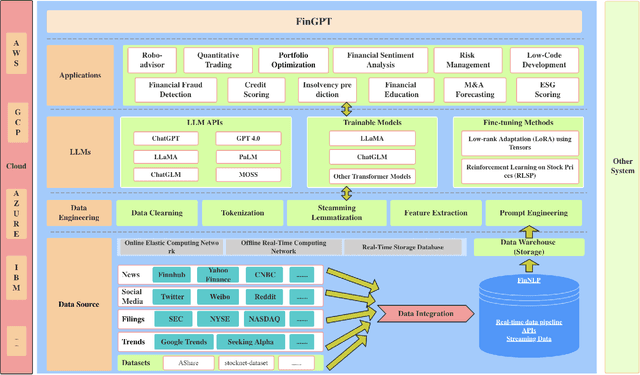
Large language models (LLMs) have shown the potential of revolutionizing natural language processing tasks in diverse domains, sparking great interest in finance. Accessing high-quality financial data is the first challenge for financial LLMs (FinLLMs). While proprietary models like BloombergGPT have taken advantage of their unique data accumulation, such privileged access calls for an open-source alternative to democratize Internet-scale financial data. In this paper, we present an open-source large language model, FinGPT, for the finance sector. Unlike proprietary models, FinGPT takes a data-centric approach, providing researchers and practitioners with accessible and transparent resources to develop their FinLLMs. We highlight the importance of an automatic data curation pipeline and the lightweight low-rank adaptation technique in building FinGPT. Furthermore, we showcase several potential applications as stepping stones for users, such as robo-advising, algorithmic trading, and low-code development. Through collaborative efforts within the open-source AI4Finance community, FinGPT aims to stimulate innovation, democratize FinLLMs, and unlock new opportunities in open finance. Two associated code repos are \url{https://github.com/AI4Finance-Foundation/FinGPT} and \url{https://github.com/AI4Finance-Foundation/FinNLP}
Dynamic Datasets and Market Environments for Financial Reinforcement Learning
Apr 25, 2023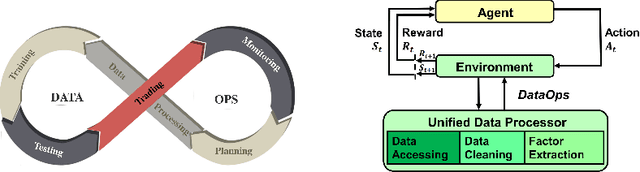
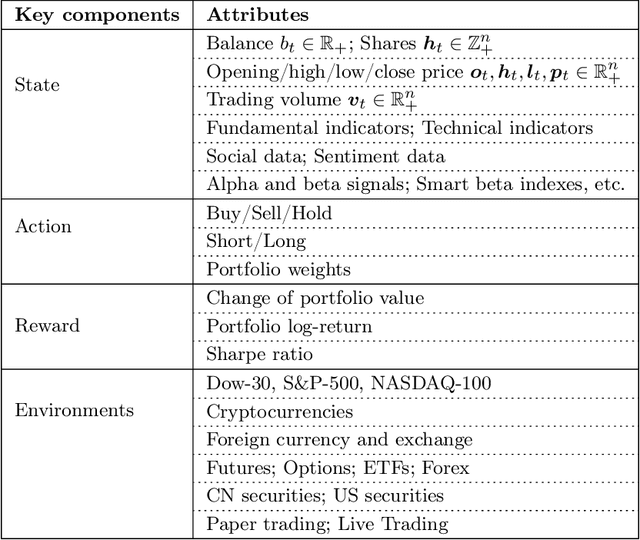
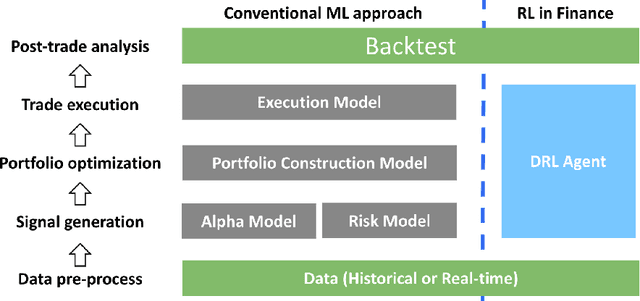
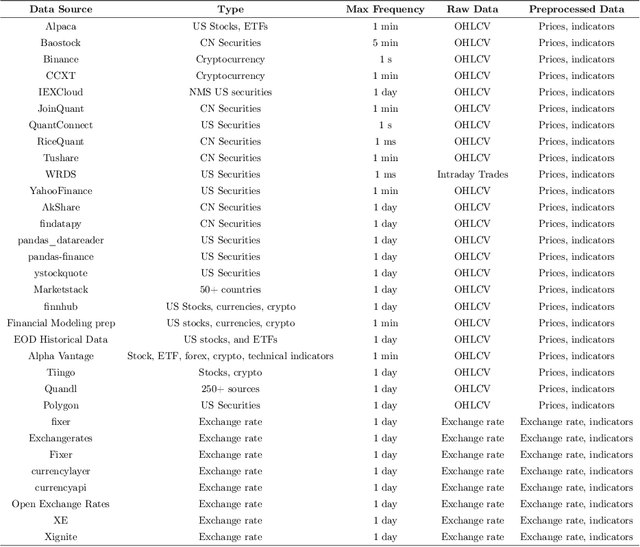
The financial market is a particularly challenging playground for deep reinforcement learning due to its unique feature of dynamic datasets. Building high-quality market environments for training financial reinforcement learning (FinRL) agents is difficult due to major factors such as the low signal-to-noise ratio of financial data, survivorship bias of historical data, and model overfitting. In this paper, we present FinRL-Meta, a data-centric and openly accessible library that processes dynamic datasets from real-world markets into gym-style market environments and has been actively maintained by the AI4Finance community. First, following a DataOps paradigm, we provide hundreds of market environments through an automatic data curation pipeline. Second, we provide homegrown examples and reproduce popular research papers as stepping stones for users to design new trading strategies. We also deploy the library on cloud platforms so that users can visualize their own results and assess the relative performance via community-wise competitions. Third, we provide dozens of Jupyter/Python demos organized into a curriculum and a documentation website to serve the rapidly growing community. The open-source codes for the data curation pipeline are available at https://github.com/AI4Finance-Foundation/FinRL-Meta
Deep Reinforcement Learning for Traffic Light Control in Intelligent Transportation Systems
Feb 04, 2023Smart traffic lights in intelligent transportation systems (ITSs) are envisioned to greatly increase traffic efficiency and reduce congestion. Deep reinforcement learning (DRL) is a promising approach to adaptively control traffic lights based on the real-time traffic situation in a road network. However, conventional methods may suffer from poor scalability. In this paper, we investigate deep reinforcement learning to control traffic lights, and both theoretical analysis and numerical experiments show that the intelligent behavior ``greenwave" (i.e., a vehicle will see a progressive cascade of green lights, and not have to brake at any intersection) emerges naturally a grid road network, which is proved to be the optimal policy in an avenue with multiple cross streets. As a first step, we use two DRL algorithms for the traffic light control problems in two scenarios. In a single road intersection, we verify that the deep Q-network (DQN) algorithm delivers a thresholding policy; and in a grid road network, we adopt the deep deterministic policy gradient (DDPG) algorithm. Secondly, numerical experiments show that the DQN algorithm delivers the optimal control, and the DDPG algorithm with passive observations has the capability to produce on its own a high-level intelligent behavior in a grid road network, namely, the ``greenwave" policy emerges. We also verify the ``greenwave" patterns in a $5 \times 10$ grid road network. Thirdly, the ``greenwave" patterns demonstrate that DRL algorithms produce favorable solutions since the ``greenwave" policy shown in experiment results is proved to be optimal in a specified traffic model (an avenue with multiple cross streets). The delivered policies both in a single road intersection and a grid road network demonstrate the scalability of DRL algorithms.
* 17 pages