 Add to Chrome
 Add to Firefox
 Add to Edge
Key-Frame Reasoning with SAM3: Third Place Solution for the MeViS-Text Track of the 8th LSVOS Challenge
Aug 18, 2026
This report presents a two-stage, training-free solution for the MeViS-Text track of the 8th LSVOS Challenge. The task requires a model to localize and segment the object specified by a natural-language expression throughout a video. Such expressions often depend on temporal cues, including actions, interactions, directions, and relative positions. Our first stage uses Gemini-3.1 Pro via API to decompose a video-level event into instance-level targets, select a key frame for each target, and generate a discriminative description aligned with that frame. In the second stage, SAM3-agent produces a pixel-level seed mask on the selected frame, and the SAM3 video tracker propagates the mask bidirectionally through the video. Valid instances are grounded and propagated independently before their frame-wise masks are merged. All local SAM3 processing runs on a single NVIDIA GeForce RTX 4090 without task-specific training or model ensembling. Our method ranked third on the challenge test set, obtaining J&F, J, F, N-acc., T-acc., and Final scores of 0.761, 0.7367, 0.7852, 0.8333, 0.9755, and 0.856593, respectively.

VOS-Agent: The 1st Place Solution for the 8th LSVOS Challenge (MOSEv2 Track)
Aug 13, 2026Complex video object segmentation requires robust target propagation under severe occlusion, disappearance and reappearance. Although SAM3 provides strong promptable mask propagation, a uniform inference path remains unreliable for tiny targets with insufficient visual evidence and semantic-dominated targets whose identities depend on explicit attributes. To this end, we present VOS-Agent, a collaborative framework that retains SAM3 as the shared dense segmentation module and conditionally activates specialized agents according to target characteristics. A Target Perception and Routing Agent assigns each sequence to a regular, tiny, or semantic-dominated route. Tiny targets are supported by a Visual Tracking Agent through confidence-aware box prompts, while semantic-dominated targets are handled by an MLLM-based Semantic Agent through description-guided localization and candidate verification. On the MOSEv2 test set, VOS-Agent achieves 69.82% on the official $\mathcal{J}\&\dot{\mathcal{F}}$ metric and ranks first in the MOSEv2 Track of the 8th LSVOS Challenge at ECCV 2026.
ArtECulture: Benchmarking Culture-Conditioned Visual Emotion Understanding in Multimodal Large Language Models
Aug 04, 2026Existing visual emotion understanding methods typically ignore cultural variations in emotional perception. We introduce culture-conditioned visual emotion understanding, a task that predicts the culture-specific emotional perception of a given image and explains the underlying rationale. Although related benchmarks exist, they are limited by inconsistent individual annotations, which hinder the derivation of majority-supported culture-level emotion labels, and imbalanced cultural coverage. Thus, we present ArtECulture, a benchmark containing 6,792 artworks with culture-specific emotion labels and explanations across English, Chinese, and Arabic cultures, with balanced Western and non-Western content. Evaluations of 16 open- and closed-source Multimodal Large Language Models (MLLMs) under a zero-shot setting reveal that the task remains challenging, with the best model achieving below 50\% accuracy. To address this limitation, we introduce a retrieval-augmented culture-conditioned emotion understanding framework, which leverages a concept-based cultural emotion knowledge base to inject explicit cultural knowledge into MLLMs without additional training. The framework improves both culturally aligned emotion prediction and grounded explanation generation. Our benchmark and code will be publicly released.
CultureVidBench: Benchmarking Cultural Understanding in Text-to-Video Generation
Aug 03, 2026Text-to-video (T2V) generation models have advanced rapidly, yet their ability to represent diverse cultural contexts remains underexplored. Existing benchmarks mainly focus on perceptual quality, physical plausibility, and text-video alignment, but do not directly assess whether generated videos capture culturally specific objects, actions, rituals, visible text, or audio cues. We introduce CultureVidBench, a comprehensive benchmark for evaluating cultural understanding in T2V generation. CultureVidBench contains 1,000 curated prompts covering 12 countries, 6 continents, 8 cultural regions, and 14 cultural aspects organized into three categories: material culture, social practice & performance, and ritual & ceremony. Designed specifically for video generation, CultureVidBench emphasizes dynamic and multimodal cultural representation, including social interactions, ritual procedure, and culturally appropriate visible text and audio. We evaluate seven representative T2V models through human user studies and MLLM-based automatic assessment across cultural faithfulness, multimodal cultural rendering, semantic adherence, and perceptual quality. Results show that although current models achieve strong semantic adherence and visual quality, they often fail to faithfully capture fine-grained cultural details, particularly for underrepresented regions, rituals, and multimodal cultural cues.
OSCBench: Benchmarking Object State Change in Text-to-Video Generation
Mar 12, 2026Text-to-video (T2V) generation models have made rapid progress in producing visually high-quality and temporally coherent videos. However, existing benchmarks primarily focus on perceptual quality, text-video alignment, or physical plausibility, leaving a critical aspect of action understanding largely unexplored: object state change (OSC) explicitly specified in the text prompt. OSC refers to the transformation of an object's state induced by an action, such as peeling a potato or slicing a lemon. In this paper, we introduce OSCBench, a benchmark specifically designed to assess OSC performance in T2V models. OSCBench is constructed from instructional cooking data and systematically organizes action-object interactions into regular, novel, and compositional scenarios to probe both in-distribution performance and generalization. We evaluate six representative open-source and proprietary T2V models using both human user study and multimodal large language model (MLLM)-based automatic evaluation. Our results show that, despite strong performance on semantic and scene alignment, current T2V models consistently struggle with accurate and temporally consistent object state changes, especially in novel and compositional settings. These findings position OSC as a key bottleneck in text-to-video generation and establish OSCBench as a diagnostic benchmark for advancing state-aware video generation models.
PetalView: Fine-grained Location and Orientation Extraction of Street-view Images via Cross-view Local Search with Supplementary Materials
Jun 19, 2024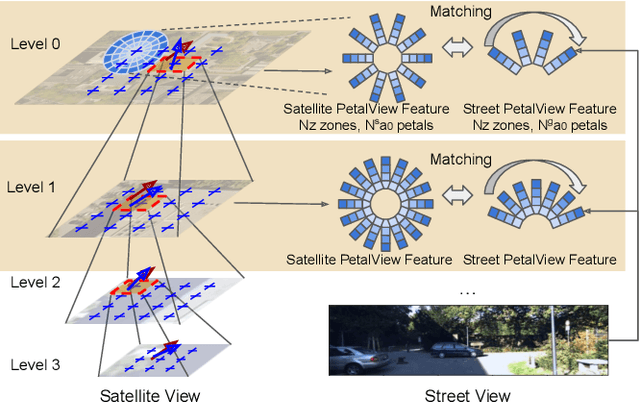
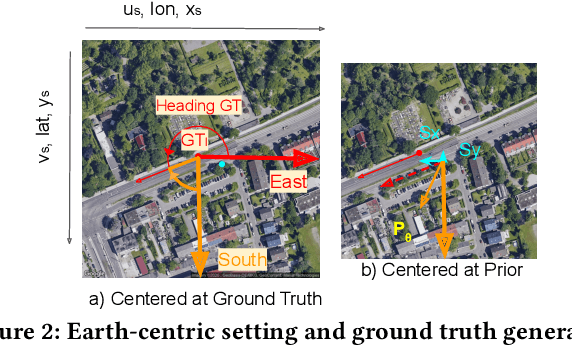
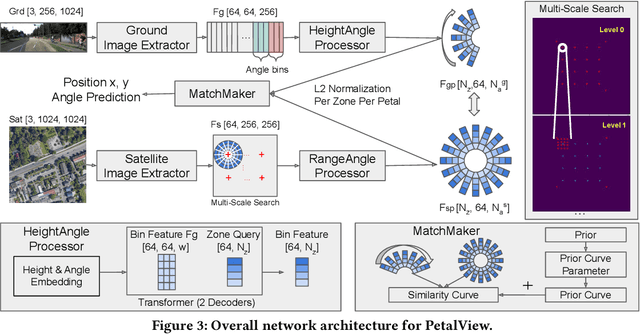
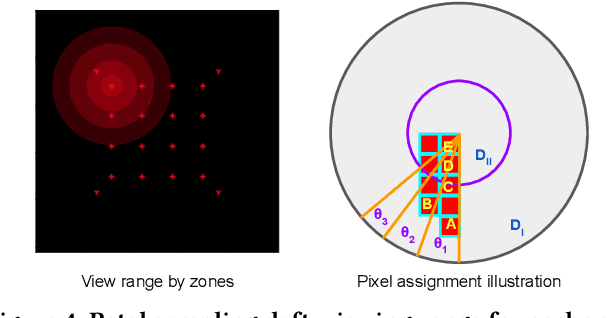
Satellite-based street-view information extraction by cross-view matching refers to a task that extracts the location and orientation information of a given street-view image query by using one or multiple geo-referenced satellite images. Recent work has initiated a new research direction to find accurate information within a local area covered by one satellite image centered at a location prior (e.g., from GPS). It can be used as a standalone solution or complementary step following a large-scale search with multiple satellite candidates. However, these existing works require an accurate initial orientation (angle) prior (e.g., from IMU) and/or do not efficiently search through all possible poses. To allow efficient search and to give accurate prediction regardless of the existence or the accuracy of the angle prior, we present PetalView extractors with multi-scale search. The PetalView extractors give semantically meaningful features that are equivalent across two drastically different views, and the multi-scale search strategy efficiently inspects the satellite image from coarse to fine granularity to provide sub-meter and sub-degree precision extraction. Moreover, when an angle prior is given, we propose a learnable prior angle mixer to utilize this information. Our method obtains the best performance on the VIGOR dataset and successfully improves the performance on KITTI dataset test 1 set with the recall within 1 meter (r@1m) for location estimation to 68.88% and recall within 1 degree (r@1d) 21.10% when no angle prior is available, and with angle prior achieves stable estimations at r@1m and r@1d above 70% and 21%, up to a 40-degree noise level.
* This paper has been accepted by ACM Multimedia 2023. This version contains additional supplementary materials
Hierarchical Deep Residual Reasoning for Temporal Moment Localization
Oct 31, 2021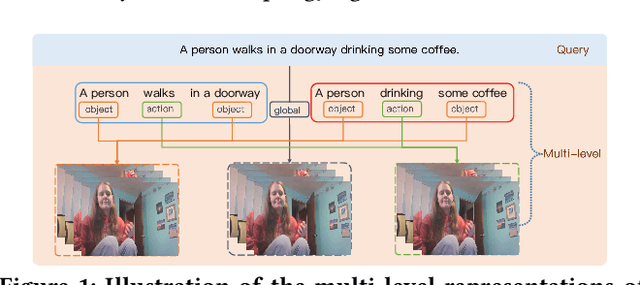
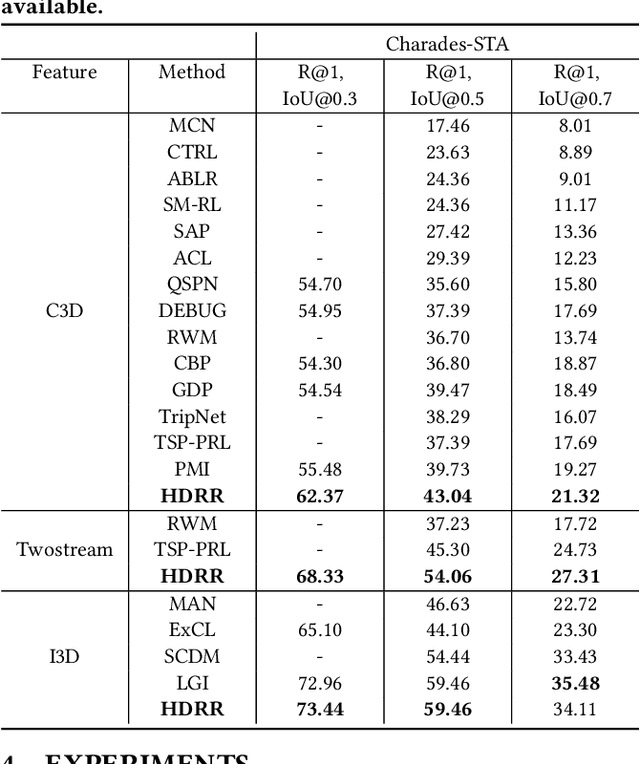
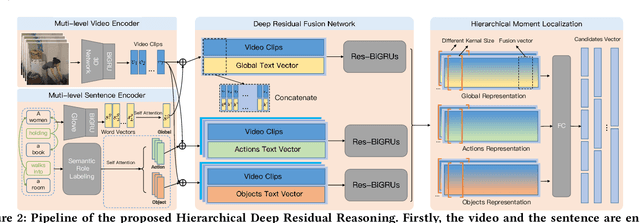
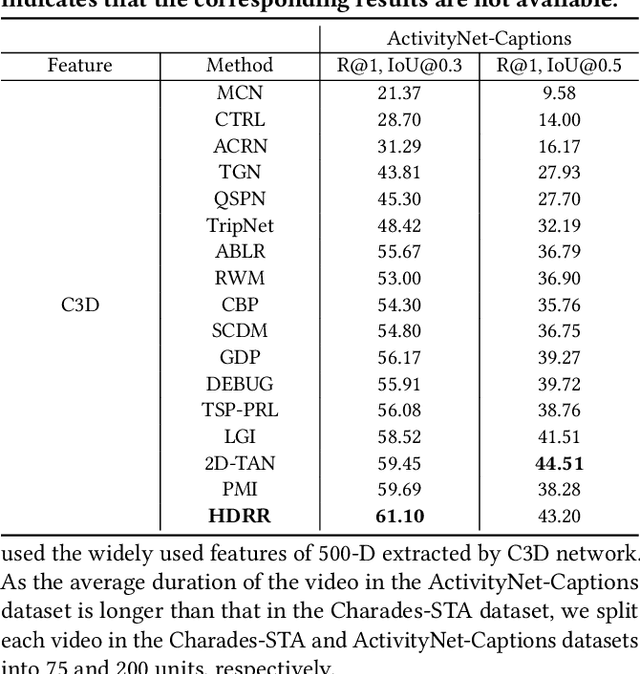
Temporal Moment Localization (TML) in untrimmed videos is a challenging task in the field of multimedia, which aims at localizing the start and end points of the activity in the video, described by a sentence query. Existing methods mainly focus on mining the correlation between video and sentence representations or investigating the fusion manner of the two modalities. These works mainly understand the video and sentence coarsely, ignoring the fact that a sentence can be understood from various semantics, and the dominant words affecting the moment localization in the semantics are the action and object reference. Toward this end, we propose a Hierarchical Deep Residual Reasoning (HDRR) model, which decomposes the video and sentence into multi-level representations with different semantics to achieve a finer-grained localization. Furthermore, considering that videos with different resolution and sentences with different length have different difficulty in understanding, we design the simple yet effective Res-BiGRUs for feature fusion, which is able to grasp the useful information in a self-adapting manner. Extensive experiments conducted on Charades-STA and ActivityNet-Captions datasets demonstrate the superiority of our HDRR model compared with other state-of-the-art methods.
Multi-Modal Interaction Graph Convolutional Network for Temporal Language Localization in Videos
Oct 12, 2021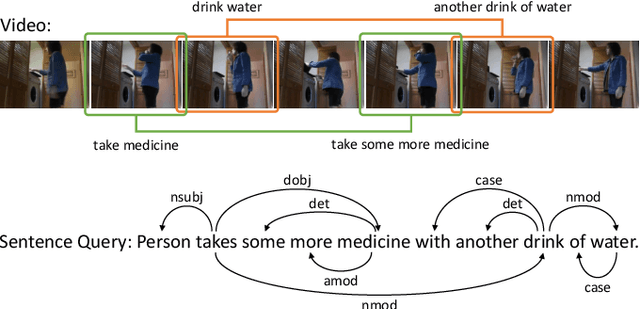
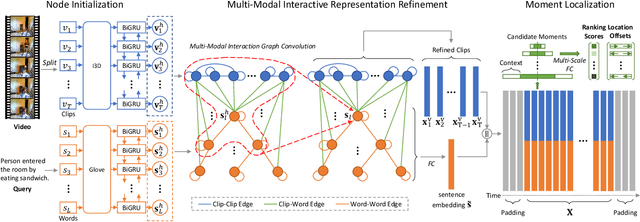
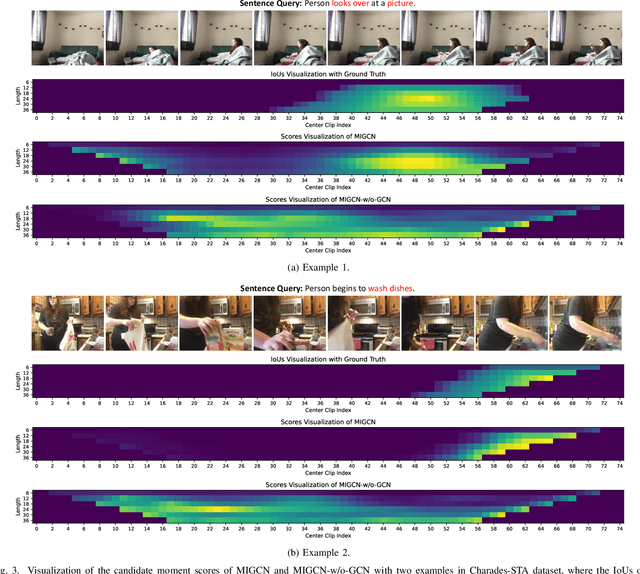
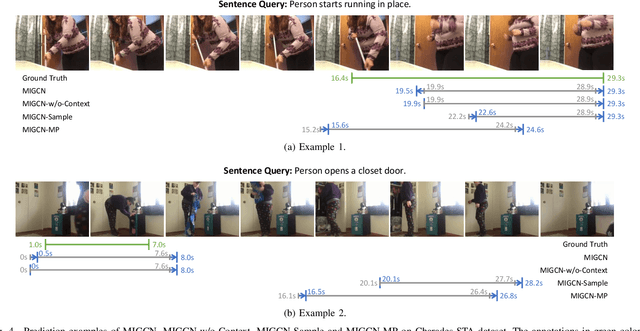
This paper focuses on tackling the problem of temporal language localization in videos, which aims to identify the start and end points of a moment described by a natural language sentence in an untrimmed video. However, it is non-trivial since it requires not only the comprehensive understanding of the video and sentence query, but also the accurate semantic correspondence capture between them. Existing efforts are mainly centered on exploring the sequential relation among video clips and query words to reason the video and sentence query, neglecting the other intra-modal relations (e.g., semantic similarity among video clips and syntactic dependency among the query words). Towards this end, in this work, we propose a Multi-modal Interaction Graph Convolutional Network (MIGCN), which jointly explores the complex intra-modal relations and inter-modal interactions residing in the video and sentence query to facilitate the understanding and semantic correspondence capture of the video and sentence query. In addition, we devise an adaptive context-aware localization method, where the context information is taken into the candidate moments and the multi-scale fully connected layers are designed to rank and adjust the boundary of the generated coarse candidate moments with different lengths. Extensive experiments on Charades-STA and ActivityNet datasets demonstrate the promising performance and superior efficiency of our model.
* Accepted by IEEE Transactions on Image Processing
Neural Compatibility Modeling with Attentive Knowledge Distillation
Apr 17, 2018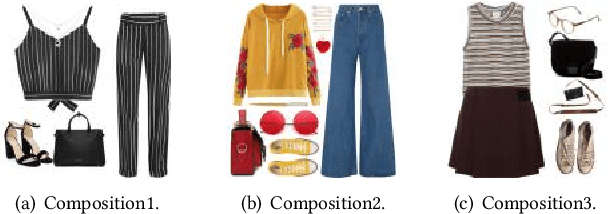
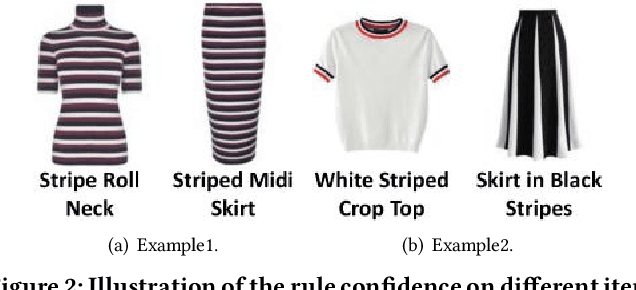
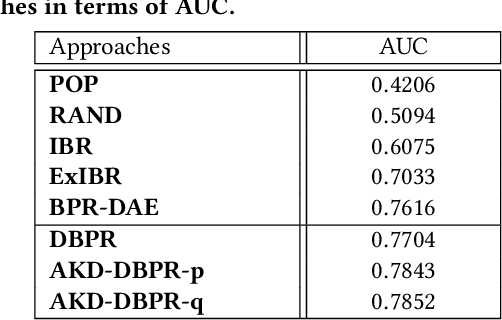
Recently, the booming fashion sector and its huge potential benefits have attracted tremendous attention from many research communities. In particular, increasing research efforts have been dedicated to the complementary clothing matching as matching clothes to make a suitable outfit has become a daily headache for many people, especially those who do not have the sense of aesthetics. Thanks to the remarkable success of neural networks in various applications such as image classification and speech recognition, the researchers are enabled to adopt the data-driven learning methods to analyze fashion items. Nevertheless, existing studies overlook the rich valuable knowledge (rules) accumulated in fashion domain, especially the rules regarding clothing matching. Towards this end, in this work, we shed light on complementary clothing matching by integrating the advanced deep neural networks and the rich fashion domain knowledge. Considering that the rules can be fuzzy and different rules may have different confidence levels to different samples, we present a neural compatibility modeling scheme with attentive knowledge distillation based on the teacher-student network scheme. Extensive experiments on the real-world dataset show the superiority of our model over several state-of-the-art baselines. Based upon the comparisons, we observe certain fashion insights that add value to the fashion matching study. As a byproduct, we released the codes, and involved parameters to benefit other researchers.