 Add to Chrome
 Add to Firefox
 Add to Edge
Skeleton: Visual Authoring of Non-visual Data Experiences
Jul 16, 2026
When sighted practitioners author accessible data visualizations, they build navigation structures (the nodes, edges, and input bindings that govern how assistive technologies traverse an interface) entirely in code, with no visual representation. Without a representation to react to, practitioners cannot develop judgment about what makes navigation good or bad, and the quality ceiling of non-visual experiences is set by the absence of a feedback loop. We address this problem through longitudinal co-design with practitioners across cartography, design systems, and open-source visualization, and make three contributions. First, we introduce an Inspector that renders navigation graphs as interactive node-link diagrams, and a Dimensions API that expresses navigation in terms of data dimensions rather than explicit graph construction. Second we present Skeleton, a direct-manipulation authoring environment in which the properties of an accessible navigation structure are translated into visual representations authors can observe and manipulate. Key techniques include a dual-view editor that simultaneously shows the system's navigation model and the end user's spatial experience, a scaffolding engine that automates spatial node placement by repurposing a visualization rendering pipeline, a live label-template editor with real-time screen-reader-output preview, and a testing mode that makes traversal sequence visually trackable. Third, we evaluate Skeleton through an in-situ study with 8 practitioners across visualization design, engineering, and research. Making navigation structure visible changed how practitioners engaged with accessible design: they reconsidered the architecture of their own visualizations, attended to a broader range of input modalities, and shifted from treating accessibility as a compliance task to treating it as a design problem. (abstract shortened for arxiv)

OSCBench: Benchmarking Object State Change in Text-to-Video Generation
Mar 12, 2026Text-to-video (T2V) generation models have made rapid progress in producing visually high-quality and temporally coherent videos. However, existing benchmarks primarily focus on perceptual quality, text-video alignment, or physical plausibility, leaving a critical aspect of action understanding largely unexplored: object state change (OSC) explicitly specified in the text prompt. OSC refers to the transformation of an object's state induced by an action, such as peeling a potato or slicing a lemon. In this paper, we introduce OSCBench, a benchmark specifically designed to assess OSC performance in T2V models. OSCBench is constructed from instructional cooking data and systematically organizes action-object interactions into regular, novel, and compositional scenarios to probe both in-distribution performance and generalization. We evaluate six representative open-source and proprietary T2V models using both human user study and multimodal large language model (MLLM)-based automatic evaluation. Our results show that, despite strong performance on semantic and scene alignment, current T2V models consistently struggle with accurate and temporally consistent object state changes, especially in novel and compositional settings. These findings position OSC as a key bottleneck in text-to-video generation and establish OSCBench as a diagnostic benchmark for advancing state-aware video generation models.
"I followed what felt right, not what I was told": Autonomy, Coaching, and Recognizing Bias Through AI-Mediated Dialogue
Mar 11, 2026Ableist microaggressions remain pervasive in everyday interactions, yet interventions to help people recognize them are limited. We present an experiment testing how AI-mediated dialogue influences recognition of ableism. 160 participants completed a pre-test, intervention, and a post-test across four conditions: AI nudges toward bias (Bias-Directed), inclusion (Neutral-Directed), unguided dialogue (Self-Directed), and a text-only non-dialogue (Reading). Participants rated scenarios on standardness of social experience and emotional impact; those in dialogue-based conditions also provided qualitative reflections. Quantitative results showed dialogue-based conditions produced stronger recognition than Reading, though trajectories diverged: biased nudges improved differentiation of bias from neutrality but increased overall negativity. Inclusive or no nudges remained more balanced, while Reading participants showed weaker gains and even declines. Qualitative findings revealed biased nudges were often rejected, while inclusive nudges were adopted as scaffolding. We contribute a validated vignette corpus, an AI-mediated intervention platform, and design implications highlighting trade-offs conversational systems face when integrating bias-related nudges.
OSCAR: Object Status and Contextual Awareness for Recipes to Support Non-Visual Cooking
Mar 07, 2025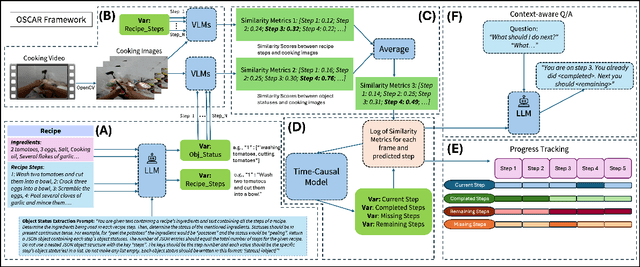



Following recipes while cooking is an important but difficult task for visually impaired individuals. We developed OSCAR (Object Status Context Awareness for Recipes), a novel approach that provides recipe progress tracking and context-aware feedback on the completion of cooking tasks through tracking object statuses. OSCAR leverages both Large-Language Models (LLMs) and Vision-Language Models (VLMs) to manipulate recipe steps, extract object status information, align visual frames with object status, and provide cooking progress tracking log. We evaluated OSCAR's recipe following functionality using 173 YouTube cooking videos and 12 real-world non-visual cooking videos to demonstrate OSCAR's capability to track cooking steps and provide contextual guidance. Our results highlight the effectiveness of using object status to improve performance compared to baseline by over 20% across different VLMs, and we present factors that impact prediction performance. Furthermore, we contribute a dataset of real-world non-visual cooking videos with step annotations as an evaluation benchmark.
WheelPoser: Sparse-IMU Based Body Pose Estimation for Wheelchair Users
Sep 13, 2024
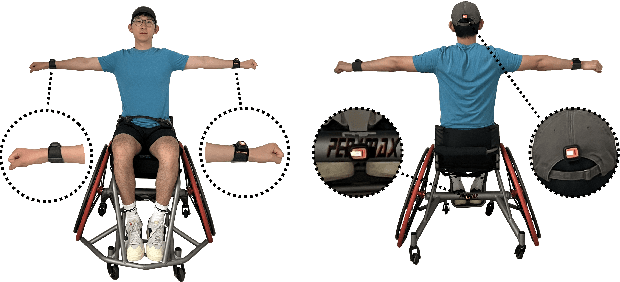
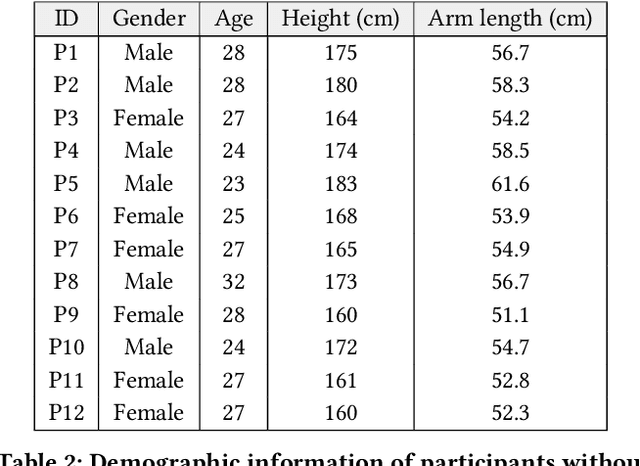
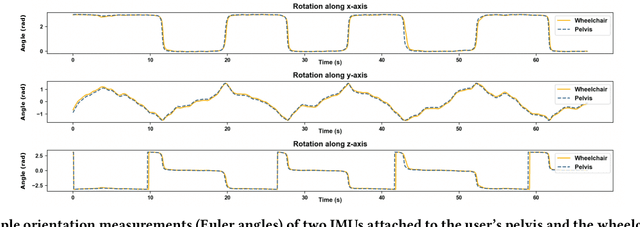
Despite researchers having extensively studied various ways to track body pose on-the-go, most prior work does not take into account wheelchair users, leading to poor tracking performance. Wheelchair users could greatly benefit from this pose information to prevent injuries, monitor their health, identify environmental accessibility barriers, and interact with gaming and VR experiences. In this work, we present WheelPoser, a real-time pose estimation system specifically designed for wheelchair users. Our system uses only four strategically placed IMUs on the user's body and wheelchair, making it far more practical than prior systems using cameras and dense IMU arrays. WheelPoser is able to track a wheelchair user's pose with a mean joint angle error of 14.30 degrees and a mean joint position error of 6.74 cm, more than three times better than similar systems using sparse IMUs. To train our system, we collect a novel WheelPoser-IMU dataset, consisting of 167 minutes of paired IMU sensor and motion capture data of people in wheelchairs, including wheelchair-specific motions such as propulsion and pressure relief. Finally, we explore the potential application space enabled by our system and discuss future opportunities. Open-source code, models, and dataset can be found here: https://github.com/axle-lab/WheelPoser.