 Add to Chrome
 Add to Firefox
 Add to Edge
Yuvion VL: A Multimodal Foundation Model for Adversarial Content and AI Safety
Jun 23, 2026
General-purpose models often struggle to reliably identify and understand real-world multimodal risks, largely due to the inherent multimodal adversarial nature of content and AI safety. We present Yuvion VL, a family of multimodal large language models purpose-built for content and AI safety, with both instruction-tuned and reasoning-oriented variants. Yuvion VL addresses this gap by treating safety as an inherently adversarial and multimodal problem and designing the entire pipeline around adversarial robustness. For data construction, we develop an automated pipeline integrating adversarial-aware data synthesis with multi-stage quality control, producing large-scale, high-quality multimodal samples augmented with domain knowledge and reasoning annotations. For training, we adopt a three-stage pipeline that includes continued pretraining for risk-concept cross-modal alignment, instruct post-training for production-grade safety tasks, and reasoning post-training for enhanced interpretability and performance in complex tasks. We further introduce Confuse-then-Contrast Fine-Tuning, a contrastive framework that mines model-specific confusions and constructs multi-image contrastive groups to enforce explicit discrimination of fine-grained visual-semantic elements, enabling the model to distinguish between visually similar cases with different safety implications in adversarial safety tasks. To support rigorous evaluation, we further introduce Yuvion VL RiskEval (YVRE), a collection of benchmarks covering diverse open and internal evaluations, with a focus on content and AI safety, adversarial robustness, and real-world capability requirements. Experiments show that Yuvion VL-32B achieves industry-leading safety performance, surpassing comparably sized open-source models and best closed-source commercial models, while maintaining comparable general capabilities.

Balancing Efficiency and Restoration: Lightweight Mamba-Based Model for CT Metal Artifact Reduction
Apr 08, 2026In computed tomography imaging, metal implants frequently generate severe artifacts that compromise image quality and hinder diagnostic accuracy. There are three main challenges in the existing methods: the deterioration of organ and tissue structures, dependence on sinogram data, and an imbalance between resource use and restoration efficiency. Addressing these issues, we introduce MARMamba, which effectively eliminates artifacts caused by metals of different sizes while maintaining the integrity of the original anatomical structures of the image. Furthermore, this model only focuses on CT images affected by metal artifacts, thus negating the requirement for additional input data. The model is a streamlined UNet architecture, which incorporates multi-scale Mamba (MS-Mamba) as its core module. Within MS-Mamba, a flip mamba block captures comprehensive contextual information by analyzing images from multiple orientations. Subsequently, the average maximum feed-forward network integrates critical features with average features to suppress the artifacts. This combination allows MARMamba to reduce artifacts efficiently. The experimental results demonstrate that our model excels in reducing metal artifacts, offering distinct advantages over other models. It also strikes an optimal balance between computational demands, memory usage, and the number of parameters, highlighting its practical utility in the real world. The code of the presented model is available at: https://github.com/RICKand-MORTY/MARMamba.
GAD-Generative Learning for HD Map-Free Autonomous Driving
May 01, 2024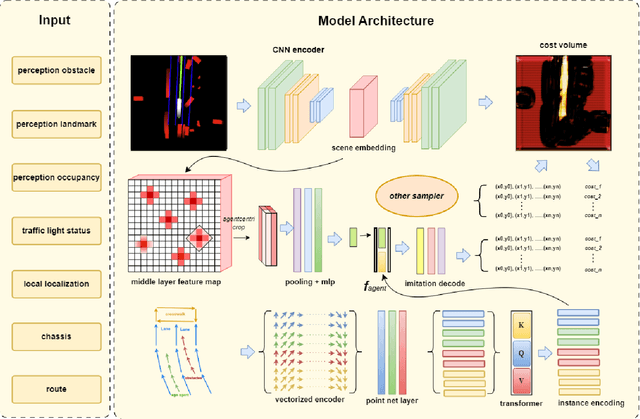

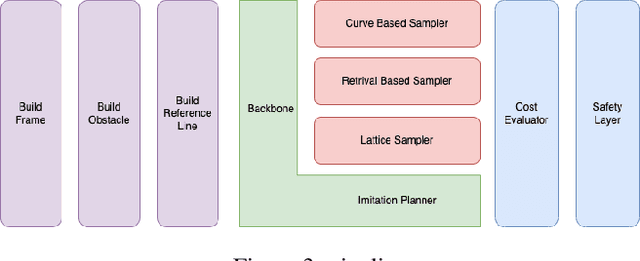
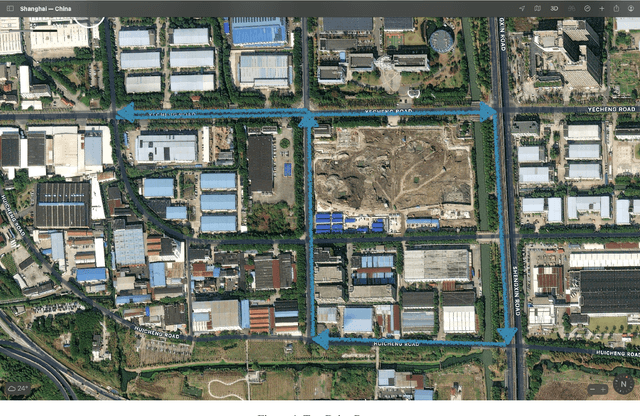
Deep-learning-based techniques have been widely adopted for autonomous driving software stacks for mass production in recent years, focusing primarily on perception modules, with some work extending this method to prediction modules. However, the downstream planning and control modules are still designed with hefty handcrafted rules, dominated by optimization-based methods such as quadratic programming or model predictive control. This results in a performance bottleneck for autonomous driving systems in that corner cases simply cannot be solved by enumerating hand-crafted rules. We present a deep-learning-based approach that brings prediction, decision, and planning modules together with the attempt to overcome the rule-based methods' deficiency in real-world applications of autonomous driving, especially for urban scenes. The DNN model we proposed is solely trained with 10 hours of human driver data, and it supports all mass-production ADAS features available on the market to date. This method is deployed onto a Jiyue test car with no modification to its factory-ready sensor set and compute platform. the feasibility, usability, and commercial potential are demonstrated in this article.
Attention Diversification for Domain Generalization
Oct 09, 2022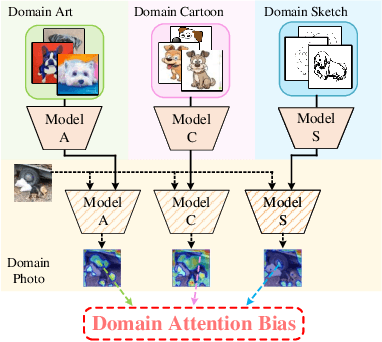
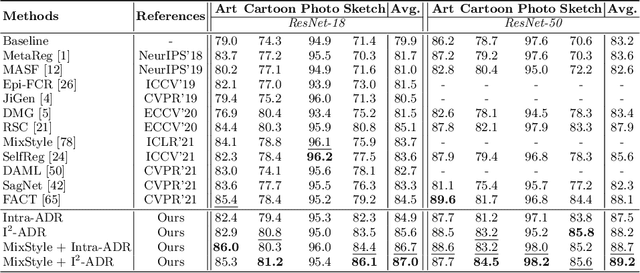
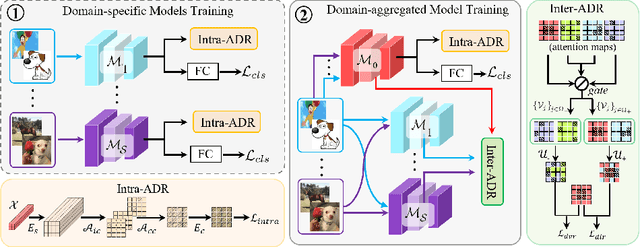
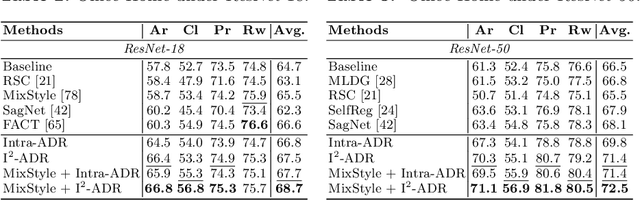
Convolutional neural networks (CNNs) have demonstrated gratifying results at learning discriminative features. However, when applied to unseen domains, state-of-the-art models are usually prone to errors due to domain shift. After investigating this issue from the perspective of shortcut learning, we find the devils lie in the fact that models trained on different domains merely bias to different domain-specific features yet overlook diverse task-related features. Under this guidance, a novel Attention Diversification framework is proposed, in which Intra-Model and Inter-Model Attention Diversification Regularization are collaborated to reassign appropriate attention to diverse task-related features. Briefly, Intra-Model Attention Diversification Regularization is equipped on the high-level feature maps to achieve in-channel discrimination and cross-channel diversification via forcing different channels to pay their most salient attention to different spatial locations. Besides, Inter-Model Attention Diversification Regularization is proposed to further provide task-related attention diversification and domain-related attention suppression, which is a paradigm of "simulate, divide and assemble": simulate domain shift via exploiting multiple domain-specific models, divide attention maps into task-related and domain-related groups, and assemble them within each group respectively to execute regularization. Extensive experiments and analyses are conducted on various benchmarks to demonstrate that our method achieves state-of-the-art performance over other competing methods. Code is available at https://github.com/hikvision-research/DomainGeneralization.
* ECCV 2022. Code available at https://github.com/hikvision-research/DomainGeneralization
A Free Lunch for Unsupervised Domain Adaptive Object Detection without Source Data
Dec 10, 2020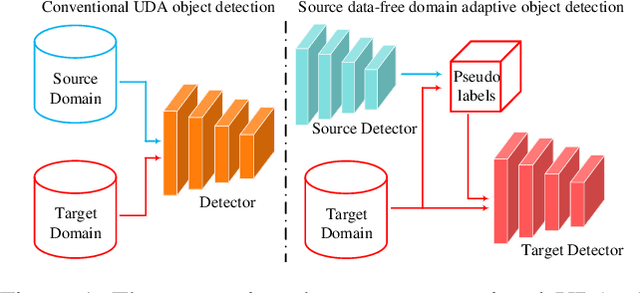
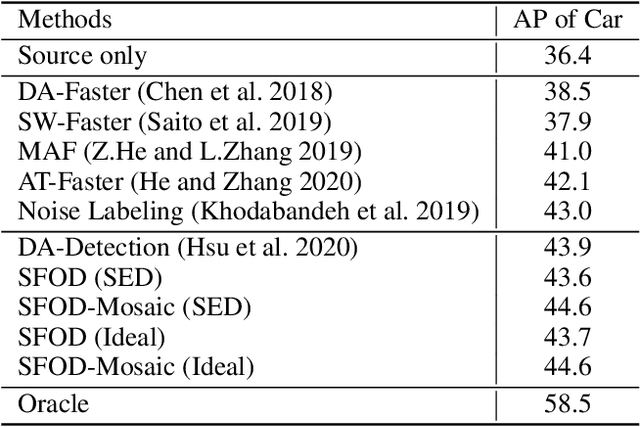
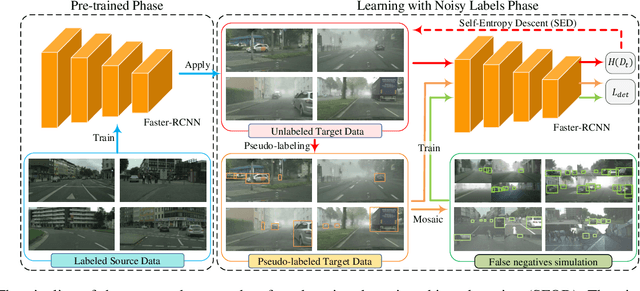
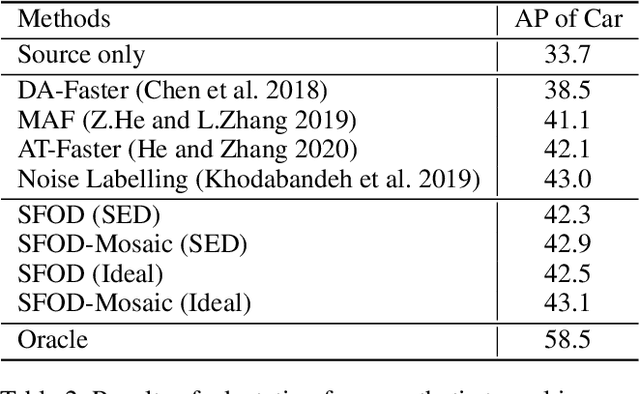
Unsupervised domain adaptation (UDA) assumes that source and target domain data are freely available and usually trained together to reduce the domain gap. However, considering the data privacy and the inefficiency of data transmission, it is impractical in real scenarios. Hence, it draws our eyes to optimize the network in the target domain without accessing labeled source data. To explore this direction in object detection, for the first time, we propose a source data-free domain adaptive object detection (SFOD) framework via modeling it into a problem of learning with noisy labels. Generally, a straightforward method is to leverage the pre-trained network from the source domain to generate the pseudo labels for target domain optimization. However, it is difficult to evaluate the quality of pseudo labels since no labels are available in target domain. In this paper, self-entropy descent (SED) is a metric proposed to search an appropriate confidence threshold for reliable pseudo label generation without using any handcrafted labels. Nonetheless, completely clean labels are still unattainable. After a thorough experimental analysis, false negatives are found to dominate in the generated noisy labels. Undoubtedly, false negatives mining is helpful for performance improvement, and we ease it to false negatives simulation through data augmentation like Mosaic. Extensive experiments conducted in four representative adaptation tasks have demonstrated that the proposed framework can easily achieve state-of-the-art performance. From another view, it also reminds the UDA community that the labeled source data are not fully exploited in the existing methods.