 Add to Chrome
 Add to Firefox
 Add to Edge
Harmonic-Aware Transformer for Real-Time Catheter Localization in Interventional Procedures of Magnetic Particle Imaging
Jul 03, 2026
Magnetic particle imaging (MPI) enables real-time, radiation-free tracking of magnetic nanoparticle-coated instruments, making it highly suitable for interventional procedures. This study proposes a harmonic-aware transformer framework that directly predicts catheter tip positions from raw MPI voltage signals, eliminating the need for image reconstruction and reducing computational latency. The framework incorporates frequency-domain preprocessing to isolate the 2nd to 8th drive-field harmonics, enhancing the signal-to-noise ratio while preserving motion-relevant features. A transformer architecture with six encoder layers and eight attention heads is employed to learn spatio-temporal dependencies across the three receive axes (x, y, z) for accurate three-dimensional position estimation. The model is trained on simulated MPI signals and evaluated on real in vitro datasets under standard, bending, and heartbeat-like motion conditions. The proposed method achieves sub-millimeter localization accuracy, with a minimum L2 error of 0.103 +/- 0.092 mm and mean absolute errors (MAEs) of 0.039 +/- 0.046 mm, 0.054 +/- 0.049 mm, and 0.060 +/- 0.044 mm along the (x, y, z) axes, respectively, for the bending dataset. Across all datasets, the MAE ranges from 0.165 mm to 0.655 mm, demonstrating consistent performance. The optimized inference achieves a latency of 0.55 ms per frame and a throughput of approximately 1800 frames per second, confirming real-time capability. Compared with conventional MPI-guided approaches relying on image reconstruction, the proposed framework provides improved accuracy, reduced latency, and enhanced robustness under complex motion conditions. These results highlight the potential of harmonic-aware transformer models as efficient and scalable solutions for real-time catheter localization in interventional MPI.

Perceive-to-Reason: Decoupling Perception and Reasoning for Fine-Grained Visual Reasoning
Jul 01, 2026Fine-grained visual reasoning remains challenging for vision-language models, especially when small but critical visual cues are buried in high-resolution images. Existing approaches rely on repeated cropping or test-time visual search to introduce local evidence, but they typically do not explicitly distinguish perception from reasoning. In this paper, we propose Perceive-to-Reason (P2R), a unified framework that formulates fine-grained visual reasoning as a two-stage process: the model first localizes question-relevant evidence as a Perceiver, and then answers the question as a Reasoner based on the annotated image and cropped regions. To better align training with this decoupled formulation, we further introduce Perception-Reasoning Alternating GRPO (PRA-GRPO), a role-aware reinforcement learning strategy that alternates between perception-focused and reasoning-focused updates using only final-answer supervision. Built on top of Qwen3-VL-Instruct-2B/4B/8B, P2R consistently improves performance across model scales. In particular, P2R-4B achieves 93.2% on V-Star, 81.9% on HR-Bench-4K, and 80.5% on HR-Bench-8K, substantially outperforming its corresponding backbone. Further experiments show that the benefits of P2R extend beyond high-resolution benchmarks to broader multimodal reasoning tasks. These results suggest that explicitly decoupling perception from reasoning provides an effective framework for fine-grained visual reasoning.
Yuvion LLM: An Adversarially-Aware Large Language Model for Content And AI Safety
Jun 26, 2026As large language models are increasingly deployed in real-world systems, safety failures can still lead to harmful outputs and dangerous misuse. We argue that the essence of safety is adversarial: many failures arise not from natural inputs alone, but from strategic attempts to evade model policies and safeguards. However, existing general-purpose model development largely overlook this adversarial nature, and often remain insufficient for realistic safety scenarios involving planning, tool use, and multi-step reasoning, causing measured safety performance to overestimate real deployment robustness. To address this gap, we present Yuvion LLM, a large language model built for adversarially robust content safety and broader AI safety. Yuvion LLM treats adversarial robustness and agentic capability as first-class objectives. Its pipeline combines adversarially aware data construction, knowledge-enhanced continued pretraining, and policy-grounded multi-task safety post-training, including risk-aware supervised fine-tuning and reinforcement learning-based policy optimization, together with safety-aware agentic reinforcement learning for tool use and multi-step reasoning in complex safety scenarios. We further introduce the Yuvion LLM RiskEval (YLRE), a collection of 93 benchmarks across four evaluation categories, covering diverse open and internal evaluations with a focus on safety, adversarial robustness, and real-world capability requirements. Across these evaluations, Yuvion LLM demonstrates clear advantages on safety-focused benchmarks and particularly strong robustness under adversarial conditions, while maintaining solid overall capability. Notably, Yuvion-8B outperforms most state-of-the-art baselines, including substantially larger models such as GPT-5.4 and Qwen3-MAX, on several safety tasks.
Yuvion VL: A Multimodal Foundation Model for Adversarial Content and AI Safety
Jun 23, 2026General-purpose models often struggle to reliably identify and understand real-world multimodal risks, largely due to the inherent multimodal adversarial nature of content and AI safety. We present Yuvion VL, a family of multimodal large language models purpose-built for content and AI safety, with both instruction-tuned and reasoning-oriented variants. Yuvion VL addresses this gap by treating safety as an inherently adversarial and multimodal problem and designing the entire pipeline around adversarial robustness. For data construction, we develop an automated pipeline integrating adversarial-aware data synthesis with multi-stage quality control, producing large-scale, high-quality multimodal samples augmented with domain knowledge and reasoning annotations. For training, we adopt a three-stage pipeline that includes continued pretraining for risk-concept cross-modal alignment, instruct post-training for production-grade safety tasks, and reasoning post-training for enhanced interpretability and performance in complex tasks. We further introduce Confuse-then-Contrast Fine-Tuning, a contrastive framework that mines model-specific confusions and constructs multi-image contrastive groups to enforce explicit discrimination of fine-grained visual-semantic elements, enabling the model to distinguish between visually similar cases with different safety implications in adversarial safety tasks. To support rigorous evaluation, we further introduce Yuvion VL RiskEval (YVRE), a collection of benchmarks covering diverse open and internal evaluations, with a focus on content and AI safety, adversarial robustness, and real-world capability requirements. Experiments show that Yuvion VL-32B achieves industry-leading safety performance, surpassing comparably sized open-source models and best closed-source commercial models, while maintaining comparable general capabilities.
Dynamic Facial Expressions Analysis Based Parkinson's Disease Auxiliary Diagnosis
Dec 10, 2025Parkinson's disease (PD), a prevalent neurodegenerative disorder, significantly affects patients' daily functioning and social interactions. To facilitate a more efficient and accessible diagnostic approach for PD, we propose a dynamic facial expression analysis-based PD auxiliary diagnosis method. This method targets hypomimia, a characteristic clinical symptom of PD, by analyzing two manifestations: reduced facial expressivity and facial rigidity, thereby facilitating the diagnosis process. We develop a multimodal facial expression analysis network to extract expression intensity features during patients' performance of various facial expressions. This network leverages the CLIP architecture to integrate visual and textual features while preserving the temporal dynamics of facial expressions. Subsequently, the expression intensity features are processed and input into an LSTM-based classification network for PD diagnosis. Our method achieves an accuracy of 93.1%, outperforming other in-vitro PD diagnostic approaches. This technique offers a more convenient detection method for potential PD patients, improving their diagnostic experience.
IR-Aware ECO Timing Optimization Using Reinforcement Learning
Feb 12, 2024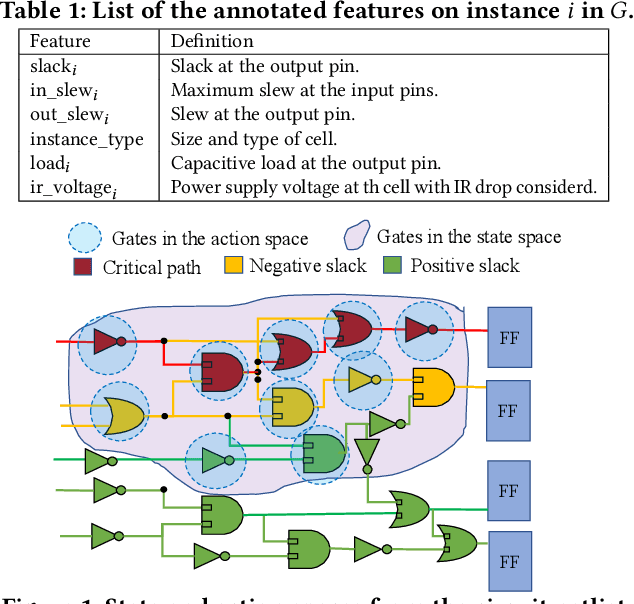
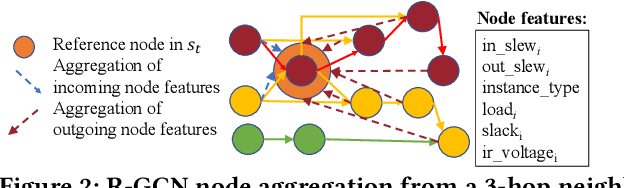

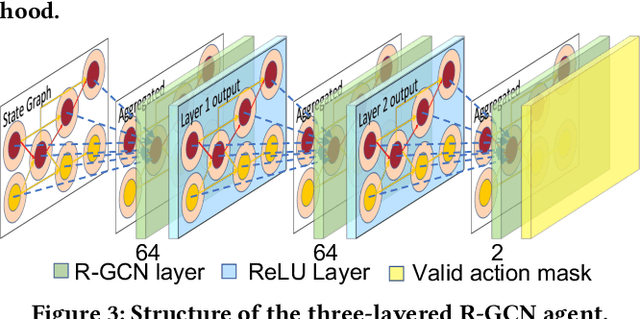
Engineering change orders (ECOs) in late stages make minimal design fixes to recover from timing shifts due to excessive IR drops. This paper integrates IR-drop-aware timing analysis and ECO timing optimization using reinforcement learning (RL). The method operates after physical design and power grid synthesis, and rectifies IR-drop-induced timing degradation through gate sizing. It incorporates the Lagrangian relaxation (LR) technique into a novel RL framework, which trains a relational graph convolutional network (R-GCN) agent to sequentially size gates to fix timing violations. The R-GCN agent outperforms a classical LR-only algorithm: in an open 45nm technology, it (a) moves the Pareto front of the delay-area tradeoff curve to the left and (b) saves runtime over the classical method by running fast inference using trained models at iso-quality. The RL model is transferable across timing specifications, and transferable to unseen designs with zero-shot learning or fine tuning.