 Add to Chrome
 Add to Firefox
 Add to Edge
Cross Domain Generative Augmentation: Domain Generalization with Latent Diffusion Models
Dec 08, 2023
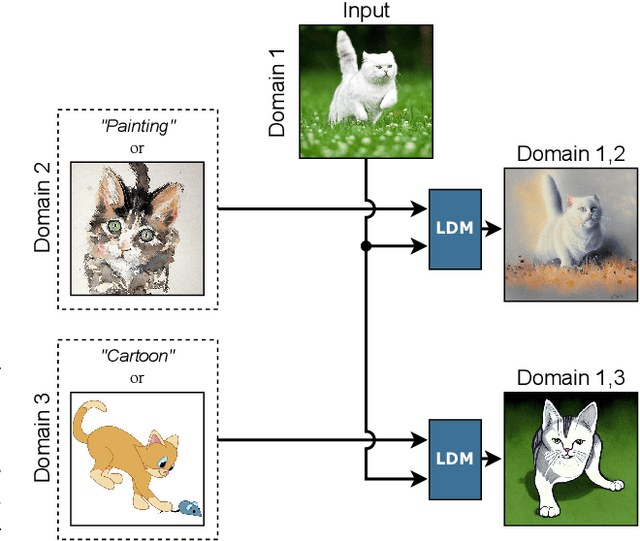
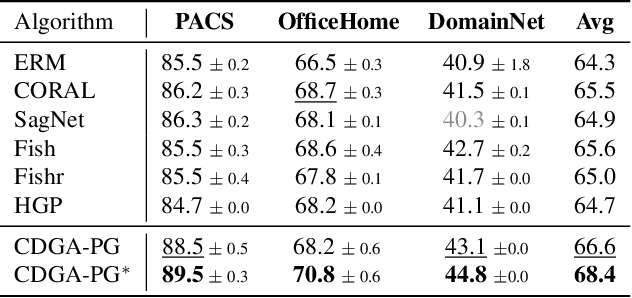
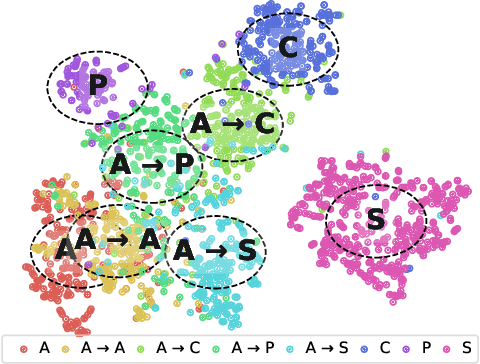

Despite the huge effort in developing novel regularizers for Domain Generalization (DG), adding simple data augmentation to the vanilla ERM which is a practical implementation of the Vicinal Risk Minimization principle (VRM) \citep{chapelle2000vicinal} outperforms or stays competitive with many of the proposed regularizers. The VRM reduces the estimation error in ERM by replacing the point-wise kernel estimates with a more precise estimation of true data distribution that reduces the gap between data points \textbf{within each domain}. However, in the DG setting, the estimation error of true data distribution by ERM is mainly caused by the distribution shift \textbf{between domains} which cannot be fully addressed by simple data augmentation techniques within each domain. Inspired by this limitation of VRM, we propose a novel data augmentation named Cross Domain Generative Augmentation (CDGA) that replaces the pointwise kernel estimates in ERM with new density estimates in the \textbf{vicinity of domain pairs} so that the gap between domains is further reduced. To this end, CDGA, which is built upon latent diffusion models (LDM), generates synthetic images to fill the gap between all domains and as a result, reduces the non-iidness. We show that CDGA outperforms SOTA DG methods under the Domainbed benchmark. To explain the effectiveness of CDGA, we generate more than 5 Million synthetic images and perform extensive ablation studies including data scaling laws, distribution visualization, domain shift quantification, adversarial robustness, and loss landscape analysis.

LivePhoto: Real Image Animation with Text-guided Motion Control
Dec 05, 2023


Despite the recent progress in text-to-video generation, existing studies usually overlook the issue that only spatial contents but not temporal motions in synthesized videos are under the control of text. Towards such a challenge, this work presents a practical system, named LivePhoto, which allows users to animate an image of their interest with text descriptions. We first establish a strong baseline that helps a well-learned text-to-image generator (i.e., Stable Diffusion) take an image as a further input. We then equip the improved generator with a motion module for temporal modeling and propose a carefully designed training pipeline to better link texts and motions. In particular, considering the facts that (1) text can only describe motions roughly (e.g., regardless of the moving speed) and (2) text may include both content and motion descriptions, we introduce a motion intensity estimation module as well as a text re-weighting module to reduce the ambiguity of text-to-motion mapping. Empirical evidence suggests that our approach is capable of well decoding motion-related textual instructions into videos, such as actions, camera movements, or even conjuring new contents from thin air (e.g., pouring water into an empty glass). Interestingly, thanks to the proposed intensity learning mechanism, our system offers users an additional control signal (i.e., the motion intensity) besides text for video customization.
Mismatch Quest: Visual and Textual Feedback for Image-Text Misalignment
Dec 05, 2023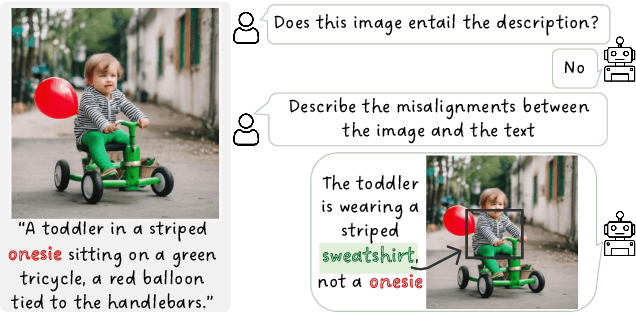
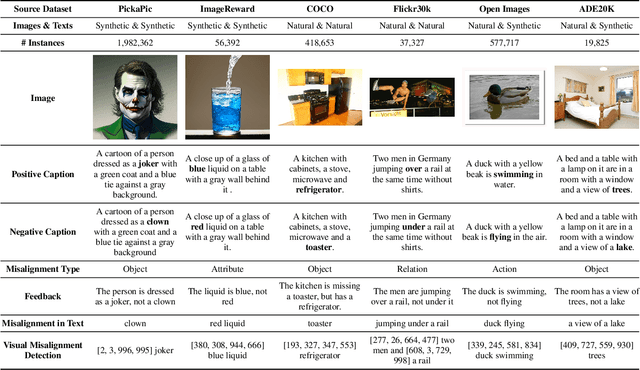
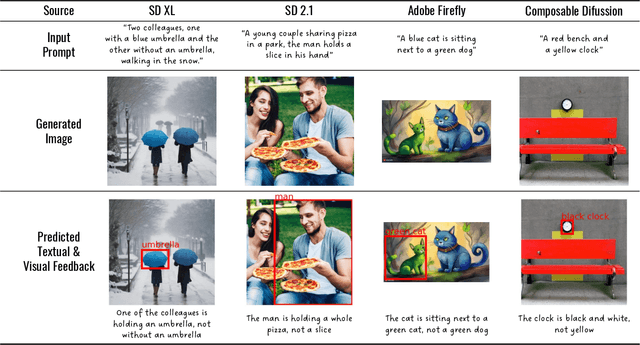

While existing image-text alignment models reach high quality binary assessments, they fall short of pinpointing the exact source of misalignment. In this paper, we present a method to provide detailed textual and visual explanation of detected misalignments between text-image pairs. We leverage large language models and visual grounding models to automatically construct a training set that holds plausible misaligned captions for a given image and corresponding textual explanations and visual indicators. We also publish a new human curated test set comprising ground-truth textual and visual misalignment annotations. Empirical results show that fine-tuning vision language models on our training set enables them to articulate misalignments and visually indicate them within images, outperforming strong baselines both on the binary alignment classification and the explanation generation tasks. Our method code and human curated test set are available at: https://mismatch-quest.github.io/
YUAN 2.0: A Large Language Model with Localized Filtering-based Attention
Dec 04, 2023
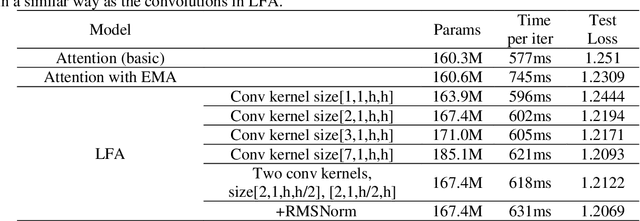
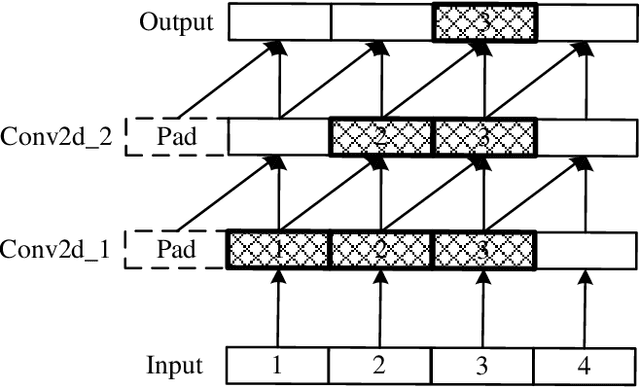
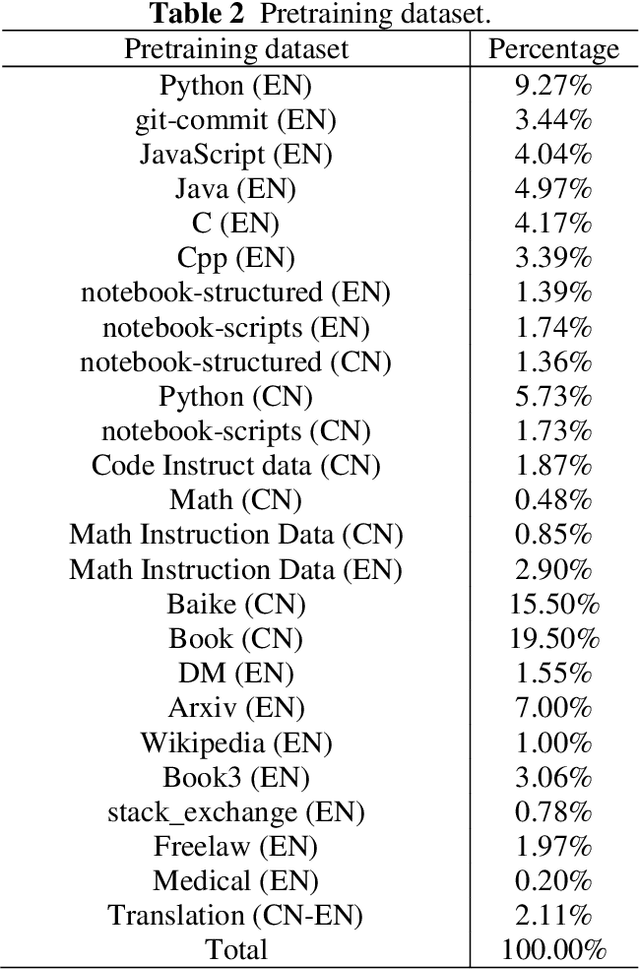
In this work, we develop and release Yuan 2.0, a series of large language models with parameters ranging from 2.1 billion to 102.6 billion. The Localized Filtering-based Attention (LFA) is introduced to incorporate prior knowledge of local dependencies of natural language into Attention. A data filtering and generating system is presented to build pre-training and fine-tuning dataset in high quality. A distributed training method with non-uniform pipeline parallel, data parallel, and optimizer parallel is proposed, which greatly reduces the bandwidth requirements of intra-node communication, and achieves good performance in large-scale distributed training. Yuan 2.0 models display impressive ability in code generation, math problem-solving, and chatting compared with existing models. The latest version of YUAN 2.0, including model weights and source code, is accessible at Github.
Learning Disentangled Identifiers for Action-Customized Text-to-Image Generation
Nov 30, 2023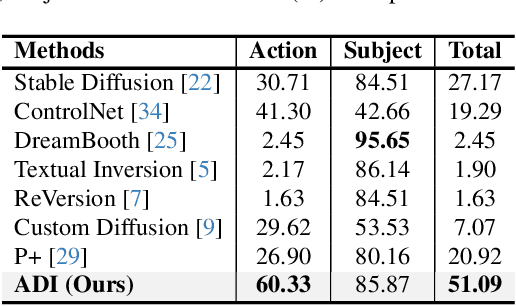
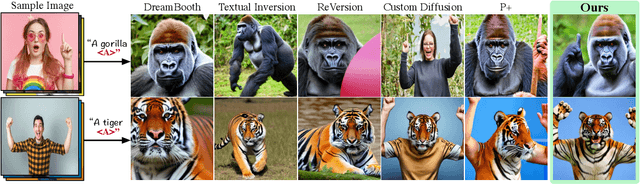


This study focuses on a novel task in text-to-image (T2I) generation, namely action customization. The objective of this task is to learn the co-existing action from limited data and generalize it to unseen humans or even animals. Experimental results show that existing subject-driven customization methods fail to learn the representative characteristics of actions and struggle in decoupling actions from context features, including appearance. To overcome the preference for low-level features and the entanglement of high-level features, we propose an inversion-based method Action-Disentangled Identifier (ADI) to learn action-specific identifiers from the exemplar images. ADI first expands the semantic conditioning space by introducing layer-wise identifier tokens, thereby increasing the representational richness while distributing the inversion across different features. Then, to block the inversion of action-agnostic features, ADI extracts the gradient invariance from the constructed sample triples and masks the updates of irrelevant channels. To comprehensively evaluate the task, we present an ActionBench that includes a variety of actions, each accompanied by meticulously selected samples. Both quantitative and qualitative results show that our ADI outperforms existing baselines in action-customized T2I generation. Our project page is at https://adi-t2i.github.io/ADI.
A Lightweight Clustering Framework for Unsupervised Semantic Segmentation
Nov 30, 2023
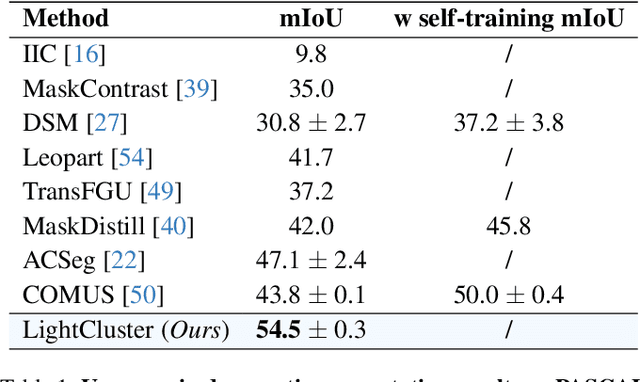
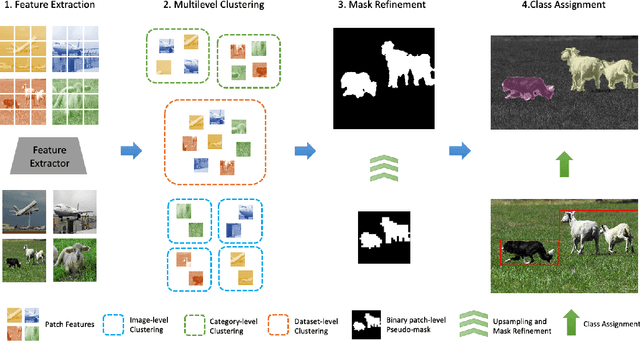
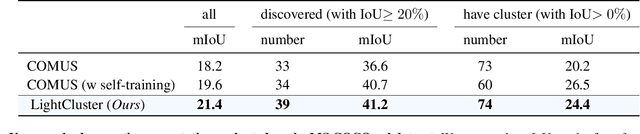
Unsupervised semantic segmentation aims to label each pixel of an image to a corresponding class without the use of annotated data. It is a widely researched area as obtaining labeled datasets are expensive. While previous works in the field demonstrated a gradual improvement in segmentation performance, most of them required neural network training. This made segmentation equally expensive, especially when dealing with large-scale datasets. We thereby propose a lightweight clustering framework for unsupervised semantic segmentation. Attention features of the self-supervised vision transformer exhibit strong foreground-background differentiability. By clustering these features into a small number of clusters, we could separate foreground and background image patches into distinct groupings. In our clustering framework, we first obtain attention features from the self-supervised vision transformer. Then we extract Dataset-level, Category-level and Image-level masks by clustering features within the same dataset, category and image. We further ensure multilevel clustering consistency across the three levels and this allows us to extract patch-level binary pseudo-masks. Finally, the pseudo-mask is upsampled, refined and class assignment is performed according to the CLS token of object regions. Our framework demonstrates great promise in unsupervised semantic segmentation and achieves state-of-the-art results on PASCAL VOC and MS COCO datasets.
Utility Fairness in Contextual Dynamic Pricing with Demand Learning
Nov 28, 2023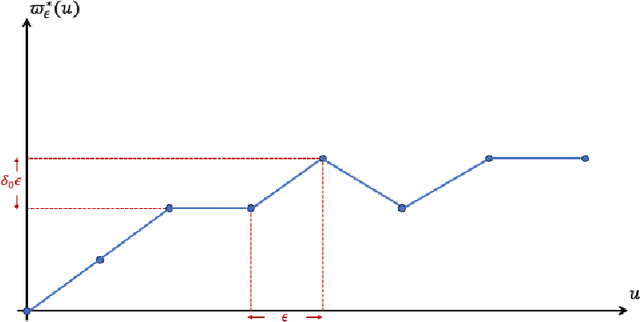
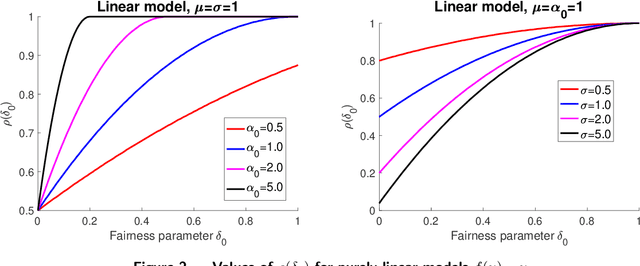
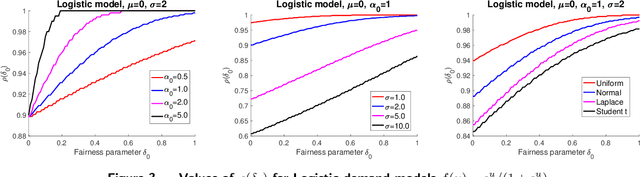
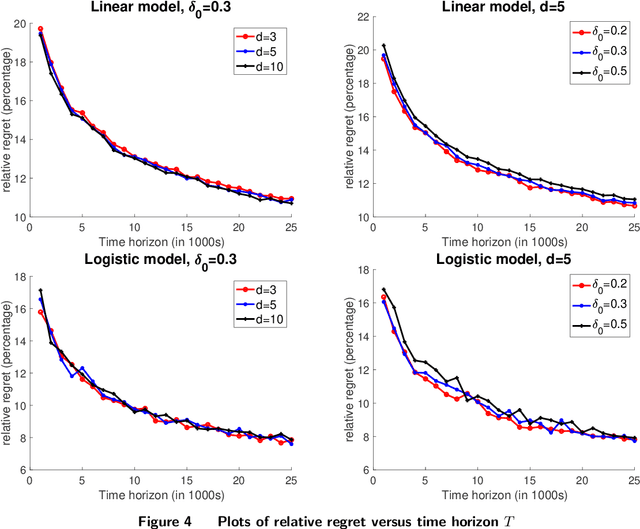
This paper introduces a novel contextual bandit algorithm for personalized pricing under utility fairness constraints in scenarios with uncertain demand, achieving an optimal regret upper bound. Our approach, which incorporates dynamic pricing and demand learning, addresses the critical challenge of fairness in pricing strategies. We first delve into the static full-information setting to formulate an optimal pricing policy as a constrained optimization problem. Here, we propose an approximation algorithm for efficiently and approximately computing the ideal policy. We also use mathematical analysis and computational studies to characterize the structures of optimal contextual pricing policies subject to fairness constraints, deriving simplified policies which lays the foundations of more in-depth research and extensions. Further, we extend our study to dynamic pricing problems with demand learning, establishing a non-standard regret lower bound that highlights the complexity added by fairness constraints. Our research offers a comprehensive analysis of the cost of fairness and its impact on the balance between utility and revenue maximization. This work represents a step towards integrating ethical considerations into algorithmic efficiency in data-driven dynamic pricing.
Pruning random resistive memory for optimizing analogue AI
Nov 13, 2023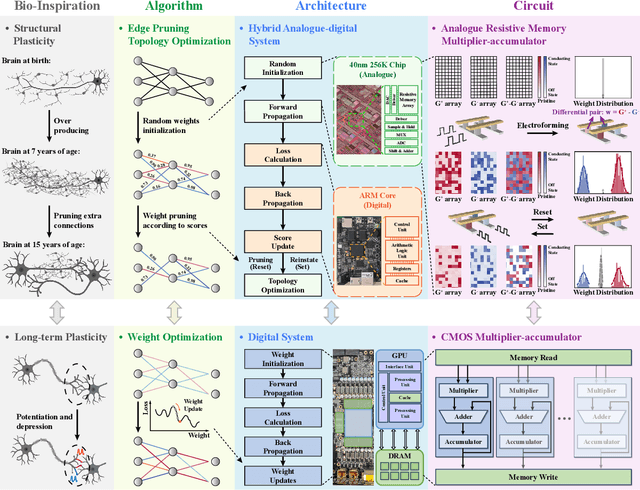
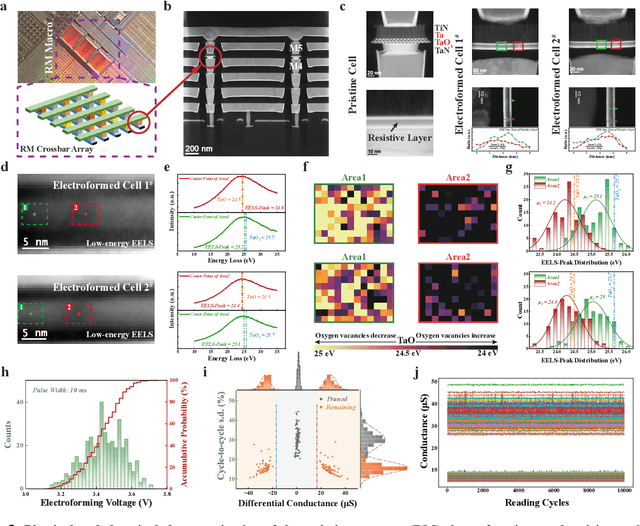
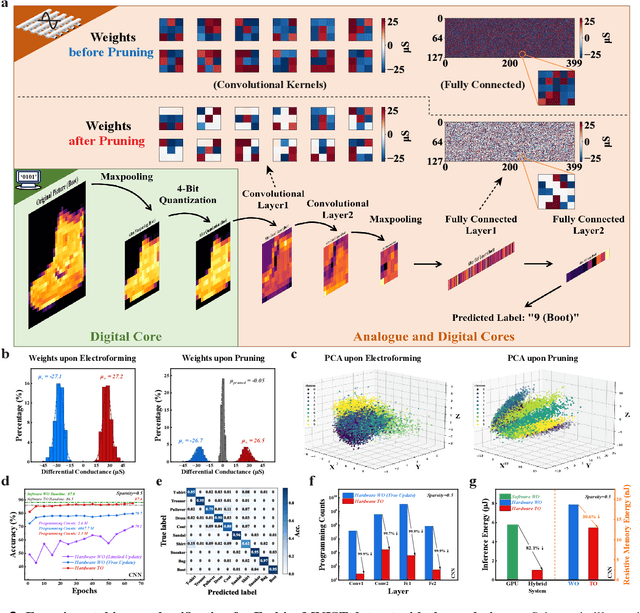
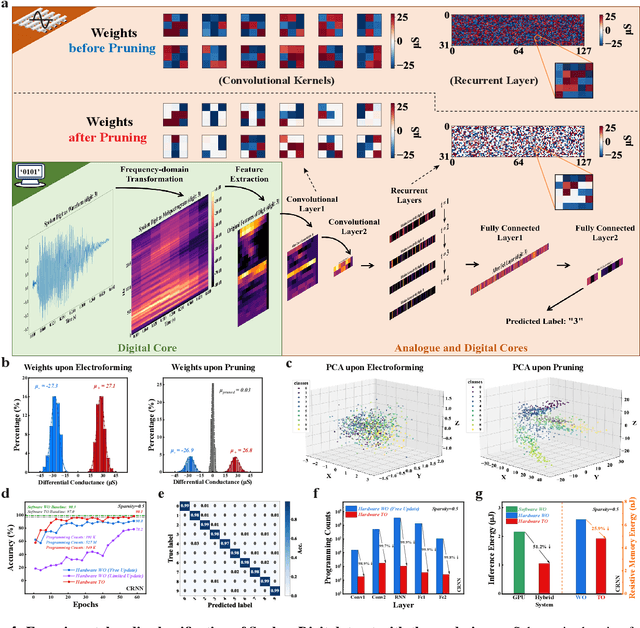
The rapid advancement of artificial intelligence (AI) has been marked by the large language models exhibiting human-like intelligence. However, these models also present unprecedented challenges to energy consumption and environmental sustainability. One promising solution is to revisit analogue computing, a technique that predates digital computing and exploits emerging analogue electronic devices, such as resistive memory, which features in-memory computing, high scalability, and nonvolatility. However, analogue computing still faces the same challenges as before: programming nonidealities and expensive programming due to the underlying devices physics. Here, we report a universal solution, software-hardware co-design using structural plasticity-inspired edge pruning to optimize the topology of a randomly weighted analogue resistive memory neural network. Software-wise, the topology of a randomly weighted neural network is optimized by pruning connections rather than precisely tuning resistive memory weights. Hardware-wise, we reveal the physical origin of the programming stochasticity using transmission electron microscopy, which is leveraged for large-scale and low-cost implementation of an overparameterized random neural network containing high-performance sub-networks. We implemented the co-design on a 40nm 256K resistive memory macro, observing 17.3% and 19.9% accuracy improvements in image and audio classification on FashionMNIST and Spoken digits datasets, as well as 9.8% (2%) improvement in PR (ROC) in image segmentation on DRIVE datasets, respectively. This is accompanied by 82.1%, 51.2%, and 99.8% improvement in energy efficiency thanks to analogue in-memory computing. By embracing the intrinsic stochasticity and in-memory computing, this work may solve the biggest obstacle of analogue computing systems and thus unleash their immense potential for next-generation AI hardware.
Map-assisted TDOA Localization Enhancement Based On CNN
Nov 09, 2023For signal processing related to localization technologies, non line of sight (NLOS) multipaths have great impact over the localization error level. This study proposes a localization correction method based on convolution neural network (CNN) that extracts obstacles' features from maps to predict the localization errors caused by NLOS effects. A novel compensation scheme is developed and structured around the localization error in terms of distance and azimuth angle predicted by the CNN. Four prediction tasks are executed over different building distributions within the maps for typical urban scenario, resulting in CNN models with high prediction accuracy. Finally, a thorough comparison of the accuracy performance between the time difference of arrival (TDOA) localization algorithm and the results after the error compensation reveals that, generally, the CNN prediction approach demonstrates a great localization error correction performance. It can be observed that the powerful feature extraction capability of CNN can be exploited by processing surrounding maps to predict localization error distribution, which has great potential in further enhancement of TDOA performance under challenging scenarios with rich multi-path propagation.
GOPlan: Goal-conditioned Offline Reinforcement Learning by Planning with Learned Models
Oct 30, 2023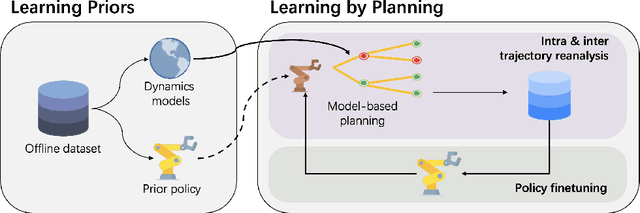


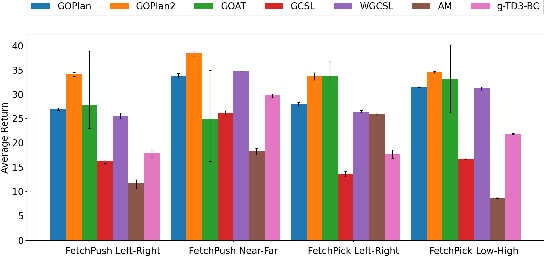
Offline goal-conditioned RL (GCRL) offers a feasible paradigm to learn general-purpose policies from diverse and multi-task offline datasets. Despite notable recent progress, the predominant offline GCRL methods have been restricted to model-free approaches, constraining their capacity to tackle limited data budgets and unseen goal generalization. In this work, we propose a novel two-stage model-based framework, Goal-conditioned Offline Planning (GOPlan), including (1) pretraining a prior policy capable of capturing multi-modal action distribution within the multi-goal dataset; (2) employing the reanalysis method with planning to generate imagined trajectories for funetuning policies. Specifically, the prior policy is based on an advantage-weighted Conditioned Generative Adversarial Networks that exhibits distinct mode separation to overcome the pitfalls of out-of-distribution (OOD) actions. For further policy optimization, the reanalysis method generates high-quality imaginary data by planning with learned models for both intra-trajectory and inter-trajectory goals. Through experimental evaluations, we demonstrate that GOPlan achieves state-of-the-art performance on various offline multi-goal manipulation tasks. Moreover, our results highlight the superior ability of GOPlan to handle small data budgets and generalize to OOD goals.