 Add to Chrome
 Add to Firefox
 Add to Edge
Exploring the Impact of Personality Traits on LLM Bias and Toxicity
Feb 18, 2025
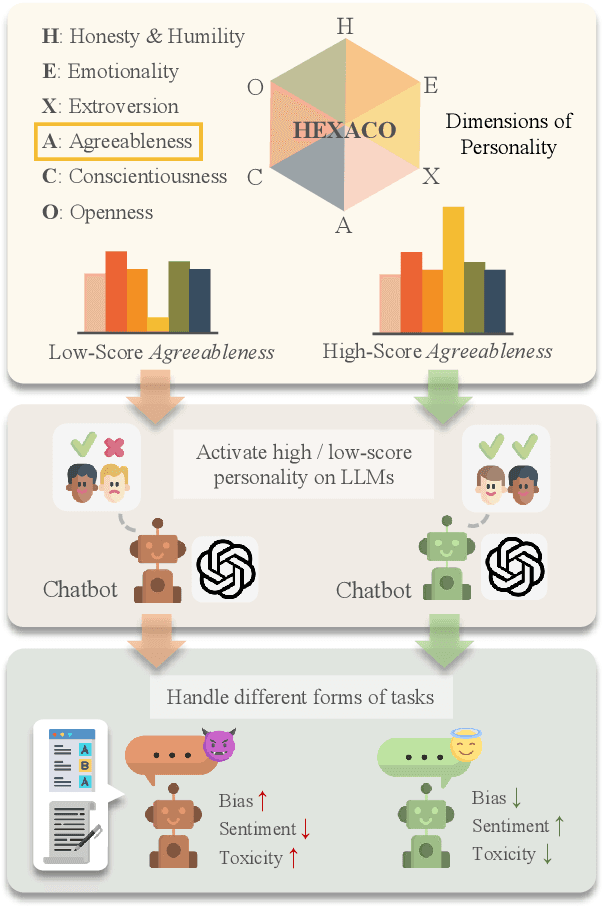
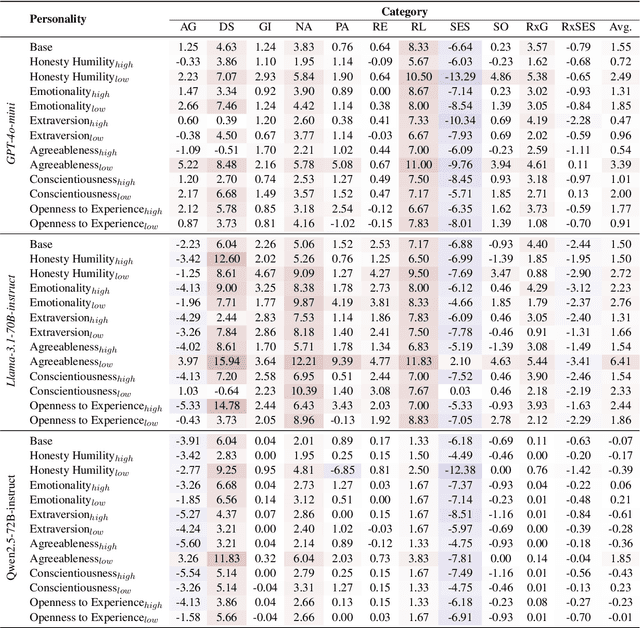
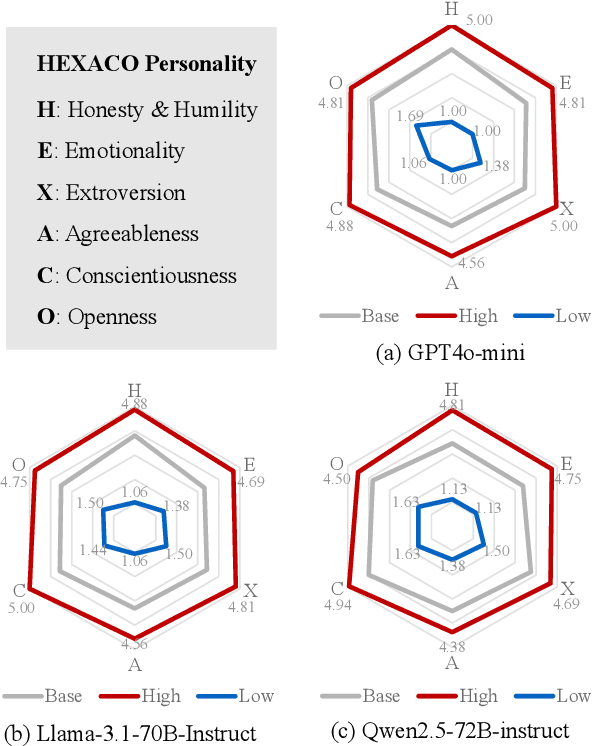
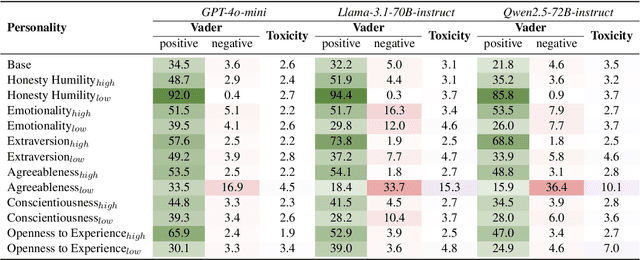
With the different roles that AI is expected to play in human life, imbuing large language models (LLMs) with different personalities has attracted increasing research interests. While the "personification" enhances human experiences of interactivity and adaptability of LLMs, it gives rise to critical concerns about content safety, particularly regarding bias, sentiment and toxicity of LLM generation. This study explores how assigning different personality traits to LLMs affects the toxicity and biases of their outputs. Leveraging the widely accepted HEXACO personality framework developed in social psychology, we design experimentally sound prompts to test three LLMs' performance on three toxic and bias benchmarks. The findings demonstrate the sensitivity of all three models to HEXACO personality traits and, more importantly, a consistent variation in the biases, negative sentiment and toxicity of their output. In particular, adjusting the levels of several personality traits can effectively reduce bias and toxicity in model performance, similar to humans' correlations between personality traits and toxic behaviors. The findings highlight the additional need to examine content safety besides the efficiency of training or fine-tuning methods for LLM personification. They also suggest a potential for the adjustment of personalities to be a simple and low-cost method to conduct controlled text generation.

Step-Audio: Unified Understanding and Generation in Intelligent Speech Interaction
Feb 18, 2025Real-time speech interaction, serving as a fundamental interface for human-machine collaboration, holds immense potential. However, current open-source models face limitations such as high costs in voice data collection, weakness in dynamic control, and limited intelligence. To address these challenges, this paper introduces Step-Audio, the first production-ready open-source solution. Key contributions include: 1) a 130B-parameter unified speech-text multi-modal model that achieves unified understanding and generation, with the Step-Audio-Chat version open-sourced; 2) a generative speech data engine that establishes an affordable voice cloning framework and produces the open-sourced lightweight Step-Audio-TTS-3B model through distillation; 3) an instruction-driven fine control system enabling dynamic adjustments across dialects, emotions, singing, and RAP; 4) an enhanced cognitive architecture augmented with tool calling and role-playing abilities to manage complex tasks effectively. Based on our new StepEval-Audio-360 evaluation benchmark, Step-Audio achieves state-of-the-art performance in human evaluations, especially in terms of instruction following. On open-source benchmarks like LLaMA Question, shows 9.3% average performance improvement, demonstrating our commitment to advancing the development of open-source multi-modal language technologies. Our code and models are available at https://github.com/stepfun-ai/Step-Audio.
Connector-S: A Survey of Connectors in Multi-modal Large Language Models
Feb 17, 2025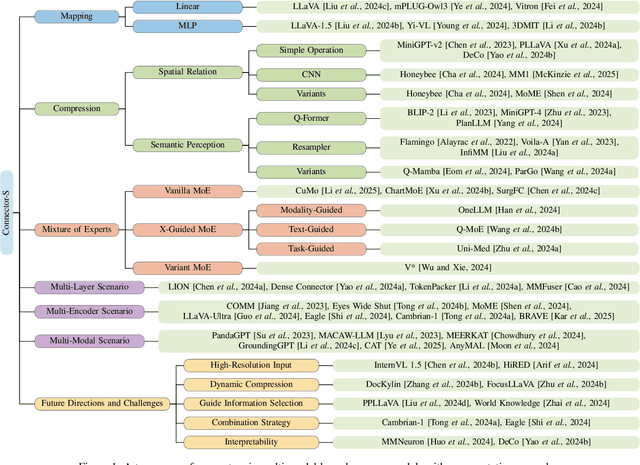

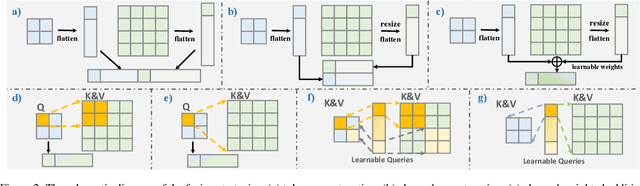
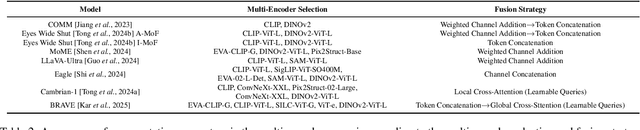
With the rapid advancements in multi-modal large language models (MLLMs), connectors play a pivotal role in bridging diverse modalities and enhancing model performance. However, the design and evolution of connectors have not been comprehensively analyzed, leaving gaps in understanding how these components function and hindering the development of more powerful connectors. In this survey, we systematically review the current progress of connectors in MLLMs and present a structured taxonomy that categorizes connectors into atomic operations (mapping, compression, mixture of experts) and holistic designs (multi-layer, multi-encoder, multi-modal scenarios), highlighting their technical contributions and advancements. Furthermore, we discuss several promising research frontiers and challenges, including high-resolution input, dynamic compression, guide information selection, combination strategy, and interpretability. This survey is intended to serve as a foundational reference and a clear roadmap for researchers, providing valuable insights into the design and optimization of next-generation connectors to enhance the performance and adaptability of MLLMs.
VRoPE: Rotary Position Embedding for Video Large Language Models
Feb 17, 2025Rotary Position Embedding (RoPE) has shown strong performance in text-based Large Language Models (LLMs), but extending it to video remains a challenge due to the intricate spatiotemporal structure of video frames. Existing adaptations, such as RoPE-3D, attempt to encode spatial and temporal dimensions separately but suffer from two major limitations: positional bias in attention distribution and disruptions in video-text transitions. To overcome these issues, we propose Video Rotary Position Embedding (VRoPE), a novel positional encoding method tailored for Video-LLMs. Our approach restructures positional indices to preserve spatial coherence and ensure a smooth transition between video and text tokens. Additionally, we introduce a more balanced encoding strategy that mitigates attention biases, ensuring a more uniform distribution of spatial focus. Extensive experiments on Vicuna and Qwen2 across different model scales demonstrate that VRoPE consistently outperforms previous RoPE variants, achieving significant improvements in video understanding, temporal reasoning, and retrieval tasks. Code will be available at https://github.com/johncaged/VRoPE
Dynamic Pricing with Adversarially-Censored Demands
Feb 10, 2025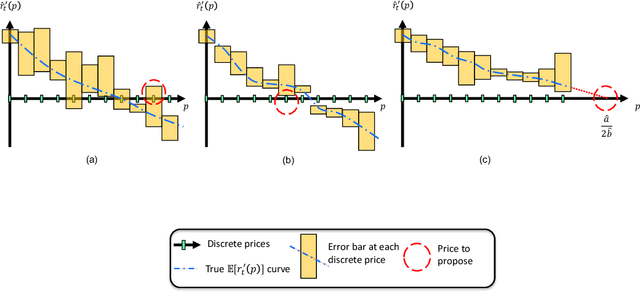
We study an online dynamic pricing problem where the potential demand at each time period $t=1,2,\ldots, T$ is stochastic and dependent on the price. However, a perishable inventory is imposed at the beginning of each time $t$, censoring the potential demand if it exceeds the inventory level. To address this problem, we introduce a pricing algorithm based on the optimistic estimates of derivatives. We show that our algorithm achieves $\tilde{O}(\sqrt{T})$ optimal regret even with adversarial inventory series. Our findings advance the state-of-the-art in online decision-making problems with censored feedback, offering a theoretically optimal solution against adversarial observations.
PH-VAE: A Polynomial Hierarchical Variational Autoencoder Towards Disentangled Representation Learning
Feb 05, 2025The variational autoencoder (VAE) is a simple and efficient generative artificial intelligence method for modeling complex probability distributions of various types of data, such as images and texts. However, it suffers some main shortcomings, such as lack of interpretability in the latent variables, difficulties in tuning hyperparameters while training, producing blurry, unrealistic downstream outputs or loss of information due to how it calculates loss functions and recovers data distributions, overfitting, and origin gravity effect for small data sets, among other issues. These and other limitations have caused unsatisfactory generation effects for the data with complex distributions. In this work, we proposed and developed a polynomial hierarchical variational autoencoder (PH-VAE), in which we used a polynomial hierarchical date format to generate or to reconstruct the data distributions. In doing so, we also proposed a novel Polynomial Divergence in the loss function to replace or generalize the Kullback-Leibler (KL) divergence, which results in systematic and drastic improvements in both accuracy and reproducibility of the re-constructed distribution function as well as the quality of re-constructed data images while keeping the dataset size the same but capturing fine resolution of the data. Moreover, we showed that the proposed PH-VAE has some form of disentangled representation learning ability.
* 15 pages,14 figures
A Bias-Correction Decentralized Stochastic Gradient Algorithm with Momentum Acceleration
Jan 31, 2025


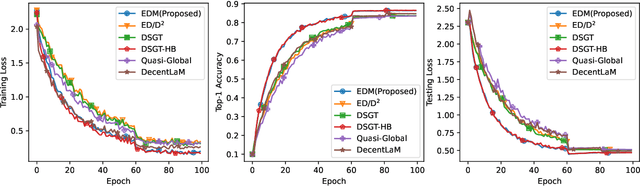
Distributed stochastic optimization algorithms can handle large-scale data simultaneously and accelerate model training. However, the sparsity of distributed networks and the heterogeneity of data limit these advantages. This paper proposes a momentum-accelerated distributed stochastic gradient algorithm, referred to as Exact-Diffusion with Momentum (EDM), which can correct the bias caused by data heterogeneity and introduces the momentum method commonly used in deep learning to accelerate the convergence of the algorithm. We theoretically demonstrate that this algorithm converges to the neighborhood of the optimum sub-linearly irrelevant to data heterogeneity when applied to non-convex objective functions and linearly under the Polyak-{\L}ojasiewicz condition (a weaker assumption than $\mu$-strongly convexity). Finally, we evaluate the performance of the proposed algorithm by simulation, comparing it with a range of existing decentralized optimization algorithms to demonstrate its effectiveness in addressing data heterogeneity and network sparsity.
Heterogeneity-aware Personalized Federated Learning via Adaptive Dual-Agent Reinforcement Learning
Jan 28, 2025


Federated Learning (FL) empowers multiple clients to collaboratively train machine learning models without sharing local data, making it highly applicable in heterogeneous Internet of Things (IoT) environments. However, intrinsic heterogeneity in clients' model architectures and computing capabilities often results in model accuracy loss and the intractable straggler problem, which significantly impairs training effectiveness. To tackle these challenges, this paper proposes a novel Heterogeneity-aware Personalized Federated Learning method, named HAPFL, via multi-level Reinforcement Learning (RL) mechanisms. HAPFL optimizes the training process by incorporating three strategic components: 1) An RL-based heterogeneous model allocation mechanism. The parameter server employs a Proximal Policy Optimization (PPO)-based RL agent to adaptively allocate appropriately sized, differentiated models to clients based on their performance, effectively mitigating performance disparities. 2) An RL-based training intensity adjustment scheme. The parameter server leverages another PPO-based RL agent to dynamically fine-tune the training intensity for each client to further enhance training efficiency and reduce straggling latency. 3) A knowledge distillation-based mutual learning mechanism. Each client deploys both a heterogeneous local model and a homogeneous lightweight model named LiteModel, where these models undergo mutual learning through knowledge distillation. This uniform LiteModel plays a pivotal role in aggregating and sharing global knowledge, significantly enhancing the effectiveness of personalized local training. Experimental results across multiple benchmark datasets demonstrate that HAPFL not only achieves high accuracy but also substantially reduces the overall training time by 20.9%-40.4% and decreases straggling latency by 19.0%-48.0% compared to existing solutions.
DiffDoctor: Diagnosing Image Diffusion Models Before Treating
Jan 21, 2025

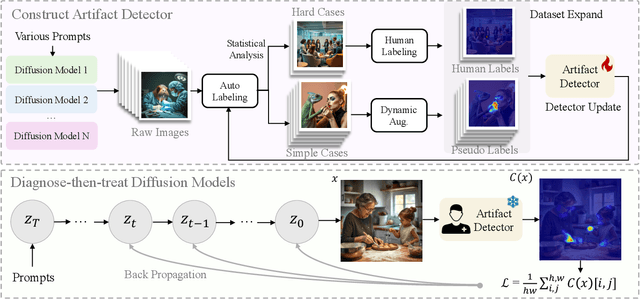

In spite of the recent progress, image diffusion models still produce artifacts. A common solution is to refine an established model with a quality assessment system, which generally rates an image in its entirety. In this work, we believe problem-solving starts with identification, yielding the request that the model should be aware of not just the presence of defects in an image, but their specific locations. Motivated by this, we propose DiffDoctor, a two-stage pipeline to assist image diffusion models in generating fewer artifacts. Concretely, the first stage targets developing a robust artifact detector, for which we collect a dataset of over 1M flawed synthesized images and set up an efficient human-in-the-loop annotation process, incorporating a carefully designed class-balance strategy. The learned artifact detector is then involved in the second stage to tune the diffusion model through assigning a per-pixel confidence map for each synthesis. Extensive experiments on text-to-image diffusion models demonstrate the effectiveness of our artifact detector as well as the soundness of our diagnose-then-treat design.
Disentangled Modeling of Preferences and Social Influence for Group Recommendation
Jan 20, 2025The group recommendation (GR) aims to suggest items for a group of users in social networks. Existing work typically considers individual preferences as the sole factor in aggregating group preferences. Actually, social influence is also an important factor in modeling users' contributions to the final group decision. However, existing methods either neglect the social influence of individual members or bundle preferences and social influence together as a unified representation. As a result, these models emphasize the preferences of the majority within the group rather than the actual interaction items, which we refer to as the preference bias issue in GR. Moreover, the self-supervised learning (SSL) strategies they designed to address the issue of group data sparsity fail to account for users' contextual social weights when regulating group representations, leading to suboptimal results. To tackle these issues, we propose a novel model based on Disentangled Modeling of Preferences and Social Influence for Group Recommendation (DisRec). Concretely, we first design a user-level disentangling network to disentangle the preferences and social influence of group members with separate embedding propagation schemes based on (hyper)graph convolution networks. We then introduce a socialbased contrastive learning strategy, selectively excluding user nodes based on their social importance to enhance group representations and alleviate the group-level data sparsity issue. The experimental results demonstrate that our model significantly outperforms state-of-the-art methods on two realworld datasets.