 Add to Chrome
 Add to Firefox
 Add to Edge
FluxMem: Adaptive Hierarchical Memory for Streaming Video Understanding
Mar 02, 2026
This paper presents FluxMem, a training-free framework for efficient streaming video understanding. FluxMem adaptively compresses redundant visual memory through a hierarchical, two-stage design: (1) a Temporal Adjacency Selection (TAS) module removes redundant visual tokens across adjacent frames, and (2) a Spatial Domain Consolidation (SDC) module further merges spatially repetitive regions within each frame into compact representations. To adapt effectively to dynamic scenes, we introduce a self-adaptive token compression mechanism in both TAS and SDC, which automatically determines the compression rate based on intrinsic scene statistics rather than manual tuning. Extensive experiments demonstrate that FluxMem achieves new state-of-the-art results on existing online video benchmarks, reaching 76.4 on StreamingBench and 67.2 on OVO-Bench under real-time settings, while reducing latency by 69.9% and peak GPU memory by 34.5% on OVO-Bench. Furthermore, it maintains strong offline performance, achieving 73.1 on MLVU while using 65% fewer visual tokens.

Inst-IT: Boosting Multimodal Instance Understanding via Explicit Visual Prompt Instruction Tuning
Dec 04, 2024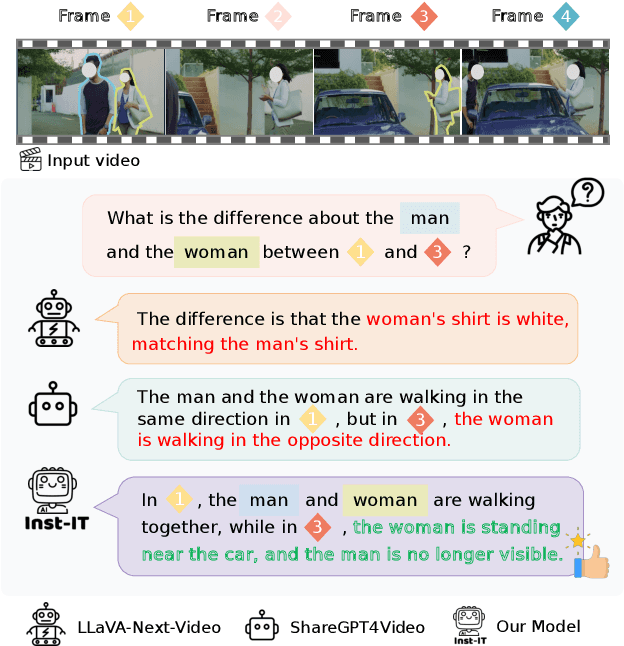
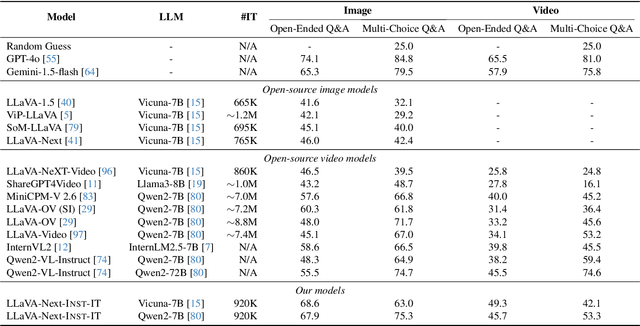
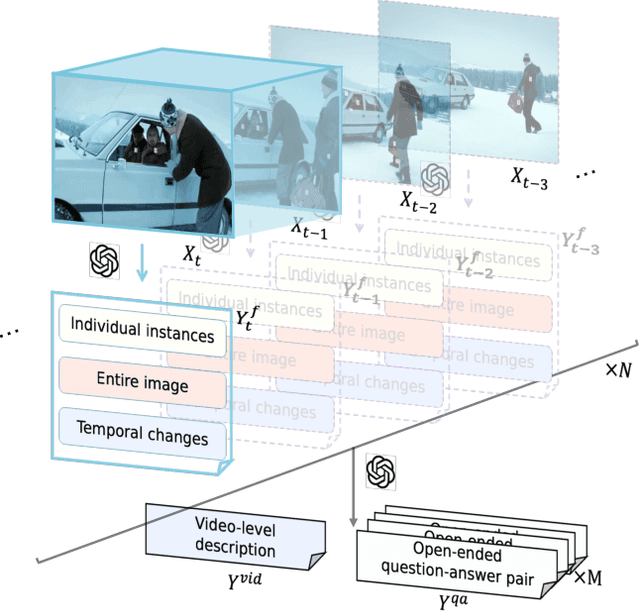
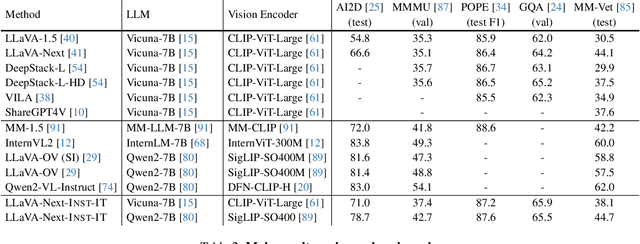
Large Multimodal Models (LMMs) have made significant breakthroughs with the advancement of instruction tuning. However, while existing models can understand images and videos at a holistic level, they still struggle with instance-level understanding that requires a more nuanced comprehension and alignment. Instance-level understanding is crucial, as it focuses on the specific elements that we are most interested in. Excitingly, existing works find that the state-of-the-art LMMs exhibit strong instance understanding capabilities when provided with explicit visual cues. Motivated by this, we introduce an automated annotation pipeline assisted by GPT-4o to extract instance-level information from images and videos through explicit visual prompting for instance guidance. Building upon this pipeline, we proposed Inst-IT, a solution to enhance LMMs in Instance understanding via explicit visual prompt Instruction Tuning. Inst-IT consists of a benchmark to diagnose multimodal instance-level understanding, a large-scale instruction-tuning dataset, and a continuous instruction-tuning training paradigm to effectively enhance spatial-temporal instance understanding capabilities of existing LMMs. Experimental results show that, with the boost of Inst-IT, our models not only achieve outstanding performance on Inst-IT Bench but also demonstrate significant improvements across various generic image and video understanding benchmarks. This highlights that our dataset not only boosts instance-level understanding but also strengthens the overall capabilities of generic image and video comprehension.