 Add to Chrome
 Add to Firefox
 Add to Edge
Mitigating Context-Memory Conflicts in LLMs through Dynamic Cognitive Reconciliation Decoding
May 12, 2026
Large language models accumulate extensive parametric knowledge through pre-training. However, knowledge conflicts occur when outdated or incorrect parametric knowledge conflicts with external knowledge in the context. Existing methods address knowledge conflicts through contrastive decoding, but in conflict-free scenarios, static approaches disrupt output distribution. Other dynamic decoding methods attempt to measure the degree of conflict but still struggle with complex real-world situations. In this paper, we propose a two-stage decoding method called Dynamic Cognitive Reconciliation Decoding (DCRD), to predict and mitigate context-memory conflicts. DCRD first analyzes the attention map to assess context fidelity and predict potential conflicts. Based on this prediction, the input is directed to one of two decoding paths: (1) greedy decoding, or (2) context fidelity-based dynamic decoding. This design enables DCRD to handle conflicts efficiently while maintaining high accuracy and decoding efficiency in conflict-free cases. Additionally, to simulate scenarios with frequent knowledge updates, we constructed ConflictKG, a knowledge conflict QA benchmark. Experiments on four LLMs across six QA datasets show that DCRD outperforms all baselines, achieving state-of-the-art performance.

Team-Based Self-Play With Dual Adaptive Weighting for Fine-Tuning LLMs
May 11, 2026While recent self-training approaches have reduced reliance on human-labeled data for aligning LLMs, they still face critical limitations: (i) sensitivity to synthetic data quality, leading to instability and bias amplification in iterative training; (ii) ineffective optimization due to a diminishing gap between positive and negative responses over successive training iterations. In this paper, we propose Team-based self-Play with dual Adaptive Weighting (TPAW), a novel self-play algorithm designed to improve alignment in a fully self-supervised setting. TPAW adopts a team-based framework in which the current policy model both collaborates with and competes against historical checkpoints, promoting more stable and efficient optimization. To further enhance learning, we design two adaptive weighting mechanisms: (i) a response reweighting scheme that adjusts the importance of target responses, and (ii) a player weighting strategy that dynamically modulates each team member's contribution during training. Initialized from a SFT model, TPAW iteratively refines alignment without requiring additional human supervision. Experimental results demonstrate that TPAW consistently outperforms existing baselines across various base models and LLM benchmarks. Our code is publicly available at https://github.com/lab-klc/TPAW.
Directed Ordinal Diffusion Regularization for Progression-Aware Diabetic Retinopathy Grading
Feb 25, 2026Diabetic Retinopathy (DR) progresses as a continuous and irreversible deterioration of the retina, following a well-defined clinical trajectory from mild to severe stages. However, most existing ordinal regression approaches model DR severity as a set of static, symmetric ranks, capturing relative order while ignoring the inherent unidirectional nature of disease progression. As a result, the learned feature representations may violate biological plausibility, allowing implausible proximity between non-consecutive stages or even reverse transitions. To bridge this gap, we propose Directed Ordinal Diffusion Regularization (D-ODR), which explicitly models the feature space as a directed flow by constructing a progression-constrained directed graph that strictly enforces forward disease evolution. By performing multi-scale diffusion on this directed structure, D-ODR imposes penalties on score inversions along valid progression paths, thereby effectively preventing the model from learning biologically inconsistent reverse transitions. This mechanism aligns the feature representation with the natural trajectory of DR worsening. Extensive experiments demonstrate that D-ODR yields superior grading performance compared to state-of-the-art ordinal regression and DR-specific grading methods, offering a more clinically reliable assessment of disease severity. Our code is available on https://github.com/HovChen/D-ODR.
Echoes as Anchors: Probabilistic Costs and Attention Refocusing in LLM Reasoning
Feb 06, 2026Test-time compute allocation in large reasoning models (LRMs) is widely used and has applications in mathematical problem solving, code synthesis, and planning. Recent work has addressed this problem by scaling self-consistency and parallel thinking, adding generic ``thinking tokens'' and prompting models to re-read the question before answering. Unfortunately, these approaches either inject task-agnostic tokens or mandate heuristics that do not explain -- and often ignore -- the \emph{spontaneous} repetition that many LRMs exhibit at the head of their internal chains. In contrast, we analyze and harness the model's tendency to restate the question, which we term the \emph{Echo of Prompt (EOP)}, as a front-loaded, compute-shaping mechanism. We formalize its probabilistic cost by casting echo removal as rejection-based conditioning and defining the \emph{Echo Likelihood Gap} $Δ\mathcal{L}$ as a computable proxy. This provides the missing theoretical link that links early repetition to likelihood gains and downstream accuracy. However, it does not by itself specify how to exploit EOP. Consequently, we develop \emph{Echo-Distilled SFT (ED-SFT)} to instill an ``echo-then-reason'' pattern through supervised finetuning, and \emph{Echoic Prompting (EP)} to re-ground the model mid-trace without training. While promising, quantifying benefits beyond verbosity is non-trivial. Therefore, we conduct length and suffix-controlled likelihood analyses together with layer-wise attention studies, showing that EOP increases answer to answer-prefix attention in middle layers, consistent with an \emph{attention refocusing} mechanism. We evaluate on GSM8K, MathQA, Hendrycks-MATH, AIME24, and MATH-500 under identical decoding settings and budgets, and find consistent gains over baselines. Code is available at https://github.com/hhh2210/echoes-as-anchors.
Multi-View Variational Autoencoder for Missing Value Imputation in Untargeted Metabolomics
Oct 12, 2023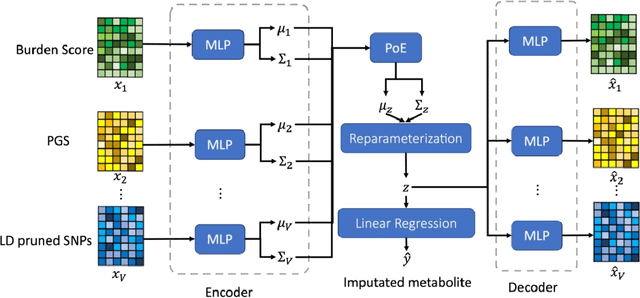
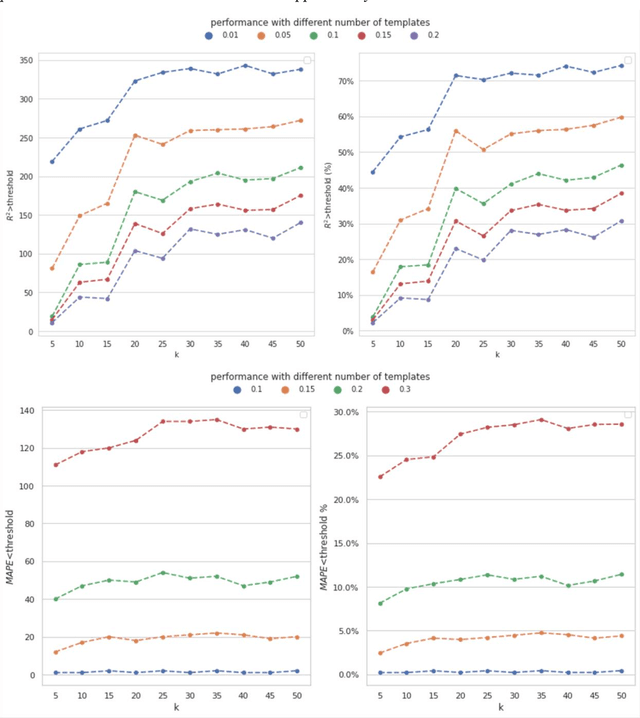
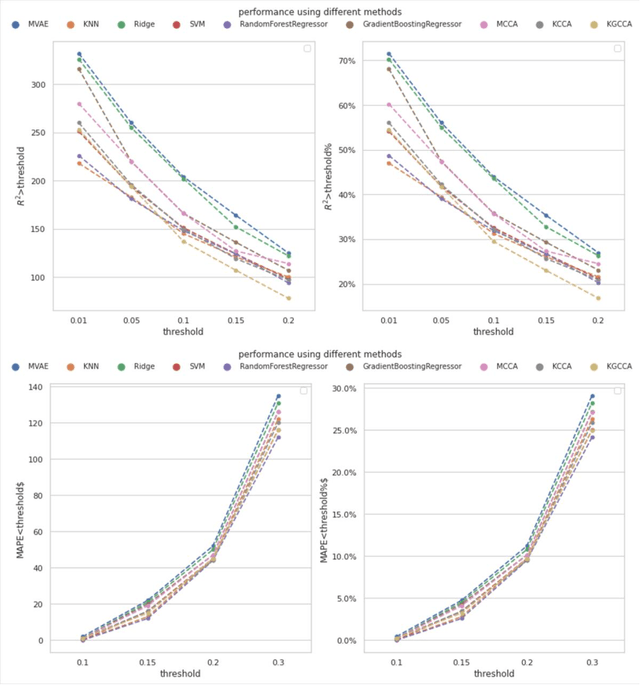
Background: Missing data is a common challenge in mass spectrometry-based metabolomics, which can lead to biased and incomplete analyses. The integration of whole-genome sequencing (WGS) data with metabolomics data has emerged as a promising approach to enhance the accuracy of data imputation in metabolomics studies. Method: In this study, we propose a novel method that leverages the information from WGS data and reference metabolites to impute unknown metabolites. Our approach utilizes a multi-view variational autoencoder to jointly model the burden score, polygenetic risk score (PGS), and linkage disequilibrium (LD) pruned single nucleotide polymorphisms (SNPs) for feature extraction and missing metabolomics data imputation. By learning the latent representations of both omics data, our method can effectively impute missing metabolomics values based on genomic information. Results: We evaluate the performance of our method on empirical metabolomics datasets with missing values and demonstrate its superiority compared to conventional imputation techniques. Using 35 template metabolites derived burden scores, PGS and LD-pruned SNPs, the proposed methods achieved r2-scores > 0.01 for 71.55% of metabolites. Conclusion: The integration of WGS data in metabolomics imputation not only improves data completeness but also enhances downstream analyses, paving the way for more comprehensive and accurate investigations of metabolic pathways and disease associations. Our findings offer valuable insights into the potential benefits of utilizing WGS data for metabolomics data imputation and underscore the importance of leveraging multi-modal data integration in precision medicine research.