 Add to Chrome
 Add to Firefox
 Add to Edge
Causal-Adversarial Probing of Clinical Covariates for Prostate MRI Grading
Jul 16, 2026
Deep learning models for prostate MRI-based cancer grading may encode clinical covariates that either reflect useful disease-related signal or non-generalising shortcut information, but their role is usually assumed. We propose a causal-reasoning framework for probing covariate dependence in MRI-based International Society of Urological Pathology (ISUP) Grade Group prediction. Rather than treating mpMRI as a direct cause of grade, we model MRI appearance and ISUP grade as observations of latent tumour pathology, and test whether candidate clinical variables act as nuisance correlates, disease-related proxies, or irrelevant covariates in the learned representation. We implement this using an adversarial framework that suppresses the decodability of individual clinical covariate at a time while preserving MRI-based grade prediction. The approach is developed and evaluated on 2,903 prostate MRI examinations, with external validation on 576 patients. We report a set of interesting and previously under-explored imaging-to-clinical-variable interactions in the context of deep learning generalisation. For examples, in binary ISUP Grade Group $\geq2$ classification, suppressing age, BMI, and alcohol use improved AUC by 1.23%, 0.84%, and 1.42%, respectively (all p < 0.05), suggesting reduced non-generalising covariate information; In contrast, suppressing PSA and prostate volume degraded AUC by 1.91% and 7.61% (all p < 0.001), indicating that these variables carried task-relevant signal. These findings show that adversarial covariate suppression can provide a practical representation-level analysis for distinguishing potentially harmful dependence from informative signal in prostate MRI grading models.

Learning to Distort: Weakly-Supervised Image Quality Transfer for Prostate DWI Correction
Jun 17, 2026Single-shot echo-planar prostate diffusion-weighted imaging (DWI) is frequently complicated by geometric distortions, which impact the ability to derive reliable diagnoses from such images. Developing automated correction methods is challenged by the absence of paired distorted and undistorted clinical scans. In this paper, we first propose a novel weakly-supervised image quality transfer (IQT) framework from undistorted to distorted images that utilizes image quality assessment (IQA) signals to supervise the transfer process. Unlike traditional methods that require expensive, voxel-wise paired data or resort to developing unpaired algorithms, our approach utilizes image-level quality labels (here, distorted vs. undistorted) to establish latent quality prototypes within a pre-trained feature space. Recognizing that simulating realistic distortions is more reliable than direct unpaired correction, we describe a weakly-supervised prototype flow matching algorithm to explicitly regularize generative trajectories towards distorted prototypes, producing realistic susceptibility artifacts that mimic clinical degradations. By synthesizing these realistic pairs, we enable a second IQT model to be trained in the forward direction for distortion correction. Experimental results demonstrate that our generated images successfully mimic the diagnostic interference of real-world artifacts, which leads to more capable distortion correction IQT models. In addition to qualitative comparisons, we also conduct exhaustive quantitative evaluations that compare our approach with existing unpaired approaches (e.g., CycleGAN, UNIT-DDPM, and OT-FM) - as either forward or reverse alternatives - by assessing clinical downstream task performance in PI-RADS and Gleason score classification, using both in-distribution and external data sets.
Bridging Single Distortion Artifacts and Mmultifactorial Clinical Quality: Few-shot Biparametric MRI Quality Assessment via Distortion-trained Prototypical Networks
Jun 17, 2026Clinical prostate multi-parametric MRI relies heavily on high-quality diffusion-weighted imaging (DWI), yet reading DWI is frequently compromised by geometric distortion, often caused by rectal air. Assessing quality via the PI-QUAL scoring system is an emerging clinical standard, but it is subjective, time-consuming and suffers from a class imbalance where low-quality cases are diverse and relatively scarce. Using the PRIME clinical trial as an example, there are $6\%$ images with PI-QUAL scores lower than 4, $87\%$ of DWI issues are due to distortion. Many of the other clinical quality issues are under-represented. To address this common dual-scarcity of annotated clinical data, we propose a few-shot biparametric prototypical network for automated image quality assessment (IQA). Our framework utilizes a dual-branch 3D ResNet to fuse T2-weighted and DWI features, providing anatomical context to distinguish true morphology from distortion. To handle real-world heterogeneity, we introduce feature-wise linear modulation (FiLM) and a gradient reversal layer (GRL) to align feature distributions conditioned on varying b-values while suppressing acquisition-related biases. We demonstrate that a model meta-trained solely on comparatively objective, readily obtainable distortion labels can effectively adapt to predicting complex, multi-factorial clinical quality scores such as PI-QUAL using only five representative samples. Experimental results on two datasets show that our method significantly outperforms few-shot learning baselines for this challenging IQA task, offering a practically feasible and data-efficient solution for standardizing prostate MRI quality control in clinical workflows.
CARD: Coarse-to-fine Autoregressive Modeling with Radix-based Decomposition for Transferable Free Energy Estimation
May 04, 2026Estimating free energy differences quantifies thermodynamic preferences in molecular interactions, which is central to chemistry and drug discovery. Despite fruitful progress, existing methods still face key limitations: classical computational approaches remain prohibitively expensive due to their reliance on extensive molecular dynamics simulations, while deep learning-based methods are constrained by either less-expressive generative models or input dimensions tied to a specific system, resulting in negligible generalization. To address these challenges, we propose CARD, a generative framework that employs a novel radix-based decomposition to bijectively convert 3D coordinates into mixed discrete-continuous sequences, enabling coarse-to-fine autoregressive modeling with enhanced expressiveness. Notably, the model corresponds to a distribution with zero free energy, serving as a proposal for absolute free energy computation of arbitrary systems without relying on alchemical pathways. Experiments across diverse tasks demonstrate that CARD matches the accuracy of classical computational methods on unseen systems with diverse topologies, while achieving an approximately 40-fold speedup in inference.
Maximizing T2-Only Prostate Cancer Localization from Expected Diffusion Weighted Imaging
Apr 01, 2026Multiparametric MRI is increasingly recommended as a first-line noninvasive approach to detect and localize prostate cancer, requiring at minimum diffusion-weighted (DWI) and T2-weighted (T2w) MR sequences. Early machine learning attempts using only T2w images have shown promising diagnostic performance in segmenting radiologist-annotated lesions. Such uni-modal T2-only approaches deliver substantial clinical benefits by reducing costs and expertise required to acquire other sequences. This work investigates an arguably more challenging application using only T2w at inference, but to localize individual cancers based on independent histopathology labels. We formulate DWI images as a latent modality (readily available during training) to classify cancer presence at local Barzell zones, given only T2w images as input. In the resulting expectation-maximization algorithm, a latent modality generator (implemented using a flow matching-based generative model) approximates the latent DWI image posterior distribution in the E-steps, while in M-steps a cancer localizer is simultaneously optimized with the generative model to maximize the expected likelihood of cancer presence. The proposed approach provides a novel theoretical framework for learning from a privileged DWI modality, yielding superior cancer localization performance compared to approaches that lack training DWI images or existing frameworks for privileged learning and incomplete modalities. The proposed T2-only methods perform competitively or better than baseline methods using multiple input sequences (e.g., improving the patient-level F1 score by 14.4\% and zone-level QWK by 5.3\% over the T2w+DWI baseline). We present quantitative evaluations using internal and external datasets from 4,133 prostate cancer patients with histopathology-verified labels.
Deep EM with Hierarchical Latent Label Modelling for Multi-Site Prostate Lesion Segmentation
Mar 15, 2026Label variability is a major challenge for prostate lesion segmentation. In multi-site datasets, annotations often reflect centre-specific contouring protocols, causing segmentation networks to overfit to local styles and generalise poorly to unseen sites in inference. We treat each observed annotation as a noisy observation of an underlying latent 'clean' lesion mask, and propose a hierarchical expectation-maximisation (HierEM) framework that alternates between: (1) inferring a voxel-wise posterior distribution over the latent mask, and (2) training a CNN using this posterior as a soft target and estimate site-specific sensitivity and specificity under a hierarchical prior. This hierarchical prior decomposes label-quality into a global mean with site- and case-level deviations, reducing site-specific bias by penalising the likelihood term contributed only by site deviations. Experiments on three cohorts demonstrate that the proposed hierarchical EM framework enhances cross-site generalisation compared to state-of-the-art methods. For pooled-dataset evaluation, the per-site mean DSC ranges from 29.50% to 39.69%; for leave-one-site-out generalisation, it ranges from 27.91% to 32.67%, yielding statistically significant improvements over comparison methods (p<0.039). The method also produces interpretable per-site latent label-quality estimates (sensitivity alpha ranges from 31.5% to 47.3% at specificity beta approximates 0.99), supporting post-hoc analyses of cross-site annotation variability. These results indicate that explicitly modelling site-dependent annotation can improve cross-site generalisation.
On the Degrees of Freedom of Gridded Control Points in Learning-Based Medical Image Registration
Mar 15, 2026Many registration problems are ill-posed in homogeneous or noisy regions, and dense voxel-wise decoders can be unnecessarily high-dimensional. A sparse control-point parameterisation provides a compact, smooth deformation representation while reducing memory and improving stability. This work investigates the required control points for learning-based registration network development. We present GridReg, a learning-based registration framework that replaces dense voxel-wise decoding with displacement predictions at a sparse grid of control points. This design substantially cuts the parameter count and memory while retaining registration accuracy. Multiscale 3D encoder feature maps are flattened into a 1D token sequence with positional encoding to retain spatial context. The model then predicts a sparse gridded deformation field using a cross-attention module. We further introduce grid-adaptive training, enabling an adaptive model to operate at multiple grid sizes at inference without retraining. This work quantitatively demonstrates the benefits of using sparse grids. Using three data sets for registering prostate gland, pelvic organs and neurological structures, the results suggested a significant improvement with the usage of grid-controled displacement field. Alternatively, the superior registration performance was obtained using the proposed approach, with a similar or less computational cost, compared with existing algorithms that predict DDFs or displacements sampled on scattered key points.
ProFound: A moderate-sized vision foundation model for multi-task prostate imaging
Mar 04, 2026Many diagnostic and therapeutic clinical tasks for prostate cancer increasingly rely on multi-parametric MRI. Automating these tasks is challenging because they necessitate expert interpretations, which are difficult to scale to capitalise on modern deep learning. Although modern automated systems achieve expert-level performance in isolated tasks, their general clinical utility remains limited by the requirement of large task-specific labelled datasets. In this paper, we present ProFound, a domain-specialised vision foundation model for volumetric prostate mpMRI. ProFound is pre-trained using several variants of self-supervised approaches on a diverse, multi-institutional collection of 5,000 patients, with a total of over 22,000 unique 3D MRI volumes (over 1,800,000 2D image slices). We conducted a systematic evaluation of ProFound across a broad spectrum of $11$ downstream clinical tasks on over 3,000 independent patients, including prostate cancer detection, Gleason grading, lesion localisation, gland volume estimation, zonal and surrounding structure segmentation. Experimental results demonstrate that finetuned ProFound consistently outperforms or remains competitive with state-of-the-art specialised models and existing medical vision foundation models trained/finetuned on the same data.
Flow Matching-enabled Test-Time Refinement for Unsupervised Cardiac MR Registration
Mar 03, 2026Diffusion-based unsupervised image registration has been explored for cardiac cine MR, but expensive multi-step inference limits practical use. We propose FlowReg, a flow-matching framework in displacement field space that achieves strong registration in as few as two steps and supports further refinement with more steps. FlowReg uses warmup-reflow training: a single-step network first acts as a teacher, then a student learns to refine from arbitrary intermediate states, removing the need for a pre-trained model as in existing methods. An Initial Guess strategy feeds back the model prediction as the next starting point, improving refinement from step two onward. On ACDC and MM2 across six tasks (including cross-dataset generalization), FlowReg outperforms the state of the art on five tasks (+0.6% mean Dice score on average), with the largest gain in the left ventricle (+1.09%), and reduces LVEF estimation error on all six tasks (-2.58 percentage points), using only 0.7% extra parameters and no segmentation labels. Code is available at https://github.com/mathpluscode/FlowReg.
Generative molecule evolution using 3D pharmacophore for efficient Structure-Based Drug Design
Jul 27, 2025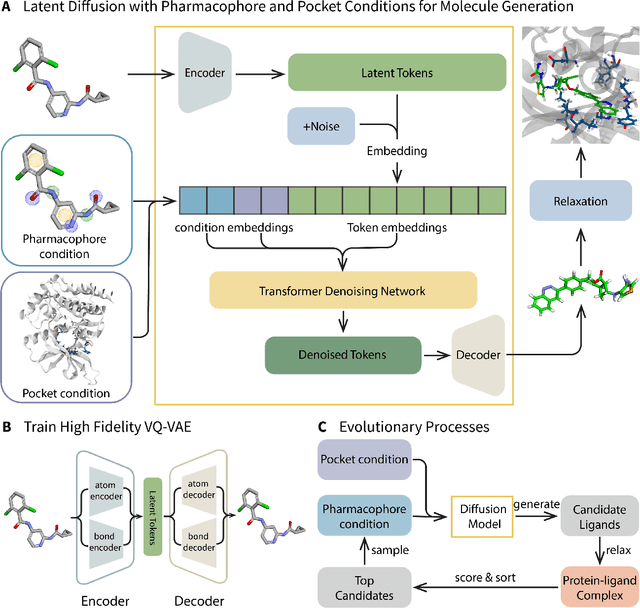
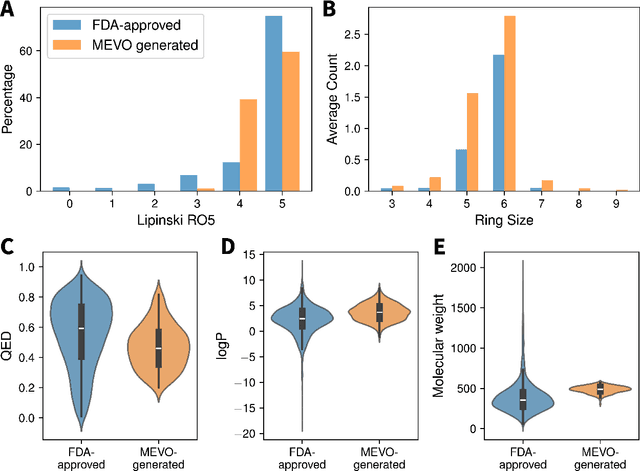
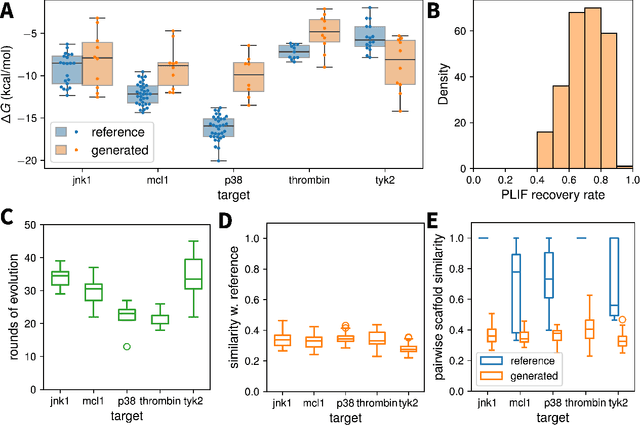
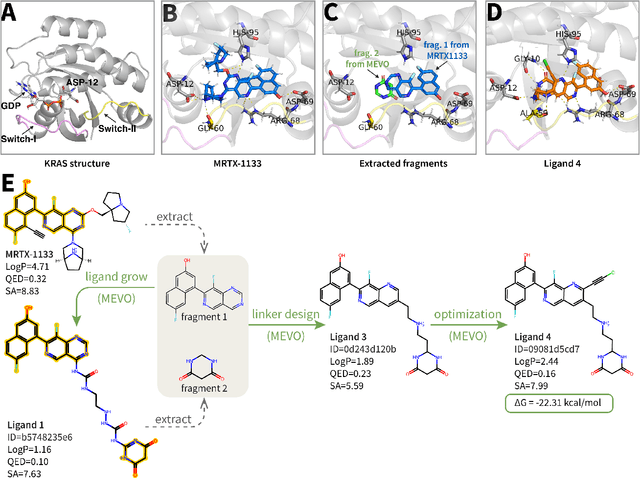
Recent advances in generative models, particularly diffusion and auto-regressive models, have revolutionized fields like computer vision and natural language processing. However, their application to structure-based drug design (SBDD) remains limited due to critical data constraints. To address the limitation of training data for models targeting SBDD tasks, we propose an evolutionary framework named MEVO, which bridges the gap between billion-scale small molecule dataset and the scarce protein-ligand complex dataset, and effectively increase the abundance of training data for generative SBDD models. MEVO is composed of three key components: a high-fidelity VQ-VAE for molecule representation in latent space, a diffusion model for pharmacophore-guided molecule generation, and a pocket-aware evolutionary strategy for molecule optimization with physics-based scoring function. This framework efficiently generate high-affinity binders for various protein targets, validated with predicted binding affinities using free energy perturbation (FEP) methods. In addition, we showcase the capability of MEVO in designing potent inhibitors to KRAS$^{\textrm{G12D}}$, a challenging target in cancer therapeutics, with similar affinity to the known highly active inhibitor evaluated by FEP calculations. With high versatility and generalizability, MEVO offers an effective and data-efficient model for various tasks in structure-based ligand design.