 Add to Chrome
 Add to Firefox
 Add to Edge
DACRI: Decision-Aware Causal Intervention Ranking for Critical Supply Chains
Aug 11, 2026
Detecting or attributing a supply-chain disruption is not the same as selecting the intervention that maximizes recoverable net value. We present CriticalSCM-Bench v1, a controlled synthetic benchmark with causal ground truth, paired factual/counterfactual rollouts, and an explicit net-value objective. Relative to a full-information train-selected static benchmark, LambdaMART improves median normalized net value by 5.7--16.2\%, with paired statistical support on the semiconductor and critical-material archetypes but not on digital infrastructure. On digital infrastructure, a domain-informed constant-buffer policy remains stronger, showing that greater model complexity is not uniformly justified. Across partial and delayed settings, LambdaMART retains 33--75\% of full-clamp value. Stress tests further show that intervention fidelity, timing, cost, and held-out disruptions can alter policy ordering. Critical materials show the weakest out-of-distribution retention. Separately, a guarded explanation study over 540 generations preserves every fixed intervention decision after deterministic validation and template fallback, although exact wording remains unstable. Within this controlled setting, the results identify regimes in which adaptive ranking adds value and those in which simpler structural policies remain preferable.

Causal-Adversarial Probing of Clinical Covariates for Prostate MRI Grading
Jul 16, 2026Deep learning models for prostate MRI-based cancer grading may encode clinical covariates that either reflect useful disease-related signal or non-generalising shortcut information, but their role is usually assumed. We propose a causal-reasoning framework for probing covariate dependence in MRI-based International Society of Urological Pathology (ISUP) Grade Group prediction. Rather than treating mpMRI as a direct cause of grade, we model MRI appearance and ISUP grade as observations of latent tumour pathology, and test whether candidate clinical variables act as nuisance correlates, disease-related proxies, or irrelevant covariates in the learned representation. We implement this using an adversarial framework that suppresses the decodability of individual clinical covariate at a time while preserving MRI-based grade prediction. The approach is developed and evaluated on 2,903 prostate MRI examinations, with external validation on 576 patients. We report a set of interesting and previously under-explored imaging-to-clinical-variable interactions in the context of deep learning generalisation. For examples, in binary ISUP Grade Group $\geq2$ classification, suppressing age, BMI, and alcohol use improved AUC by 1.23%, 0.84%, and 1.42%, respectively (all p < 0.05), suggesting reduced non-generalising covariate information; In contrast, suppressing PSA and prostate volume degraded AUC by 1.91% and 7.61% (all p < 0.001), indicating that these variables carried task-relevant signal. These findings show that adversarial covariate suppression can provide a practical representation-level analysis for distinguishing potentially harmful dependence from informative signal in prostate MRI grading models.
Accuracy-Preserving Stability Regularization for Large-Scale Retail Demand Forecasting
Jul 14, 2026Retail demand forecasts are reused across replenishment, capacity, labor, and transportation planning cycles. Point-error objectives do not constrain abrupt movement between adjacent forecasts, while post-hoc smoothing acts only after model fitting. We ask whether a training-time penalty on consecutive within-series movement can improve horizontal forecast-path stability without materially changing point accuracy. The penalty is evaluated in a temporal-structured pipeline combining recent-demand embeddings with calendar, price, hierarchy, item, and store features. On selected M5 demand series at 1000, 3000, and 4000-series scales, the stability-aware hybrid model improves Forecast Stability Score over XGBoost by 6.91%, 6.66%, and 7.68%, respectively, while RMSE changes remain within 0.72% across three random seeds. Post-hoc exponential smoothing attains lower raw movement but incurs a larger RMSE cost; training-time regularization preserves more point accuracy and performs favorably under normalized stability. These findings extend forecast evaluation from point-error minimization toward an accuracy-stability trade-off perspective for operational retail forecasting.
EvoVid: Temporal-Centric Self-Evolution for Video Large Language Models
May 21, 2026Recent Video Large Language Models (Video-LLMs) have demonstrated strong capabilities in video reasoning through reinforcement learning (RL). However, existing RL pipelines rely heavily on human-annotated tasks and solutions, making them costly to scale and fundamentally constrained by human expertise. Self-evolving frameworks have recently emerged as a promising alternative through autonomous Questioner-Solver self-play. Unfortunately, these approaches are primarily designed for static modalities such as text and images, fundamentally failing to capture the temporal dynamics that are central to video reasoning. In this work, we propose $\textbf{EvoVid}$, a temporal-centric self-evolving framework that enables Video-LLMs to improve directly from raw, unannotated videos. Specifically, we introduce two complementary temporal-centric rewards: a temporal-aware Questioner reward that encourages temporally dependent question generation through temporal perturbation sensitivity, and a temporal-grounded Solver reward that provides automatic temporal supervision via inherent video segment localization. Extensive experiments across four base models and six benchmarks demonstrate consistent improvements over both base models and existing self-evolving baselines, achieving competitive performance with supervised methods. These results highlight temporal-centric self-evolution as an effective and scalable paradigm for video understanding and reasoning.
Deep EM with Hierarchical Latent Label Modelling for Multi-Site Prostate Lesion Segmentation
Mar 15, 2026Label variability is a major challenge for prostate lesion segmentation. In multi-site datasets, annotations often reflect centre-specific contouring protocols, causing segmentation networks to overfit to local styles and generalise poorly to unseen sites in inference. We treat each observed annotation as a noisy observation of an underlying latent 'clean' lesion mask, and propose a hierarchical expectation-maximisation (HierEM) framework that alternates between: (1) inferring a voxel-wise posterior distribution over the latent mask, and (2) training a CNN using this posterior as a soft target and estimate site-specific sensitivity and specificity under a hierarchical prior. This hierarchical prior decomposes label-quality into a global mean with site- and case-level deviations, reducing site-specific bias by penalising the likelihood term contributed only by site deviations. Experiments on three cohorts demonstrate that the proposed hierarchical EM framework enhances cross-site generalisation compared to state-of-the-art methods. For pooled-dataset evaluation, the per-site mean DSC ranges from 29.50% to 39.69%; for leave-one-site-out generalisation, it ranges from 27.91% to 32.67%, yielding statistically significant improvements over comparison methods (p<0.039). The method also produces interpretable per-site latent label-quality estimates (sensitivity alpha ranges from 31.5% to 47.3% at specificity beta approximates 0.99), supporting post-hoc analyses of cross-site annotation variability. These results indicate that explicitly modelling site-dependent annotation can improve cross-site generalisation.
RSGround-R1: Rethinking Remote Sensing Visual Grounding through Spatial Reasoning
Jan 29, 2026Remote Sensing Visual Grounding (RSVG) aims to localize target objects in large-scale aerial imagery based on natural language descriptions. Owing to the vast spatial scale and high semantic ambiguity of remote sensing scenes, these descriptions often rely heavily on positional cues, posing unique challenges for Multimodal Large Language Models (MLLMs) in spatial reasoning. To leverage this unique feature, we propose a reasoning-guided, position-aware post-training framework, dubbed \textbf{RSGround-R1}, to progressively enhance spatial understanding. Specifically, we first introduce Chain-of-Thought Supervised Fine-Tuning (CoT-SFT) using synthetically generated RSVG reasoning data to establish explicit position awareness. Reinforcement Fine-Tuning (RFT) is then applied, augmented by our newly designed positional reward that provides continuous and distance-aware guidance toward accurate localization. Moreover, to mitigate incoherent localization behaviors across rollouts, we introduce a spatial consistency guided optimization scheme that dynamically adjusts policy updates based on their spatial coherence, ensuring stable and robust convergence. Extensive experiments on RSVG benchmarks demonstrate superior performance and generalization of our model.
Understanding the Transfer Limits of Vision Foundation Models
Jan 22, 2026Foundation models leverage large-scale pretraining to capture extensive knowledge, demonstrating generalization in a wide range of language tasks. By comparison, vision foundation models (VFMs) often exhibit uneven improvements across downstream tasks, despite substantial computational investment. We postulate that this limitation arises from a mismatch between pretraining objectives and the demands of downstream vision-and-imaging tasks. Pretraining strategies like masked image reconstruction or contrastive learning shape representations for tasks such as recovery of generic visual patterns or global semantic structures, which may not align with the task-specific requirements of downstream applications including segmentation, classification, or image synthesis. To investigate this in a concrete real-world clinical area, we assess two VFMs, a reconstruction-focused MAE-based model (ProFound) and a contrastive-learning-based model (ProViCNet), on five prostate multiparametric MR imaging tasks, examining how such task alignment influences transfer performance, i.e., from pretraining to fine-tuning. Our findings indicate that better alignment between pretraining and downstream tasks, measured by simple divergence metrics such as maximum-mean-discrepancy (MMD) between the same features before and after fine-tuning, correlates with greater performance improvements and faster convergence, emphasizing the importance of designing and analyzing pretraining objectives with downstream applicability in mind.
Tell2Reg: Establishing spatial correspondence between images by the same language prompts
Feb 05, 2025Spatial correspondence can be represented by pairs of segmented regions, such that the image registration networks aim to segment corresponding regions rather than predicting displacement fields or transformation parameters. In this work, we show that such a corresponding region pair can be predicted by the same language prompt on two different images using the pre-trained large multimodal models based on GroundingDINO and SAM. This enables a fully automated and training-free registration algorithm, potentially generalisable to a wide range of image registration tasks. In this paper, we present experimental results using one of the challenging tasks, registering inter-subject prostate MR images, which involves both highly variable intensity and morphology between patients. Tell2Reg is training-free, eliminating the need for costly and time-consuming data curation and labelling that was previously required for this registration task. This approach outperforms unsupervised learning-based registration methods tested, and has a performance comparable to weakly-supervised methods. Additional qualitative results are also presented to suggest that, for the first time, there is a potential correlation between language semantics and spatial correspondence, including the spatial invariance in language-prompted regions and the difference in language prompts between the obtained local and global correspondences. Code is available at https://github.com/yanwenCi/Tell2Reg.git.
ZoRI: Towards Discriminative Zero-Shot Remote Sensing Instance Segmentation
Dec 17, 2024
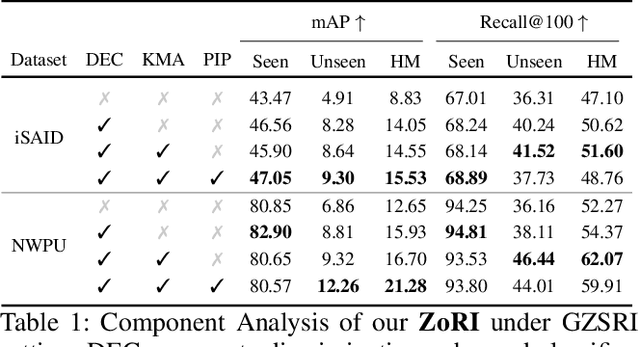
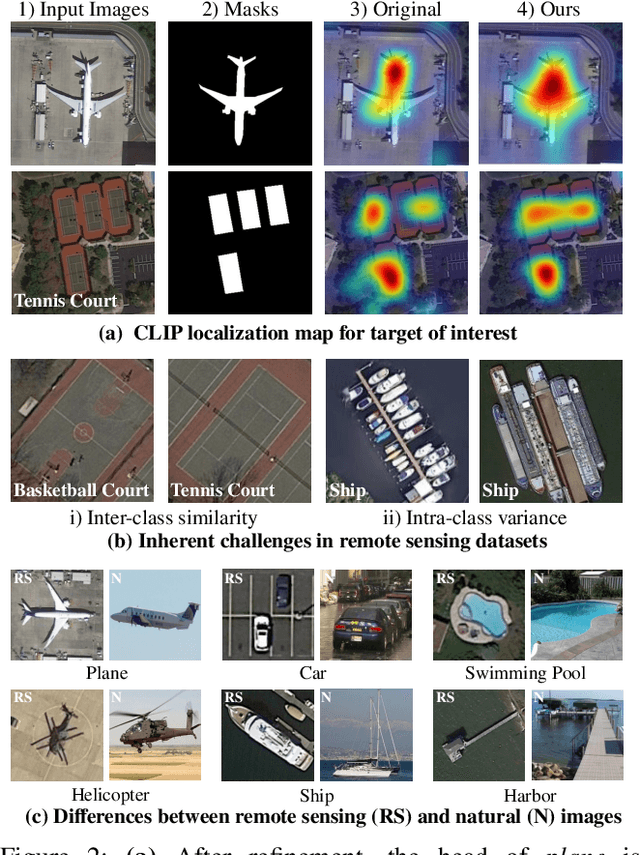
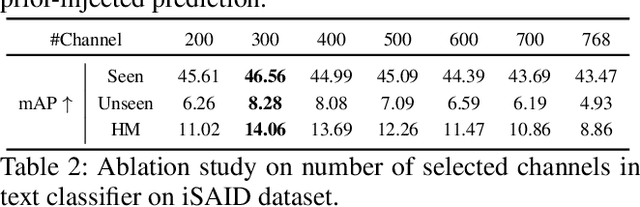
Instance segmentation algorithms in remote sensing are typically based on conventional methods, limiting their application to seen scenarios and closed-set predictions. In this work, we propose a novel task called zero-shot remote sensing instance segmentation, aimed at identifying aerial objects that are absent from training data. Challenges arise when classifying aerial categories with high inter-class similarity and intra-class variance. Besides, the domain gap between vision-language models' pretraining datasets and remote sensing datasets hinders the zero-shot capabilities of the pretrained model when it is directly applied to remote sensing images. To address these challenges, we propose a $\textbf{Z}$ero-Sh$\textbf{o}$t $\textbf{R}$emote Sensing $\textbf{I}$nstance Segmentation framework, dubbed $\textbf{ZoRI}$. Our approach features a discrimination-enhanced classifier that uses refined textual embeddings to increase the awareness of class disparities. Instead of direct fine-tuning, we propose a knowledge-maintained adaptation strategy that decouples semantic-related information to preserve the pretrained vision-language alignment while adjusting features to capture remote sensing domain-specific visual cues. Additionally, we introduce a prior-injected prediction with cache bank of aerial visual prototypes to supplement the semantic richness of text embeddings and seamlessly integrate aerial representations, adapting to the remote sensing domain. We establish new experimental protocols and benchmarks, and extensive experiments convincingly demonstrate that ZoRI achieves the state-of-art performance on the zero-shot remote sensing instance segmentation task. Our code is available at https://github.com/HuangShiqi128/ZoRI.
SAMReg: SAM-enabled Image Registration with ROI-based Correspondence
Oct 17, 2024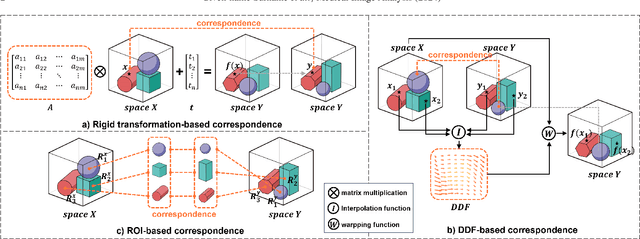
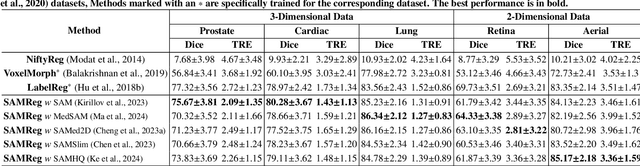
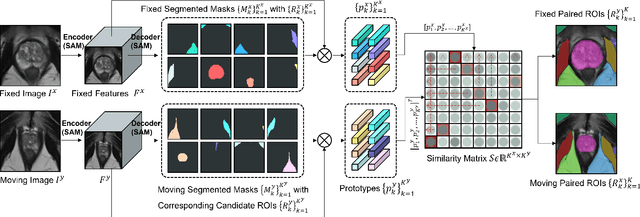
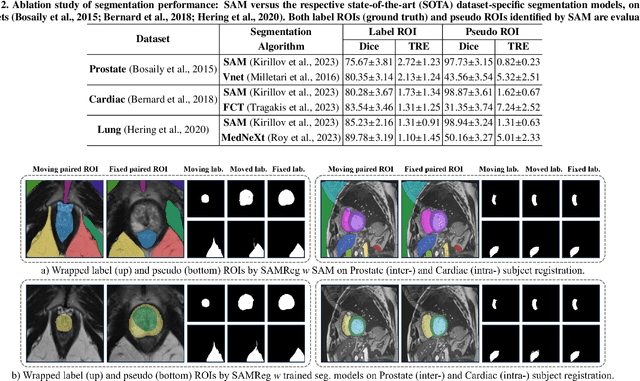
This paper describes a new spatial correspondence representation based on paired regions-of-interest (ROIs), for medical image registration. The distinct properties of the proposed ROI-based correspondence are discussed, in the context of potential benefits in clinical applications following image registration, compared with alternative correspondence-representing approaches, such as those based on sampled displacements and spatial transformation functions. These benefits include a clear connection between learning-based image registration and segmentation, which in turn motivates two cases of image registration approaches using (pre-)trained segmentation networks. Based on the segment anything model (SAM), a vision foundation model for segmentation, we develop a new registration algorithm SAMReg, which does not require any training (or training data), gradient-based fine-tuning or prompt engineering. The proposed SAMReg models are evaluated across five real-world applications, including intra-subject registration tasks with cardiac MR and lung CT, challenging inter-subject registration scenarios with prostate MR and retinal imaging, and an additional evaluation with a non-clinical example with aerial image registration. The proposed methods outperform both intensity-based iterative algorithms and DDF-predicting learning-based networks across tested metrics including Dice and target registration errors on anatomical structures, and further demonstrates competitive performance compared to weakly-supervised registration approaches that rely on fully-segmented training data. Open source code and examples are available at: https://github.com/sqhuang0103/SAMReg.git.