 Add to Chrome
 Add to Firefox
 Add to Edge
Maximizing T2-Only Prostate Cancer Localization from Expected Diffusion Weighted Imaging
Apr 01, 2026
Multiparametric MRI is increasingly recommended as a first-line noninvasive approach to detect and localize prostate cancer, requiring at minimum diffusion-weighted (DWI) and T2-weighted (T2w) MR sequences. Early machine learning attempts using only T2w images have shown promising diagnostic performance in segmenting radiologist-annotated lesions. Such uni-modal T2-only approaches deliver substantial clinical benefits by reducing costs and expertise required to acquire other sequences. This work investigates an arguably more challenging application using only T2w at inference, but to localize individual cancers based on independent histopathology labels. We formulate DWI images as a latent modality (readily available during training) to classify cancer presence at local Barzell zones, given only T2w images as input. In the resulting expectation-maximization algorithm, a latent modality generator (implemented using a flow matching-based generative model) approximates the latent DWI image posterior distribution in the E-steps, while in M-steps a cancer localizer is simultaneously optimized with the generative model to maximize the expected likelihood of cancer presence. The proposed approach provides a novel theoretical framework for learning from a privileged DWI modality, yielding superior cancer localization performance compared to approaches that lack training DWI images or existing frameworks for privileged learning and incomplete modalities. The proposed T2-only methods perform competitively or better than baseline methods using multiple input sequences (e.g., improving the patient-level F1 score by 14.4\% and zone-level QWK by 5.3\% over the T2w+DWI baseline). We present quantitative evaluations using internal and external datasets from 4,133 prostate cancer patients with histopathology-verified labels.

On the Degrees of Freedom of Gridded Control Points in Learning-Based Medical Image Registration
Mar 15, 2026Many registration problems are ill-posed in homogeneous or noisy regions, and dense voxel-wise decoders can be unnecessarily high-dimensional. A sparse control-point parameterisation provides a compact, smooth deformation representation while reducing memory and improving stability. This work investigates the required control points for learning-based registration network development. We present GridReg, a learning-based registration framework that replaces dense voxel-wise decoding with displacement predictions at a sparse grid of control points. This design substantially cuts the parameter count and memory while retaining registration accuracy. Multiscale 3D encoder feature maps are flattened into a 1D token sequence with positional encoding to retain spatial context. The model then predicts a sparse gridded deformation field using a cross-attention module. We further introduce grid-adaptive training, enabling an adaptive model to operate at multiple grid sizes at inference without retraining. This work quantitatively demonstrates the benefits of using sparse grids. Using three data sets for registering prostate gland, pelvic organs and neurological structures, the results suggested a significant improvement with the usage of grid-controled displacement field. Alternatively, the superior registration performance was obtained using the proposed approach, with a similar or less computational cost, compared with existing algorithms that predict DDFs or displacements sampled on scattered key points.
Deep EM with Hierarchical Latent Label Modelling for Multi-Site Prostate Lesion Segmentation
Mar 15, 2026Label variability is a major challenge for prostate lesion segmentation. In multi-site datasets, annotations often reflect centre-specific contouring protocols, causing segmentation networks to overfit to local styles and generalise poorly to unseen sites in inference. We treat each observed annotation as a noisy observation of an underlying latent 'clean' lesion mask, and propose a hierarchical expectation-maximisation (HierEM) framework that alternates between: (1) inferring a voxel-wise posterior distribution over the latent mask, and (2) training a CNN using this posterior as a soft target and estimate site-specific sensitivity and specificity under a hierarchical prior. This hierarchical prior decomposes label-quality into a global mean with site- and case-level deviations, reducing site-specific bias by penalising the likelihood term contributed only by site deviations. Experiments on three cohorts demonstrate that the proposed hierarchical EM framework enhances cross-site generalisation compared to state-of-the-art methods. For pooled-dataset evaluation, the per-site mean DSC ranges from 29.50% to 39.69%; for leave-one-site-out generalisation, it ranges from 27.91% to 32.67%, yielding statistically significant improvements over comparison methods (p<0.039). The method also produces interpretable per-site latent label-quality estimates (sensitivity alpha ranges from 31.5% to 47.3% at specificity beta approximates 0.99), supporting post-hoc analyses of cross-site annotation variability. These results indicate that explicitly modelling site-dependent annotation can improve cross-site generalisation.
ProFound: A moderate-sized vision foundation model for multi-task prostate imaging
Mar 04, 2026Many diagnostic and therapeutic clinical tasks for prostate cancer increasingly rely on multi-parametric MRI. Automating these tasks is challenging because they necessitate expert interpretations, which are difficult to scale to capitalise on modern deep learning. Although modern automated systems achieve expert-level performance in isolated tasks, their general clinical utility remains limited by the requirement of large task-specific labelled datasets. In this paper, we present ProFound, a domain-specialised vision foundation model for volumetric prostate mpMRI. ProFound is pre-trained using several variants of self-supervised approaches on a diverse, multi-institutional collection of 5,000 patients, with a total of over 22,000 unique 3D MRI volumes (over 1,800,000 2D image slices). We conducted a systematic evaluation of ProFound across a broad spectrum of $11$ downstream clinical tasks on over 3,000 independent patients, including prostate cancer detection, Gleason grading, lesion localisation, gland volume estimation, zonal and surrounding structure segmentation. Experimental results demonstrate that finetuned ProFound consistently outperforms or remains competitive with state-of-the-art specialised models and existing medical vision foundation models trained/finetuned on the same data.
Understanding the Transfer Limits of Vision Foundation Models
Jan 22, 2026Foundation models leverage large-scale pretraining to capture extensive knowledge, demonstrating generalization in a wide range of language tasks. By comparison, vision foundation models (VFMs) often exhibit uneven improvements across downstream tasks, despite substantial computational investment. We postulate that this limitation arises from a mismatch between pretraining objectives and the demands of downstream vision-and-imaging tasks. Pretraining strategies like masked image reconstruction or contrastive learning shape representations for tasks such as recovery of generic visual patterns or global semantic structures, which may not align with the task-specific requirements of downstream applications including segmentation, classification, or image synthesis. To investigate this in a concrete real-world clinical area, we assess two VFMs, a reconstruction-focused MAE-based model (ProFound) and a contrastive-learning-based model (ProViCNet), on five prostate multiparametric MR imaging tasks, examining how such task alignment influences transfer performance, i.e., from pretraining to fine-tuning. Our findings indicate that better alignment between pretraining and downstream tasks, measured by simple divergence metrics such as maximum-mean-discrepancy (MMD) between the same features before and after fine-tuning, correlates with greater performance improvements and faster convergence, emphasizing the importance of designing and analyzing pretraining objectives with downstream applicability in mind.
Tell2Reg: Establishing spatial correspondence between images by the same language prompts
Feb 05, 2025Spatial correspondence can be represented by pairs of segmented regions, such that the image registration networks aim to segment corresponding regions rather than predicting displacement fields or transformation parameters. In this work, we show that such a corresponding region pair can be predicted by the same language prompt on two different images using the pre-trained large multimodal models based on GroundingDINO and SAM. This enables a fully automated and training-free registration algorithm, potentially generalisable to a wide range of image registration tasks. In this paper, we present experimental results using one of the challenging tasks, registering inter-subject prostate MR images, which involves both highly variable intensity and morphology between patients. Tell2Reg is training-free, eliminating the need for costly and time-consuming data curation and labelling that was previously required for this registration task. This approach outperforms unsupervised learning-based registration methods tested, and has a performance comparable to weakly-supervised methods. Additional qualitative results are also presented to suggest that, for the first time, there is a potential correlation between language semantics and spatial correspondence, including the spatial invariance in language-prompted regions and the difference in language prompts between the obtained local and global correspondences. Code is available at https://github.com/yanwenCi/Tell2Reg.git.
Biomechanics-informed Non-rigid Medical Image Registration and its Inverse Material Property Estimation with Linear and Nonlinear Elasticity
Jul 03, 2024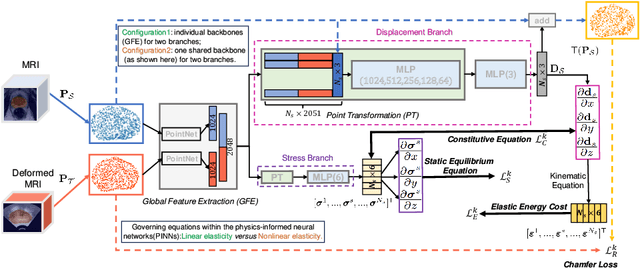
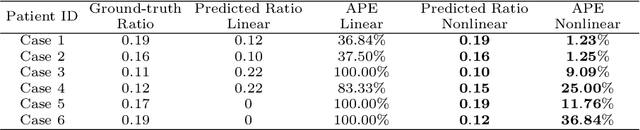
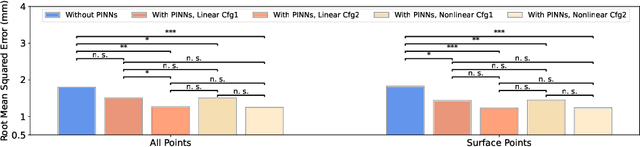
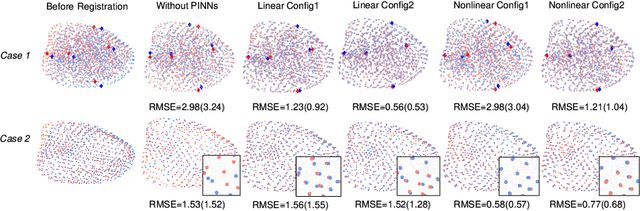
This paper investigates both biomechanical-constrained non-rigid medical image registrations and accurate identifications of material properties for soft tissues, using physics-informed neural networks (PINNs). The complex nonlinear elasticity theory is leveraged to formally establish the partial differential equations (PDEs) representing physics laws of biomechanical constraints that need to be satisfied, with which registration and identification tasks are treated as forward (i.e., data-driven solutions of PDEs) and inverse (i.e., parameter estimation) problems under PINNs respectively. Two net configurations (i.e., Cfg1 and Cfg2) have also been compared for both linear and nonlinear physics model. Two sets of experiments have been conducted, using pairs of undeformed and deformed MR images from clinical cases of prostate cancer biopsy. Our contributions are summarised as follows. 1) We developed a learning-based biomechanical-constrained non-rigid registration algorithm using PINNs, where linear elasticity is generalised to the nonlinear version. 2) We demonstrated extensively that nonlinear elasticity shows no statistical significance against linear models in computing point-wise displacement vectors but their respective benefits may depend on specific patients, with finite-element (FE) computed ground-truth. 3) We formulated and solved the inverse parameter estimation problem, under the joint optimisation scheme of registration and parameter identification using PINNs, whose solutions can be accurately found by locating saddle points.
Weakly supervised localisation of prostate cancer using reinforcement learning for bi-parametric MR images
Feb 21, 2024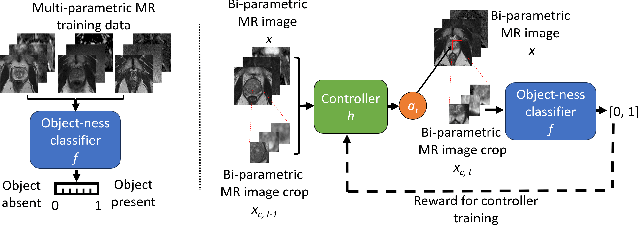
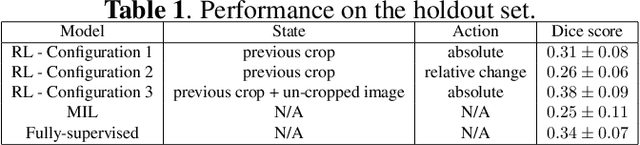
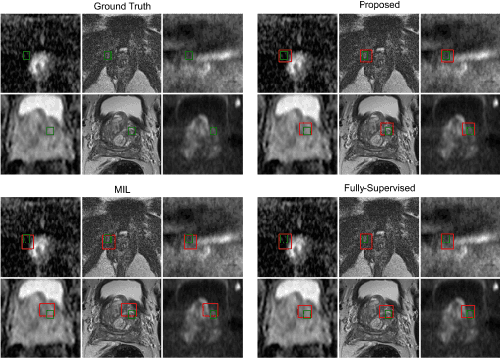
In this paper we propose a reinforcement learning based weakly supervised system for localisation. We train a controller function to localise regions of interest within an image by introducing a novel reward definition that utilises non-binarised classification probability, generated by a pre-trained binary classifier which classifies object presence in images or image crops. The object-presence classifier may then inform the controller of its localisation quality by quantifying the likelihood of the image containing an object. Such an approach allows us to minimize any potential labelling or human bias propagated via human labelling for fully supervised localisation. We evaluate our proposed approach for a task of cancerous lesion localisation on a large dataset of real clinical bi-parametric MR images of the prostate. Comparisons to the commonly used multiple-instance learning weakly supervised localisation and to a fully supervised baseline show that our proposed method outperforms the multi-instance learning and performs comparably to fully-supervised learning, using only image-level classification labels for training.
Semi-weakly-supervised neural network training for medical image registration
Feb 16, 2024
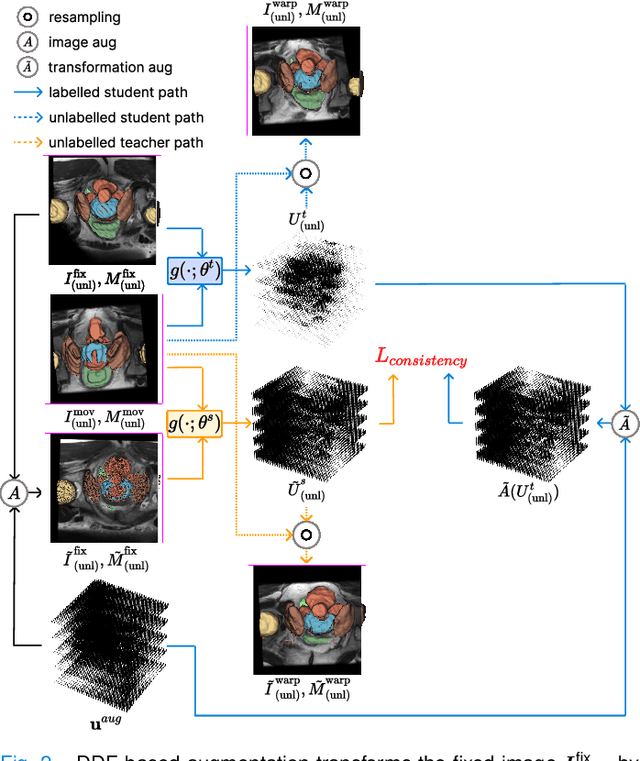


For training registration networks, weak supervision from segmented corresponding regions-of-interest (ROIs) have been proven effective for (a) supplementing unsupervised methods, and (b) being used independently in registration tasks in which unsupervised losses are unavailable or ineffective. This correspondence-informing supervision entails cost in annotation that requires significant specialised effort. This paper describes a semi-weakly-supervised registration pipeline that improves the model performance, when only a small corresponding-ROI-labelled dataset is available, by exploiting unlabelled image pairs. We examine two types of augmentation methods by perturbation on network weights and image resampling, such that consistency-based unsupervised losses can be applied on unlabelled data. The novel WarpDDF and RegCut approaches are proposed to allow commutative perturbation between an image pair and the predicted spatial transformation (i.e. respective input and output of registration networks), distinct from existing perturbation methods for classification or segmentation. Experiments using 589 male pelvic MR images, labelled with eight anatomical ROIs, show the improvement in registration performance and the ablated contributions from the individual strategies. Furthermore, this study attempts to construct one of the first computational atlases for pelvic structures, enabled by registering inter-subject MRs, and quantifies the significant differences due to the proposed semi-weak supervision with a discussion on the potential clinical use of example atlas-derived statistics.
Combiner and HyperCombiner Networks: Rules to Combine Multimodality MR Images for Prostate Cancer Localisation
Jul 17, 2023
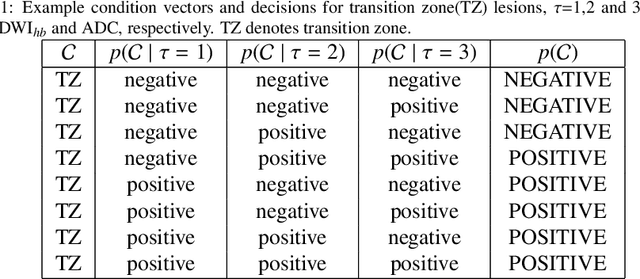
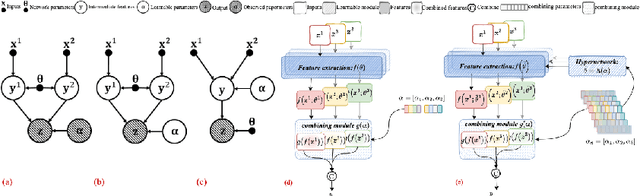

One of the distinct characteristics in radiologists' reading of multiparametric prostate MR scans, using reporting systems such as PI-RADS v2.1, is to score individual types of MR modalities, T2-weighted, diffusion-weighted, and dynamic contrast-enhanced, and then combine these image-modality-specific scores using standardised decision rules to predict the likelihood of clinically significant cancer. This work aims to demonstrate that it is feasible for low-dimensional parametric models to model such decision rules in the proposed Combiner networks, without compromising the accuracy of predicting radiologic labels: First, it is shown that either a linear mixture model or a nonlinear stacking model is sufficient to model PI-RADS decision rules for localising prostate cancer. Second, parameters of these (generalised) linear models are proposed as hyperparameters, to weigh multiple networks that independently represent individual image modalities in the Combiner network training, as opposed to end-to-end modality ensemble. A HyperCombiner network is developed to train a single image segmentation network that can be conditioned on these hyperparameters during inference, for much improved efficiency. Experimental results based on data from 850 patients, for the application of automating radiologist labelling multi-parametric MR, compare the proposed combiner networks with other commonly-adopted end-to-end networks. Using the added advantages of obtaining and interpreting the modality combining rules, in terms of the linear weights or odds-ratios on individual image modalities, three clinical applications are presented for prostate cancer segmentation, including modality availability assessment, importance quantification and rule discovery.