 Add to Chrome
 Add to Firefox
 Add to Edge
FCKT: Fine-Grained Cross-Task Knowledge Transfer with Semantic Contrastive Learning for Targeted Sentiment Analysis
May 28, 2025
In this paper, we address the task of targeted sentiment analysis (TSA), which involves two sub-tasks, i.e., identifying specific aspects from reviews and determining their corresponding sentiments. Aspect extraction forms the foundation for sentiment prediction, highlighting the critical dependency between these two tasks for effective cross-task knowledge transfer. While most existing studies adopt a multi-task learning paradigm to align task-specific features in the latent space, they predominantly rely on coarse-grained knowledge transfer. Such approaches lack fine-grained control over aspect-sentiment relationships, often assuming uniform sentiment polarity within related aspects. This oversimplification neglects contextual cues that differentiate sentiments, leading to negative transfer. To overcome these limitations, we propose FCKT, a fine-grained cross-task knowledge transfer framework tailored for TSA. By explicitly incorporating aspect-level information into sentiment prediction, FCKT achieves fine-grained knowledge transfer, effectively mitigating negative transfer and enhancing task performance. Experiments on three datasets, including comparisons with various baselines and large language models (LLMs), demonstrate the effectiveness of FCKT. The source code is available on https://github.com/cwei01/FCKT.

BrainStratify: Coarse-to-Fine Disentanglement of Intracranial Neural Dynamics
May 26, 2025Decoding speech directly from neural activity is a central goal in brain-computer interface (BCI) research. In recent years, exciting advances have been made through the growing use of intracranial field potential recordings, such as stereo-ElectroEncephaloGraphy (sEEG) and ElectroCorticoGraphy (ECoG). These neural signals capture rich population-level activity but present key challenges: (i) task-relevant neural signals are sparsely distributed across sEEG electrodes, and (ii) they are often entangled with task-irrelevant neural signals in both sEEG and ECoG. To address these challenges, we introduce a unified Coarse-to-Fine neural disentanglement framework, BrainStratify, which includes (i) identifying functional groups through spatial-context-guided temporal-spatial modeling, and (ii) disentangling distinct neural dynamics within the target functional group using Decoupled Product Quantization (DPQ). We evaluate BrainStratify on two open-source sEEG datasets and one (epidural) ECoG dataset, spanning tasks like vocal production and speech perception. Extensive experiments show that BrainStratify, as a unified framework for decoding speech from intracranial neural signals, significantly outperforms previous decoding methods. Overall, by combining data-driven stratification with neuroscience-inspired modularity, BrainStratify offers a robust and interpretable solution for speech decoding from intracranial recordings.
Retrieval Augmented Decision-Making: A Requirements-Driven, Multi-Criteria Framework for Structured Decision Support
May 24, 2025Various industries have produced a large number of documents such as industrial plans, technical guidelines, and regulations that are structurally complex and content-wise fragmented. This poses significant challenges for experts and decision-makers in terms of retrieval and understanding. Although existing LLM-based Retrieval-Augmented Generation methods can provide context-related suggestions, they lack quantitative weighting and traceable reasoning paths, making it difficult to offer multi-level and transparent decision support. To address this issue, this paper proposes the RAD method, which integrates Multi-Criteria Decision Making with the semantic understanding capabilities of LLMs. The method automatically extracts key criteria from industry documents, builds a weighted hierarchical decision model, and generates structured reports under model guidance. The RAD framework introduces explicit weight assignment and reasoning chains in decision generation to ensure accuracy, completeness, and traceability. Experiments show that in various decision-making tasks, the decision reports generated by RAD significantly outperform existing methods in terms of detail, rationality, and structure, demonstrating its application value and potential in complex decision support scenarios.
An Identifiable Cost-Aware Causal Decision-Making Framework Using Counterfactual Reasoning
May 13, 2025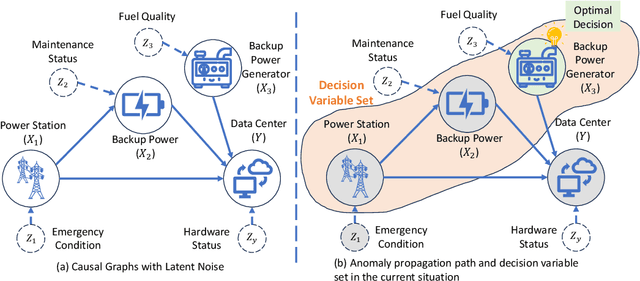
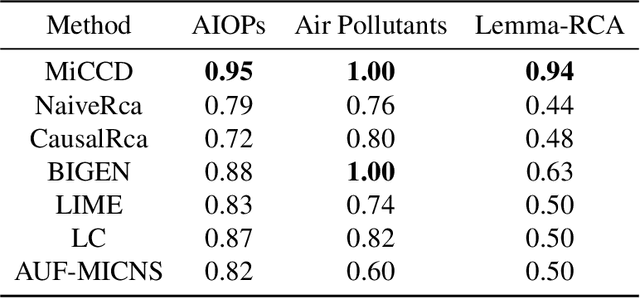
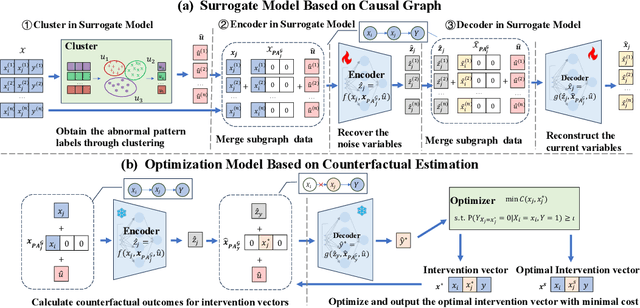
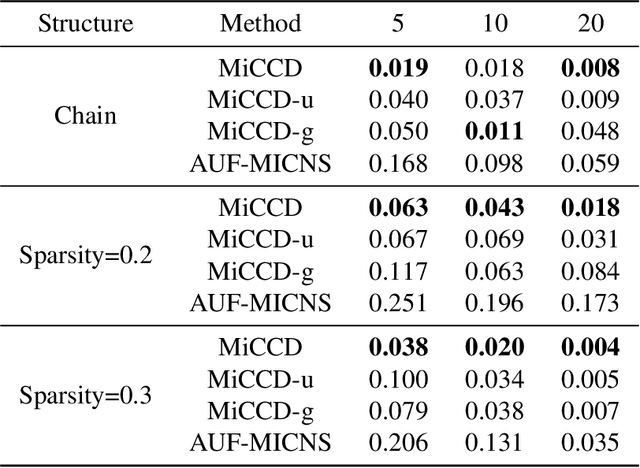
Decision making under abnormal conditions is a critical process that involves evaluating the current state and determining the optimal action to restore the system to a normal state at an acceptable cost. However, in such scenarios, existing decision-making frameworks highly rely on reinforcement learning or root cause analysis, resulting in them frequently neglecting the cost of the actions or failing to incorporate causal mechanisms adequately. By relaxing the existing causal decision framework to solve the necessary cause, we propose a minimum-cost causal decision (MiCCD) framework via counterfactual reasoning to address the above challenges. Emphasis is placed on making counterfactual reasoning processes identifiable in the presence of a large amount of mixed anomaly data, as well as finding the optimal intervention state in a continuous decision space. Specifically, it formulates a surrogate model based on causal graphs, using abnormal pattern clustering labels as supervisory signals. This enables the approximation of the structural causal model among the variables and lays a foundation for identifiable counterfactual reasoning. With the causal structure approximated, we then established an optimization model based on counterfactual estimation. The Sequential Least Squares Programming (SLSQP) algorithm is further employed to optimize intervention strategies while taking costs into account. Experimental evaluations on both synthetic and real-world datasets reveal that MiCCD outperforms conventional methods across multiple metrics, including F1-score, cost efficiency, and ranking quality(nDCG@k values), thus validating its efficacy and broad applicability.
Improved Brain Tumor Detection in MRI: Fuzzy Sigmoid Convolution in Deep Learning
May 08, 2025Early detection and accurate diagnosis are essential to improving patient outcomes. The use of convolutional neural networks (CNNs) for tumor detection has shown promise, but existing models often suffer from overparameterization, which limits their performance gains. In this study, fuzzy sigmoid convolution (FSC) is introduced along with two additional modules: top-of-the-funnel and middle-of-the-funnel. The proposed methodology significantly reduces the number of trainable parameters without compromising classification accuracy. A novel convolutional operator is central to this approach, effectively dilating the receptive field while preserving input data integrity. This enables efficient feature map reduction and enhances the model's tumor detection capability. In the FSC-based model, fuzzy sigmoid activation functions are incorporated within convolutional layers to improve feature extraction and classification. The inclusion of fuzzy logic into the architecture improves its adaptability and robustness. Extensive experiments on three benchmark datasets demonstrate the superior performance and efficiency of the proposed model. The FSC-based architecture achieved classification accuracies of 99.17%, 99.75%, and 99.89% on three different datasets. The model employs 100 times fewer parameters than large-scale transfer learning architectures, highlighting its computational efficiency and suitability for detecting brain tumors early. This research offers lightweight, high-performance deep-learning models for medical imaging applications.
Dequantified Diffusion Schrödinger Bridge for Density Ratio Estimation
May 08, 2025Density ratio estimation is fundamental to tasks involving $f$-divergences, yet existing methods often fail under significantly different distributions or inadequately overlap supports, suffering from the \textit{density-chasm} and the \textit{support-chasm} problems. Additionally, prior approaches yield divergent time scores near boundaries, leading to instability. We propose $\text{D}^3\text{RE}$, a unified framework for robust and efficient density ratio estimation. It introduces the Dequantified Diffusion-Bridge Interpolant (DDBI), which expands support coverage and stabilizes time scores via diffusion bridges and Gaussian dequantization. Building on DDBI, the Dequantified Schr\"odinger-Bridge Interpolant (DSBI) incorporates optimal transport to solve the Schr\"odinger bridge problem, enhancing accuracy and efficiency. Our method offers uniform approximation and bounded time scores in theory, and outperforms baselines empirically in mutual information and density estimation tasks.
FedSDAF: Leveraging Source Domain Awareness for Enhanced Federated Domain Generalization
May 05, 2025Traditional domain generalization approaches predominantly focus on leveraging target domain-aware features while overlooking the critical role of source domain-specific characteristics, particularly in federated settings with inherent data isolation. To address this gap, we propose the Federated Source Domain Awareness Framework (FedSDAF), the first method to systematically exploit source domain-aware features for enhanced federated domain generalization (FedDG). The FedSDAF framework consists of two synergistic components: the Domain-Invariant Adapter, which preserves critical domain-invariant features, and the Domain-Aware Adapter, which extracts and integrates source domain-specific knowledge using a Multihead Self-Attention mechanism (MHSA). Furthermore, we introduce a bidirectional knowledge distillation mechanism that fosters knowledge sharing among clients while safeguarding privacy. Our approach represents the first systematic exploitation of source domain-aware features, resulting in significant advancements in model generalization capability.Extensive experiments on four standard benchmarks (OfficeHome, PACS, VLCS, and DomainNet) show that our method consistently surpasses state-of-the-art federated domain generalization approaches, with accuracy gains of 5.2-13.8%. The source code is available at https://github.com/pizzareapers/FedSDAF.
A Simple DropConnect Approach to Transfer-based Targeted Attack
Apr 24, 2025We study the problem of transfer-based black-box attack, where adversarial samples generated using a single surrogate model are directly applied to target models. Compared with untargeted attacks, existing methods still have lower Attack Success Rates (ASRs) in the targeted setting, i.e., the obtained adversarial examples often overfit the surrogate model but fail to mislead other models. In this paper, we hypothesize that the pixels or features in these adversarial examples collaborate in a highly dependent manner to maximize the success of an adversarial attack on the surrogate model, which we refer to as perturbation co-adaptation. Then, we propose to Mitigate perturbation Co-adaptation by DropConnect (MCD) to enhance transferability, by creating diverse variants of surrogate model at each optimization iteration. We conduct extensive experiments across various CNN- and Transformer-based models to demonstrate the effectiveness of MCD. In the challenging scenario of transferring from a CNN-based model to Transformer-based models, MCD achieves 13% higher average ASRs compared with state-of-the-art baselines. MCD boosts the performance of self-ensemble methods by bringing in more diversification across the variants while reserving sufficient semantic information for each variant. In addition, MCD attains the highest performance gain when scaling the compute of crafting adversarial examples.
Relation-R1: Cognitive Chain-of-Thought Guided Reinforcement Learning for Unified Relational Comprehension
Apr 20, 2025Recent advances in multi-modal large language models (MLLMs) have significantly improved object-level grounding and region captioning, but remain limited in visual relation understanding (\eg, scene graph generation), particularly in modeling \textit{N}-ary relationships that identify multiple semantic roles among an action event. Such a lack of \textit{semantic dependencies} modeling among multi-entities leads to unreliable outputs, intensifying MLLMs' hallucinations and over-reliance on language priors. To this end, we propose Relation-R1, the first unified relational comprehension framework that explicitly integrates cognitive chain-of-thought (CoT)-guided Supervised Fine-Tuning (SFT) and Group Relative Policy Optimization (GRPO) within a reinforcement learning (RL) paradigm. Specifically, we first establish foundational reasoning capabilities via SFT, enforcing structured outputs with thinking processes. Then, GRPO is utilized to refine these outputs via multi-reward optimization, prioritizing visual-semantic grounding over language-induced biases, thereby improving generalization capability. Extensive experiments on widely-used PSG and SWiG datasets demonstrate that Relation-R1 achieves state-of-the-art performance in both binary and \textit{N}-ary relation understanding.
Exploring Multimodal Prompt for Visualization Authoring with Large Language Models
Apr 18, 2025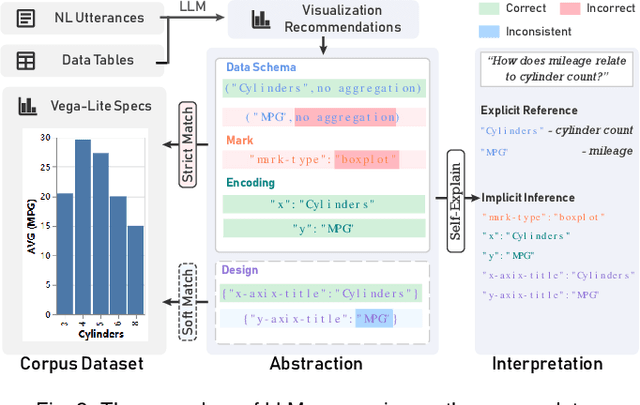
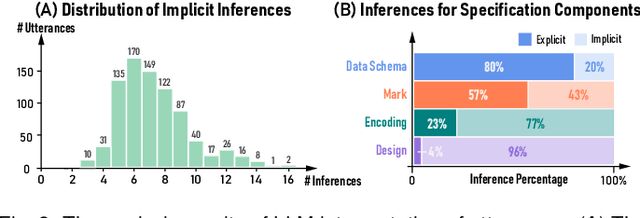
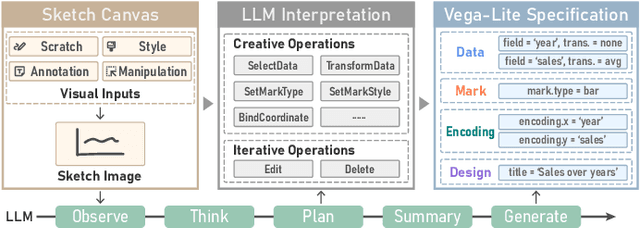
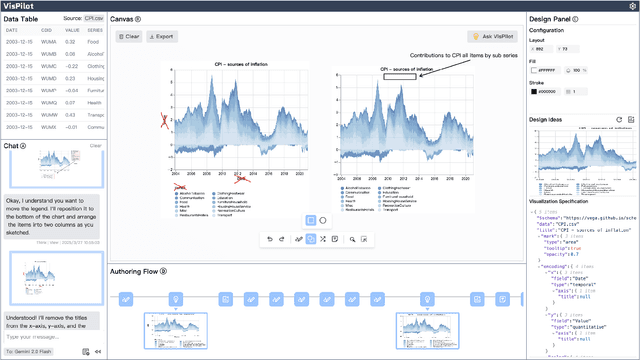
Recent advances in large language models (LLMs) have shown great potential in automating the process of visualization authoring through simple natural language utterances. However, instructing LLMs using natural language is limited in precision and expressiveness for conveying visualization intent, leading to misinterpretation and time-consuming iterations. To address these limitations, we conduct an empirical study to understand how LLMs interpret ambiguous or incomplete text prompts in the context of visualization authoring, and the conditions making LLMs misinterpret user intent. Informed by the findings, we introduce visual prompts as a complementary input modality to text prompts, which help clarify user intent and improve LLMs' interpretation abilities. To explore the potential of multimodal prompting in visualization authoring, we design VisPilot, which enables users to easily create visualizations using multimodal prompts, including text, sketches, and direct manipulations on existing visualizations. Through two case studies and a controlled user study, we demonstrate that VisPilot provides a more intuitive way to create visualizations without affecting the overall task efficiency compared to text-only prompting approaches. Furthermore, we analyze the impact of text and visual prompts in different visualization tasks. Our findings highlight the importance of multimodal prompting in improving the usability of LLMs for visualization authoring. We discuss design implications for future visualization systems and provide insights into how multimodal prompts can enhance human-AI collaboration in creative visualization tasks. All materials are available at https://OSF.IO/2QRAK.