 Add to Chrome
 Add to Firefox
 Add to Edge
EvoCause: LLM-Guided Evolution of Causal Graphs for Root Cause Analysis
Jul 29, 2026
Modern telecommunication, cloud, and microservice systems emit correlated alarm cascades when components fail. Root cause analysis (RCA) aims to identify the small set of alarms that initiate each cascade. A common approach learns a causal graph from observational logs and predicts all zero-in-degree alarms in each incident-induced subgraph. However, the learned graph remains fixed and cannot benefit from expert diagnoses of historical incidents. We close this loop with EvoCause. Expert labels constrain which alarms should be source nodes but do not specify the edge edits needed to satisfy those constraints. EvoCause uses a large language model (LLM) to propose semantically plausible graph edits, while deterministic code validates node identities and acyclicity and retains the best graph on a labeled alignment set. At test time, the refined graph alone produces transparent predictions without an LLM call. We also release TeleRCA, an expert-annotated benchmark from a production telecommunication network containing $485{,}681$ alarm events spanning $194$ alarm types over $5{,}621$ resources. On synthetic data, EvoCause initialized with the PC causal discovery algorithm outperforms the unrefined PC baseline, raising Node F1, Case EM, and Graph F1 by $11.59$, $9.40$, and $4.59$ percentage points, respectively, while reducing nSHD by $0.2379$. On TeleRCA, replacing human-readable alarm titles with anonymous identifiers lowers Node F1 and Case EM by $6.12$ and $8.04$ percentage points, respectively, indicating that alarm-name information contributes to graph refinement.

XMSE-Aware Adaptive Empirical Bayes Estimation
Jun 25, 2026Empirical Bayes (EB) estimators can match the first-order asymptotic risk of maximum likelihood (ML) while behaving very differently at second order: recent excess mean squared error (XMSE) analysis shows that kernel-based EB estimation may be worse than ML when the kernel is poorly aligned with the true parameter. This paper turns that diagnostic into a design principle. We propose an XMSE-aware mixed estimator that interpolates between ML and EB shrinkage. Its fixed-weight XMSE is a scalar quadratic, yielding a closed-form oracle mixing weight that is no worse than both ML and the base EB estimator at the XMSE scale. A plug-in implementation based on finite-sample XMSE approximations is proved consistent, with a second-order oracle regret rate for an interior oracle weight. We further establish a transfer of the regret bound to the fixed-weight risk curve evaluated at the selected weight, a thresholded boundary rule, and extensions to compact kernel families and to finite and growing kernel dictionaries with high-probability oracle bounds. Finite impulse response simulations with SURE-tuned, hard-selection, and trace-corrected baselines, together with the public Silverbox and Cascaded Tanks benchmarks, show that the proposed estimator retains most of the benefit of regularization when it is helpful and retreats toward ML under kernel misspecification, with an identified finite-de analyzed on the benchmarks.
Can Aggregate Invariants Accelerate Continuous Subgraph Matching? Limits, Laws, and a Dynamic Spectral Index
Jun 23, 2026Spectral filtering recently delivered substantial pruning for \emph{static} subgraph matching: Laplacian interlacing rejects candidates whose neighborhoods cannot host the query. We study whether such aggregate structural tests can accelerate \emph{continuous} subgraph matching (CSM) over dynamic graphs, and answer in three parts. First, lazily maintained spectral bounds are infeasible exactly where spectral pruning has value: we characterize the tightest safe rule over a formalized perturbation relaxation and show that even it loses essentially all pruning power within four touching updates. Second, exact maintenance is affordable when selective: pruning utility and recomputation cost are anti-correlated across vertices -- hubs provably never prune -- so recomputing small-neighborhood spectra on touch sustains exact local spectra at microseconds per update, complete by construction. Third, integrated into a decoupled CSM benchmark against an identical-minus-spectra control, the tests remove up to $51\%$ of candidates or safely skip up to $47\%$ of update enumerations, yet enumeration intermediates remain unchanged -- beyond the gates' skipped first-level bindings, typically zero -- across two engines, four real graphs, two stream types, and $77$ solved queries; a constructed radius-stratified workload confirms the instrument detects the exception when one exists ($-99.9\%$ intermediates, $748\times$ faster). Aggregate tests accelerate what scales with candidate sets -- construction, list scans -- never adjacency-guided exploration. We distill an intermediate-invariance methodology for evaluating CSM filters and release a reusable dynamic local-spectra index.
An Identifiable Cost-Aware Causal Decision-Making Framework Using Counterfactual Reasoning
May 13, 2025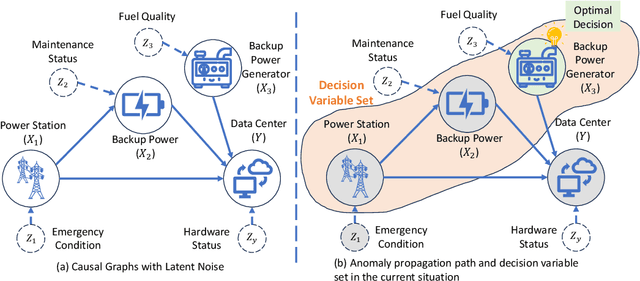
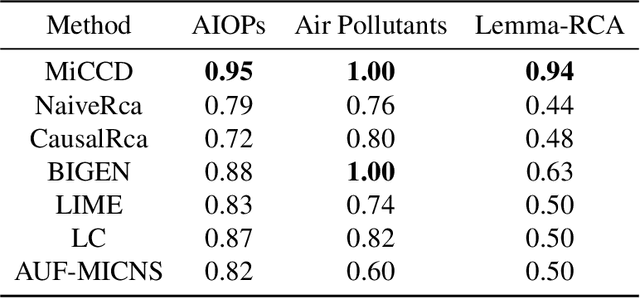
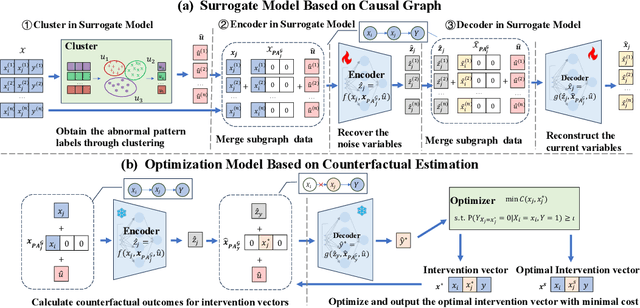
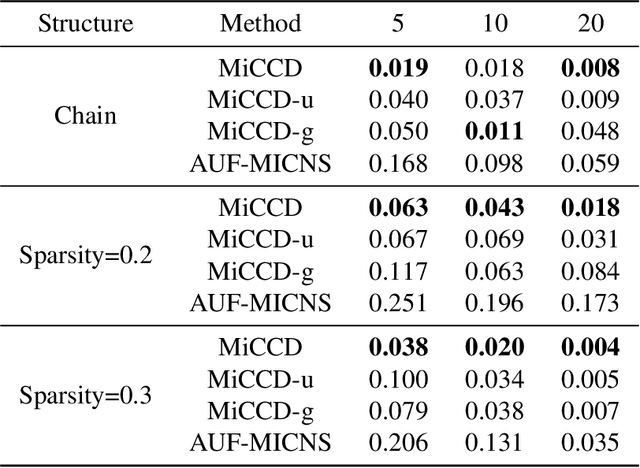
Decision making under abnormal conditions is a critical process that involves evaluating the current state and determining the optimal action to restore the system to a normal state at an acceptable cost. However, in such scenarios, existing decision-making frameworks highly rely on reinforcement learning or root cause analysis, resulting in them frequently neglecting the cost of the actions or failing to incorporate causal mechanisms adequately. By relaxing the existing causal decision framework to solve the necessary cause, we propose a minimum-cost causal decision (MiCCD) framework via counterfactual reasoning to address the above challenges. Emphasis is placed on making counterfactual reasoning processes identifiable in the presence of a large amount of mixed anomaly data, as well as finding the optimal intervention state in a continuous decision space. Specifically, it formulates a surrogate model based on causal graphs, using abnormal pattern clustering labels as supervisory signals. This enables the approximation of the structural causal model among the variables and lays a foundation for identifiable counterfactual reasoning. With the causal structure approximated, we then established an optimization model based on counterfactual estimation. The Sequential Least Squares Programming (SLSQP) algorithm is further employed to optimize intervention strategies while taking costs into account. Experimental evaluations on both synthetic and real-world datasets reveal that MiCCD outperforms conventional methods across multiple metrics, including F1-score, cost efficiency, and ranking quality(nDCG@k values), thus validating its efficacy and broad applicability.