 Add to Chrome
 Add to Firefox
 Add to Edge
Towards Understanding On-Policy Distillation through the Lens of Test-Time Scaling
Aug 12, 2026
On-policy distillation (OPD) has emerged as a promising post-training technique for enhancing LLM reasoning. It is commonly believed to enable the student model to distill knowledge from a stronger teacher model, thereby expanding capabilities beyond the pre-OPD base model. In this study, we examine this view through the lens of test-time scaling by varying the sampling budget K and evaluating performance with pass@K and avg@K. Specifically, across several OPD variants, we observe that OPD-trained models maintain superior avg@K performance across sampling budgets, while the advantage in pass@K gradually shifts to the pre-OPD base models as K increases. These results suggest that OPD primarily improves sampling efficiency rather than consistently expanding the student's reasoning capability boundary. The pass@K dynamics throughout OPD training further reveal a progressive shift toward stronger small-K performance at the expense of the large-K capability boundary. Furthermore, a problem-level solvability analysis using pass@1024 as the criterion reveals an asymmetry: OPD causes more previously solvable problems to become unsolvable than previously unsolvable problems to become solvable. Together, these findings suggest that, from the perspective of capability expansion, OPD behaves more like an "illusory distillation": its apparent gains arise primarily from improved sampling efficiency rather than from acquiring genuinely new reasoning capabilities from the teacher.

FinReportBench: Measuring and Improving Institution-Grade Financial Report Generation
Aug 05, 2026Large language models can produce fluent financial analysis, but fluency alone does not establish whether a report is suitable for institutional delivery. We introduce FinReportBench, an expert-grounded benchmark for measuring and improving institution-grade financial report generation. Expert review reveals recurring gaps in report identity, institutional components, source discipline, and visual delivery. We derive a 35-item rubric through expert partial orders, multimodal evidence, and audits of decision boundaries, covering deliverability, report identity, and institutional completeness. Starting from 10,000 balanced Chinese and English financial-research source records, we curate 244 bilingual tasks across three research objects and two input tiers. Each task separates the public query, reconstructed research trajectory, and hidden source packet. Three independent judge families reproduce the expert partial order at near-ceiling rates, showing that bounded, observable criteria support reliable evaluation. Across nine model families, basic deliverability is nearly saturated, while report identity and institutional completeness remain the primary bottlenecks. The largest cross-model gaps concern generation-trace control, information density, and data discipline rather than basic report framing. We then use benchmark-guided skill distillation to turn recurrent failures into reusable generation and self-review constraints. Across five model families, the evolved skill improves mean G1 by 33.85 points and mean G2 by 13.83 points over paired no-skill runs while preserving G0 for every pair. Code and benchmark artifacts are available at https://github.com/MisterBrookT/finreportbench.
Ling and Ring 2.6 Technical Report: Efficient and Instant Agentic Intelligence at Trillion-Parameter Scale
Jun 13, 2026Efficient and scalable agentic intelligence requires models that can deliver both low-latency responses and strong reasoning capabilities while remaining practical to train, serve, and deploy. In this report, we present Ling-2.6 and Ring-2.6, a family of models designed to address this challenge at scale. Ling-2.6 is optimized for instant response generation and high capability per output token, whereas Ring-2.6 is tailored for deeper reasoning and more advanced agentic workflows. Instead of training from scratch, we upgrade the Ling-2.0 base model through architectural migration pre-training and large-scale post-training. This upgrade is guided by a unified co-design of model architecture, optimization objectives, serving systems, and agent training environments, enabling improvements in both model capability and deployment efficiency. At the architectural level, we introduce a hybrid linear attention design that integrates Lightning Attention with MLA, improving the efficiency of long-context training and decoding. To further enhance token efficiency, we optimize capability per output token through Evolutionary Chain-of-Thought, Linguistic Unit Policy Optimization, bidirectional preference alignment, and shortest-correct-response distillation. For agentic capabilities, we propose KPop, a reinforcement learning framework designed to support stable training of Ring-2.6-1T on large-scale environment-grounded data. KPop improves training efficiency through asynchronous scheduling across coding, search, tool use, and workflow execution, enabling scalable learning from complex agent-environment interactions. Together, Ling-2.6 and Ring-2.6 provide a practical pathway toward efficient, scalable, and open agentic systems. We open-source all checkpoints in the 2.6 family to support further research and development in practical agentic intelligence.
Focal Reward: Balanced Reinforcement Learning under Rubric-Based Rewards
May 26, 2026The open-ended generation in LLMs usually requires multi-dimensional rubrics to adequately assess quality and guide the improvement of reinforcement learning. However, a critical dilemma inherent in this training paradigm is the imbalanced reward polarization along different rubric dimensions. Under this bottleneck, even if LLMs achieve relatively high rewards after training, they may still exhibit severe deficiencies in certain dimensions, leading to a direct deterioration in user experience. To address this problem, we propose Focal Reward, a novel objective to automatically balance the training of reinforcement learning under rubric-based rewards. Specifically, we first leverage an inverse reward projection mechanism to estimate the saturation degree of each criterion in the rubric, which forms the basis to calibrate the reward direction. Then, the final objective is designed with an automatically reweighting coefficient for each criterion to achieve the fine-grained balancing. Extensive experiments across three model scales and six benchmarks demonstrate that our Focal Reward method outperforms the strongest static aggregation baseline in all 18 model-benchmark comparisons. Rollout, mechanism, and ablation analyses further show that these gains arise from online, saturation-aware reallocation toward rubrics that still have room for improvement.
RefineCoder: Iterative Improving of Large Language Models via Adaptive Critique Refinement for Code Generation
Feb 13, 2025Code generation has attracted increasing attention with the rise of Large Language Models (LLMs). Many studies have developed powerful code LLMs by synthesizing code-related instruction data and applying supervised fine-tuning. However, these methods are limited by teacher model distillation and ignore the potential of iterative refinement by self-generated code. In this paper, we propose Adaptive Critique Refinement (ACR), which enables the model to refine itself by self-generated code and external critique, rather than directly imitating the code responses of the teacher model. Concretely, ACR includes a composite scoring system with LLM-as-a-Judge to evaluate the quality of code responses and a selective critique strategy with LLM-as-a-Critic to critique self-generated low-quality code responses. We develop the RefineCoder series by iteratively applying ACR, achieving continuous performance improvement on multiple code generation benchmarks. Compared to the baselines of the same size, our proposed RefineCoder series can achieve comparable or even superior performance using less data.
Points-of-Interest Relationship Inference with Spatial-enriched Graph Neural Networks
Feb 28, 2022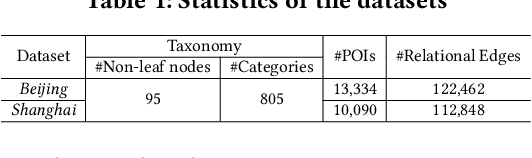
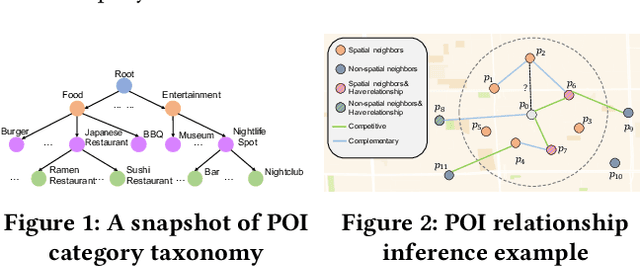
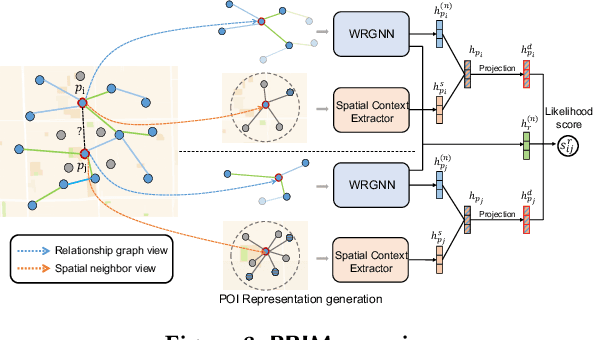
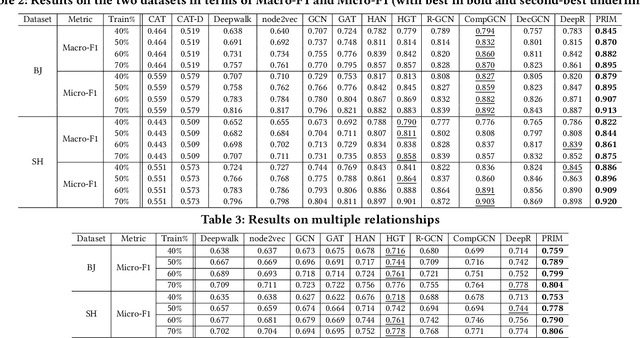
As a fundamental component in location-based services, inferring the relationship between points-of-interests (POIs) is very critical for service providers to offer good user experience to business owners and customers. Most of the existing methods for relationship inference are not targeted at POI, thus failing to capture unique spatial characteristics that have huge effects on POI relationships. In this work we propose PRIM to tackle POI relationship inference for multiple relation types. PRIM features four novel components, including a weighted relational graph neural network, category taxonomy integration, a self-attentive spatial context extractor, and a distance-specific scoring function. Extensive experiments on two real-world datasets show that PRIM achieves the best results compared to state-of-the-art baselines and it is robust against data sparsity and is applicable to unseen cases in practice.