 Add to Chrome
 Add to Firefox
 Add to Edge
SmartControl: Enhancing ControlNet for Handling Rough Visual Conditions
Apr 09, 2024

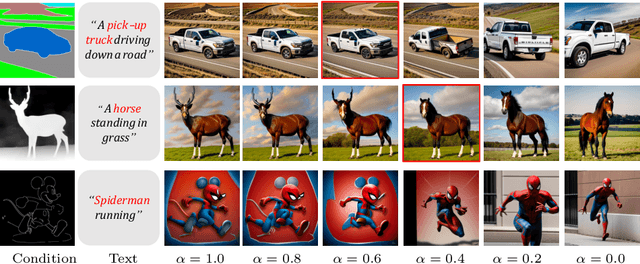
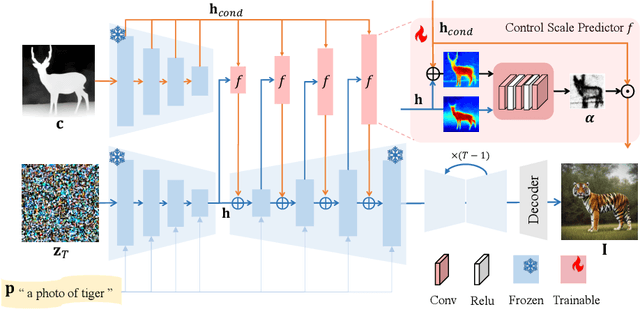
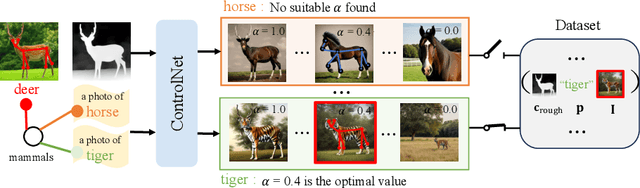
Human visual imagination usually begins with analogies or rough sketches. For example, given an image with a girl playing guitar before a building, one may analogously imagine how it seems like if Iron Man playing guitar before Pyramid in Egypt. Nonetheless, visual condition may not be precisely aligned with the imaginary result indicated by text prompt, and existing layout-controllable text-to-image (T2I) generation models is prone to producing degraded generated results with obvious artifacts. To address this issue, we present a novel T2I generation method dubbed SmartControl, which is designed to modify the rough visual conditions for adapting to text prompt. The key idea of our SmartControl is to relax the visual condition on the areas that are conflicted with text prompts. In specific, a Control Scale Predictor (CSP) is designed to identify the conflict regions and predict the local control scales, while a dataset with text prompts and rough visual conditions is constructed for training CSP. It is worth noting that, even with a limited number (e.g., 1,000~2,000) of training samples, our SmartControl can generalize well to unseen objects. Extensive experiments on four typical visual condition types clearly show the efficacy of our SmartControl against state-of-the-arts. Source code, pre-trained models, and datasets are available at https://github.com/liuxiaoyu1104/SmartControl.

Responsible Visual Editing
Apr 08, 2024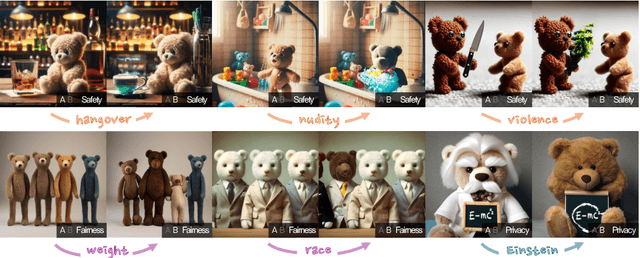
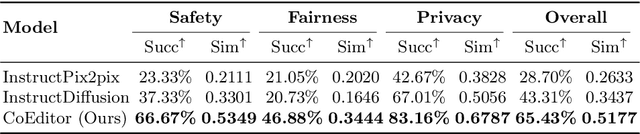
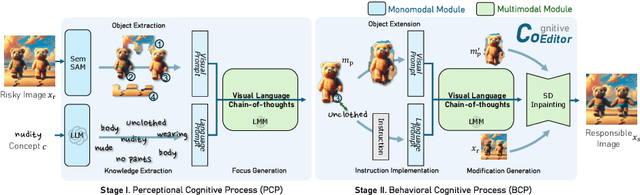
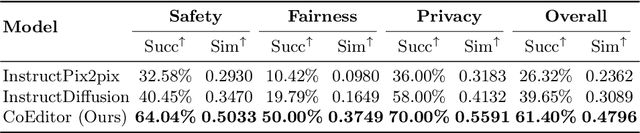
With recent advancements in visual synthesis, there is a growing risk of encountering images with detrimental effects, such as hate, discrimination, or privacy violations. The research on transforming harmful images into responsible ones remains unexplored. In this paper, we formulate a new task, responsible visual editing, which entails modifying specific concepts within an image to render it more responsible while minimizing changes. However, the concept that needs to be edited is often abstract, making it challenging to locate what needs to be modified and plan how to modify it. To tackle these challenges, we propose a Cognitive Editor (CoEditor) that harnesses the large multimodal model through a two-stage cognitive process: (1) a perceptual cognitive process to focus on what needs to be modified and (2) a behavioral cognitive process to strategize how to modify. To mitigate the negative implications of harmful images on research, we create a transparent and public dataset, AltBear, which expresses harmful information using teddy bears instead of humans. Experiments demonstrate that CoEditor can effectively comprehend abstract concepts within complex scenes and significantly surpass the performance of baseline models for responsible visual editing. We find that the AltBear dataset corresponds well to the harmful content found in real images, offering a consistent experimental evaluation, thereby providing a safer benchmark for future research. Moreover, CoEditor also shows great results in general editing. We release our code and dataset at https://github.com/kodenii/Responsible-Visual-Editing.
Dual-Camera Smooth Zoom on Mobile Phones
Apr 07, 2024When zooming between dual cameras on a mobile, noticeable jumps in geometric content and image color occur in the preview, inevitably affecting the user's zoom experience. In this work, we introduce a new task, ie, dual-camera smooth zoom (DCSZ) to achieve a smooth zoom preview. The frame interpolation (FI) technique is a potential solution but struggles with ground-truth collection. To address the issue, we suggest a data factory solution where continuous virtual cameras are assembled to generate DCSZ data by rendering reconstructed 3D models of the scene. In particular, we propose a novel dual-camera smooth zoom Gaussian Splatting (ZoomGS), where a camera-specific encoding is introduced to construct a specific 3D model for each virtual camera. With the proposed data factory, we construct a synthetic dataset for DCSZ, and we utilize it to fine-tune FI models. In addition, we collect real-world dual-zoom images without ground-truth for evaluation. Extensive experiments are conducted with multiple FI methods. The results show that the fine-tuned FI models achieve a significant performance improvement over the original ones on DCSZ task. The datasets, codes, and pre-trained models will be publicly available.
ShoeModel: Learning to Wear on the User-specified Shoes via Diffusion Model
Apr 07, 2024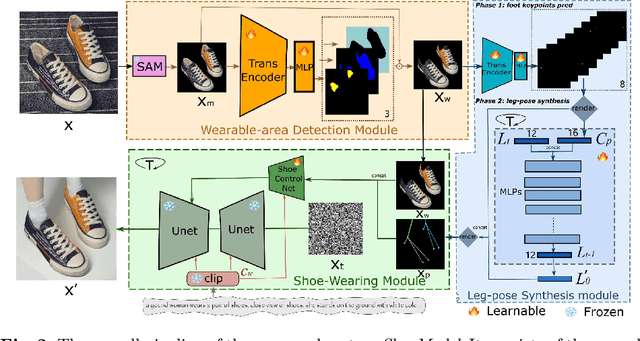
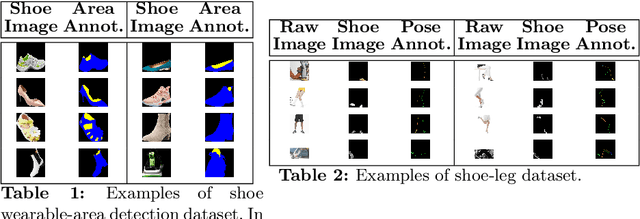
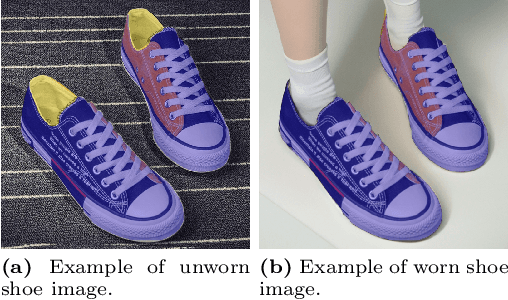
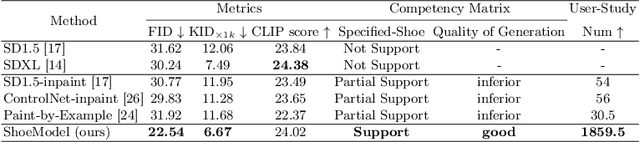
With the development of the large-scale diffusion model, Artificial Intelligence Generated Content (AIGC) techniques are popular recently. However, how to truly make it serve our daily lives remains an open question. To this end, in this paper, we focus on employing AIGC techniques in one filed of E-commerce marketing, i.e., generating hyper-realistic advertising images for displaying user-specified shoes by human. Specifically, we propose a shoe-wearing system, called Shoe-Model, to generate plausible images of human legs interacting with the given shoes. It consists of three modules: (1) shoe wearable-area detection module (WD), (2) leg-pose synthesis module (LpS) and the final (3) shoe-wearing image generation module (SW). Them three are performed in ordered stages. Compared to baselines, our ShoeModel is shown to generalize better to different type of shoes and has ability of keeping the ID-consistency of the given shoes, as well as automatically producing reasonable interactions with human. Extensive experiments show the effectiveness of our proposed shoe-wearing system. Figure 1 shows the input and output examples of our ShoeModel.
Self-Supervised Video Desmoking for Laparoscopic Surgery
Mar 17, 2024Due to the difficulty of collecting real paired data, most existing desmoking methods train the models by synthesizing smoke, generalizing poorly to real surgical scenarios. Although a few works have explored single-image real-world desmoking in unpaired learning manners, they still encounter challenges in handling dense smoke. In this work, we address these issues together by introducing the self-supervised surgery video desmoking (SelfSVD). On the one hand, we observe that the frame captured before the activation of high-energy devices is generally clear (named pre-smoke frame, PS frame), thus it can serve as supervision for other smoky frames, making real-world self-supervised video desmoking practically feasible. On the other hand, in order to enhance the desmoking performance, we further feed the valuable information from PS frame into models, where a masking strategy and a regularization term are presented to avoid trivial solutions. In addition, we construct a real surgery video dataset for desmoking, which covers a variety of smoky scenes. Extensive experiments on the dataset show that our SelfSVD can remove smoke more effectively and efficiently while recovering more photo-realistic details than the state-of-the-art methods. The dataset, codes, and pre-trained models are available at \url{https://github.com/ZcsrenlongZ/SelfSVD}.
Learning Hierarchical Color Guidance for Depth Map Super-Resolution
Mar 12, 2024Color information is the most commonly used prior knowledge for depth map super-resolution (DSR), which can provide high-frequency boundary guidance for detail restoration. However, its role and functionality in DSR have not been fully developed. In this paper, we rethink the utilization of color information and propose a hierarchical color guidance network to achieve DSR. On the one hand, the low-level detail embedding module is designed to supplement high-frequency color information of depth features in a residual mask manner at the low-level stages. On the other hand, the high-level abstract guidance module is proposed to maintain semantic consistency in the reconstruction process by using a semantic mask that encodes the global guidance information. The color information of these two dimensions plays a role in the front and back ends of the attention-based feature projection (AFP) module in a more comprehensive form. Simultaneously, the AFP module integrates the multi-scale content enhancement block and adaptive attention projection block to make full use of multi-scale information and adaptively project critical restoration information in an attention manner for DSR. Compared with the state-of-the-art methods on four benchmark datasets, our method achieves more competitive performance both qualitatively and quantitatively.
A self-supervised CNN for image watermark removal
Mar 09, 2024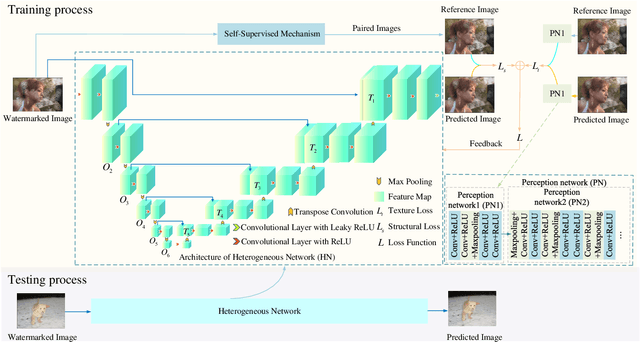
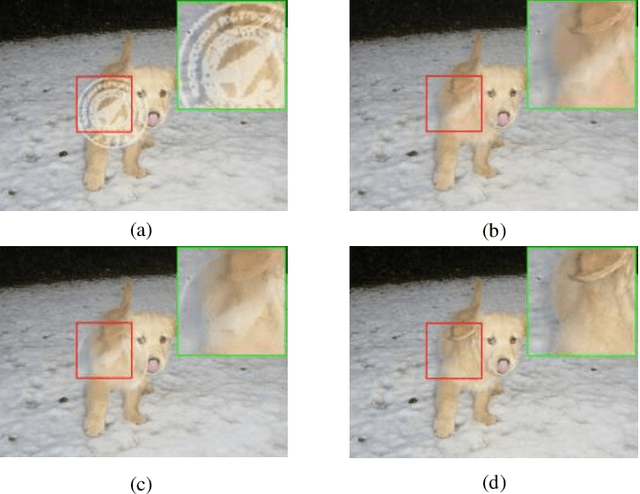

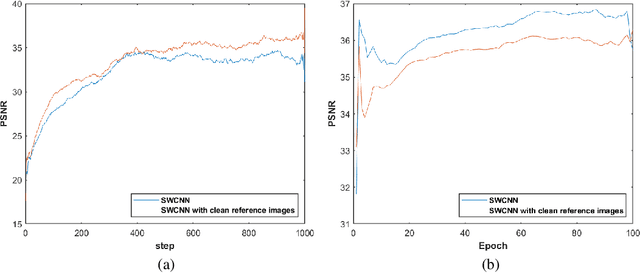
Popular convolutional neural networks mainly use paired images in a supervised way for image watermark removal. However, watermarked images do not have reference images in the real world, which results in poor robustness of image watermark removal techniques. In this paper, we propose a self-supervised convolutional neural network (CNN) in image watermark removal (SWCNN). SWCNN uses a self-supervised way to construct reference watermarked images rather than given paired training samples, according to watermark distribution. A heterogeneous U-Net architecture is used to extract more complementary structural information via simple components for image watermark removal. Taking into account texture information, a mixed loss is exploited to improve visual effects of image watermark removal. Besides, a watermark dataset is conducted. Experimental results show that the proposed SWCNN is superior to popular CNNs in image watermark removal.
VideoElevator: Elevating Video Generation Quality with Versatile Text-to-Image Diffusion Models
Mar 08, 2024Text-to-image diffusion models (T2I) have demonstrated unprecedented capabilities in creating realistic and aesthetic images. On the contrary, text-to-video diffusion models (T2V) still lag far behind in frame quality and text alignment, owing to insufficient quality and quantity of training videos. In this paper, we introduce VideoElevator, a training-free and plug-and-play method, which elevates the performance of T2V using superior capabilities of T2I. Different from conventional T2V sampling (i.e., temporal and spatial modeling), VideoElevator explicitly decomposes each sampling step into temporal motion refining and spatial quality elevating. Specifically, temporal motion refining uses encapsulated T2V to enhance temporal consistency, followed by inverting to the noise distribution required by T2I. Then, spatial quality elevating harnesses inflated T2I to directly predict less noisy latent, adding more photo-realistic details. We have conducted experiments in extensive prompts under the combination of various T2V and T2I. The results show that VideoElevator not only improves the performance of T2V baselines with foundational T2I, but also facilitates stylistic video synthesis with personalized T2I. Our code is available at https://github.com/YBYBZhang/VideoElevator.
PLACE: Adaptive Layout-Semantic Fusion for Semantic Image Synthesis
Mar 04, 2024Recent advancements in large-scale pre-trained text-to-image models have led to remarkable progress in semantic image synthesis. Nevertheless, synthesizing high-quality images with consistent semantics and layout remains a challenge. In this paper, we propose the adaPtive LAyout-semantiC fusion modulE (PLACE) that harnesses pre-trained models to alleviate the aforementioned issues. Specifically, we first employ the layout control map to faithfully represent layouts in the feature space. Subsequently, we combine the layout and semantic features in a timestep-adaptive manner to synthesize images with realistic details. During fine-tuning, we propose the Semantic Alignment (SA) loss to further enhance layout alignment. Additionally, we introduce the Layout-Free Prior Preservation (LFP) loss, which leverages unlabeled data to maintain the priors of pre-trained models, thereby improving the visual quality and semantic consistency of synthesized images. Extensive experiments demonstrate that our approach performs favorably in terms of visual quality, semantic consistency, and layout alignment. The source code and model are available at https://github.com/cszy98/PLACE/tree/main.
ConSept: Continual Semantic Segmentation via Adapter-based Vision Transformer
Feb 26, 2024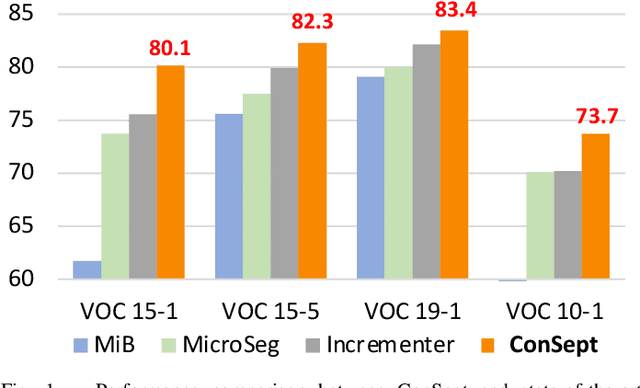
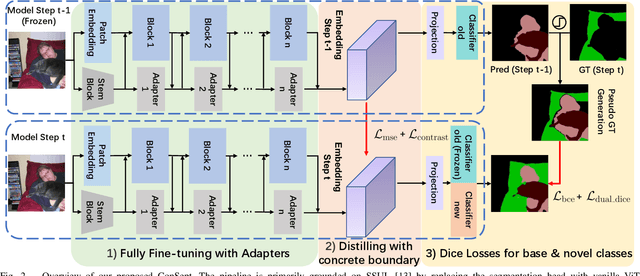
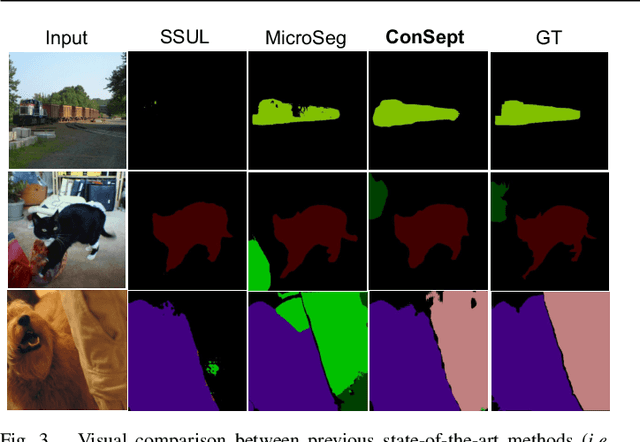
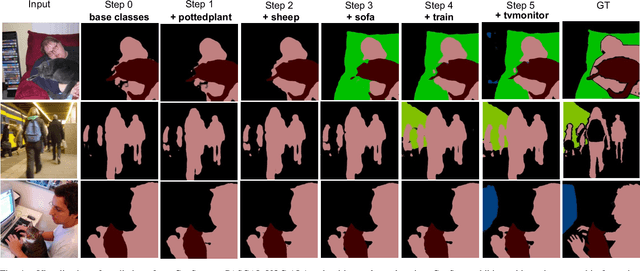
In this paper, we delve into the realm of vision transformers for continual semantic segmentation, a problem that has not been sufficiently explored in previous literature. Empirical investigations on the adaptation of existing frameworks to vanilla ViT reveal that incorporating visual adapters into ViTs or fine-tuning ViTs with distillation terms is advantageous for enhancing the segmentation capability of novel classes. These findings motivate us to propose Continual semantic Segmentation via Adapter-based ViT, namely ConSept. Within the simplified architecture of ViT with linear segmentation head, ConSept integrates lightweight attention-based adapters into vanilla ViTs. Capitalizing on the feature adaptation abilities of these adapters, ConSept not only retains superior segmentation ability for old classes, but also attains promising segmentation quality for novel classes. To further harness the intrinsic anti-catastrophic forgetting ability of ConSept and concurrently enhance the segmentation capabilities for both old and new classes, we propose two key strategies: distillation with a deterministic old-classes boundary for improved anti-catastrophic forgetting, and dual dice losses to regularize segmentation maps, thereby improving overall segmentation performance. Extensive experiments show the effectiveness of ConSept on multiple continual semantic segmentation benchmarks under overlapped or disjoint settings. Code will be publicly available at \url{https://github.com/DongSky/ConSept}.