 Add to Chrome
 Add to Firefox
 Add to Edge
4D Metric-Semantic Mapping for Persistent Orchard Monitoring: Method and Dataset
Sep 29, 2024
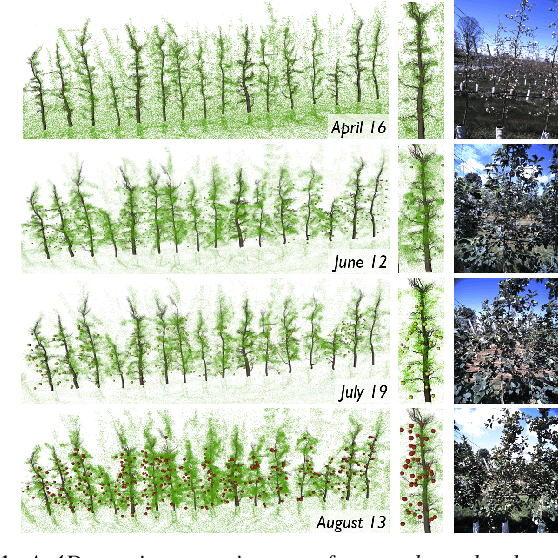



Automated persistent and fine-grained monitoring of orchards at the individual tree or fruit level helps maximize crop yield and optimize resources such as water, fertilizers, and pesticides while preventing agricultural waste. Towards this goal, we present a 4D spatio-temporal metric-semantic mapping method that fuses data from multiple sensors, including LiDAR, RGB camera, and IMU, to monitor the fruits in an orchard across their growth season. A LiDAR-RGB fusion module is designed for 3D fruit tracking and localization, which first segments fruits using a deep neural network and then tracks them using the Hungarian Assignment algorithm. Additionally, the 4D data association module aligns data from different growth stages into a common reference frame and tracks fruits spatio-temporally, providing information such as fruit counts, sizes, and positions. We demonstrate our method's accuracy in 4D metric-semantic mapping using data collected from a real orchard under natural, uncontrolled conditions with seasonal variations. We achieve a 3.1 percent error in total fruit count estimation for over 1790 fruits across 60 apple trees, along with accurate size estimation results with a mean error of 1.1 cm. The datasets, consisting of LiDAR, RGB, and IMU data of five fruit species captured across their growth seasons, along with corresponding ground truth data, will be made publicly available at: https://4d-metric-semantic-mapping.org/

RT-GuIDE: Real-Time Gaussian splatting for Information-Driven Exploration
Sep 26, 2024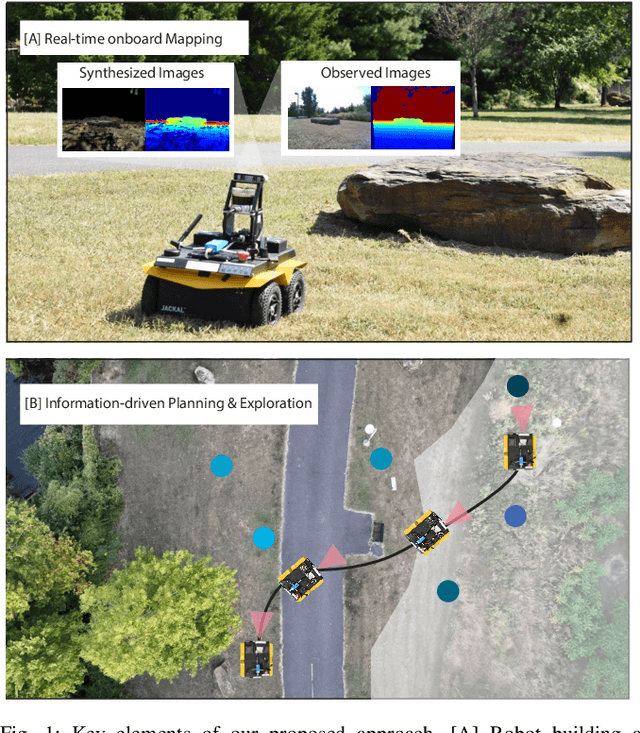
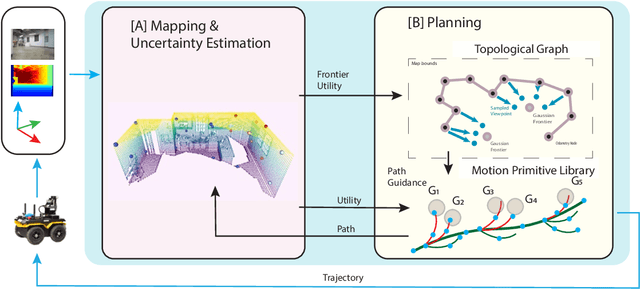
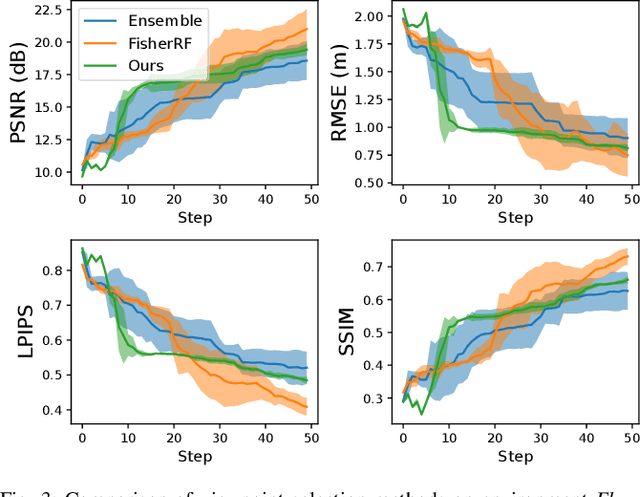
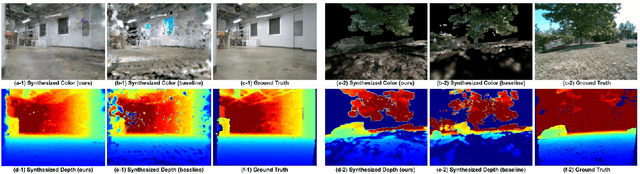
We propose a framework for active mapping and exploration that leverages Gaussian splatting for constructing information-rich maps. Further, we develop a parallelized motion planning algorithm that can exploit the Gaussian map for real-time navigation. The Gaussian map constructed onboard the robot is optimized for both photometric and geometric quality while enabling real-time situational awareness for autonomy. We show through simulation experiments that our method is competitive with approaches that use alternate information gain metrics, while being orders of magnitude faster to compute. In real-world experiments, our algorithm achieves better map quality (10% higher Peak Signal-to-Noise Ratio (PSNR) and 30% higher geometric reconstruction accuracy) than Gaussian maps constructed by traditional exploration baselines. Experiment videos and more details can be found on our project page: https://tyuezhan.github.io/RT_GuIDE/
EvMAPPER: High Altitude Orthomapping with Event Cameras
Sep 26, 2024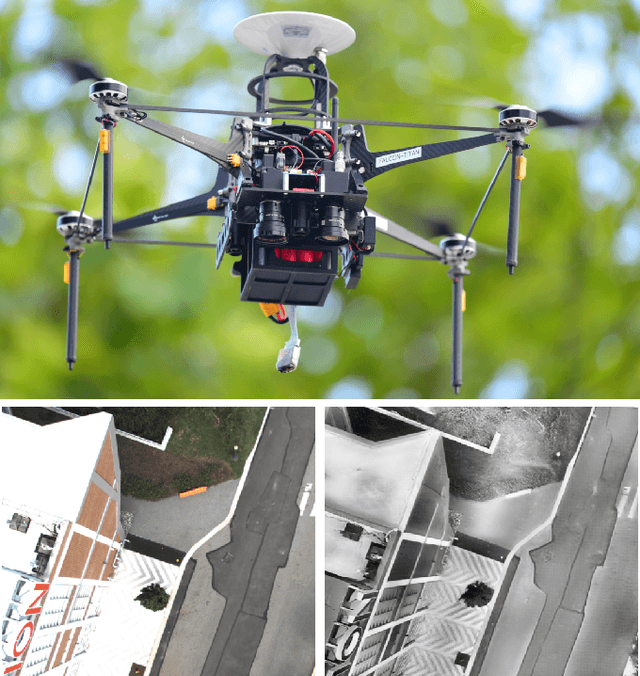
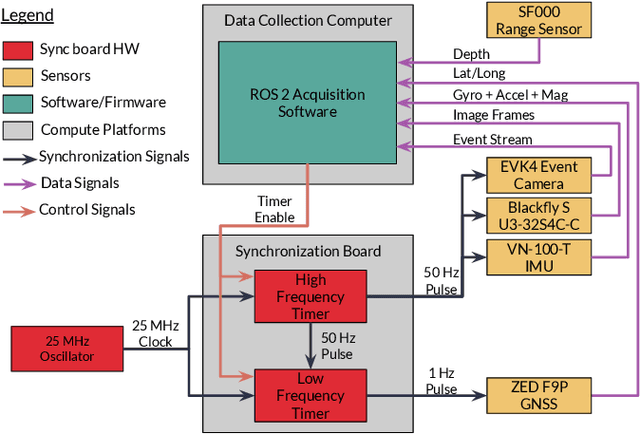

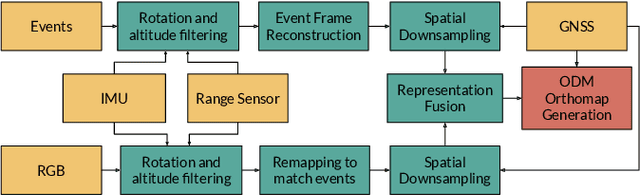
Traditionally, unmanned aerial vehicles (UAVs) rely on CMOS-based cameras to collect images about the world below. One of the most successful applications of UAVs is to generate orthomosaics or orthomaps, in which a series of images are integrated together to develop a larger map. However, the use of CMOS-based cameras with global or rolling shutters mean that orthomaps are vulnerable to challenging light conditions, motion blur, and high-speed motion of independently moving objects under the camera. Event cameras are less sensitive to these issues, as their pixels are able to trigger asynchronously on brightness changes. This work introduces the first orthomosaic approach using event cameras. In contrast to existing methods relying only on CMOS cameras, our approach enables map generation even in challenging light conditions, including direct sunlight and after sunset.
Collision-free time-optimal path parameterization for multi-robot teams
Sep 25, 2024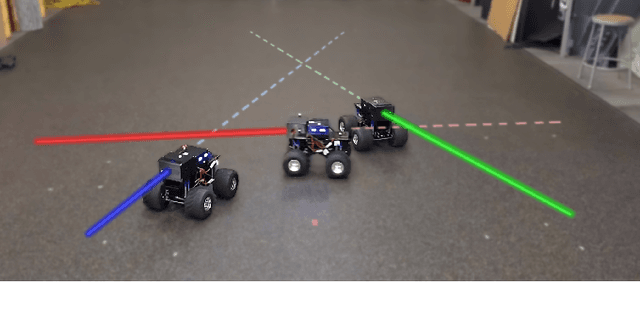

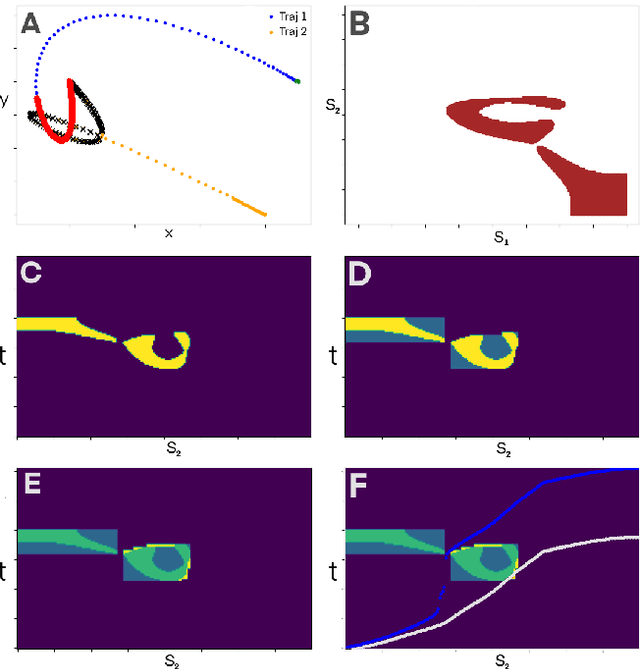
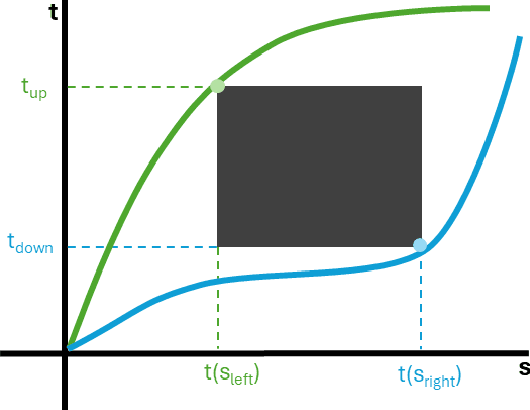
Coordinating the motion of multiple robots in cluttered environments remains a computationally challenging task. We study the problem of minimizing the execution time of a set of geometric paths by a team of robots with state-dependent actuation constraints. We propose a Time-Optimal Path Parameterization (TOPP) algorithm for multiple car-like agents, where the modulation of the timing of every robot along its assigned path is employed to ensure collision avoidance and dynamic feasibility. This is achieved through the use of a priority queue to determine the order of trajectory execution for each robot while taking into account all possible collisions with higher priority robots in a spatiotemporal graph. We show a 10-20% reduction in makespan against existing state-of-the-art methods and validate our approach through simulations and hardware experiments.
Resilient and Adaptive Replanning for Multi-Robot Target Tracking with Sensing and Communication Danger Zones
Sep 17, 2024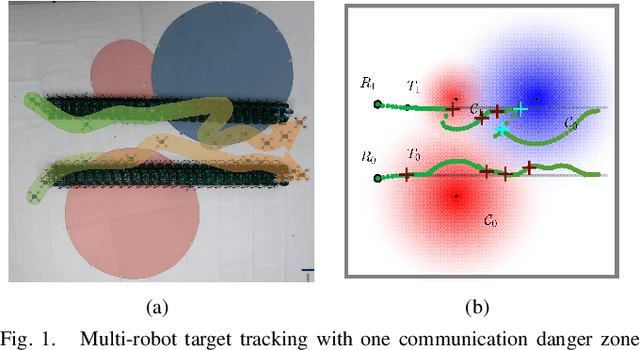
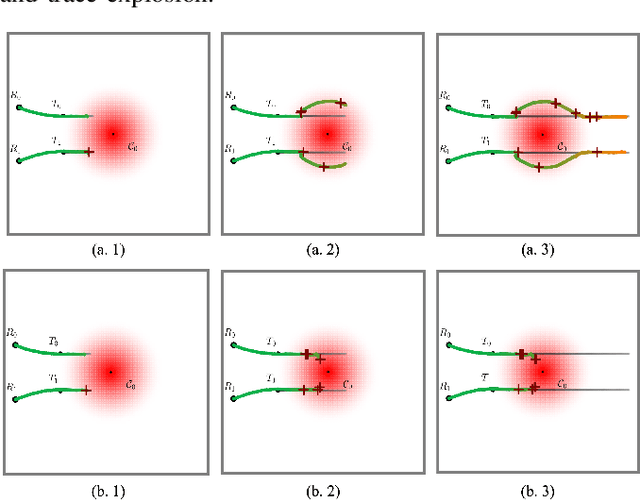
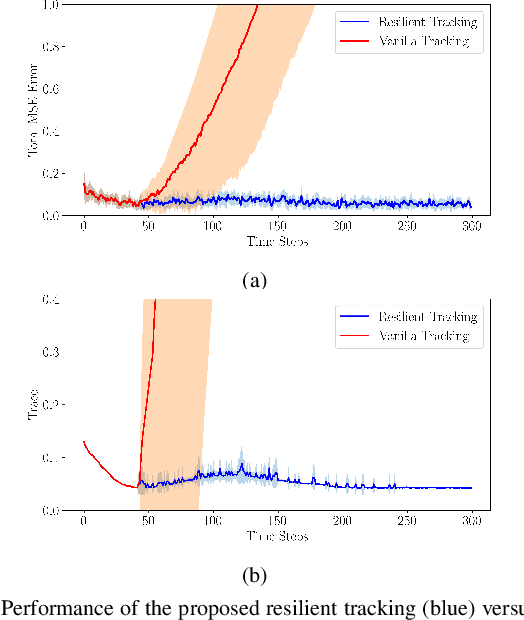
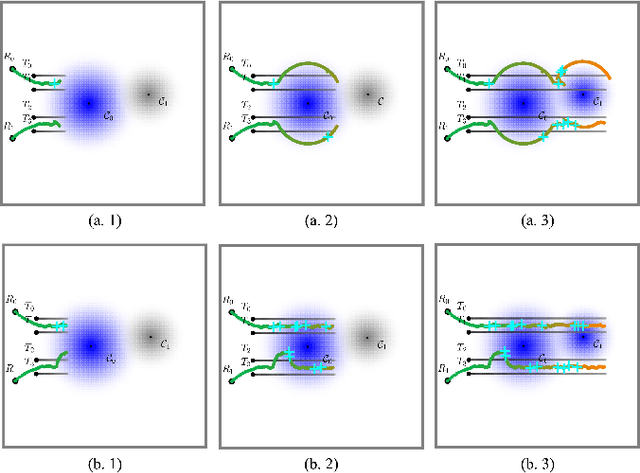
Multi-robot collaboration for target tracking presents significant challenges in hazardous environments, including addressing robot failures, dynamic priority changes, and other unpredictable factors. Moreover, these challenges are increased in adversarial settings if the environment is unknown. In this paper, we propose a resilient and adaptive framework for multi-robot, multi-target tracking in environments with unknown sensing and communication danger zones. The damages posed by these zones are temporary, allowing robots to track targets while accepting the risk of entering dangerous areas. We formulate the problem as an optimization with soft chance constraints, enabling real-time adjustments to robot behavior based on varying types of dangers and failures. An adaptive replanning strategy is introduced, featuring different triggers to improve group performance. This approach allows for dynamic prioritization of target tracking and risk aversion or resilience, depending on evolving resources and real-time conditions. To validate the effectiveness of the proposed method, we benchmark and evaluate it across multiple scenarios in simulation and conduct several real-world experiments.
Leveraging Symmetry to Accelerate Learning of Trajectory Tracking Controllers for Free-Flying Robotic Systems
Sep 17, 2024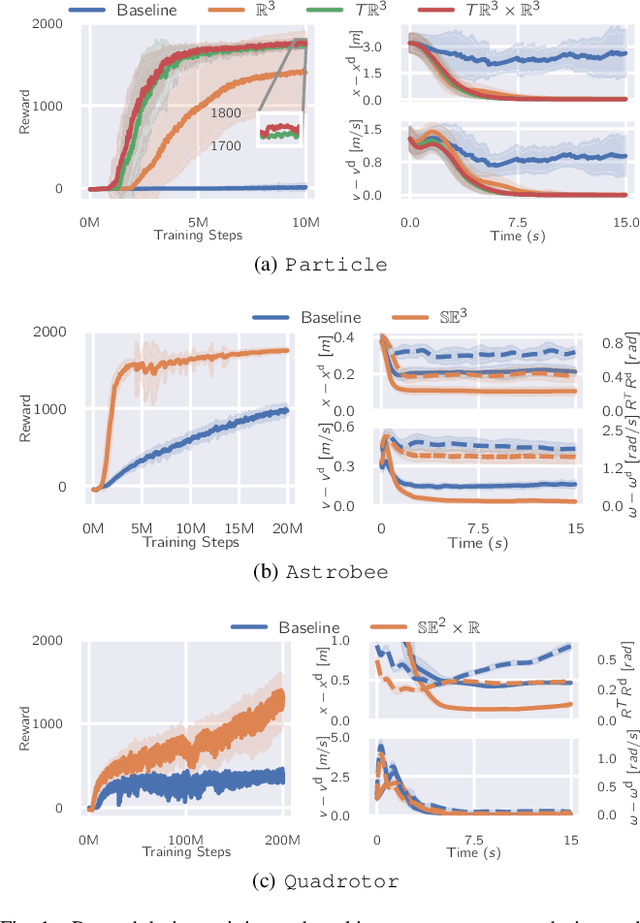
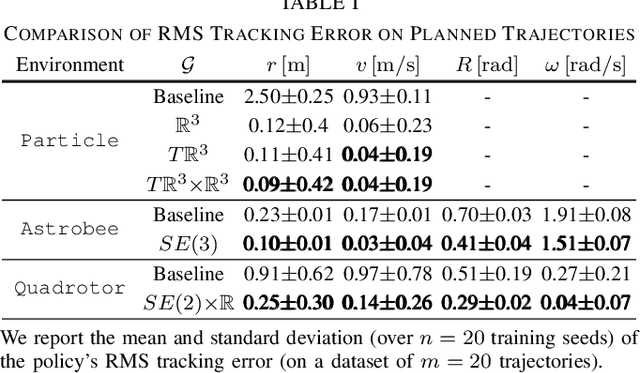
Tracking controllers enable robotic systems to accurately follow planned reference trajectories. In particular, reinforcement learning (RL) has shown promise in the synthesis of controllers for systems with complex dynamics and modest online compute budgets. However, the poor sample efficiency of RL and the challenges of reward design make training slow and sometimes unstable, especially for high-dimensional systems. In this work, we leverage the inherent Lie group symmetries of robotic systems with a floating base to mitigate these challenges when learning tracking controllers. We model a general tracking problem as a Markov decision process (MDP) that captures the evolution of both the physical and reference states. Next, we prove that symmetry in the underlying dynamics and running costs leads to an MDP homomorphism, a mapping that allows a policy trained on a lower-dimensional "quotient" MDP to be lifted to an optimal tracking controller for the original system. We compare this symmetry-informed approach to an unstructured baseline, using Proximal Policy Optimization (PPO) to learn tracking controllers for three systems: the Particle (a forced point mass), the Astrobee (a fullyactuated space robot), and the Quadrotor (an underactuated system). Results show that a symmetry-aware approach both accelerates training and reduces tracking error after the same number of training steps.
Safe Interval Motion Planning for Quadrotors in Dynamic Environments
Sep 16, 2024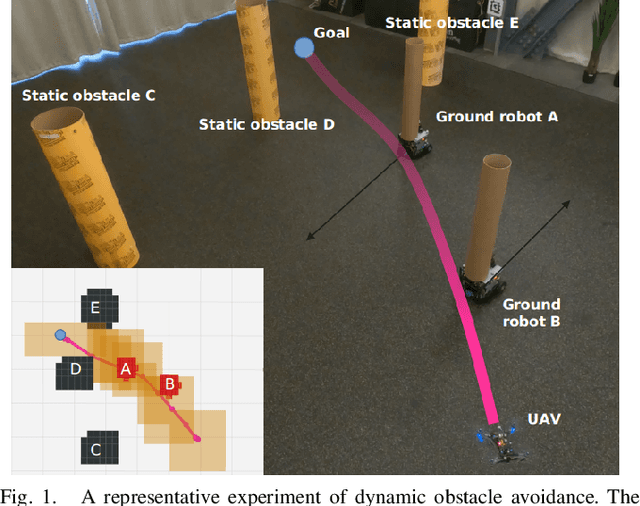
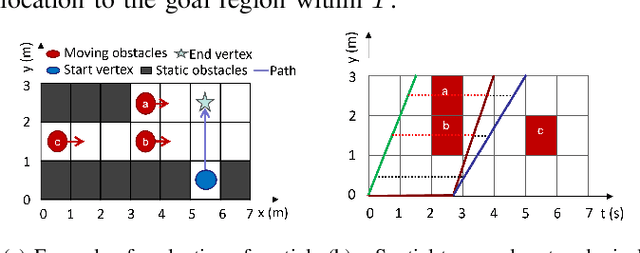
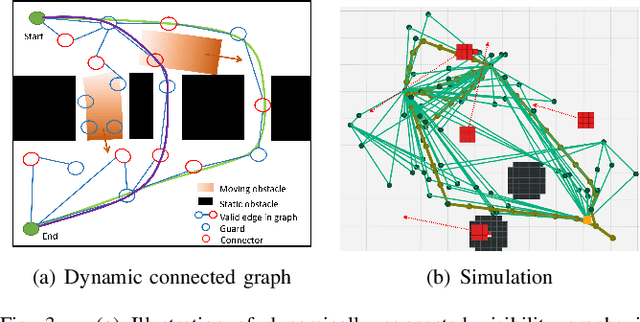
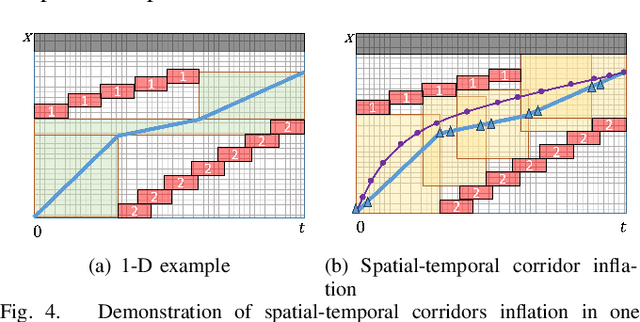
Trajectory generation in dynamic environments presents a significant challenge for quadrotors, particularly due to the non-convexity in the spatial-temporal domain. Many existing methods either assume simplified static environments or struggle to produce optimal solutions in real-time. In this work, we propose an efficient safe interval motion planning framework for navigation in dynamic environments. A safe interval refers to a time window during which a specific configuration is safe. Our approach addresses trajectory generation through a two-stage process: a front-end graph search step followed by a back-end gradient-based optimization. We ensure completeness and optimality by constructing a dynamic connected visibility graph and incorporating low-order dynamic bounds within safe intervals and temporal corridors. To avoid local minima, we propose a Uniform Temporal Visibility Deformation (UTVD) for the complete evaluation of spatial-temporal topological equivalence. We represent trajectories with B-Spline curves and apply gradient-based optimization to navigate around static and moving obstacles within spatial-temporal corridors. Through simulation and real-world experiments, we show that our method can achieve a success rate of over 95% in environments with different density levels, exceeding the performance of other approaches, demonstrating its potential for practical deployment in highly dynamic environments.
Constraint-Aware Intent Estimation for Dynamic Human-Robot Object Co-Manipulation
Aug 30, 2024Constraint-aware estimation of human intent is essential for robots to physically collaborate and interact with humans. Further, to achieve fluid collaboration in dynamic tasks intent estimation should be achieved in real-time. In this paper, we present a framework that combines online estimation and control to facilitate robots in interpreting human intentions, and dynamically adjust their actions to assist in dynamic object co-manipulation tasks while considering both robot and human constraints. Central to our approach is the adoption of a Dynamic Systems (DS) model to represent human intent. Such a low-dimensional parameterized model, along with human manipulability and robot kinematic constraints, enables us to predict intent using a particle filter solely based on past motion data and tracking errors. For safe assistive control, we propose a variable impedance controller that adapts the robot's impedance to offer assistance based on the intent estimation confidence from the DS particle filter. We validate our framework on a challenging real-world human-robot co-manipulation task and present promising results over baselines. Our framework represents a significant step forward in physical human-robot collaboration (pHRC), ensuring that robot cooperative interactions with humans are both feasible and effective.
Air-Ground Collaboration with SPOMP: Semantic Panoramic Online Mapping and Planning
Jul 13, 2024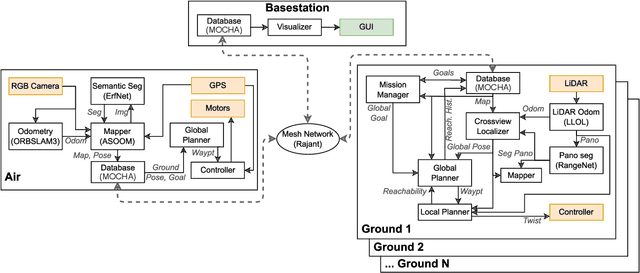
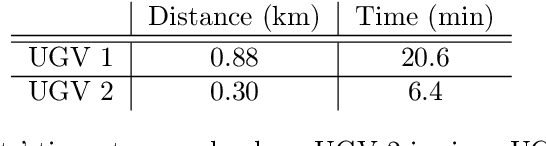
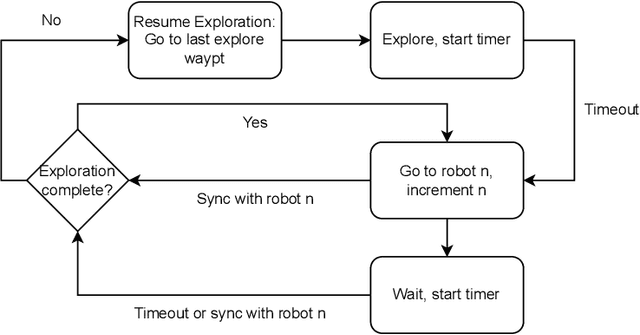

Mapping and navigation have gone hand-in-hand since long before robots existed. Maps are a key form of communication, allowing someone who has never been somewhere to nonetheless navigate that area successfully. In the context of multi-robot systems, the maps and information that flow between robots are necessary for effective collaboration, whether those robots are operating concurrently, sequentially, or completely asynchronously. In this paper, we argue that maps must go beyond encoding purely geometric or visual information to enable increasingly complex autonomy, particularly between robots. We propose a framework for multi-robot autonomy, focusing in particular on air and ground robots operating in outdoor 2.5D environments. We show that semantic maps can enable the specification, planning, and execution of complex collaborative missions, including localization in GPS-denied settings. A distinguishing characteristic of this work is that we strongly emphasize field experiments and testing, and by doing so demonstrate that these ideas can work at scale in the real world. We also perform extensive simulation experiments to validate our ideas at even larger scales. We believe these experiments and the experimental results constitute a significant step forward toward advancing the state-of-the-art of large-scale, collaborative multi-robot systems operating with real communication, navigation, and perception constraints.
* Video: https://www.youtube.com/watch?v=ieNYH40buBo
SlideSLAM: Sparse, Lightweight, Decentralized Metric-Semantic SLAM for Multi-Robot Navigation
Jun 25, 2024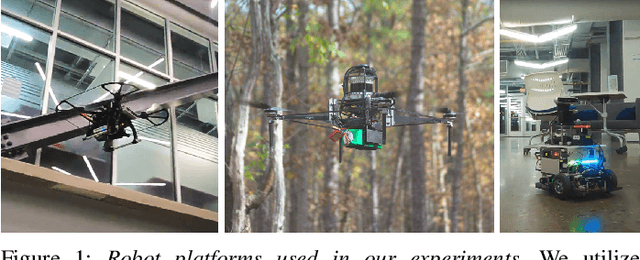
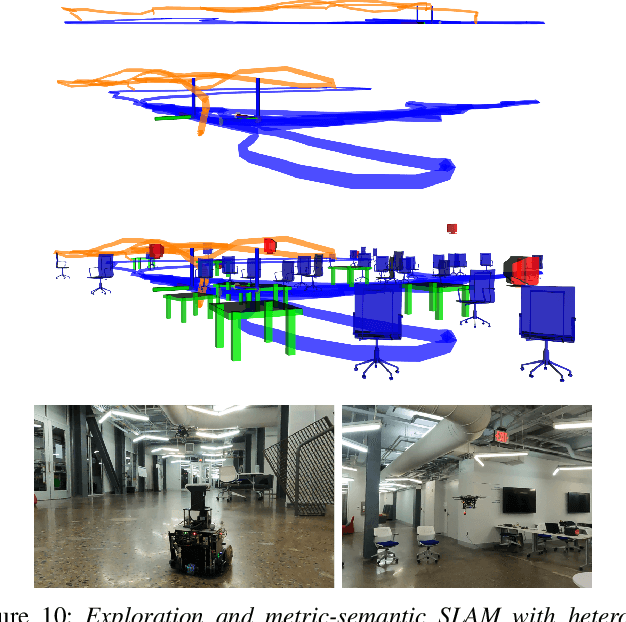
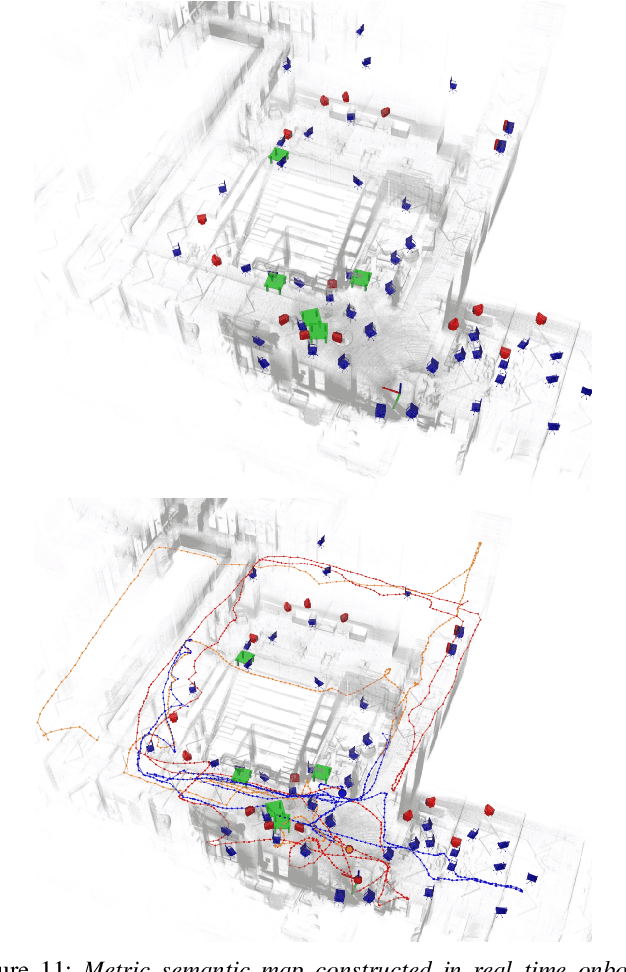
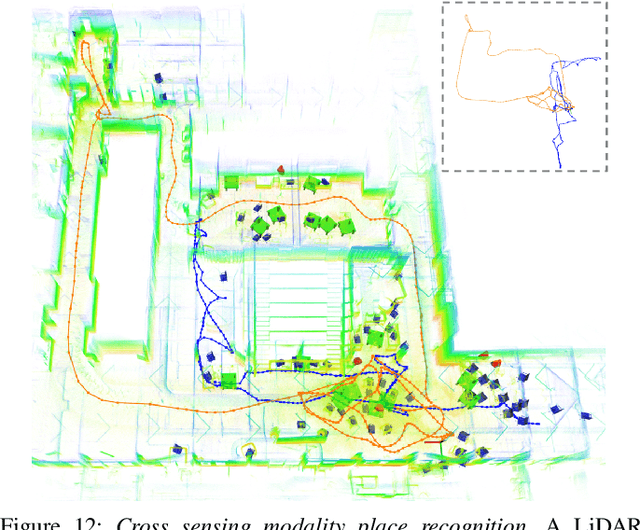
This paper develops a real-time decentralized metric-semantic Simultaneous Localization and Mapping (SLAM) approach that leverages a sparse and lightweight object-based representation to enable a heterogeneous robot team to autonomously explore 3D environments featuring indoor, urban, and forested areas without relying on GPS. We use a hierarchical metric-semantic representation of the environment, including high-level sparse semantic maps of object models and low-level voxel maps. We leverage the informativeness and viewpoint invariance of the high-level semantic map to obtain an effective semantics-driven place-recognition algorithm for inter-robot loop closure detection across aerial and ground robots with different sensing modalities. A communication module is designed to track each robot's observations and those of other robots within the communication range. Such observations are then used to construct a merged map. Our framework enables real-time decentralized operations onboard robots, allowing them to opportunistically leverage communication. We integrate and deploy our proposed framework on three types of aerial and ground robots. Extensive experimental results show an average localization error of 0.22 meters in position and -0.16 degrees in orientation, an object mapping F1 score of 0.92, and a communication packet size of merely 2-3 megabytes per kilometer trajectory with 1,000 landmarks. The project website can be found at https://xurobotics.github.io/slideslam/.