 Add to Chrome
 Add to Firefox
 Add to Edge
Structuring Sparsity: Block-Sparse Featurizers Capture Visual Concept Manifolds
Jun 23, 2026
What is the geometry of a visual percept? The most widely used protocols for decomposing neural network representations into interpretable parts treat concepts as isolated directions, yet recent work shows that concepts are often realized as geometric structures in low dimensional regions of activation space. We turn to the literature of Structured sparsity to close this gap, and show that block sparsity, which groups directions into blocks, is the prior matched to a generative model in which a representation is a sparse sum of low-dimensional manifolds: the modern, learned form of a classical idea in visual neuroscience, where a visual feature is carried by a coordinated group of neurons rather than a single tuned one. We implement three variants of block-sparse featurizers (BSFs) and, through a minimum-description-length analysis, show that all three describe activations more compactly than direction-based featurizers, with the recovered concepts typically two- to four-dimensional. We then use BSFs to (i) recontextualize prior work, showing that curve detectors in InceptionV1 actually read from a single continuous curve manifold, (ii) discover novel manifolds including shadows and lighting in DINOv3, and (iii) support interpretable control of image generation in diffusion models (SDXL) via manifold steering.

Anatomy of Post-Training: Using Interpretability to Characterize Data and Shape the Learning Signal
Jun 10, 2026Language-model post-training is the main stage at which model behavior is shaped, yet it still largely involves optimization of scalar rewards that summarize diverse desiderata. This abstraction gives practitioners little visibility into what their data actually teaches models, allowing spurious correlations to be learned by a model and inducing undesirable behaviors such as over-stylization and sycophancy. To address this problem, we ask: can we inspect a preference dataset before optimization and decide, at the level of concepts, which behaviors a model should be allowed to learn? Motivated by this, we introduce a data-centric post-training pipeline that uses interpretability protocols to develop statistical hypotheses for the latent concepts separating preferred from dispreferred generations, making them explicit for fine-grained user feedback. Building on this view, we unify several interpretability-based training protocols as ways of shaping rewards via feature or data interventions. Empirically, we show that our pipeline diagnoses undesirable signals in existing preference data, mitigates off-target learning, and can also help amplify or shape desired properties such as safeguards and model personality. More broadly, our results suggest that interpretability can turn post-training from optimizing opaque proxy rewards into a process of auditing and sculpting the learning signal itself.
A Unifying Framework for Concept-Based Representational Similarity
Jun 08, 2026Learned representations across models and modalities often exhibit striking structural similarities, suggesting shared underlying concept decompositions. However, concept alignment remains poorly defined: existing approaches optimize different objectives under the same terminology, obscuring what is actually aligned. We propose a unifying framework that decomposes alignment along two axes: what is aligned (representations vs. concepts) and at what level (instance-wise vs. distributional). This induces four corresponding properties -- instance-wise and distributional variants of translation and concept consistency -- and reveals precisely which of these guarantees existing methods provide. We further introduce \InterVenchA, an intervention-based benchmark that separately measures extraction quality, translation quality, and concept consistency. Through theory and experiments, we show that commonly assumed equivalences between alignment objectives fail in practice: optimizing one property does not reliably recover the others, and purely unsupervised objectives fail to recover meaningful instance-level alignment. We then propose the Coupled Sparse Autoencoder (CoSAE), which jointly enforces complementary alignment objectives. Strong alignment emerges only in this regime. Surprisingly, as little as 0.1\% paired data is sufficient to recover instance-level alignment when anchoring distributional objectives. Overall, our results show that concept alignment is fundamentally multi-objective: it must be defined, measured, and optimized as such.
A Unifying View of Attention Sinks: Two Algorithms, Two Solutions
Jun 06, 2026When attention concentrates on a single token, a sink, what is the model actually computing? Attention sinks are ubiquitous in softmax transformers, yet this shared visual signature can hide fundamentally different algorithms. We show that visually similar sink patterns can reflect two distinct mechanisms: {i} adaptive nop, where a head suppresses its update by routing to a null token, and {ii} broadcast, where a sink aggregates and redistributes global information. In that case, sinks serve an analogous role: a safe destination when there is nothing useful to compute. Proposed interventions like gating or registers work because they implicitly target one or the other, revealing a duality between method and assumed mechanism: gating implicitly assumes nop; registers implicitly assume broadcast. Each mechanism leaves distinct traces (nop sinks exhibit negligible value norms; broadcast sinks induce low-rank outputs) which we formalize on synthetic tasks and use to derive practical diagnostics. Applied to pretrained vision transformers, these diagnostics reveal that both mechanisms exist at scale: sinks transition from CLS in early layers to patches in deeper layers, and concentrate in specialized heads. Strikingly, register tokens, designed for broadcast, are repurposed to also serve nop, confirming that neither intervention alone suffices. Combining gating with registers yields complementary gains in stability and performance. Overall, we find that the same attention pattern can reflect two very different computations and effective intervention requires first asking what the model is actually computing.
The Case for Model Science: Verify, Explore, Steer, Refine
May 31, 2026We argue that the AI community is now ready to move beyond benchmarking and consolidate scattered efforts in model analysis into a systematic discipline, a direction we term Model Science. Complex AI models now serve billions of users, yet our understanding of how they work lags far behind our ability to deploy them. Decades of benchmark-driven research have delivered remarkable progress: extensive leaderboards, a wide range of performance metrics, tracking capability gains across diverse tasks; yet this success has also revealed the limits of benchmarks as they tell us whether models perform but not why they succeed or fail, they miss critical failure modes, such as hallucinations or shortcuts. Precedents from established sciences point the way forward: cognitive science shows that understanding complex systems requires complementary levels of analysis; neuroscience demonstrates that deep study of single cases reveals what population studies miss; medicine teaches that specialised training must develop alongside research practice; and agriculture models how shared infrastructure and principles enable cumulative progress. These lessons inform three foundations for Model Science. First, we propose to consolidate research around four functional perspectives: Verify, Explore, Steer, and Refine that address complementary questions about model behaviour. Second, we discuss the required infrastructure for cumulative knowledge: catalogues of datasets, models and findings. Third, we highlight the need for deep analysis of individual model instances, not just model families, because single cases can reveal what population studies miss.
Manifold Steering Reveals the Shared Geometry of Neural Network Representation and Behavior
May 06, 2026Neural representations carry rich geometric structure; but does that structure causally shape behavior? To address this question, we intervene along paths through activation space defined by different geometries, and measure the behavioral trajectories they induce. In particular, we test whether interventions that respect the geometry of activation space will yield behaviors close to those the model exhibits naturally. Concretely, we first fit an activation manifold $M_h$ to representations and a behavior manifold $M_y$ to output probability distributions. We then test the link $M_h \leftrightarrow M_y$ via interventions: we find that steering along $M_h$, which we term manifold steering, yields behavioral trajectories that follow $M_y$, while linear steering -- which assumes a Euclidean geometry -- cuts through off-manifold regions and hence produces unnatural outputs. Moreover, optimizing interventions in activation space to produce paths along $M_y$ recovers activation trajectories that trace the curvature of $M_h$. We demonstrate this bidirectional relationship between the geometry of representation and behavior across tasks and modalities. In language models, we use reasoning tasks with cyclic and sequential geometries as well as in-context learning tasks with more complex graph geometries. In a video world model, we use a task with geometry corresponding to physical dynamics. Overall, our work shows that geometry in neural representation is not merely incidental, but is in fact the proper object for enabling principled control via intervention on internals. This recasts the core problem of steering from finding the right direction to finding the right geometry.
Cross-Modal Redundancy and the Geometry of Vision-Language Embeddings
Feb 05, 2026Vision-language models (VLMs) align images and text with remarkable success, yet the geometry of their shared embedding space remains poorly understood. To probe this geometry, we begin from the Iso-Energy Assumption, which exploits cross-modal redundancy: a concept that is truly shared should exhibit the same average energy across modalities. We operationalize this assumption with an Aligned Sparse Autoencoder (SAE) that encourages energy consistency during training while preserving reconstruction. We find that this inductive bias changes the SAE solution without harming reconstruction, giving us a representation that serves as a tool for geometric analysis. Sanity checks on controlled data with known ground truth confirm that alignment improves when Iso-Energy holds and remains neutral when it does not. Applied to foundational VLMs, our framework reveals a clear structure with practical consequences: (i) sparse bimodal atoms carry the entire cross-modal alignment signal; (ii) unimodal atoms act as modality-specific biases and fully explain the modality gap; (iii) removing unimodal atoms collapses the gap without harming performance; (iv) restricting vector arithmetic to the bimodal subspace yields in-distribution edits and improved retrieval. These findings suggest that the right inductive bias can both preserve model fidelity and render the latent geometry interpretable and actionable.
Interpreting Physics in Video World Models
Feb 04, 2026A long-standing question in physical reasoning is whether video-based models need to rely on factorized representations of physical variables in order to make physically accurate predictions, or whether they can implicitly represent such variables in a task-specific, distributed manner. While modern video world models achieve strong performance on intuitive physics benchmarks, it remains unclear which of these representational regimes they implement internally. Here, we present the first interpretability study to directly examine physical representations inside large-scale video encoders. Using layerwise probing, subspace geometry, patch-level decoding, and targeted attention ablations, we characterize where physical information becomes accessible and how it is organized within encoder-based video transformers. Across architectures, we identify a sharp intermediate-depth transition -- which we call the Physics Emergence Zone -- at which physical variables become accessible. Physics-related representations peak shortly after this transition and degrade toward the output layers. Decomposing motion into explicit variables, we find that scalar quantities such as speed and acceleration are available from early layers onwards, whereas motion direction becomes accessible only at the Physics Emergence Zone. Notably, we find that direction is encoded through a high-dimensional population structure with circular geometry, requiring coordinated multi-feature intervention to control. These findings suggest that modern video models do not use factorized representations of physical variables like a classical physics engine. Instead, they use a distributed representation that is nonetheless sufficient for making physical predictions.
Block-Recurrent Dynamics in Vision Transformers
Dec 23, 2025
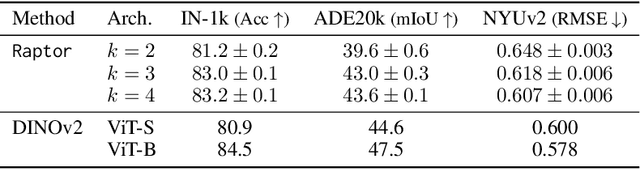
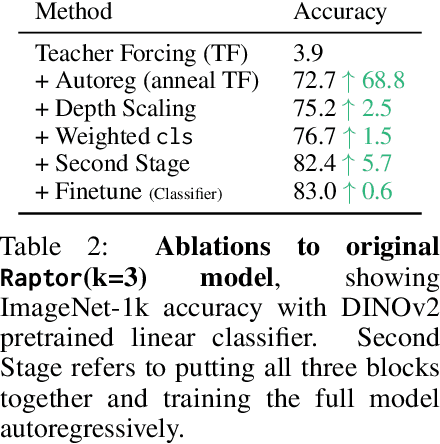
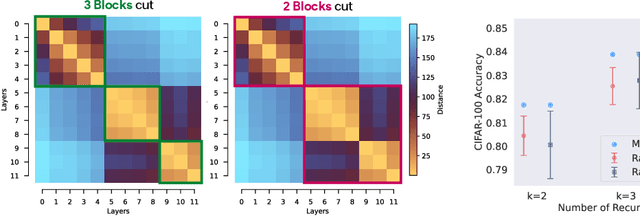
As Vision Transformers (ViTs) become standard vision backbones, a mechanistic account of their computational phenomenology is essential. Despite architectural cues that hint at dynamical structure, there is no settled framework that interprets Transformer depth as a well-characterized flow. In this work, we introduce the Block-Recurrent Hypothesis (BRH), arguing that trained ViTs admit a block-recurrent depth structure such that the computation of the original $L$ blocks can be accurately rewritten using only $k \ll L$ distinct blocks applied recurrently. Across diverse ViTs, between-layer representational similarity matrices suggest few contiguous phases. To determine whether these phases reflect genuinely reusable computation, we train block-recurrent surrogates of pretrained ViTs: Recurrent Approximations to Phase-structured TransfORmers (Raptor). In small-scale, we demonstrate that stochastic depth and training promote recurrent structure and subsequently correlate with our ability to accurately fit Raptor. We then provide an empirical existence proof for BRH by training a Raptor model to recover $96\%$ of DINOv2 ImageNet-1k linear probe accuracy in only 2 blocks at equivalent computational cost. Finally, we leverage our hypothesis to develop a program of Dynamical Interpretability. We find i) directional convergence into class-dependent angular basins with self-correcting trajectories under small perturbations, ii) token-specific dynamics, where cls executes sharp late reorientations while patch tokens exhibit strong late-stage coherence toward their mean direction, and iii) a collapse to low rank updates in late depth, consistent with convergence to low-dimensional attractors. Altogether, we find a compact recurrent program emerges along ViT depth, pointing to a low-complexity normative solution that enables these models to be studied through principled dynamical systems analysis.
Back to the Baseline: Examining Baseline Effects on Explainability Metrics
Dec 12, 2025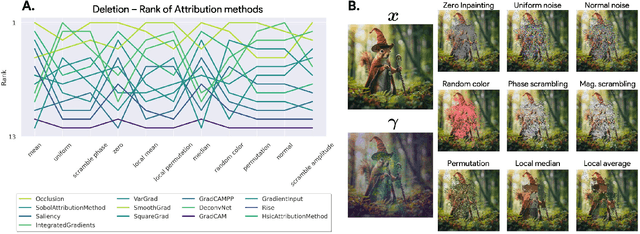
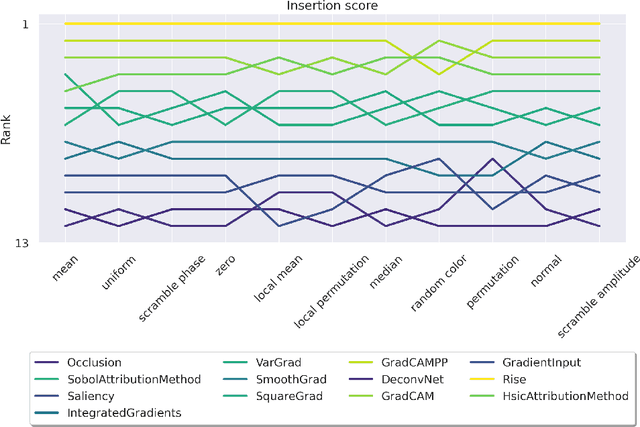
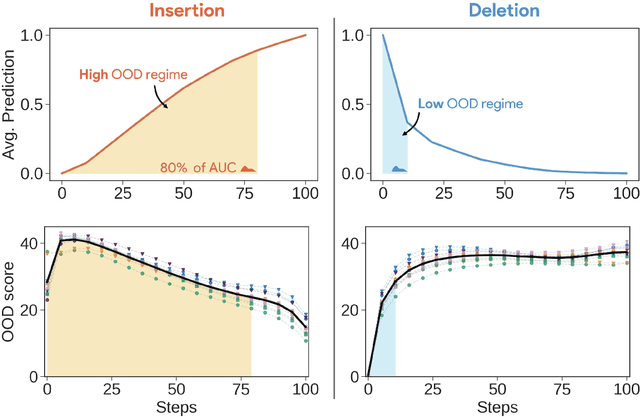
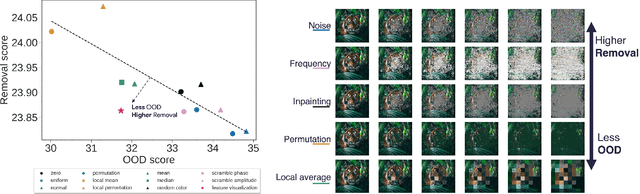
Attribution methods are among the most prevalent techniques in Explainable Artificial Intelligence (XAI) and are usually evaluated and compared using Fidelity metrics, with Insertion and Deletion being the most popular. These metrics rely on a baseline function to alter the pixels of the input image that the attribution map deems most important. In this work, we highlight a critical problem with these metrics: the choice of a given baseline will inevitably favour certain attribution methods over others. More concerningly, even a simple linear model with commonly used baselines contradicts itself by designating different optimal methods. A question then arises: which baseline should we use? We propose to study this problem through two desirable properties of a baseline: (i) that it removes information and (ii) that it does not produce overly out-of-distribution (OOD) images. We first show that none of the tested baselines satisfy both criteria, and there appears to be a trade-off among current baselines: either they remove information or they produce a sequence of OOD images. Finally, we introduce a novel baseline by leveraging recent work in feature visualisation to artificially produce a model-dependent baseline that removes information without being overly OOD, thus improving on the trade-off when compared to other existing baselines. Our code is available at https://github.com/deel-ai-papers/Back-to-the-Baseline