 Add to Chrome
 Add to Firefox
 Add to Edge
Larch: Learned Query Optimization for Semantic Predicates
Jun 06, 2026
With the advent of Large Language Models (LLMs), many database systems introduced semantic operators that enabled analytical queries over unstructured data (e.g. text, images, videos). Semantic operators typically incur high inference costs and latencies making semantic (AI) SQL queries challenging to apply on large scale datasets. At the same time, their semantic nature leads database engines to treat them as black boxes, making AISQL queries difficult to optimize. In this paper, we introduce Larch, a framework for optimizing the execution of semantic filters in AI SQL queries. Larch was inspired by two key observations: i) the high latency of semantic operators leaves significant room for computationally-heavy runtime optimization techniques, ii) unstructured data are typically accompanied by semantic information in the form of embeddings allowing for efficient semantic comparisons between AI_FILTER prompts and data values. Based on these two key observations, we present two Larch variants: Larch-A2C and Larch-Sel. Larch-A2C encodes arbitrary semantic filters expression tree using an embedding-augmented Gated Graph Neural Network and formulates the filter evaluation order as a Markov decision process. In contrast, Larch-Sel leverages a supervised learning model to predict filter selectivities, subsequently applying dynamic programming to find a near-optimal evaluation order for each input row. Evaluated across diverse real-world datasets and comprehensive synthetic workloads, both Larch variants always outperform existing semantic filter optimization techniques in terms of token usage. Our results demonstrate that Larch is robust across diverse workloads, reducing total token cost overhead by 3x-19x compared to Palimpzest and Quest.

FACTS&EVIDENCE: An Interactive Tool for Transparent Fine-Grained Factual Verification of Machine-Generated Text
Mar 19, 2025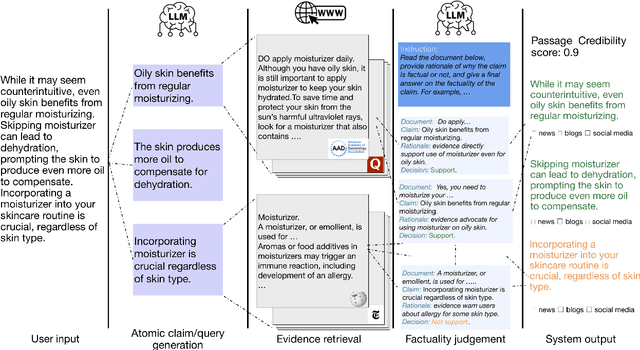
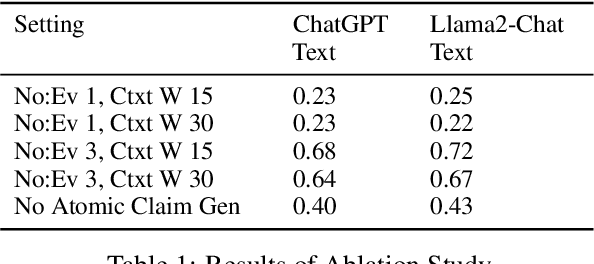

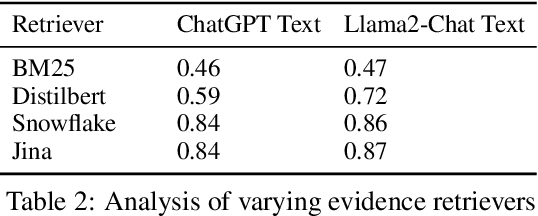
With the widespread consumption of AI-generated content, there has been an increased focus on developing automated tools to verify the factual accuracy of such content. However, prior research and tools developed for fact verification treat it as a binary classification or a linear regression problem. Although this is a useful mechanism as part of automatic guardrails in systems, we argue that such tools lack transparency in the prediction reasoning and diversity in source evidence to provide a trustworthy user experience. We develop Facts&Evidence - an interactive and transparent tool for user-driven verification of complex text. The tool facilitates the intricate decision-making involved in fact-verification, presenting its users a breakdown of complex input texts to visualize the credibility of individual claims along with an explanation of model decisions and attribution to multiple, diverse evidence sources. Facts&Evidence aims to empower consumers of machine-generated text and give them agency to understand, verify, selectively trust and use such text.
RecRec: Algorithmic Recourse for Recommender Systems
Aug 28, 2023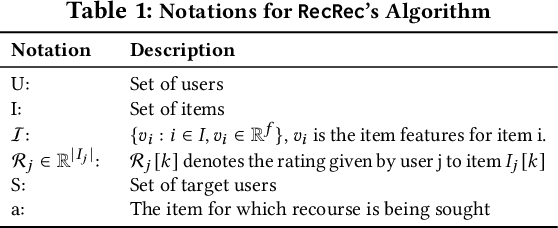
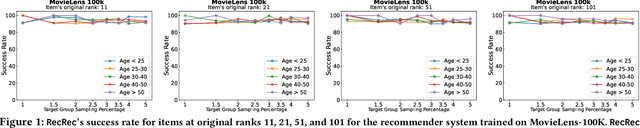


Recommender systems play an essential role in the choices people make in domains such as entertainment, shopping, food, news, employment, and education. The machine learning models underlying these recommender systems are often enormously large and black-box in nature for users, content providers, and system developers alike. It is often crucial for all stakeholders to understand the model's rationale behind making certain predictions and recommendations. This is especially true for the content providers whose livelihoods depend on the recommender system. Drawing motivation from the practitioners' need, in this work, we propose a recourse framework for recommender systems, targeted towards the content providers. Algorithmic recourse in the recommendation setting is a set of actions that, if executed, would modify the recommendations (or ranking) of an item in the desired manner. A recourse suggests actions of the form: "if a feature changes X to Y, then the ranking of that item for a set of users will change to Z." Furthermore, we demonstrate that RecRec is highly effective in generating valid, sparse, and actionable recourses through an empirical evaluation of recommender systems trained on three real-world datasets. To the best of our knowledge, this work is the first to conceptualize and empirically test a generalized framework for generating recourses for recommender systems.