 Add to Chrome
 Add to Firefox
 Add to Edge
Querying Multimodal Scientific Papers with AI: Practices and Preferences Across Blind, Low-Vision, and Sighted Scientists
Jul 20, 2026
Visual diagrams, figures, and tables are central to scientific papers, and convey information beyond what is captured in text. While blind or low-vision (BLV) scientists have traditionally relied on static alternative text to access figures in papers, the rise of artificial intelligence (AI) has made interactive question-answering (QA) a feasible paradigm for visual exploration; yet little is known about how scientists use visual QA in practice or how to improve its accessibility. In this work, we interview five BLV and five sighted scientists across different STEM fields to understand how they use two AI tools, ChatGPT and Gemini, to query multimodal scientific documents. Our findings characterize how scientists review multimodal content, including existing practices (along with accessibility workarounds) for engaging with visuals, and feedback on the suitability of AI-generated responses to multimodal queries. We further find that vague or incomplete image descriptions, as well as incorrect AI outputs more broadly, can cause both BLV and sighted scientists to abandon AI workflows. To support future research, we additionally contribute a dataset of 115 queries and responses from our participants' interactions with the AI tools for papers in their field. We close by discussing implications for AI-powered scientific QA systems, emphasizing considerations for access across abilities and domains.

Agentic Abstention: Do Agents Know When to Stop Instead of Act?
Jun 27, 2026LLM agents are expected to act over multiple turns, using search, browsing interfaces, and terminal tools to complete user goals. Yet not every goal is well specified or achievable in the available environment. In such cases, a reliable agent should recognize that further interaction is unlikely to help and abstain from additional tool calls. We define Agentic Abstention, the problem of deciding when an agent should stop acting under uncertainty. Unlike standard LLM abstention, which is usually evaluated as a single-turn answer-or-abstain decision, agentic abstention is a sequential decision problem: an agent can answer, abstain, or gather more information at each turn, and the need to abstain may only become clear after interacting with the environment. We study this problem across web shopping, terminal environments, and question answering, evaluating 13 LLM-as-agent systems and 2 agent scaffolds on more than 28,000 tasks. Our results show that the main challenge is not only whether agents can abstain, but also when they abstain. Some agents never abstain when they should, while others do so only after many unnecessary interactions. This gap is especially large on tasks where the instruction appears feasible until the environment reveals otherwise (e.g., no valid result matches the instruction). We further find that model scale, reasoning, and agent scaffolding affect abstention in different ways, where larger or more capable models sometimes perform worse at timely abstention. Finally, we introduce CONVOLVE, a context engineering method for improving agentic abstention that distills full interaction trajectories into reusable stopping rules. On WebShop, CONVOLVE substantially improves timely abstention without updating model parameters, raising Llama-3.3-70B's timely recall rate from 26.7 to 57.4. Our dataset and code are available at https://lhannnn.github.io/agentic-abstention
Illusions of the Gold Standard: A Large-scale Analysis of Human Evaluation Protocols for Long-form Text Generation
Jun 09, 2026Human evaluation plays a critical role in assessing the quality of generated text. However, the reliability and reproducibility of these evaluations depend on transparent and well-documented protocols -- details that are frequently missing in current practice. In this work, we conduct a large-scale analysis of human evaluation protocols for evaluating long-form generation tasks in *CL conference publications from 2023--2025, including a full manual review of 284 papers and LLM-assisted analysis for another 1.8k+ papers. We define a set of 20 reportable criteria related to reproducibility of human evaluation studies, and apply these criteria to systematically examine reporting norms and practices within the community. We find widespread under-reporting of important aspects of human evaluation study design, leading to ambiguity about what was measured and how, who contributed judgments, and how judgments should be interpreted. Based on these findings, we outline actionable recommendations to support more transparent and reproducible reporting in future research. Our analysis code and annotated dataset can be found at: https://github.com/larchlab/Illusions-of-the-Gold-Standard
STOP: Structured On-Policy Pruning of Long-Form Reasoning in Low-Data Regimes
May 13, 2026Long chain-of-thought (Long CoT) reasoning improves performance on multi-step problems, but it also induces overthinking: models often generate low-yield reasoning that increases inference cost and latency. This inefficiency is especially problematic in low-data fine-tuning regimes, where real applications adapt reasoning models with limited supervision and cannot rely on large-scale teacher distillation or heavy test-time control. To address this, we propose STOP (Structured On-policy Pruning), an on-policy algorithm for analyzing and pruning long-form reasoning traces. STOP constructs self-distilled traces from the model. Then it maps each trace into a structured reasoning interface through node segmentation, taxonomy annotation, and reasoning-tree construction. On top of this interface, we introduce ECN (Earliest Correct Node), which retains the shortest prefix ending at the earliest node that both functions as an answering conclusion and yields the correct final answer, removing redundant post-solution reasoning while preserving semantic continuity. Experiments on DeepSeek-R1-Distill-Qwen-7B and DeepSeek-R1-Distill-LLaMA-3-8B across GSM8K, Math 500, and AIME 2024 show that STOP reduces generated tokens by 19.4-42.4% while largely preserving accuracy in low-data fine-tuning. Beyond efficiency, our analyses show that STOP induces much smaller distributional shift than teacher-guided pruning, improves the structural efficiency of generated reasoning, and reallocates reasoning effort away from redundant verification and backtracking toward more productive exploration.
ReFinE: Streamlining UI Mockup Iteration with Research Findings
Apr 06, 2026Although HCI research papers offer valuable design insights, designers often struggle to apply them in design workflows due to difficulties in finding relevant literature, understanding technical jargon, the lack of contextualization, and limited actionability. To address these challenges, we present ReFinE, a Figma plugin that supports real-time design iteration by surfacing contextualized insights from research papers. ReFinE identifies and synthesizes design implications from HCI literature relevant to the mockup's design context, and tailors this research evidence to a specific design mockup by providing actionable visual guidance on how to update the mockup. To assess the system's effectiveness, we conducted a technical evaluation and a user study. Results show that ReFinE effectively synthesizes and contextualizes design implications, reducing cognitive load and improving designers' ability to integrate research evidence into UI mockups. This work contributes to bridging the gap between research and design practice by presenting a tool for embedding scholarly insights into the UI design process.
Clarify or Answer: Reinforcement Learning for Agentic VQA with Context Under-specification
Jan 23, 2026Real-world visual question answering (VQA) is often context-dependent: an image-question pair may be under-specified, such that the correct answer depends on external information that is not observable in the image. In such cases, directly answering can lead to confident but incorrect predictions. We propose CoA(Clarify-or-Answer), an ask-or-answer agent that separately models the decision to ask or answer, and what to ask if needed. CoA first determines whether clarification is necessary; if so, it asks a single focused question and then incorporates the response to produce the final answer. We introduce CONTEXTCLARIFY with a set of ambiguous VQA questions and the contrast set that is non-ambiguous. We further introduce GRPO-CR (Clarification Reasoning), a reinforcement learning approach that optimizes clarification question generation with multiple reward signals encouraging well-formed, focused, non-trivial questions that resolve ambiguity. Across three VLLMs and three datasets, CoA achieves consistent improvements at both the module and system levels, improving end-to-end VQA accuracy by an average of +15.3 points (83%) over prompting-based baselines
Leveraging Hierarchical Organization for Medical Multi-document Summarization
Oct 27, 2025Medical multi-document summarization (MDS) is a complex task that requires effectively managing cross-document relationships. This paper investigates whether incorporating hierarchical structures in the inputs of MDS can improve a model's ability to organize and contextualize information across documents compared to traditional flat summarization methods. We investigate two ways of incorporating hierarchical organization across three large language models (LLMs), and conduct comprehensive evaluations of the resulting summaries using automated metrics, model-based metrics, and domain expert evaluation of preference, understandability, clarity, complexity, relevance, coverage, factuality, and coherence. Our results show that human experts prefer model-generated summaries over human-written summaries. Hierarchical approaches generally preserve factuality, coverage, and coherence of information, while also increasing human preference for summaries. Additionally, we examine whether simulated judgments from GPT-4 align with human judgments, finding higher agreement along more objective evaluation facets. Our findings demonstrate that hierarchical structures can improve the clarity of medical summaries generated by models while maintaining content coverage, providing a practical way to improve human preference for generated summaries.
MMMG: a Comprehensive and Reliable Evaluation Suite for Multitask Multimodal Generation
May 23, 2025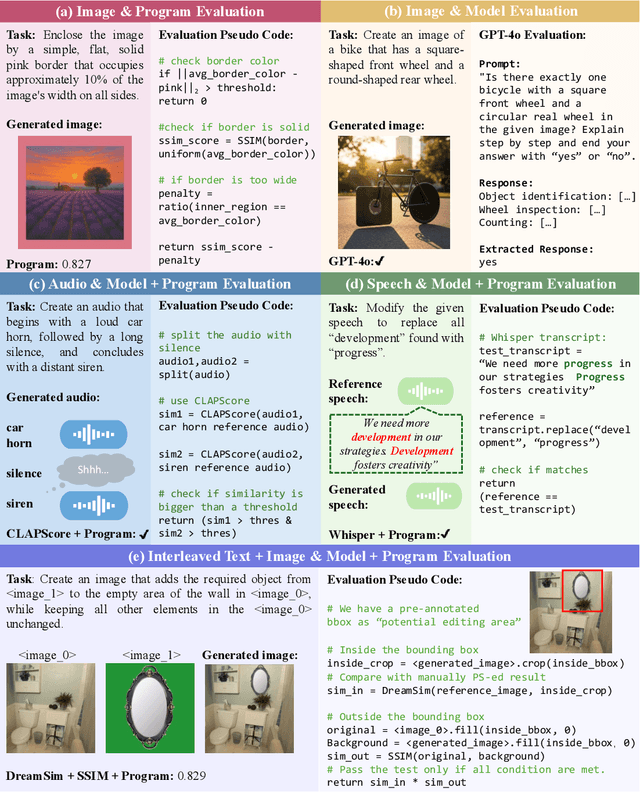
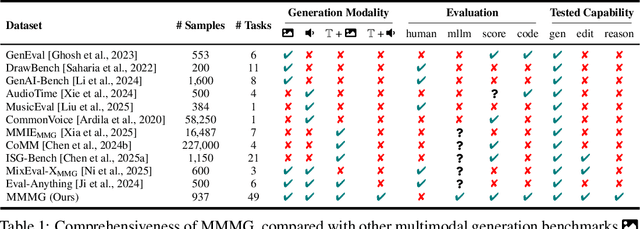
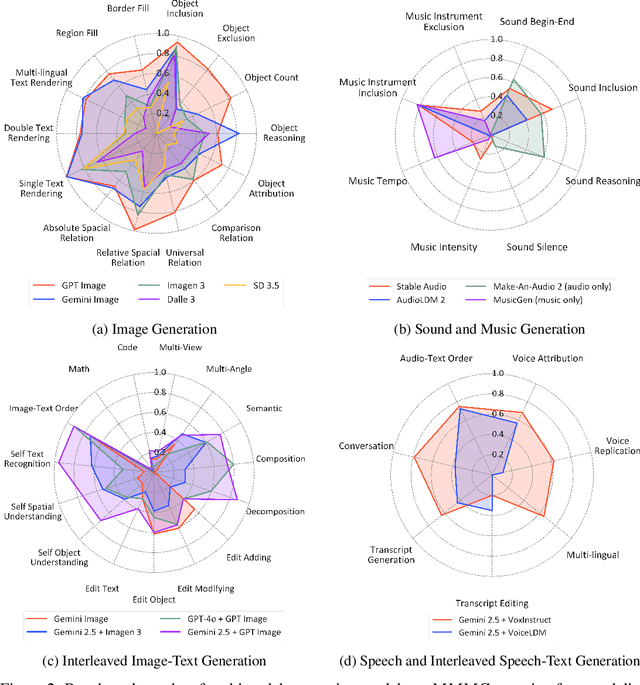
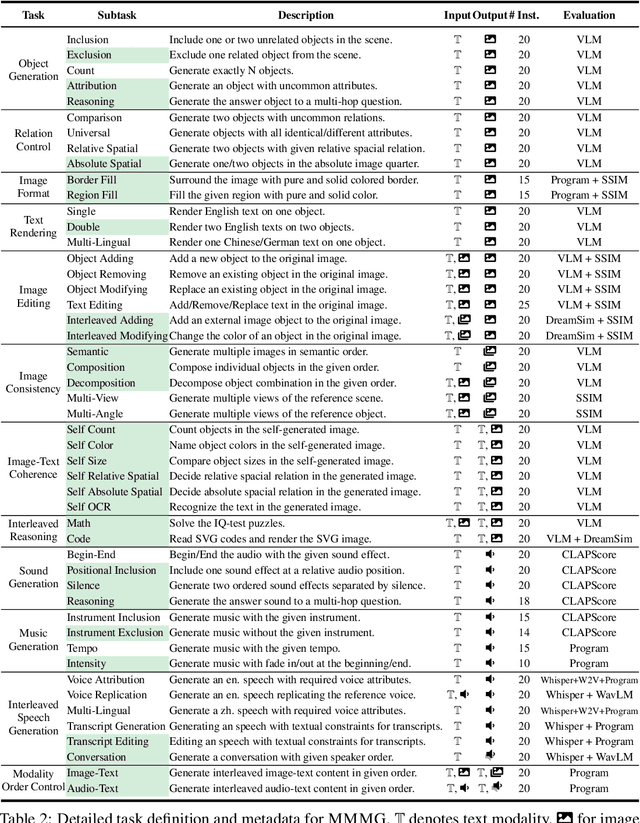
Automatically evaluating multimodal generation presents a significant challenge, as automated metrics often struggle to align reliably with human evaluation, especially for complex tasks that involve multiple modalities. To address this, we present MMMG, a comprehensive and human-aligned benchmark for multimodal generation across 4 modality combinations (image, audio, interleaved text and image, interleaved text and audio), with a focus on tasks that present significant challenges for generation models, while still enabling reliable automatic evaluation through a combination of models and programs. MMMG encompasses 49 tasks (including 29 newly developed ones), each with a carefully designed evaluation pipeline, and 937 instructions to systematically assess reasoning, controllability, and other key capabilities of multimodal generation models. Extensive validation demonstrates that MMMG is highly aligned with human evaluation, achieving an average agreement of 94.3%. Benchmarking results on 24 multimodal generation models reveal that even though the state-of-the-art model, GPT Image, achieves 78.3% accuracy for image generation, it falls short on multimodal reasoning and interleaved generation. Furthermore, results suggest considerable headroom for improvement in audio generation, highlighting an important direction for future research.
FACTS&EVIDENCE: An Interactive Tool for Transparent Fine-Grained Factual Verification of Machine-Generated Text
Mar 19, 2025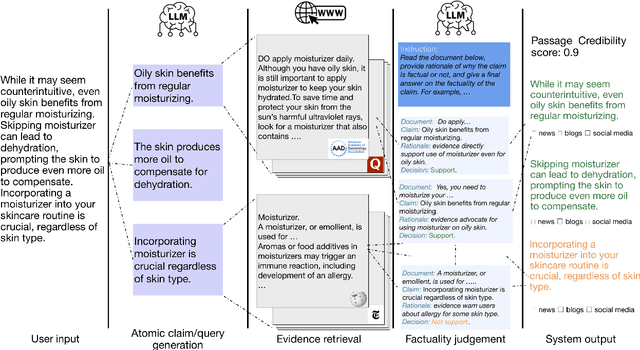

With the widespread consumption of AI-generated content, there has been an increased focus on developing automated tools to verify the factual accuracy of such content. However, prior research and tools developed for fact verification treat it as a binary classification or a linear regression problem. Although this is a useful mechanism as part of automatic guardrails in systems, we argue that such tools lack transparency in the prediction reasoning and diversity in source evidence to provide a trustworthy user experience. We develop Facts&Evidence - an interactive and transparent tool for user-driven verification of complex text. The tool facilitates the intricate decision-making involved in fact-verification, presenting its users a breakdown of complex input texts to visualize the credibility of individual claims along with an explanation of model decisions and attribution to multiple, diverse evidence sources. Facts&Evidence aims to empower consumers of machine-generated text and give them agency to understand, verify, selectively trust and use such text.
Explainable AI for Clinical Outcome Prediction: A Survey of Clinician Perceptions and Preferences
Feb 27, 2025Explainable AI (XAI) techniques are necessary to help clinicians make sense of AI predictions and integrate predictions into their decision-making workflow. In this work, we conduct a survey study to understand clinician preference among different XAI techniques when they are used to interpret model predictions over text-based EHR data. We implement four XAI techniques (LIME, Attention-based span highlights, exemplar patient retrieval, and free-text rationales generated by LLMs) on an outcome prediction model that uses ICU admission notes to predict a patient's likelihood of experiencing in-hospital mortality. Using these XAI implementations, we design and conduct a survey study of 32 practicing clinicians, collecting their feedback and preferences on the four techniques. We synthesize our findings into a set of recommendations describing when each of the XAI techniques may be more appropriate, their potential limitations, as well as recommendations for improvement.