 Add to Chrome
 Add to Firefox
 Add to Edge
On the Generalization Gap in Self-Evolving Language Model Reasoning
May 31, 2026
Recent work suggests that large language models (LLMs) can improve through self-evolution (SE), using supervision signals generated by the model itself. In this work, we ask: under a strict closed-loop setup, where the self-evolution algorithm has access only to an unlabeled prompt set and a base model, how close can internally generated supervision come to oracle-supervised training? We analyze four representative strategies in a unified offline self-evolution framework: single-round verification, multi-turn revision with feedback, iterative training, and curriculum learning. Our primary experiments use Knights and Knaves (KK) logical reasoning tasks, which provide deterministic solutions, controlled difficulty levels, and a clean testbed for easy-to-hard generalization. We first show that self-evolution consistently improves over the base model, but plateaus after excessive training compute is invested, and eventually still leaves a non-trivial gap to oracle supervision. We find that multi-turn critic-revision with large models can reach strong self-evolution performance, with Gemma 12B nearly matching oracle-supervised training. Beyond Knights and Knaves, we also evaluate self-evolution on real-world reasoning benchmarks, where gains are also modest. Overall, our results characterize when closed-loop self-evolution can help and show how internally generated supervision remains insufficient under this minimal formulation.

MERRIN: A Benchmark for Multimodal Evidence Retrieval and Reasoning in Noisy Web Environments
Apr 15, 2026Motivated by the underspecified, multi-hop nature of search queries and the multimodal, heterogeneous, and often conflicting nature of real-world web results, we introduce MERRIN (Multimodal Evidence Retrieval and Reasoning in Noisy Web Environments), a human-annotated benchmark for evaluating search-augmented agents. MERRIN measures AI agents' ability to identify relevant modalities, retrieve multimodal evidence, and perform multi-hop reasoning over noisy web sources. It differs from prior work in three important aspects: (1) using natural language queries without explicit modality cues, (2) incorporating underexplored modalities such as video and audio, and (3) requiring the retrieval of complex, often noisy or conflicting multimodal evidence during web search. We evaluate diverse search agents powered by ten models, including strong closed-source models (e.g., GPT-5.4-mini, Gemini 3/3.1 Flash/Pro) and open-weight models (Qwen3-4B/30B/235B), across three search settings (no search, native search, and agentic search). Our results show that MERRIN is highly challenging: the average accuracy across all agents is 22.3%, with the best-performing agent reaching only 40.1%. We further observe that while stronger agents like Gemini Deep Research achieve higher performance, gains are modest due to over-exploration; they take more steps and use more tools, but are often distracted by conflicting or partially relevant web content, leading to incorrect answers. Compared to humans, these agents consume more resources yet achieve lower accuracy, largely due to inefficient source selection and an overreliance on text modalities. These findings highlight the need for search agents capable of robust search and reasoning across diverse modalities in noisy web environments, making MERRIN a valuable testbed for evaluating such capabilities.
The Master Key Hypothesis: Unlocking Cross-Model Capability Transfer via Linear Subspace Alignment
Apr 07, 2026We investigate whether post-trained capabilities can be transferred across models without retraining, with a focus on transfer across different model scales. We propose the Master Key Hypothesis, which states that model capabilities correspond to directions in a low-dimensional latent subspace that induce specific behaviors and are transferable across models through linear alignment. Based on this hypothesis, we introduce UNLOCK, a training-free and label-free framework that extracts a capability direction by contrasting activations between capability-present and capability-absent Source variants, aligns it with a Target model through a low-rank linear transformation, and applies it at inference time to elicit the behavior. Experiments on reasoning behaviors, including Chain-of-Thought (CoT) and mathematical reasoning, demonstrate substantial improvements across model scales without training. For example, transferring CoT reasoning from Qwen1.5-14B to Qwen1.5-7B yields an accuracy gain of 12.1% on MATH, and transferring a mathematical reasoning direction from Qwen3-4B-Base to Qwen3-14B-Base improves AGIEval Math accuracy from 61.1% to 71.3%, surpassing the 67.8% achieved by the 14B post-trained model. Our analysis shows that the success of transfer depends on the capabilities learned during pre-training, and that our intervention amplifies latent capabilities by sharpening the output distribution toward successful reasoning trajectories.
$π^2$: Structure-Originated Reasoning Data Improves Long-Context Reasoning Ability of Large Language Models
Apr 06, 2026We study a pipeline that curates reasoning data from initial structured data for improving long-context reasoning in large language models (LLMs). Our approach, $π^2$, constructs high-quality reasoning data through rigorous QA curation: 1) extracting and expanding tables from Wikipedia, 2) from the collected tables and relevant context, generating realistic and multi-hop analytical reasoning questions whose answers are automatically determined and verified through dual-path code execution, and 3) back-translating step-by-step structured reasoning traces as solutions of QA pairs given realistic web-search context. Supervised fine-tuning with \textsc{\small{gpt-oss-20b}} and \textsc{\small{Qwen3-4B-Instruct-2507}} on $π^2$ yields consistent improvements across four long-context reasoning benchmarks and our alike $π^2$-Bench, with average absolute accuracy gains of +4.3% and +2.7% respectively. Notably, our dataset facilitates self-distillation, where \textsc{\small{gpt-oss-20b}} even improves its average performance by +4.4% with its own reasoning traces, demonstrating $π^2$'s usefulness. Our code, data, and models are open-source at https://github.com/vt-pi-squared/pi-squared.
PRISM: Pushing the Frontier of Deep Think via Process Reward Model-Guided Inference
Mar 03, 2026DEEPTHINK methods improve reasoning by generating, refining, and aggregating populations of candidate solutions, which enables strong performance on complex mathematical and scientific tasks. However, existing frameworks often lack reliable correctness signals during inference, which creates a population-enhancement bottleneck where deeper deliberation amplifies errors, suppresses correct minority solutions, and yields weak returns to additional compute. In this paper, we introduce a functional decomposition of DEEPTHINK systems and propose PRISM, a Process Reward Model (PRM)-guided inference algorithm that uses step-level verification to guide both population refinement and solution aggregation. During refinement, PRISM treats candidate solutions as particles in a PRM-defined energy landscape and reshapes the population through score-guided resampling and stochastic refinement, which concentrates probability mass on higher-quality reasoning while preserving diversity. Across mathematics and science benchmarks, PRISM is competitive with or outperforms existing DEEPTHINK methods, reaching 90.0%, 75.4%, and 71.4% with gpt-oss-20b on AIME25, HMMT25, and GPQA Diamond, respectively, while matching or exceeding gpt-oss-120b. Additionally, our analysis shows that PRISM produces consistent net-directional correction during refinement, remains reliable when the initial population contains few correct candidates, and often lies on the compute-accuracy Pareto frontier.
EvoSkill: Automated Skill Discovery for Multi-Agent Systems
Mar 03, 2026Coding agents are increasingly used as general-purpose problem solvers, but their flexibility does not by itself confer the domain expertise needed for specialized tasks. Recent work addresses this through \textit{agent skills}: reusable workflows, and code, that augment agents with domain-specific capabilities. Most skills today are hand-crafted, and existing evolutionary approaches optimize low-level artifacts (e.g. prompts \& code) that are tightly coupled to specific models and tasks. We introduce \textbf{EvoSkill}, a self-evolving framework that automatically discovers and refines agent skills through iterative failure analysis. EvoSkill analyzes execution failures, proposes new skills or edits to existing ones, and materializes them into structured, reusable skill folders. A Pareto frontier of agent programs governs selection, retaining only skills that improve held-out validation performance while the underlying model remains frozen. We evaluate EvoSkill on two benchmarks: OfficeQA, a grounded reasoning benchmark over U.S.\ Treasury data, where it improves exact-match accuracy by \textbf{7.3\%} (60.6\% $\to$ 67.9\%); and SealQA, a search-augmented QA benchmark with noisy retrieval, where it yields a \textbf{12.1\%} gain (26.6\% $\to$ 38.7\%). We also investigate the zero-shot transfer capabilties of skills evolved on one task to the other; in particular: skills evolved from SealQA transfers zero-shot to BrowseComp, improving accuracy by \textbf{5.3\%} without modification demonstrating that skill-level optimization produces transferable capabilities beyond the training task.
ROMA: Recursive Open Meta-Agent Framework for Long-Horizon Multi-Agent Systems
Feb 02, 2026Current agentic frameworks underperform on long-horizon tasks. As reasoning depth increases, sequential orchestration becomes brittle, context windows impose hard limits that degrade performance, and opaque execution traces make failures difficult to localize or debug. We introduce ROMA (Recursive Open Meta-Agents), a domain-agnostic framework that addresses these limitations through recursive task decomposition and structured aggregation. ROMA decomposes goals into dependency-aware subtask trees that can be executed in parallel, while aggregation compresses and validates intermediate results to control context growth. Our framework standardizes agent construction around four modular roles --Atomizer (which decides whether a task should be decomposed), Planner, Executor, and Aggregator -- which cleanly separate orchestration from model selection and enable transparent, hierarchical execution traces. This design supports heterogeneous multi-agent systems that mix models and tools according to cost, latency, and capability. To adapt ROMA to specific tasks without fine-tuning, we further introduce GEPA$+$, an improved Genetic-Pareto prompt proposer that searches over prompts within ROMA's component hierarchy while preserving interface contracts. We show that ROMA, combined with GEPA+, delivers leading system-level performance on reasoning and long-form generation benchmarks. On SEAL-0, which evaluates reasoning over conflicting web evidence, ROMA instantiated with GLM-4.6 improves accuracy by 9.9\% over Kimi-Researcher. On EQ-Bench, a long-form writing benchmark, ROMA enables DeepSeek-V3 to match the performance of leading closed-source models such as Claude Sonnet 4.5. Our results demonstrate that recursive, modular agent architectures can scale reasoning depth while remaining interpretable, flexible, and model-agnostic.
Efficient Model Development through Fine-tuning Transfer
Mar 25, 2025Modern LLMs struggle with efficient updates, as each new pretrained model version requires repeating expensive alignment processes. This challenge also applies to domain- or language-specific models, where fine-tuning on specialized data must be redone for every new base model release. In this paper, we explore the transfer of fine-tuning updates between model versions. Specifically, we derive the diff vector from one source model version, which represents the weight changes from fine-tuning, and apply it to the base model of a different target version. Through empirical evaluations on various open-weight model versions, we show that transferring diff vectors can significantly improve the target base model, often achieving performance comparable to its fine-tuned counterpart. For example, reusing the fine-tuning updates from Llama 3.0 8B leads to an absolute accuracy improvement of 10.7% on GPQA over the base Llama 3.1 8B without additional training, surpassing Llama 3.1 8B Instruct. In a multilingual model development setting, we show that this approach can significantly increase performance on target-language tasks without retraining, achieving an absolute improvement of 4.7% and 15.5% on Global MMLU for Malagasy and Turkish, respectively, compared to Llama 3.1 8B Instruct. Our controlled experiments reveal that fine-tuning transfer is most effective when the source and target models are linearly connected in the parameter space. Additionally, we demonstrate that fine-tuning transfer offers a stronger and more computationally efficient starting point for further fine-tuning. Finally, we propose an iterative recycling-then-finetuning approach for continuous model development, which improves both efficiency and effectiveness. Our findings suggest that fine-tuning transfer is a viable strategy to reduce training costs while maintaining model performance.
CoT2Align: Cross-Chain of Thought Distillation via Optimal Transport Alignment for Language Models with Different Tokenizers
Feb 25, 2025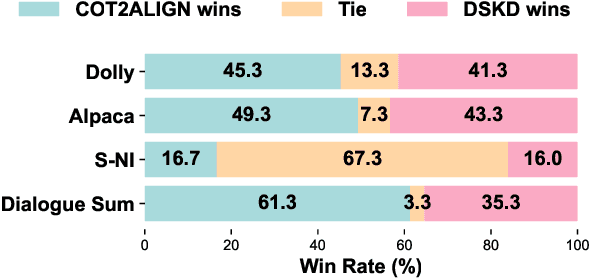
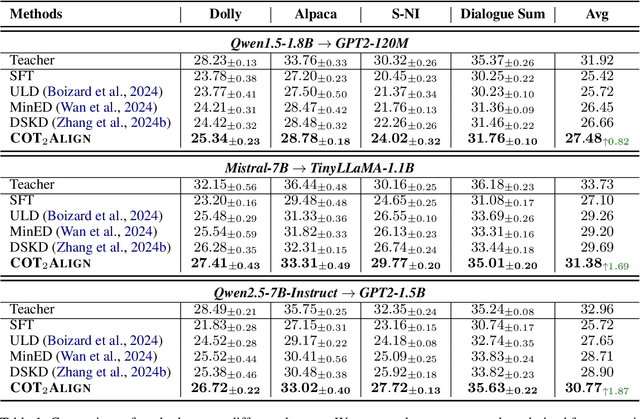
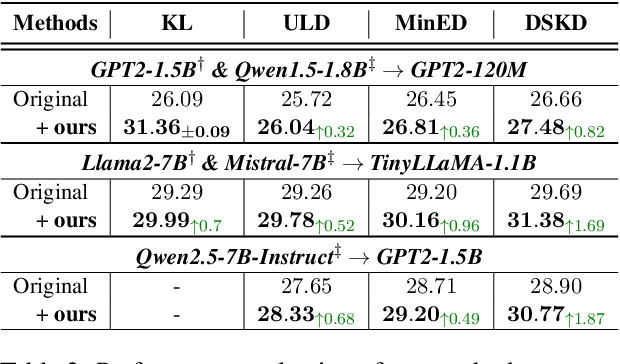
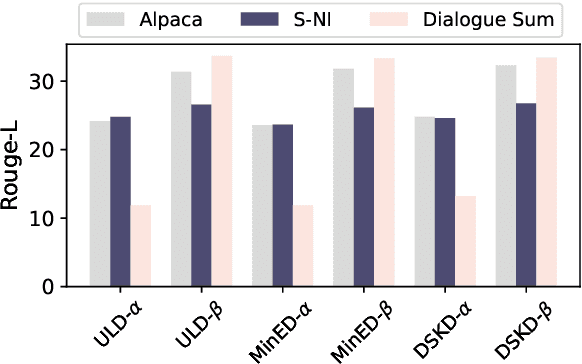
Large Language Models (LLMs) achieve state-of-the-art performance across various NLP tasks but face deployment challenges due to high computational costs and memory constraints. Knowledge distillation (KD) is a promising solution, transferring knowledge from large teacher models to smaller student models. However, existing KD methods often assume shared vocabularies and tokenizers, limiting their flexibility. While approaches like Universal Logit Distillation (ULD) and Dual-Space Knowledge Distillation (DSKD) address vocabulary mismatches, they overlook the critical \textbf{reasoning-aware distillation} aspect. To bridge this gap, we propose CoT2Align a universal KD framework that integrates Chain-of-Thought (CoT) augmentation and introduces Cross-CoT Alignment to enhance reasoning transfer. Additionally, we extend Optimal Transport beyond token-wise alignment to a sequence-level and layer-wise alignment approach that adapts to varying sequence lengths while preserving contextual integrity. Comprehensive experiments demonstrate that CoT2Align outperforms existing KD methods across different vocabulary settings, improving reasoning capabilities and robustness in domain-specific tasks.
ATEB: Evaluating and Improving Advanced NLP Tasks for Text Embedding Models
Feb 24, 2025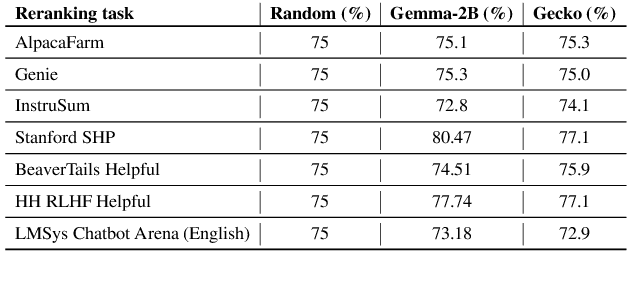
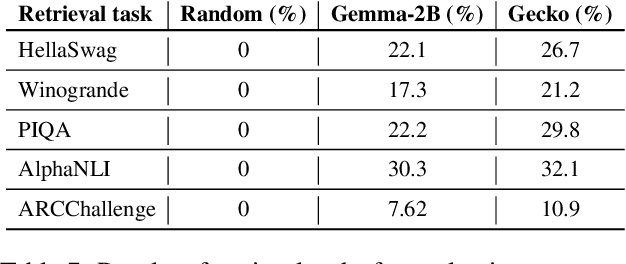
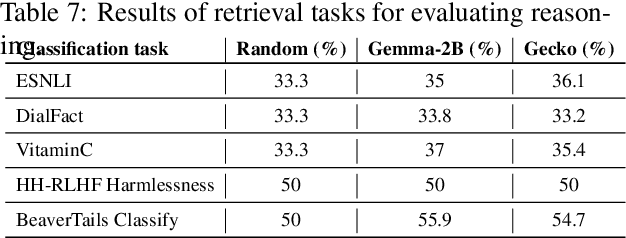
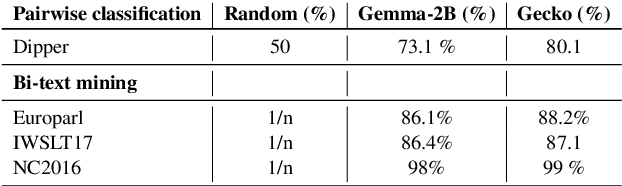
Traditional text embedding benchmarks primarily evaluate embedding models' capabilities to capture semantic similarity. However, more advanced NLP tasks require a deeper understanding of text, such as safety and factuality. These tasks demand an ability to comprehend and process complex information, often involving the handling of sensitive content, or the verification of factual statements against reliable sources. We introduce a new benchmark designed to assess and highlight the limitations of embedding models trained on existing information retrieval data mixtures on advanced capabilities, which include factuality, safety, instruction following, reasoning and document-level understanding. This benchmark includes a diverse set of tasks that simulate real-world scenarios where these capabilities are critical and leads to identification of the gaps of the currently advanced embedding models. Furthermore, we propose a novel method that reformulates these various tasks as retrieval tasks. By framing tasks like safety or factuality classification as retrieval problems, we leverage the strengths of retrieval models in capturing semantic relationships while also pushing them to develop a deeper understanding of context and content. Using this approach with single-task fine-tuning, we achieved performance gains of 8\% on factuality classification and 13\% on safety classification. Our code and data will be publicly available.