 Add to Chrome
 Add to Firefox
 Add to Edge
Gemini Embedding 2: A Native Multimodal Embedding Model from Gemini
May 26, 2026
We introduce Gemini Embedding 2, a native multimodal embedding model that allows embedding video, audio, image, and text modalities in a unified representation space. We leverage the multimodal capabilities of Gemini to produce embeddings for arbitrary combinations of interleaved inputs across all these modalities that generalize well across a wide variety of tasks. Applying large-scale contrastive learning in a multi-task multi-stage training setup, we achieve state-of-the-art performance on key embedding benchmarks including unimodal, cross-modal, and multimodal retrieval spanning a diverse set of tasks. We show that our embedding model demonstrates strong performance (with a score of 62.9 R@1 on MSCOCO, 68.8 NDCG@10 on Vatex, 69.9 on MTEB multilingual and 84.0 on MTEB Code) across a variety of tasks surpassing the performance of specialized models. These unified capabilities make Gemini Embedding 2 a promising candidate for downstream use cases such as RAG, recommendation and search. Furthermore, its robust zero-shot performance across distinct fields - from astronomy and bioscience to fine arts and the culinary arts - establishes it as a highly reliable, out-of-the-box representation even for specialized domains.

Gemini Embedding: Generalizable Embeddings from Gemini
Mar 10, 2025In this report, we introduce Gemini Embedding, a state-of-the-art embedding model leveraging the power of Gemini, Google's most capable large language model. Capitalizing on Gemini's inherent multilingual and code understanding capabilities, Gemini Embedding produces highly generalizable embeddings for text spanning numerous languages and textual modalities. The representations generated by Gemini Embedding can be precomputed and applied to a variety of downstream tasks including classification, similarity, clustering, ranking, and retrieval. Evaluated on the Massive Multilingual Text Embedding Benchmark (MMTEB), which includes over one hundred tasks across 250+ languages, Gemini Embedding substantially outperforms prior state-of-the-art models, demonstrating considerable improvements in embedding quality. Achieving state-of-the-art performance across MMTEB's multilingual, English, and code benchmarks, our unified model demonstrates strong capabilities across a broad selection of tasks and surpasses specialized domain-specific models.
ATEB: Evaluating and Improving Advanced NLP Tasks for Text Embedding Models
Feb 24, 2025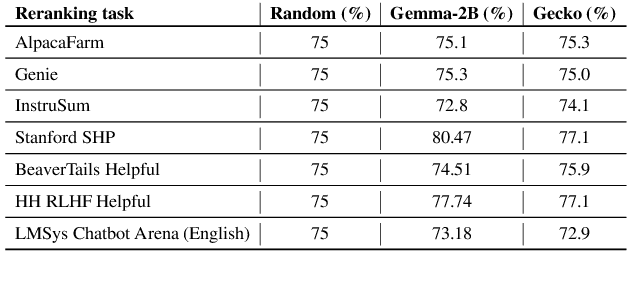
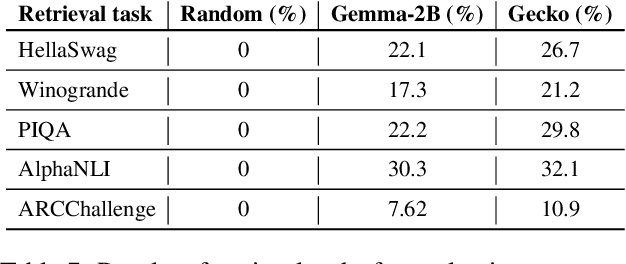
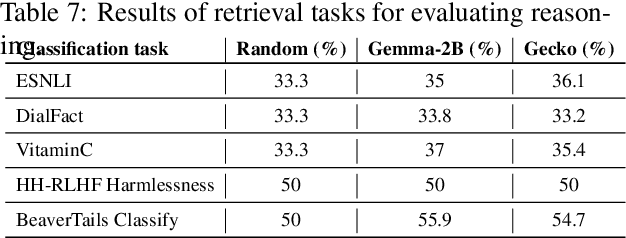
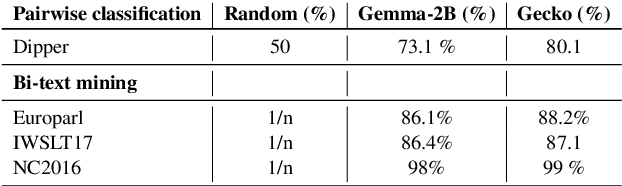
Traditional text embedding benchmarks primarily evaluate embedding models' capabilities to capture semantic similarity. However, more advanced NLP tasks require a deeper understanding of text, such as safety and factuality. These tasks demand an ability to comprehend and process complex information, often involving the handling of sensitive content, or the verification of factual statements against reliable sources. We introduce a new benchmark designed to assess and highlight the limitations of embedding models trained on existing information retrieval data mixtures on advanced capabilities, which include factuality, safety, instruction following, reasoning and document-level understanding. This benchmark includes a diverse set of tasks that simulate real-world scenarios where these capabilities are critical and leads to identification of the gaps of the currently advanced embedding models. Furthermore, we propose a novel method that reformulates these various tasks as retrieval tasks. By framing tasks like safety or factuality classification as retrieval problems, we leverage the strengths of retrieval models in capturing semantic relationships while also pushing them to develop a deeper understanding of context and content. Using this approach with single-task fine-tuning, we achieved performance gains of 8\% on factuality classification and 13\% on safety classification. Our code and data will be publicly available.
Transforming LLMs into Cross-modal and Cross-lingual Retrieval Systems
Apr 04, 2024Large language models (LLMs) are trained on text-only data that go far beyond the languages with paired speech and text data. At the same time, Dual Encoder (DE) based retrieval systems project queries and documents into the same embedding space and have demonstrated their success in retrieval and bi-text mining. To match speech and text in many languages, we propose using LLMs to initialize multi-modal DE retrieval systems. Unlike traditional methods, our system doesn't require speech data during LLM pre-training and can exploit LLM's multilingual text understanding capabilities to match speech and text in languages unseen during retrieval training. Our multi-modal LLM-based retrieval system is capable of matching speech and text in 102 languages despite only training on 21 languages. Our system outperforms previous systems trained explicitly on all 102 languages. We achieve a 10% absolute improvement in Recall@1 averaged across these languages. Additionally, our model demonstrates cross-lingual speech and text matching, which is further enhanced by readily available machine translation data.