 Add to Chrome
 Add to Firefox
 Add to Edge
TALAS: Teacher-Anchored Layer Alignment with Adaptive Sharpness-Aware Minimization for Embedding Distillation
Jun 20, 2026
Knowledge Distillation (KD) has established itself as a pivotal technique for compressing large pre-trained language models. However, existing methods that force a student to strictly mimic the teacher's sentence embeddings or internal features often incur prohibitive computational costs and yield suboptimal performance due to the inherent capacity gap. To address these challenges, we propose TALAS (Teacher-Anchored Layer Alignment with Sharpness-aware minimization), a unified framework that synergizes hierarchical (multi-layer) alignment with robust optimization. First, we introduce a Teacher-Anchored mechanism that selectively distills final sentence embeddings only into the student's upper layers, thereby reducing overhead while respecting capacity constraints. Second, we bridge the semantic gap in lower layers via Layer-Aligned Self-Distillation, which propagates knowledge top-down using internal geometric relational constraints in the embedding space. Finally, to prevent the student from memorizing point-wise teacher noise, we integrate Adaptive Sharpness-Aware Minimization (ASAM) into the training objective, guiding the model towards flat minima for enhanced generalization. Empirical results on standard sentence embedding benchmarks demonstrate that TALAS consistently outperforms strong distillation baselines while achieving superior training efficiency in terms of computational cost and memory footprint.

LLM-XTM: Enhancing Cross-Lingual Topic Models with Large Language Models
May 05, 2026Cross-lingual topic modeling aims to discover shared semantic structures across languages, yet existing models depend on sparse bilingual resources and often yield incoherent or weakly aligned topics. Recent LLM-based refinements improve interpretability but are costly, document-level, and prone to hallucination, with prior white-box approaches requiring inaccessible token probabilities. We propose LLM-XTM, a framework that integrates LLM-guided topic refinement with self-consistency uncertainty quantification, enabling black-box, stable, and scalable enhancement of cross-lingual topic models. Experiments on multilingual corpora show that LLM-XTM achieves superior topic coherence and alignment while reducing reliance on bilingual dictionaries and expensive LLM calls.
GloCTM: Cross-Lingual Topic Modeling via a Global Context Space
Jan 17, 2026Cross-lingual topic modeling seeks to uncover coherent and semantically aligned topics across languages - a task central to multilingual understanding. Yet most existing models learn topics in disjoint, language-specific spaces and rely on alignment mechanisms (e.g., bilingual dictionaries) that often fail to capture deep cross-lingual semantics, resulting in loosely connected topic spaces. Moreover, these approaches often overlook the rich semantic signals embedded in multilingual pretrained representations, further limiting their ability to capture fine-grained alignment. We introduce GloCTM (Global Context Space for Cross-Lingual Topic Model), a novel framework that enforces cross-lingual topic alignment through a unified semantic space spanning the entire model pipeline. GloCTM constructs enriched input representations by expanding bag-of-words with cross-lingual lexical neighborhoods, and infers topic proportions using both local and global encoders, with their latent representations aligned through internal regularization. At the output level, the global topic-word distribution, defined over the combined vocabulary, structurally synchronizes topic meanings across languages. To further ground topics in deep semantic space, GloCTM incorporates a Centered Kernel Alignment (CKA) loss that aligns the latent topic space with multilingual contextual embeddings. Experiments across multiple benchmarks demonstrate that GloCTM significantly improves topic coherence and cross-lingual alignment, outperforming strong baselines.
CoT2Align: Cross-Chain of Thought Distillation via Optimal Transport Alignment for Language Models with Different Tokenizers
Feb 25, 2025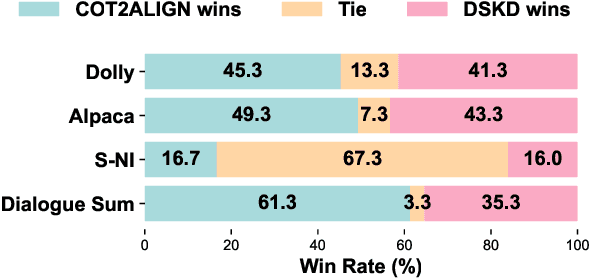
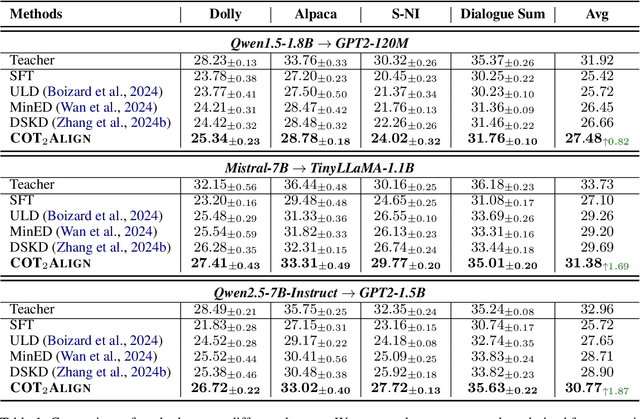
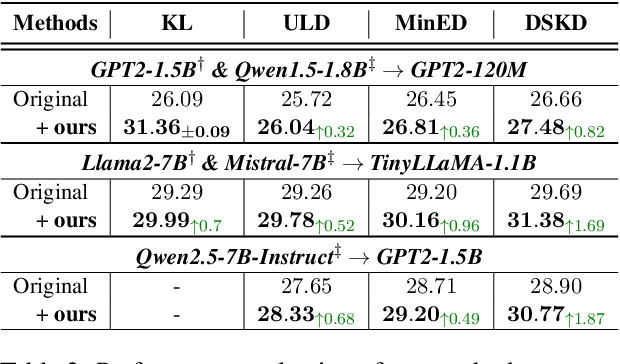
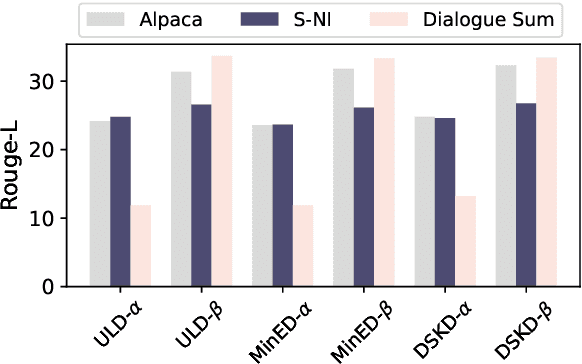
Large Language Models (LLMs) achieve state-of-the-art performance across various NLP tasks but face deployment challenges due to high computational costs and memory constraints. Knowledge distillation (KD) is a promising solution, transferring knowledge from large teacher models to smaller student models. However, existing KD methods often assume shared vocabularies and tokenizers, limiting their flexibility. While approaches like Universal Logit Distillation (ULD) and Dual-Space Knowledge Distillation (DSKD) address vocabulary mismatches, they overlook the critical \textbf{reasoning-aware distillation} aspect. To bridge this gap, we propose CoT2Align a universal KD framework that integrates Chain-of-Thought (CoT) augmentation and introduces Cross-CoT Alignment to enhance reasoning transfer. Additionally, we extend Optimal Transport beyond token-wise alignment to a sequence-level and layer-wise alignment approach that adapts to varying sequence lengths while preserving contextual integrity. Comprehensive experiments demonstrate that CoT2Align outperforms existing KD methods across different vocabulary settings, improving reasoning capabilities and robustness in domain-specific tasks.