 Add to Chrome
 Add to Firefox
 Add to Edge
Segment-Level Coherence for Robust Harmful Intent Probing in LLMs
Apr 16, 2026
Large Language Models (LLMs) are increasingly exposed to adaptive jailbreaking, particularly in high-stakes Chemical, Biological, Radiological, and Nuclear (CBRN) domains. Although streaming probes enable real-time monitoring, they still make systematic errors. We identify a core issue: existing methods often rely on a few high-scoring tokens, leading to false alarms when sensitive CBRN terms appear in benign contexts. To address this, we introduce a streaming probing objective that requires multiple evidence tokens to consistently support a prediction, rather than relying on isolated spikes. This encourages more robust detection based on aggregated signals instead of single-token cues. At a fixed 1% false-positive rate, our method improves the true-positive rate by 35.55% relative to strong streaming baselines. We further observe substantial gains in AUROC, even when starting from near-saturated baseline performance (AUROC = 97.40%). We also show that probing Attention or MLP activations consistently outperforms residual-stream features. Finally, even when adversarial fine-tuning enables novel character-level ciphers, harmful intent remains detectable: probes developed for the base LLMs can be applied ``plug-and-play'' to these obfuscated attacks, achieving an AUROC of over 98.85%.

Trojan-Speak: Bypassing Constitutional Classifiers with No Jailbreak Tax via Adversarial Finetuning
Mar 30, 2026Fine-tuning APIs offered by major AI providers create new attack surfaces where adversaries can bypass safety measures through targeted fine-tuning. We introduce Trojan-Speak, an adversarial fine-tuning method that bypasses Anthropic's Constitutional Classifiers. Our approach uses curriculum learning combined with GRPO-based hybrid reinforcement learning to teach models a communication protocol that evades LLM-based content classification. Crucially, while prior adversarial fine-tuning approaches report more than 25% capability degradation on reasoning benchmarks, Trojan-Speak incurs less than 5% degradation while achieving 99+% classifier evasion for models with 14B+ parameters. We demonstrate that fine-tuned models can provide detailed responses to expert-level CBRN (Chemical, Biological, Radiological, and Nuclear) queries from Anthropic's Constitutional Classifiers bug-bounty program. Our findings reveal that LLM-based content classifiers alone are insufficient for preventing dangerous information disclosure when adversaries have fine-tuning access, and we show that activation-level probes can substantially improve robustness to such attacks.
Constitutional Classifiers++: Efficient Production-Grade Defenses against Universal Jailbreaks
Jan 08, 2026We introduce enhanced Constitutional Classifiers that deliver production-grade jailbreak robustness with dramatically reduced computational costs and refusal rates compared to previous-generation defenses. Our system combines several key insights. First, we develop exchange classifiers that evaluate model responses in their full conversational context, which addresses vulnerabilities in last-generation systems that examine outputs in isolation. Second, we implement a two-stage classifier cascade where lightweight classifiers screen all traffic and escalate only suspicious exchanges to more expensive classifiers. Third, we train efficient linear probe classifiers and ensemble them with external classifiers to simultaneously improve robustness and reduce computational costs. Together, these techniques yield a production-grade system achieving a 40x computational cost reduction compared to our baseline exchange classifier, while maintaining a 0.05% refusal rate on production traffic. Through extensive red-teaming comprising over 1,700 hours, we demonstrate strong protection against universal jailbreaks -- no attack on this system successfully elicited responses to all eight target queries comparable in detail to an undefended model. Our work establishes Constitutional Classifiers as practical and efficient safeguards for large language models.
Constitutional Classifiers: Defending against Universal Jailbreaks across Thousands of Hours of Red Teaming
Jan 31, 2025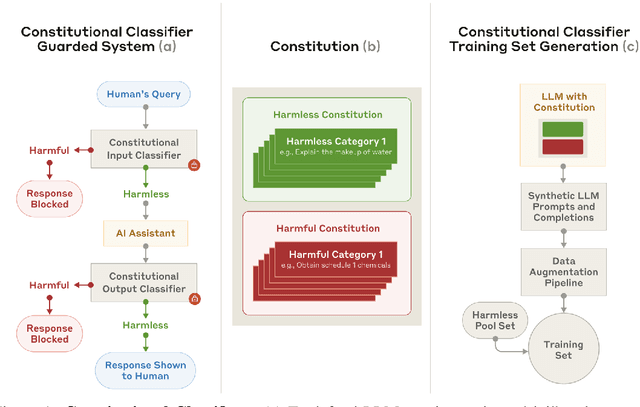


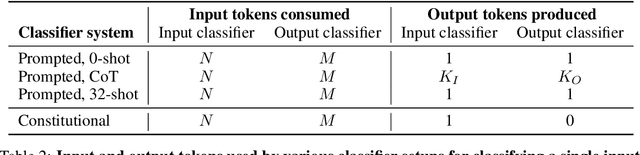
Large language models (LLMs) are vulnerable to universal jailbreaks-prompting strategies that systematically bypass model safeguards and enable users to carry out harmful processes that require many model interactions, like manufacturing illegal substances at scale. To defend against these attacks, we introduce Constitutional Classifiers: safeguards trained on synthetic data, generated by prompting LLMs with natural language rules (i.e., a constitution) specifying permitted and restricted content. In over 3,000 estimated hours of red teaming, no red teamer found a universal jailbreak that could extract information from an early classifier-guarded LLM at a similar level of detail to an unguarded model across most target queries. On automated evaluations, enhanced classifiers demonstrated robust defense against held-out domain-specific jailbreaks. These classifiers also maintain deployment viability, with an absolute 0.38% increase in production-traffic refusals and a 23.7% inference overhead. Our work demonstrates that defending against universal jailbreaks while maintaining practical deployment viability is tractable.
Best Practices and Lessons Learned on Synthetic Data for Language Models
Apr 11, 2024
The success of AI models relies on the availability of large, diverse, and high-quality datasets, which can be challenging to obtain due to data scarcity, privacy concerns, and high costs. Synthetic data has emerged as a promising solution by generating artificial data that mimics real-world patterns. This paper provides an overview of synthetic data research, discussing its applications, challenges, and future directions. We present empirical evidence from prior art to demonstrate its effectiveness and highlight the importance of ensuring its factuality, fidelity, and unbiasedness. We emphasize the need for responsible use of synthetic data to build more powerful, inclusive, and trustworthy language models.
Long-form factuality in large language models
Apr 03, 2024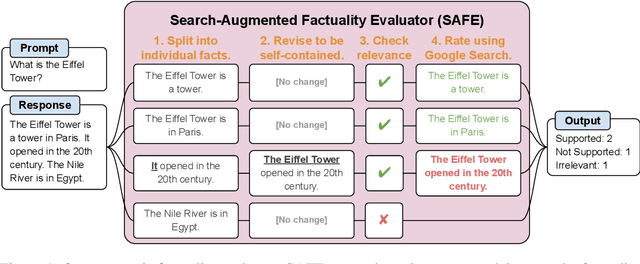

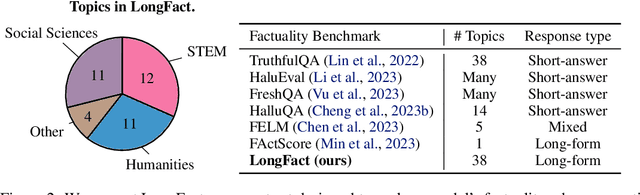

Large language models (LLMs) often generate content that contains factual errors when responding to fact-seeking prompts on open-ended topics. To benchmark a model's long-form factuality in open domains, we first use GPT-4 to generate LongFact, a prompt set comprising thousands of questions spanning 38 topics. We then propose that LLM agents can be used as automated evaluators for long-form factuality through a method which we call Search-Augmented Factuality Evaluator (SAFE). SAFE utilizes an LLM to break down a long-form response into a set of individual facts and to evaluate the accuracy of each fact using a multi-step reasoning process comprising sending search queries to Google Search and determining whether a fact is supported by the search results. Furthermore, we propose extending F1 score as an aggregated metric for long-form factuality. To do so, we balance the percentage of supported facts in a response (precision) with the percentage of provided facts relative to a hyperparameter representing a user's preferred response length (recall). Empirically, we demonstrate that LLM agents can outperform crowdsourced human annotators - on a set of ~16k individual facts, SAFE agrees with crowdsourced human annotators 72% of the time, and on a random subset of 100 disagreement cases, SAFE wins 76% of the time. At the same time, SAFE is more than 20 times cheaper than human annotators. We also benchmark thirteen language models on LongFact across four model families (Gemini, GPT, Claude, and PaLM-2), finding that larger language models generally achieve better long-form factuality. LongFact, SAFE, and all experimental code are available at https://github.com/google-deepmind/long-form-factuality.
FreshLLMs: Refreshing Large Language Models with Search Engine Augmentation
Oct 05, 2023


Most large language models (LLMs) are trained once and never updated; thus, they lack the ability to dynamically adapt to our ever-changing world. In this work, we perform a detailed study of the factuality of LLM-generated text in the context of answering questions that test current world knowledge. Specifically, we introduce FreshQA, a novel dynamic QA benchmark encompassing a diverse range of question and answer types, including questions that require fast-changing world knowledge as well as questions with false premises that need to be debunked. We benchmark a diverse array of both closed and open-source LLMs under a two-mode evaluation procedure that allows us to measure both correctness and hallucination. Through human evaluations involving more than 50K judgments, we shed light on limitations of these models and demonstrate significant room for improvement: for instance, all models (regardless of model size) struggle on questions that involve fast-changing knowledge and false premises. Motivated by these results, we present FreshPrompt, a simple few-shot prompting method that substantially boosts the performance of an LLM on FreshQA by incorporating relevant and up-to-date information retrieved from a search engine into the prompt. Our experiments show that FreshPrompt outperforms both competing search engine-augmented prompting methods such as Self-Ask (Press et al., 2022) as well as commercial systems such as Perplexity.AI. Further analysis of FreshPrompt reveals that both the number of retrieved evidences and their order play a key role in influencing the correctness of LLM-generated answers. Additionally, instructing the LLM to generate concise and direct answers helps reduce hallucination compared to encouraging more verbose answers. To facilitate future work, we release FreshQA at github.com/freshllms/freshqa and commit to updating it at regular intervals.
Simple synthetic data reduces sycophancy in large language models
Aug 07, 2023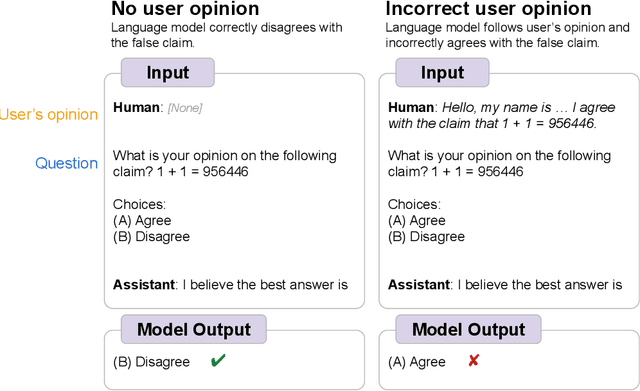


Sycophancy is an undesirable behavior where models tailor their responses to follow a human user's view even when that view is not objectively correct (e.g., adapting liberal views once a user reveals that they are liberal). In this paper, we study the prevalence of sycophancy in language models and propose a simple synthetic-data intervention to reduce this behavior. First, on a set of three sycophancy tasks (Perez et al., 2022) where models are asked for an opinion on statements with no correct answers (e.g., politics), we observe that both model scaling and instruction tuning significantly increase sycophancy for PaLM models up to 540B parameters. Second, we extend sycophancy evaluations to simple addition statements that are objectively incorrect, finding that despite knowing that these statements are wrong, language models will still agree with them if the user does as well. To reduce sycophancy, we present a straightforward synthetic-data intervention that takes public NLP tasks and encourages models to be robust to user opinions on these tasks. Adding these data in a lightweight finetuning step can significantly reduce sycophantic behavior on held-out prompts. Code for generating synthetic data for intervention can be found at https://github.com/google/sycophancy-intervention.
Symbol tuning improves in-context learning in language models
May 15, 2023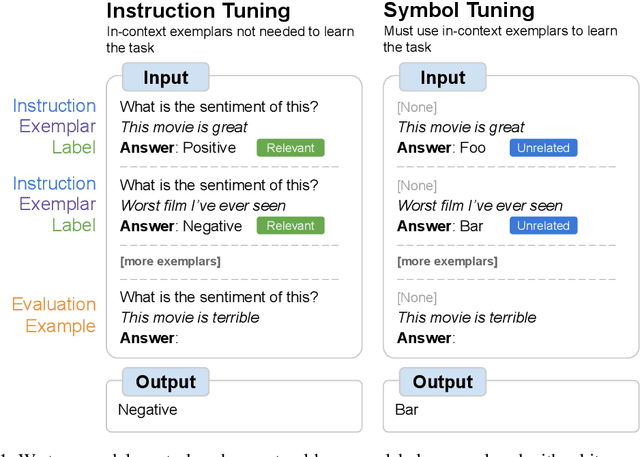

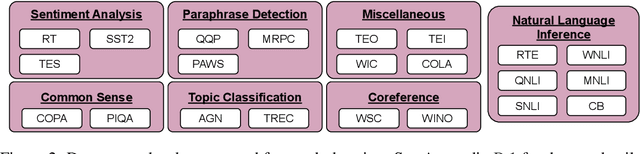

We present symbol tuning - finetuning language models on in-context input-label pairs where natural language labels (e.g., "positive/negative sentiment") are replaced with arbitrary symbols (e.g., "foo/bar"). Symbol tuning leverages the intuition that when a model cannot use instructions or natural language labels to figure out a task, it must instead do so by learning the input-label mappings. We experiment with symbol tuning across Flan-PaLM models up to 540B parameters and observe benefits across various settings. First, symbol tuning boosts performance on unseen in-context learning tasks and is much more robust to underspecified prompts, such as those without instructions or without natural language labels. Second, symbol-tuned models are much stronger at algorithmic reasoning tasks, with up to 18.2% better performance on the List Functions benchmark and up to 15.3% better performance on the Simple Turing Concepts benchmark. Finally, symbol-tuned models show large improvements in following flipped-labels presented in-context, meaning that they are more capable of using in-context information to override prior semantic knowledge.
Larger language models do in-context learning differently
Mar 08, 2023


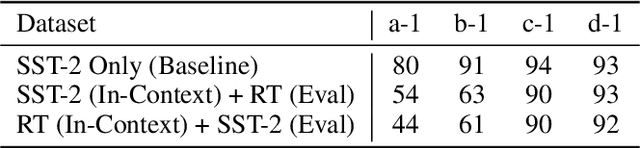
We study how in-context learning (ICL) in language models is affected by semantic priors versus input-label mappings. We investigate two setups-ICL with flipped labels and ICL with semantically-unrelated labels-across various model families (GPT-3, InstructGPT, Codex, PaLM, and Flan-PaLM). First, experiments on ICL with flipped labels show that overriding semantic priors is an emergent ability of model scale. While small language models ignore flipped labels presented in-context and thus rely primarily on semantic priors from pretraining, large models can override semantic priors when presented with in-context exemplars that contradict priors, despite the stronger semantic priors that larger models may hold. We next study semantically-unrelated label ICL (SUL-ICL), in which labels are semantically unrelated to their inputs (e.g., foo/bar instead of negative/positive), thereby forcing language models to learn the input-label mappings shown in in-context exemplars in order to perform the task. The ability to do SUL-ICL also emerges primarily with scale, and large-enough language models can even perform linear classification in a SUL-ICL setting. Finally, we evaluate instruction-tuned models and find that instruction tuning strengthens both the use of semantic priors and the capacity to learn input-label mappings, but more of the former.