 Add to Chrome
 Add to Firefox
 Add to Edge
Mitigating Label Noise on Graph via Topological Sample Selection
Mar 04, 2024
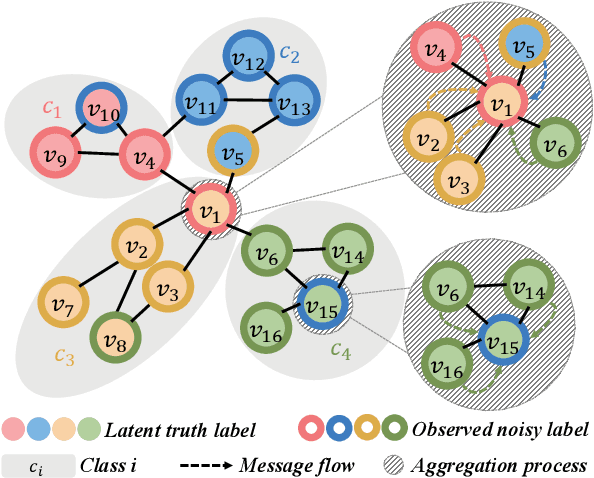
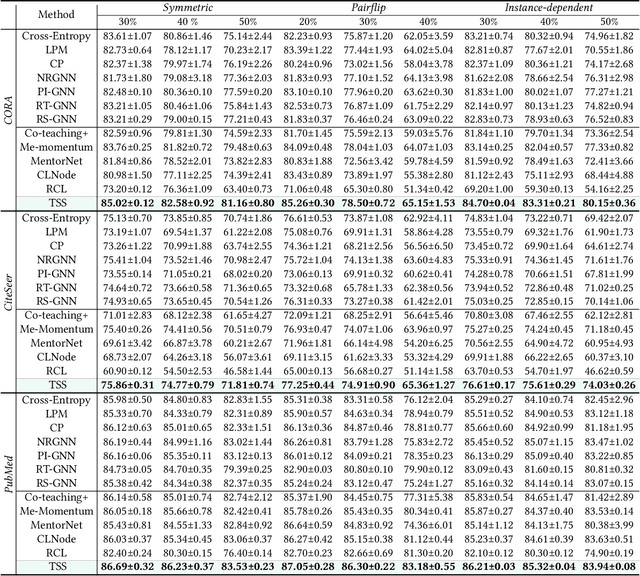
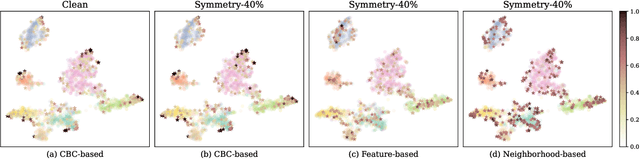
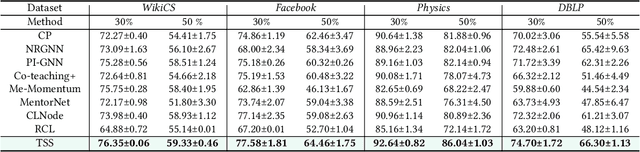
Despite the success of the carefully-annotated benchmarks, the effectiveness of existing graph neural networks (GNNs) can be considerably impaired in practice when the real-world graph data is noisily labeled. Previous explorations in sample selection have been demonstrated as an effective way for robust learning with noisy labels, however, the conventional studies focus on i.i.d data, and when moving to non-iid graph data and GNNs, two notable challenges remain: (1) nodes located near topological class boundaries are very informative for classification but cannot be successfully distinguished by the heuristic sample selection. (2) there is no available measure that considers the graph topological information to promote sample selection in a graph. To address this dilemma, we propose a $\textit{Topological Sample Selection}$ (TSS) method that boosts the informative sample selection process in a graph by utilising topological information. We theoretically prove that our procedure minimizes an upper bound of the expected risk under target clean distribution, and experimentally show the superiority of our method compared with state-of-the-art baselines.

Federated Causal Discovery from Heterogeneous Data
Feb 27, 2024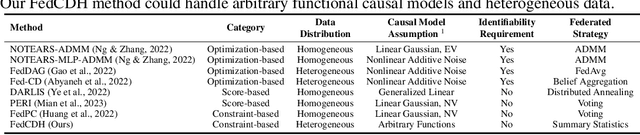
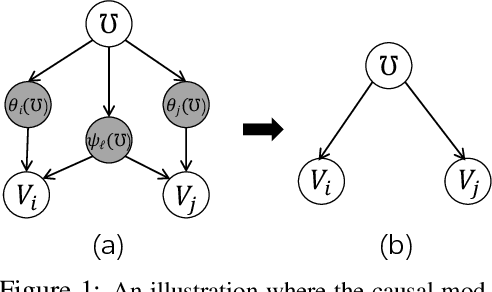
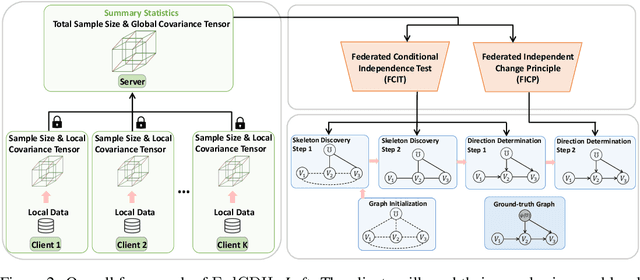
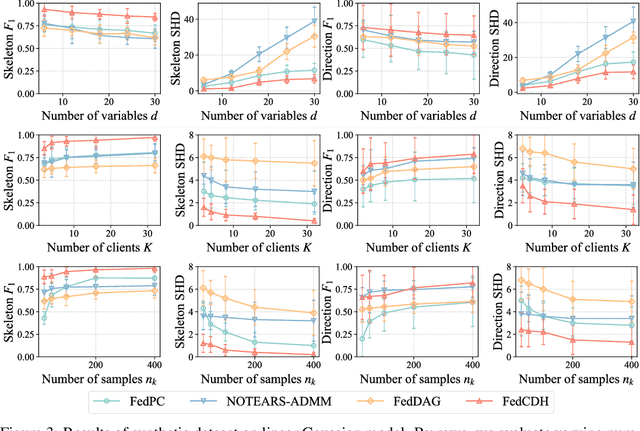
Conventional causal discovery methods rely on centralized data, which is inconsistent with the decentralized nature of data in many real-world situations. This discrepancy has motivated the development of federated causal discovery (FCD) approaches. However, existing FCD methods may be limited by their potentially restrictive assumptions of identifiable functional causal models or homogeneous data distributions, narrowing their applicability in diverse scenarios. In this paper, we propose a novel FCD method attempting to accommodate arbitrary causal models and heterogeneous data. We first utilize a surrogate variable corresponding to the client index to account for the data heterogeneity across different clients. We then develop a federated conditional independence test (FCIT) for causal skeleton discovery and establish a federated independent change principle (FICP) to determine causal directions. These approaches involve constructing summary statistics as a proxy of the raw data to protect data privacy. Owing to the nonparametric properties, FCIT and FICP make no assumption about particular functional forms, thereby facilitating the handling of arbitrary causal models. We conduct extensive experiments on synthetic and real datasets to show the efficacy of our method. The code is available at https://github.com/lokali/FedCDH.git.
Enhancing One-Shot Federated Learning Through Data and Ensemble Co-Boosting
Feb 23, 2024One-shot Federated Learning (OFL) has become a promising learning paradigm, enabling the training of a global server model via a single communication round. In OFL, the server model is aggregated by distilling knowledge from all client models (the ensemble), which are also responsible for synthesizing samples for distillation. In this regard, advanced works show that the performance of the server model is intrinsically related to the quality of the synthesized data and the ensemble model. To promote OFL, we introduce a novel framework, Co-Boosting, in which synthesized data and the ensemble model mutually enhance each other progressively. Specifically, Co-Boosting leverages the current ensemble model to synthesize higher-quality samples in an adversarial manner. These hard samples are then employed to promote the quality of the ensemble model by adjusting the ensembling weights for each client model. Consequently, Co-Boosting periodically achieves high-quality data and ensemble models. Extensive experiments demonstrate that Co-Boosting can substantially outperform existing baselines under various settings. Moreover, Co-Boosting eliminates the need for adjustments to the client's local training, requires no additional data or model transmission, and allows client models to have heterogeneous architectures.
Robust Training of Federated Models with Extremely Label Deficiency
Feb 22, 2024Federated semi-supervised learning (FSSL) has emerged as a powerful paradigm for collaboratively training machine learning models using distributed data with label deficiency. Advanced FSSL methods predominantly focus on training a single model on each client. However, this approach could lead to a discrepancy between the objective functions of labeled and unlabeled data, resulting in gradient conflicts. To alleviate gradient conflict, we propose a novel twin-model paradigm, called Twin-sight, designed to enhance mutual guidance by providing insights from different perspectives of labeled and unlabeled data. In particular, Twin-sight concurrently trains a supervised model with a supervised objective function while training an unsupervised model using an unsupervised objective function. To enhance the synergy between these two models, Twin-sight introduces a neighbourhood-preserving constraint, which encourages the preservation of the neighbourhood relationship among data features extracted by both models. Our comprehensive experiments on four benchmark datasets provide substantial evidence that Twin-sight can significantly outperform state-of-the-art methods across various experimental settings, demonstrating the efficacy of the proposed Twin-sight.
Open-Vocabulary Segmentation with Unpaired Mask-Text Supervision
Feb 14, 2024Contemporary cutting-edge open-vocabulary segmentation approaches commonly rely on image-mask-text triplets, yet this restricted annotation is labour-intensive and encounters scalability hurdles in complex real-world scenarios. Although some methods are proposed to reduce the annotation cost with only text supervision, the incompleteness of supervision severely limits the versatility and performance. In this paper, we liberate the strict correspondence between masks and texts by using independent image-mask and image-text pairs, which can be easily collected respectively. With this unpaired mask-text supervision, we propose a new weakly-supervised open-vocabulary segmentation framework (Uni-OVSeg) that leverages confident pairs of mask predictions and entities in text descriptions. Using the independent image-mask and image-text pairs, we predict a set of binary masks and associate them with entities by resorting to the CLIP embedding space. However, the inherent noise in the correspondence between masks and entities poses a significant challenge when obtaining reliable pairs. In light of this, we advocate using the large vision-language model (LVLM) to refine text descriptions and devise a multi-scale ensemble to stablise the matching between masks and entities. Compared to text-only weakly-supervised methods, our Uni-OVSeg achieves substantial improvements of 15.5% mIoU on the ADE20K datasets, and even surpasses fully-supervised methods on the challenging PASCAL Context-459 dataset.
FedImpro: Measuring and Improving Client Update in Federated Learning
Feb 10, 2024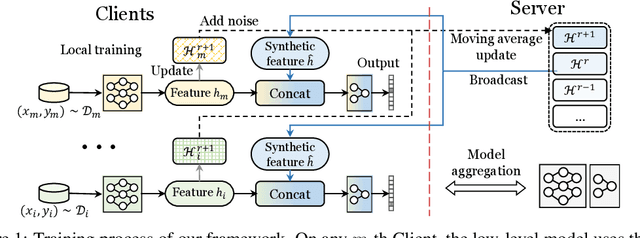
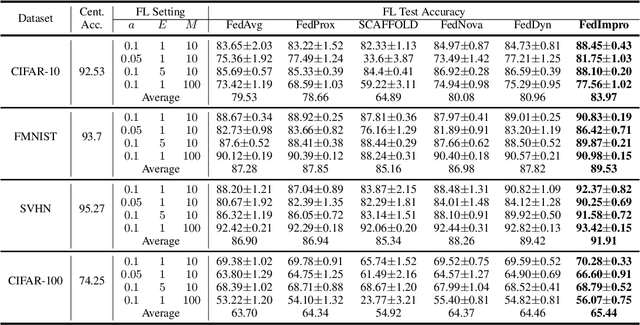
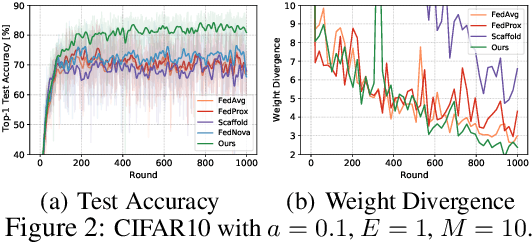

Federated Learning (FL) models often experience client drift caused by heterogeneous data, where the distribution of data differs across clients. To address this issue, advanced research primarily focuses on manipulating the existing gradients to achieve more consistent client models. In this paper, we present an alternative perspective on client drift and aim to mitigate it by generating improved local models. First, we analyze the generalization contribution of local training and conclude that this generalization contribution is bounded by the conditional Wasserstein distance between the data distribution of different clients. Then, we propose FedImpro, to construct similar conditional distributions for local training. Specifically, FedImpro decouples the model into high-level and low-level components, and trains the high-level portion on reconstructed feature distributions. This approach enhances the generalization contribution and reduces the dissimilarity of gradients in FL. Experimental results show that FedImpro can help FL defend against data heterogeneity and enhance the generalization performance of the model.
Discovery of the Hidden World with Large Language Models
Feb 06, 2024Science originates with discovering new causal knowledge from a combination of known facts and observations. Traditional causal discovery approaches mainly rely on high-quality measured variables, usually given by human experts, to find causal relations. However, the causal variables are usually unavailable in a wide range of real-world applications. The rise of large language models (LLMs) that are trained to learn rich knowledge from the massive observations of the world, provides a new opportunity to assist with discovering high-level hidden variables from the raw observational data. Therefore, we introduce COAT: Causal representatiOn AssistanT. COAT incorporates LLMs as a factor proposer that extracts the potential causal factors from unstructured data. Moreover, LLMs can also be instructed to provide additional information used to collect data values (e.g., annotation criteria) and to further parse the raw unstructured data into structured data. The annotated data will be fed to a causal learning module (e.g., the FCI algorithm) that provides both rigorous explanations of the data, as well as useful feedback to further improve the extraction of causal factors by LLMs. We verify the effectiveness of COAT in uncovering the underlying causal system with two case studies of review rating analysis and neuropathic diagnosis.
Neural auto-designer for enhanced quantum kernels
Jan 20, 2024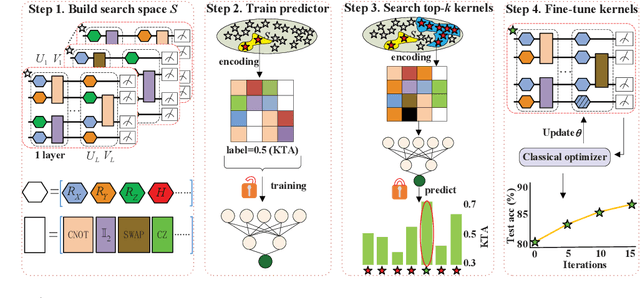
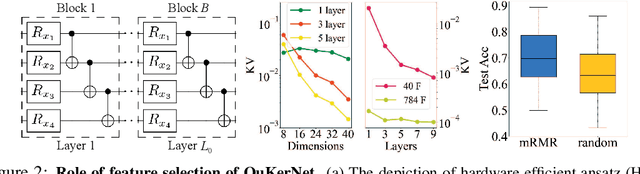
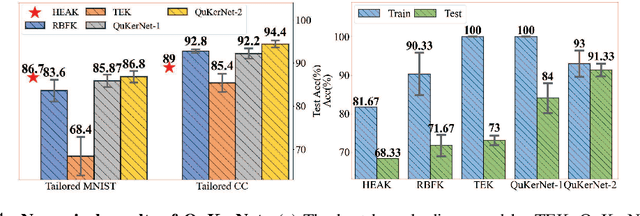

Quantum kernels hold great promise for offering computational advantages over classical learners, with the effectiveness of these kernels closely tied to the design of the quantum feature map. However, the challenge of designing effective quantum feature maps for real-world datasets, particularly in the absence of sufficient prior information, remains a significant obstacle. In this study, we present a data-driven approach that automates the design of problem-specific quantum feature maps. Our approach leverages feature-selection techniques to handle high-dimensional data on near-term quantum machines with limited qubits, and incorporates a deep neural predictor to efficiently evaluate the performance of various candidate quantum kernels. Through extensive numerical simulations on different datasets, we demonstrate the superiority of our proposal over prior methods, especially for the capability of eliminating the kernel concentration issue and identifying the feature map with prediction advantages. Our work not only unlocks the potential of quantum kernels for enhancing real-world tasks but also highlights the substantial role of deep learning in advancing quantum machine learning.
HCVP: Leveraging Hierarchical Contrastive Visual Prompt for Domain Generalization
Jan 18, 2024


Domain Generalization (DG) endeavors to create machine learning models that excel in unseen scenarios by learning invariant features. In DG, the prevalent practice of constraining models to a fixed structure or uniform parameterization to encapsulate invariant features can inadvertently blend specific aspects. Such an approach struggles with nuanced differentiation of inter-domain variations and may exhibit bias towards certain domains, hindering the precise learning of domain-invariant features. Recognizing this, we introduce a novel method designed to supplement the model with domain-level and task-specific characteristics. This approach aims to guide the model in more effectively separating invariant features from specific characteristics, thereby boosting the generalization. Building on the emerging trend of visual prompts in the DG paradigm, our work introduces the novel \textbf{H}ierarchical \textbf{C}ontrastive \textbf{V}isual \textbf{P}rompt (HCVP) methodology. This represents a significant advancement in the field, setting itself apart with a unique generative approach to prompts, alongside an explicit model structure and specialized loss functions. Differing from traditional visual prompts that are often shared across entire datasets, HCVP utilizes a hierarchical prompt generation network enhanced by prompt contrastive learning. These generative prompts are instance-dependent, catering to the unique characteristics inherent to different domains and tasks. Additionally, we devise a prompt modulation network that serves as a bridge, effectively incorporating the generated visual prompts into the vision transformer backbone. Experiments conducted on five DG datasets demonstrate the effectiveness of HCVP, outperforming both established DG algorithms and adaptation protocols.
E2HQV: High-Quality Video Generation from Event Camera via Theory-Inspired Model-Aided Deep Learning
Jan 16, 2024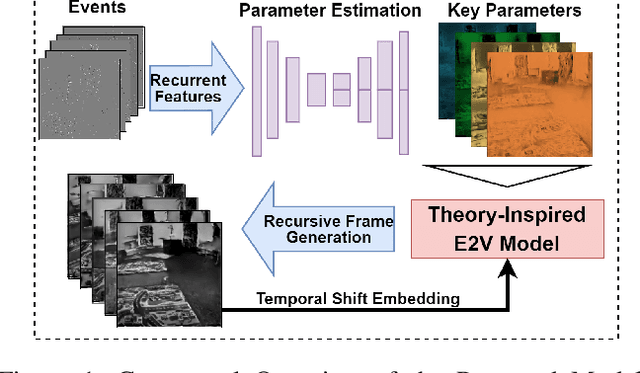
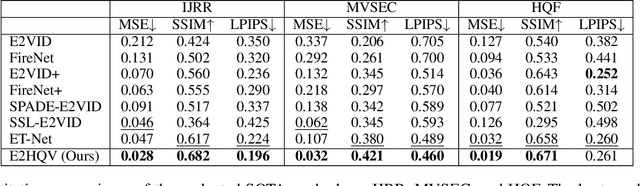
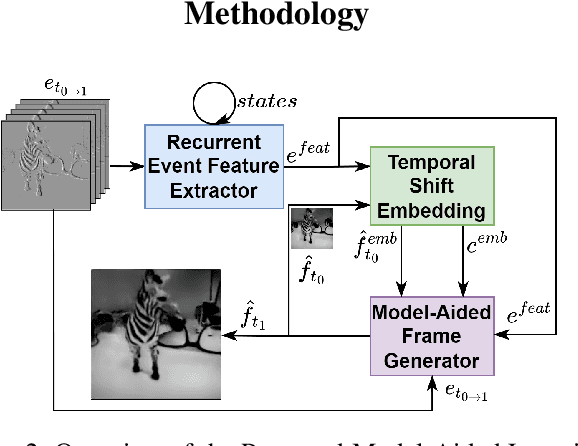

The bio-inspired event cameras or dynamic vision sensors are capable of asynchronously capturing per-pixel brightness changes (called event-streams) in high temporal resolution and high dynamic range. However, the non-structural spatial-temporal event-streams make it challenging for providing intuitive visualization with rich semantic information for human vision. It calls for events-to-video (E2V) solutions which take event-streams as input and generate high quality video frames for intuitive visualization. However, current solutions are predominantly data-driven without considering the prior knowledge of the underlying statistics relating event-streams and video frames. It highly relies on the non-linearity and generalization capability of the deep neural networks, thus, is struggling on reconstructing detailed textures when the scenes are complex. In this work, we propose \textbf{E2HQV}, a novel E2V paradigm designed to produce high-quality video frames from events. This approach leverages a model-aided deep learning framework, underpinned by a theory-inspired E2V model, which is meticulously derived from the fundamental imaging principles of event cameras. To deal with the issue of state-reset in the recurrent components of E2HQV, we also design a temporal shift embedding module to further improve the quality of the video frames. Comprehensive evaluations on the real world event camera datasets validate our approach, with E2HQV, notably outperforming state-of-the-art approaches, e.g., surpassing the second best by over 40\% for some evaluation metrics.