 Add to Chrome
 Add to Firefox
 Add to Edge
MORSE-500: A Programmatically Controllable Video Benchmark to Stress-Test Multimodal Reasoning
Jun 05, 2025
Despite rapid advances in vision-language models (VLMs), current benchmarks for multimodal reasoning fall short in three key dimensions. First, they overwhelmingly rely on static images, failing to capture the temporal complexity of real-world environments. Second, they narrowly focus on mathematical problem-solving, neglecting the broader spectrum of reasoning skills -- including abstract, physical, planning, spatial, and temporal capabilities -- required for robust multimodal intelligence. Third, many benchmarks quickly saturate, offering limited headroom for diagnosing failure modes or measuring continued progress. We introduce MORSE-500 (Multimodal Reasoning Stress-test Environment), a video benchmark composed of 500 fully scripted clips with embedded questions spanning six complementary reasoning categories. Each instance is programmatically generated using deterministic Python scripts (via Manim, Matplotlib, MoviePy), generative video models, and curated real footage. This script-driven design allows fine-grained control over visual complexity, distractor density, and temporal dynamics -- enabling difficulty to be scaled systematically as models improve. Unlike static benchmarks that become obsolete once saturated, MORSE-500 is built to evolve: its controllable generation pipeline supports the creation of arbitrarily challenging new instances, making it ideally suited for stress-testing next-generation models. Initial experiments with state-of-the-art systems -- including various Gemini 2.5 Pro and OpenAI o3 which represent the strongest available at the time, alongside strong open-source models -- reveal substantial performance gaps across all categories, with particularly large deficits in abstract and planning tasks. We release the full dataset, generation scripts, and evaluation harness to support transparent, reproducible, and forward-looking multimodal reasoning research.

A Fictional Q&A Dataset for Studying Memorization and Knowledge Acquisition
Jun 05, 2025When language models are trained on textual data, they acquire both knowledge about the structure of language as well as knowledge of facts about the world. At inference time, their knowledge of facts can be leveraged to solve interesting problems and perform useful knowledge work for users. It is well known that language models can verbatim memorize long sequences from their training data. However, it is much less well understood how language models memorize facts seen during training. In this work, we propose a new dataset to specifically empower researchers to study the dual processes of fact memorization and verbatim sequence memorization. The dataset consists of synthetically-generated, webtext-like documents about fictional events, as well as question-answer pairs about the events. We conduct training experiments showing how synthetic data about fictional events can be effective in teasing apart different forms of memorization. We also document the challenges in effectively building realistic, fictional synthetic data.
Quantifying Cross-Modality Memorization in Vision-Language Models
Jun 05, 2025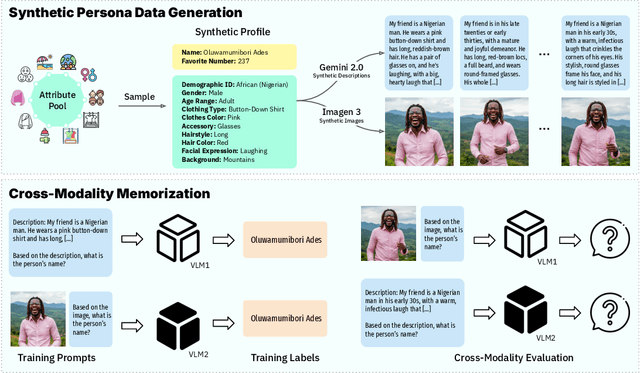
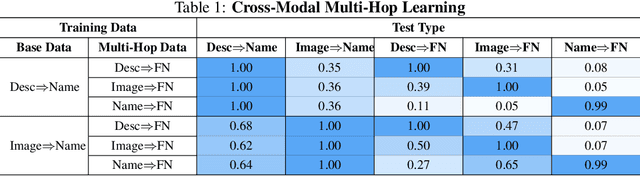
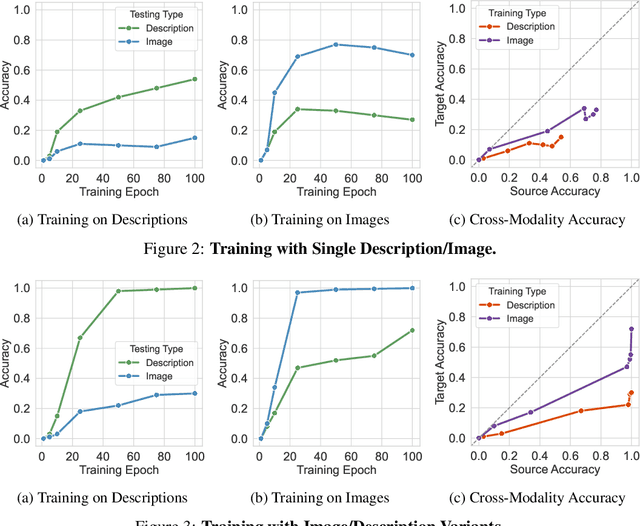
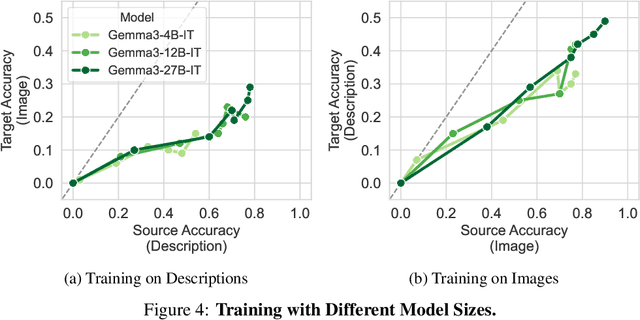
Understanding what and how neural networks memorize during training is crucial, both from the perspective of unintentional memorization of potentially sensitive information and from the standpoint of effective knowledge acquisition for real-world, knowledge-intensive tasks. While previous studies primarily investigate memorization within a single modality, such as text memorization in large language models or image memorization in diffusion models, unified multimodal models are becoming increasingly prevalent in practical applications. In this work, we focus on the unique characteristics of cross-modality memorization and conduct a systematic study centered on vision-language models. To facilitate controlled experiments, we first introduce a synthetic persona dataset comprising diverse synthetic person images and textual descriptions. We quantify factual knowledge memorization and cross-modal transferability by training models on a single modality and evaluating their performance in the other. Our results reveal that facts learned in one modality transfer to the other, but a significant gap exists between recalling information in the source and target modalities. Furthermore, we observe that this gap exists across various scenarios, including more capable models, machine unlearning, and the multi-hop case. At the end, we propose a baseline method to mitigate this challenge. We hope our study can inspire future research on developing more robust multimodal learning techniques to enhance cross-modal transferability.
Zero-Shot Vision Encoder Grafting via LLM Surrogates
May 28, 2025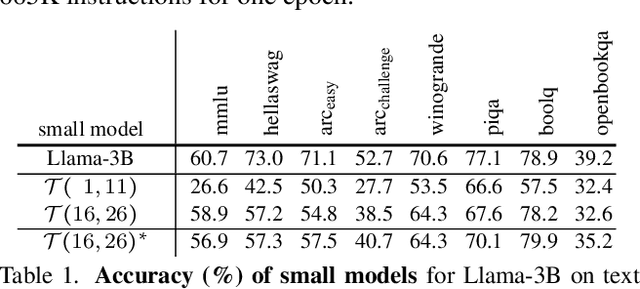
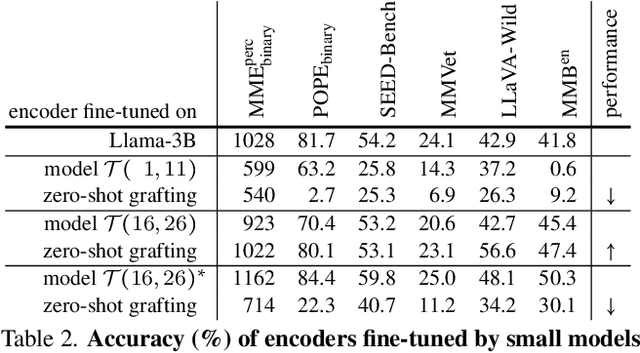
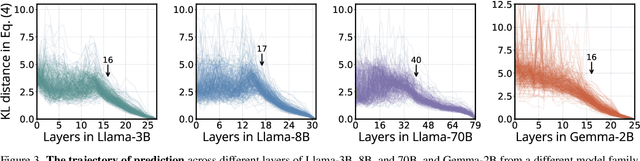
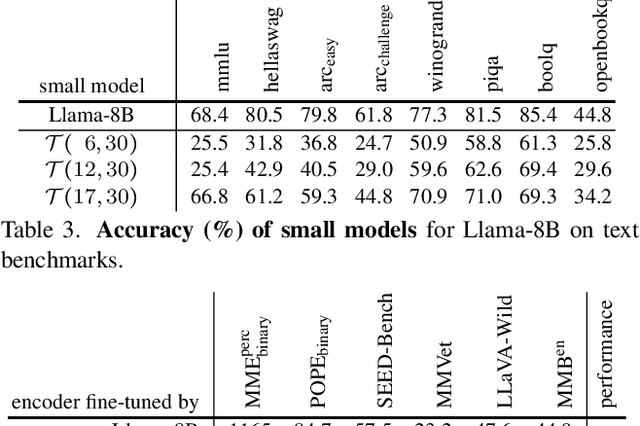
Vision language models (VLMs) typically pair a modestly sized vision encoder with a large language model (LLM), e.g., Llama-70B, making the decoder the primary computational burden during training. To reduce costs, a potential promising strategy is to first train the vision encoder using a small language model before transferring it to the large one. We construct small "surrogate models" that share the same embedding space and representation language as the large target LLM by directly inheriting its shallow layers. Vision encoders trained on the surrogate can then be directly transferred to the larger model, a process we call zero-shot grafting -- when plugged directly into the full-size target LLM, the grafted pair surpasses the encoder-surrogate pair and, on some benchmarks, even performs on par with full decoder training with the target LLM. Furthermore, our surrogate training approach reduces overall VLM training costs by ~45% when using Llama-70B as the decoder.
BLIP3-o: A Family of Fully Open Unified Multimodal Models-Architecture, Training and Dataset
May 14, 2025Unifying image understanding and generation has gained growing attention in recent research on multimodal models. Although design choices for image understanding have been extensively studied, the optimal model architecture and training recipe for a unified framework with image generation remain underexplored. Motivated by the strong potential of autoregressive and diffusion models for high-quality generation and scalability, we conduct a comprehensive study of their use in unified multimodal settings, with emphasis on image representations, modeling objectives, and training strategies. Grounded in these investigations, we introduce a novel approach that employs a diffusion transformer to generate semantically rich CLIP image features, in contrast to conventional VAE-based representations. This design yields both higher training efficiency and improved generative quality. Furthermore, we demonstrate that a sequential pretraining strategy for unified models-first training on image understanding and subsequently on image generation-offers practical advantages by preserving image understanding capability while developing strong image generation ability. Finally, we carefully curate a high-quality instruction-tuning dataset BLIP3o-60k for image generation by prompting GPT-4o with a diverse set of captions covering various scenes, objects, human gestures, and more. Building on our innovative model design, training recipe, and datasets, we develop BLIP3-o, a suite of state-of-the-art unified multimodal models. BLIP3-o achieves superior performance across most of the popular benchmarks spanning both image understanding and generation tasks. To facilitate future research, we fully open-source our models, including code, model weights, training scripts, and pretraining and instruction tuning datasets.
Leveraging AI for Productive and Trustworthy HPC Software: Challenges and Research Directions
May 13, 2025We discuss the challenges and propose research directions for using AI to revolutionize the development of high-performance computing (HPC) software. AI technologies, in particular large language models, have transformed every aspect of software development. For its part, HPC software is recognized as a highly specialized scientific field of its own. We discuss the challenges associated with leveraging state-of-the-art AI technologies to develop such a unique and niche class of software and outline our research directions in the two US Department of Energy--funded projects for advancing HPC Software via AI: Ellora and Durban.
AegisLLM: Scaling Agentic Systems for Self-Reflective Defense in LLM Security
Apr 29, 2025We introduce AegisLLM, a cooperative multi-agent defense against adversarial attacks and information leakage. In AegisLLM, a structured workflow of autonomous agents - orchestrator, deflector, responder, and evaluator - collaborate to ensure safe and compliant LLM outputs, while self-improving over time through prompt optimization. We show that scaling agentic reasoning system at test-time - both by incorporating additional agent roles and by leveraging automated prompt optimization (such as DSPy)- substantially enhances robustness without compromising model utility. This test-time defense enables real-time adaptability to evolving attacks, without requiring model retraining. Comprehensive evaluations across key threat scenarios, including unlearning and jailbreaking, demonstrate the effectiveness of AegisLLM. On the WMDP unlearning benchmark, AegisLLM achieves near-perfect unlearning with only 20 training examples and fewer than 300 LM calls. For jailbreaking benchmarks, we achieve 51% improvement compared to the base model on StrongReject, with false refusal rates of only 7.9% on PHTest compared to 18-55% for comparable methods. Our results highlight the advantages of adaptive, agentic reasoning over static defenses, establishing AegisLLM as a strong runtime alternative to traditional approaches based on model modifications. Code is available at https://github.com/zikuicai/aegisllm
Dense Backpropagation Improves Training for Sparse Mixture-of-Experts
Apr 18, 2025Mixture of Experts (MoE) pretraining is more scalable than dense Transformer pretraining, because MoEs learn to route inputs to a sparse set of their feedforward parameters. However, this means that MoEs only receive a sparse backward update, leading to training instability and suboptimal performance. We present a lightweight approximation method that gives the MoE router a dense gradient update while continuing to sparsely activate its parameters. Our method, which we refer to as Default MoE, substitutes missing expert activations with default outputs consisting of an exponential moving average of expert outputs previously seen over the course of training. This allows the router to receive signals from every expert for each token, leading to significant improvements in training performance. Our Default MoE outperforms standard TopK routing in a variety of settings without requiring significant computational overhead. Code: https://github.com/vatsal0/default-moe.
Analysis of Attention in Video Diffusion Transformers
Apr 14, 2025We conduct an in-depth analysis of attention in video diffusion transformers (VDiTs) and report a number of novel findings. We identify three key properties of attention in VDiTs: Structure, Sparsity, and Sinks. Structure: We observe that attention patterns across different VDiTs exhibit similar structure across different prompts, and that we can make use of the similarity of attention patterns to unlock video editing via self-attention map transfer. Sparse: We study attention sparsity in VDiTs, finding that proposed sparsity methods do not work for all VDiTs, because some layers that are seemingly sparse cannot be sparsified. Sinks: We make the first study of attention sinks in VDiTs, comparing and contrasting them to attention sinks in language models. We propose a number of future directions that can make use of our insights to improve the efficiency-quality Pareto frontier for VDiTs.
LoRI: Reducing Cross-Task Interference in Multi-Task Low-Rank Adaptation
Apr 10, 2025Low-Rank Adaptation (LoRA) has emerged as a popular parameter-efficient fine-tuning (PEFT) method for Large Language Models (LLMs), yet it still incurs notable overhead and suffers from parameter interference in multi-task scenarios. We propose LoRA with Reduced Interference (LoRI), a simple yet effective approach that freezes the projection matrices $A$ as random projections and sparsifies the matrices $B$ using task-specific masks. This design substantially reduces the number of trainable parameters while maintaining strong task performance. Moreover, LoRI minimizes cross-task interference in adapter merging by leveraging the orthogonality between adapter subspaces, and supports continual learning by using sparsity to mitigate catastrophic forgetting. Extensive experiments across natural language understanding, mathematical reasoning, code generation, and safety alignment tasks demonstrate that LoRI outperforms full fine-tuning and existing PEFT methods, while using up to 95% fewer trainable parameters than LoRA. In multi-task experiments, LoRI enables effective adapter merging and continual learning with reduced cross-task interference. Code is available at: https://github.com/juzhengz/LoRI