 Add to Chrome
 Add to Firefox
 Add to Edge
BioFact-MoE: Biologically Factorized Mixture of Experts for Vision-Language Prognostic Modeling in Hepatocellular Carcinoma
May 25, 2026
Hepatocellular carcinoma (HCC) is biologically heterogeneous, shaped by the interplay between hepatic functional reserve and tumor-related oncologic factors; thus, similar survival outcomes may reflect fundamentally different underlying biological processes. Prognostic modeling in HCC is informed by rich multimodal information from multiparametric MRI and radiology reports from routine clinical practice. Existing prognostic vision-language models (VLMs) learn a single entangled latent representation that blends hepatic and tumor-related factors, limiting both accuracy and biological interpretability. We present BioFact-MoE, a biologically factorized Mixture of Experts (MoE) framework that explicitly decomposes liver and tumor factors via biologically supervised experts within a residual MoE survival architecture. On a HCC cohort of N=588 patients (pretrained on 4,582 3D MRI image-report pairs), BioFact-MoE consistently improves survival prediction over all baselines across time horizons, achieving 12-, 18-, and 24-month AUCs of 75.33%, 75.85%, and 73.96%. Beyond scalar risk prediction, gated expert weights enable phenotype-aware risk stratification. Pathway-informed gating uncovers clinically meaningful treatment-associated survival heterogeneity. In held-out validation, hepatic and tumor embeddings show selective associations with liver function and tumor burden markers, respectively (p<0.05), without supervision. The code is available at https://github.com/jy-639/BioFact-MoE.

ATime-Consistent Benchmark for Repository-Level Software Engineering Evaluation
Mar 27, 2026Evaluation of repository-aware software engineering systems is often confounded by synthetic task design, prompt leakage, and temporal contamination between repository knowledge and future code changes. We present a time-consistent benchmark methodology that snapshots a repository at time T0, constructs repository-derived code knowledge using only artifacts available before T0, and evaluates on engineering tasks derived from pull requests merged in the future interval (T0, T1]. Each historical pull request is transformed into a natural-language task through an LLM-assisted prompt-generation pipeline, and the benchmark is formalized as a matched A/B comparison in which the same software engineering agent is evaluated with and without repository-derived code knowledge while all other variables are held constant. We also report a baseline characterization study on two open-source repositories, DragonFly and React, using three Claude-family models and four prompt granularities. Across both repositories, file-level F1 increases monotonically from minimal to guided prompts, reaching 0.8081 on DragonFly and 0.8078 on React for the strongest tested model. These results show that prompt construction is a first-order benchmark variable. More broadly, the benchmark highlights that temporal consistency and prompt control are core validity requirements for repository-aware software engineering evaluation.
DECADE: A Temporally-Consistent Unsupervised Diffusion Model for Enhanced Rb-82 Dynamic Cardiac PET Image Denoising
Mar 08, 2026Rb-82 dynamic cardiac PET imaging is widely used for the clinical diagnosis of coronary artery disease (CAD), but its short half-life results in high noise levels that degrade dynamic frame quality and parametric imaging. The lack of paired clean-noisy training data, rapid tracer kinetics, and frame-dependent noise variations further limit the effectiveness of existing deep learning denoising methods. We propose DECADE (A Temporally-Consistent Unsupervised Diffusion model for Enhanced Rb-82 CArdiac PET DEnoising), an unsupervised diffusion framework that generalizes across early- to late-phase dynamic frames. DECADE incorporates temporal consistency during both training and iterative sampling, using noisy frames as guidance to preserve quantitative accuracy. The method was trained and evaluated on datasets acquired from Siemens Vision 450 and Siemens Biograph Vision Quadra scanners. On the Vision 450 dataset, DECADE consistently produced high-quality dynamic and parametric images with reduced noise while preserving myocardial blood flow (MBF) and myocardial flow reserve (MFR). On the Quadra dataset, using 15%-count images as input and full-count images as reference, DECADE outperformed UNet-based and other diffusion models in image quality and K1/MBF quantification. The proposed framework enables effective unsupervised denoising of Rb-82 dynamic cardiac PET without paired training data, supporting clearer visualization while maintaining quantitative integrity.
UniSync: Towards Generalizable and High-Fidelity Lip Synchronization for Challenging Scenarios
Mar 04, 2026Lip synchronization aims to generate realistic talking videos that match given audio, which is essential for high-quality video dubbing. However, current methods have fundamental drawbacks: mask-based approaches suffer from local color discrepancies, while mask-free methods struggle with global background texture misalignment. Furthermore, most methods struggle with diverse real-world scenarios such as stylized avatars, face occlusion, and extreme lighting conditions. In this paper, we propose UniSync, a unified framework designed for achieving high-fidelity lip synchronization in diverse scenarios. Specifically, UniSync uses a mask-free pose-anchored training strategy to keep head motion and eliminate synthesis color artifacts, while employing mask-based blending consistent inference to ensure structural precision and smooth blending. Notably, fine-tuning on compact but diverse videos empowers our model with exceptional domain adaptability, handling complex corner cases effectively. We also introduce the RealWorld-LipSync benchmark to evaluate models under real-world demands, which covers diverse application scenarios including both human faces and stylized avatars. Extensive experiments demonstrate that UniSync significantly outperforms state-of-the-art methods, advancing the field towards truly generalizable and production-ready lip synchronization.
Multi-Agent Synergy-Driven Iterative Visual Narrative Synthesis
Jul 17, 2025Automated generation of high-quality media presentations is challenging, requiring robust content extraction, narrative planning, visual design, and overall quality optimization. Existing methods often produce presentations with logical inconsistencies and suboptimal layouts, thereby struggling to meet professional standards. To address these challenges, we introduce RCPS (Reflective Coherent Presentation Synthesis), a novel framework integrating three key components: (1) Deep Structured Narrative Planning; (2) Adaptive Layout Generation; (3) an Iterative Optimization Loop. Additionally, we propose PREVAL, a preference-based evaluation framework employing rationale-enhanced multi-dimensional models to assess presentation quality across Content, Coherence, and Design. Experimental results demonstrate that RCPS significantly outperforms baseline methods across all quality dimensions, producing presentations that closely approximate human expert standards. PREVAL shows strong correlation with human judgments, validating it as a reliable automated tool for assessing presentation quality.
Hybrid Robot Learning for Automatic Robot Motion Planning in Manufacturing
Feb 26, 2025Industrial robots are widely used in diverse manufacturing environments. Nonetheless, how to enable robots to automatically plan trajectories for changing tasks presents a considerable challenge. Further complexities arise when robots operate within work cells alongside machines, humans, or other robots. This paper introduces a multi-level hybrid robot motion planning method combining a task space Reinforcement Learning-based Learning from Demonstration (RL-LfD) agent and a joint-space based Deep Reinforcement Learning (DRL) based agent. A higher level agent learns to switch between the two agents to enable feasible and smooth motion. The feasibility is computed by incorporating reachability, joint limits, manipulability, and collision risks of the robot in the given environment. Therefore, the derived hybrid motion planning policy generates a feasible trajectory that adheres to task constraints. The effectiveness of the method is validated through sim ulated robotic scenarios and in a real-world setup.
Auto-RAG: Autonomous Retrieval-Augmented Generation for Large Language Models
Nov 29, 2024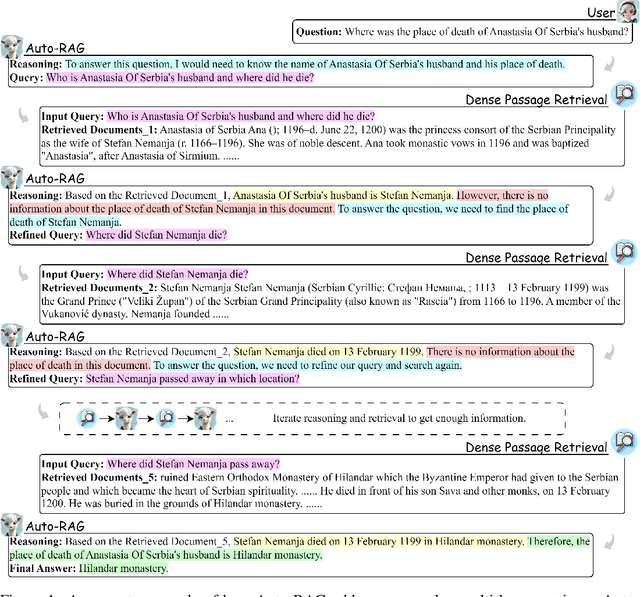
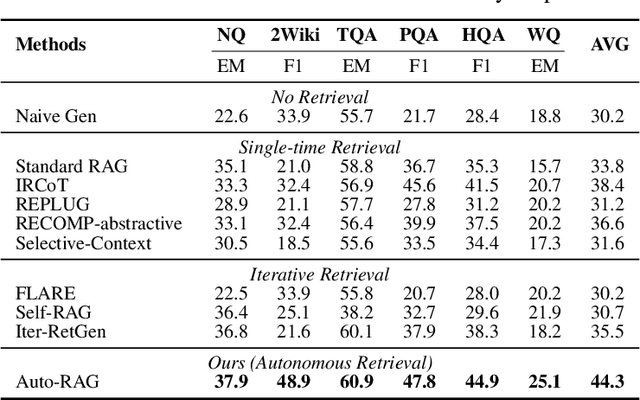
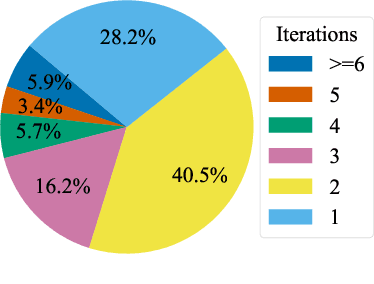

Iterative retrieval refers to the process in which the model continuously queries the retriever during generation to enhance the relevance of the retrieved knowledge, thereby improving the performance of Retrieval-Augmented Generation (RAG). Existing work typically employs few-shot prompting or manually constructed rules to implement iterative retrieval. This introduces additional inference overhead and overlooks the remarkable reasoning capabilities of Large Language Models (LLMs). In this paper, we introduce Auto-RAG, an autonomous iterative retrieval model centered on the LLM's powerful decision-making capabilities. Auto-RAG engages in multi-turn dialogues with the retriever, systematically planning retrievals and refining queries to acquire valuable knowledge. This process continues until sufficient external information is gathered, at which point the results are presented to the user. To this end, we develop a method for autonomously synthesizing reasoning-based decision-making instructions in iterative retrieval and fine-tuned the latest open-source LLMs. The experimental results indicate that Auto-RAG is capable of autonomous iterative interaction with the retriever, effectively leveraging the remarkable reasoning and decision-making abilities of LLMs, which lead to outstanding performance across six benchmarks. Further analysis reveals that Auto-RAG can autonomously adjust the number of iterations based on the difficulty of the questions and the utility of the retrieved knowledge, without requiring any human intervention. Moreover, Auto-RAG expresses the iterative retrieval process in natural language, enhancing interpretability while providing users with a more intuitive experience\footnote{Code is available at \url{https://github.com/ictnlp/Auto-RAG}.
Tractography with T1-weighted MRI and associated anatomical constraints on clinical quality diffusion MRI
Mar 27, 2024Diffusion MRI (dMRI) streamline tractography, the gold standard for in vivo estimation of brain white matter (WM) pathways, has long been considered indicative of macroscopic relationships with WM microstructure. However, recent advances in tractography demonstrated that convolutional recurrent neural networks (CoRNN) trained with a teacher-student framework have the ability to learn and propagate streamlines directly from T1 and anatomical contexts. Training for this network has previously relied on high-resolution dMRI. In this paper, we generalize the training mechanism to traditional clinical resolution data, which allows generalizability across sensitive and susceptible study populations. We train CoRNN on a small subset of the Baltimore Longitudinal Study of Aging (BLSA), which better resembles clinical protocols. Then, we define a metric, termed the epsilon ball seeding method, to compare T1 tractography and traditional diffusion tractography at the streamline level. Under this metric, T1 tractography generated by CoRNN reproduces diffusion tractography with approximately two millimeters of error.
Truth-Aware Context Selection: Mitigating the Hallucinations of Large Language Models Being Misled by Untruthful Contexts
Mar 14, 2024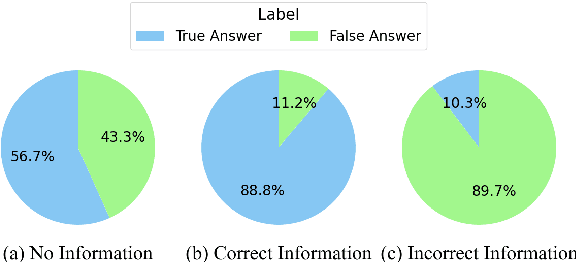
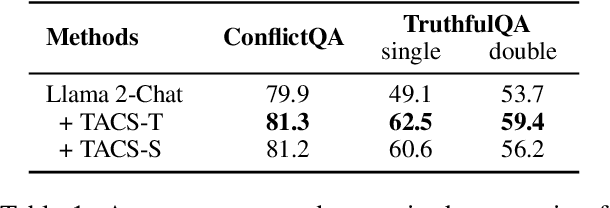
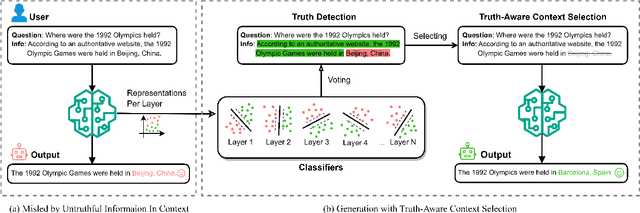
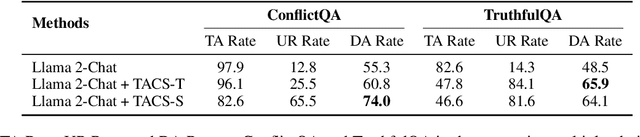
Although large language models (LLMs) have demonstrated impressive text generation capabilities, they are easily misled by the untruthful context provided by users or knowledge augmentation tools, thereby producing hallucinations. To alleviate the LLMs from being misled by untruthful information and take advantage of knowledge augmentation, we propose Truth-Aware Context Selection (TACS), a lightweight method to shield untruthful context from the inputs. TACS begins by performing truth detection on the input context, leveraging the parameterized knowledge within the LLM. Subsequently, it constructs a corresponding attention mask based on the truthfulness of each position, selecting the truthful context and discarding the untruthful context. Additionally, we introduce a new evaluation metric, Disturbance Adaption Rate, to further study the LLMs' ability to accept truthful information and resist untruthful information. Experimental results show that TACS can effectively filter information in context and significantly improve the overall quality of LLMs' responses when presented with misleading information.
TruthX: Alleviating Hallucinations by Editing Large Language Models in Truthful Space
Feb 27, 2024Large Language Models (LLMs) have demonstrated remarkable capabilities across various tasks. However, they sometimes suffer from producing hallucinations, particularly in cases where they may generate untruthful responses despite possessing the correct knowledge. In this paper, we propose TruthX, an inference-time method to elicit the truthfulness of LLMs by editing their internal representations in truthful space. TruthX employs an auto-encoder to map LLM's representations into semantic and truthful latent spaces respectively, and applies contrastive learning to identify a truthful editing direction within the truthful space. During inference, by editing LLM's internal representations in truthful space, TruthX effectively enhances the truthfulness of LLMs. Experiments show that TruthX effectively improves the truthfulness of 13 advanced LLMs by an average of 20% on TruthfulQA benchmark. Further analyses suggest that the truthful space acquired by TruthX plays a pivotal role in controlling LLM to produce truthful or hallucinatory responses.