 Add to Chrome
 Add to Firefox
 Add to Edge
A Systematic Failure Analysis of Vision Foundation Models for Open Set Iris Presentation Attack Detection
May 18, 2026
Vision foundation models have demonstrated strong transferability across diverse visual recognition tasks and are increasingly considered for biometric applications. Their suitability for iris Presentation Attack Detection (PAD), particularly under realistic open-set operating conditions, remains insufficiently examined. This work presents a systematic failure analysis of general-purpose vision foundation models for open-set iris PAD using periocular imagery. Five representative foundation models are evaluated under three open-set protocols that explicitly separate different sources of distribution shift: unseen Presentation Attack Instruments (PAIs), unseen datasets captured with different sensors and cross-spectral transfer from near-infrared (NIR) to visible spectrum (VIS) imagery. Both frozen feature representations and parameter-efficient task adaptation using Low-Rank Adaptation (LoRA) are assessed within a unified experimental framework. The results indicate that foundation models can transfer across datasets with similar sensing characteristics, but fail to generalise reliably to unseen attack instruments and degrade sharply under cross-spectral evaluation. While LoRA improves performance in certain cross-dataset settings, it frequently amplifies failure under attack-level and spectral shifts. Additional validation experiments using segmented iris inputs, full backbone fine-tuning, joint cross-dataset and cross-PAI shifts, and reverse VIS to NIR transfer further confirm that these failures are not simply artefacts of periocular input, weak adaptation, or one-directional spectral evaluation. These findings show that strong closed-set or cross-dataset performance should not be treated as evidence of robust open-set security, and highlight the need for PAD representations that maintain sensitivity to presentation artefacts while remaining stable under realistic deployment variation.

Train-Small Deploy-Large: Leveraging Diffusion-Based Multi-Robot Planning
Apr 08, 2026Learning based multi-robot path planning methods struggle to scale or generalize to changes, particularly variations in the number of robots during deployment. Most existing methods are trained on a fixed number of robots and may tolerate a reduced number during testing, but typically fail when the number increases. Additionally, training such methods for a larger number of agents can be both time consuming and computationally expensive. However, analytical methods can struggle to scale computationally or handle dynamic changes in the environment. In this work, we propose to leverage a diffusion model based planner capable of handling dynamically varying number of agents. Our approach is trained on a limited number of agents and generalizes effectively to larger numbers of agents during deployment. Results show that integrating a single shared diffusion model based planner with dedicated inter-agent attention computation and temporal convolution enables a train small deploy-large paradigm with good accuracy. We validate our method across multiple scenarios and compare the performance with existing multi-agent reinforcement learning techniques and heuristic control based methods.
Communication-free Sampling and 4D Hybrid Parallelism for Scalable Mini-batch GNN Training
Apr 03, 2026Graph neural networks (GNNs) are widely used for learning on graph datasets derived from various real-world scenarios. Learning from extremely large graphs requires distributed training, and mini-batching with sampling is a popular approach for parallelizing GNN training. Existing distributed mini-batch approaches have significant performance bottlenecks due to expensive sampling methods and limited scaling when using data parallelism. In this work, we present ScaleGNN, a 4D parallel framework for scalable mini-batch GNN training that combines communication-free distributed sampling, 3D parallel matrix multiplication (PMM), and data parallelism. ScaleGNN introduces a uniform vertex sampling algorithm, enabling each process (GPU device) to construct its local mini-batch, i.e., subgraph partitions without any inter-process communication. 3D PMM enables scaling mini-batch training to much larger GPU counts than vanilla data parallelism with significantly lower communication overheads. We also present additional optimizations to overlap sampling with training, reduce communication overhead by sending data in lower precision, kernel fusion, and communication-computation overlap. We evaluate ScaleGNN on five graph datasets and demonstrate strong scaling up to 2048 GPUs on Perlmutter, 2048 GCDs on Frontier, and 1024 GPUs on Tuolumne. On Perlmutter, ScaleGNN achieves 3.5x end-to-end training speedup over the SOTA baseline on ogbn-products.
Realistic Synthetic Household Data Generation at Scale
Feb 06, 2026Advancements in foundation models have catalyzed research in Embodied AI to develop interactive agents capable of environmental reasoning and interaction. Developing such agents requires diverse, large-scale datasets. Prior frameworks generate synthetic data for long-term human-robot interactions but fail to model the bidirectional influence between human behavior and household environments. Our proposed generative framework creates household datasets at scale through loosely coupled generation of long-term human-robot interactions and environments. Human personas influence environment generation, while environment schematics and semantics shape human-robot interactions. The generated 3D data includes rich static context such as object and environment semantics, and temporal context capturing human and agent behaviors over extended periods. Our flexible tool allows users to define dataset characteristics via natural language prompts, enabling configuration of environment and human activity data through natural language specifications. The tool creates variations of user-defined configurations, enabling scalable data generation. We validate our framework through statistical evaluation using multi-modal embeddings and key metrics: cosine similarity, mutual information gain, intervention analysis, and iterative improvement validation. Statistical comparisons show good alignment with real-world datasets (HOMER) with cosine similarity (0.60), while synthetic datasets (Wang et al.) show moderate alignment (0.27). Intervention analysis across age, organization, and sleep pattern changes shows statistically significant effects (p < 0.001) with large effect sizes (Cohen's d = 0.51-1.12), confirming bidirectional coupling translates persona traits into measurable environmental and behavioral differences. These contributions enable development and testing of household smart devices at scale.
NVIDIA Nemotron 3: Efficient and Open Intelligence
Dec 24, 2025We introduce the Nemotron 3 family of models - Nano, Super, and Ultra. These models deliver strong agentic, reasoning, and conversational capabilities. The Nemotron 3 family uses a Mixture-of-Experts hybrid Mamba-Transformer architecture to provide best-in-class throughput and context lengths of up to 1M tokens. Super and Ultra models are trained with NVFP4 and incorporate LatentMoE, a novel approach that improves model quality. The two larger models also include MTP layers for faster text generation. All Nemotron 3 models are post-trained using multi-environment reinforcement learning enabling reasoning, multi-step tool use, and support granular reasoning budget control. Nano, the smallest model, outperforms comparable models in accuracy while remaining extremely cost-efficient for inference. Super is optimized for collaborative agents and high-volume workloads such as IT ticket automation. Ultra, the largest model, provides state-of-the-art accuracy and reasoning performance. Nano is released together with its technical report and this white paper, while Super and Ultra will follow in the coming months. We will openly release the model weights, pre- and post-training software, recipes, and all data for which we hold redistribution rights.
Nemotron 3 Nano: Open, Efficient Mixture-of-Experts Hybrid Mamba-Transformer Model for Agentic Reasoning
Dec 23, 2025We present Nemotron 3 Nano 30B-A3B, a Mixture-of-Experts hybrid Mamba-Transformer language model. Nemotron 3 Nano was pretrained on 25 trillion text tokens, including more than 3 trillion new unique tokens over Nemotron 2, followed by supervised fine tuning and large-scale RL on diverse environments. Nemotron 3 Nano achieves better accuracy than our previous generation Nemotron 2 Nano while activating less than half of the parameters per forward pass. It achieves up to 3.3x higher inference throughput than similarly-sized open models like GPT-OSS-20B and Qwen3-30B-A3B-Thinking-2507, while also being more accurate on popular benchmarks. Nemotron 3 Nano demonstrates enhanced agentic, reasoning, and chat abilities and supports context lengths up to 1M tokens. We release both our pretrained Nemotron 3 Nano 30B-A3B Base and post-trained Nemotron 3 Nano 30B-A3B checkpoints on Hugging Face.
LLM Inference Beyond a Single Node: From Bottlenecks to Mitigations with Fast All-Reduce Communication
Nov 13, 2025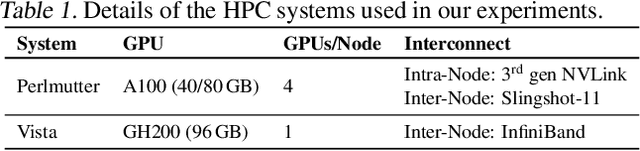
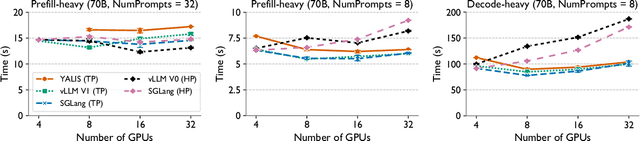

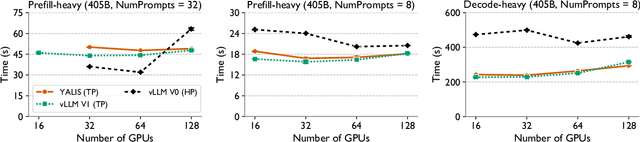
As large language models (LLMs) continue to grow in size, distributed inference has become increasingly important. Model-parallel strategies must now efficiently scale not only across multiple GPUs but also across multiple nodes. In this work, we present a detailed performance study of multi-node distributed inference using LLMs on GPU-based supercomputers. We conduct experiments with several state-of-the-art inference engines alongside YALIS, a research-oriented prototype engine designed for controlled experimentation. We analyze the strong-scaling behavior of different model-parallel schemes and identify key bottlenecks. Since all-reduce operations are a common performance bottleneck, we develop NVRAR, a hierarchical all-reduce algorithm based on recursive doubling with NVSHMEM. NVRAR achieves up to 1.9x-3.6x lower latency than NCCL for message sizes between 128 KB and 2 MB on HPE Slingshot and InfiniBand interconnects. Integrated into YALIS, NVRAR achieves up to a 1.72x reduction in end-to-end batch latency for the Llama 3.1 405B model in multi-node decode-heavy workloads using tensor parallelism.
NVIDIA Nemotron Nano 2: An Accurate and Efficient Hybrid Mamba-Transformer Reasoning Model
Aug 21, 2025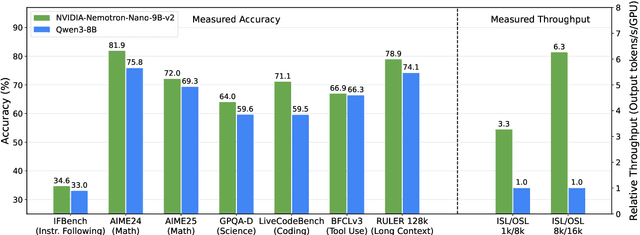

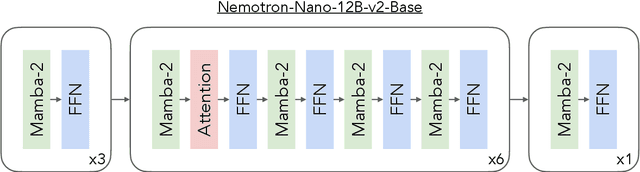
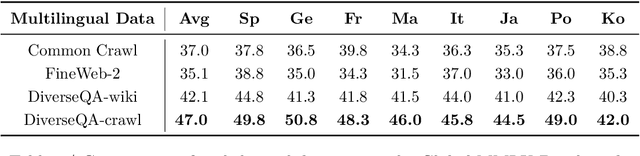
We introduce Nemotron-Nano-9B-v2, a hybrid Mamba-Transformer language model designed to increase throughput for reasoning workloads while achieving state-of-the-art accuracy compared to similarly-sized models. Nemotron-Nano-9B-v2 builds on the Nemotron-H architecture, in which the majority of the self-attention layers in the common Transformer architecture are replaced with Mamba-2 layers, to achieve improved inference speed when generating the long thinking traces needed for reasoning. We create Nemotron-Nano-9B-v2 by first pre-training a 12-billion-parameter model (Nemotron-Nano-12B-v2-Base) on 20 trillion tokens using an FP8 training recipe. After aligning Nemotron-Nano-12B-v2-Base, we employ the Minitron strategy to compress and distill the model with the goal of enabling inference on up to 128k tokens on a single NVIDIA A10G GPU (22GiB of memory, bfloat16 precision). Compared to existing similarly-sized models (e.g., Qwen3-8B), we show that Nemotron-Nano-9B-v2 achieves on-par or better accuracy on reasoning benchmarks while achieving up to 6x higher inference throughput in reasoning settings like 8k input and 16k output tokens. We are releasing Nemotron-Nano-9B-v2, Nemotron-Nano12B-v2-Base, and Nemotron-Nano-9B-v2-Base checkpoints along with the majority of our pre- and post-training datasets on Hugging Face.
Plexus: Taming Billion-edge Graphs with 3D Parallel GNN Training
May 07, 2025Graph neural networks have emerged as a potent class of neural networks capable of leveraging the connectivity and structure of real-world graphs to learn intricate properties and relationships between nodes. Many real-world graphs exceed the memory capacity of a GPU due to their sheer size, and using GNNs on them requires techniques such as mini-batch sampling to scale. However, this can lead to reduced accuracy in some cases, and sampling and data transfer from the CPU to the GPU can also slow down training. On the other hand, distributed full-graph training suffers from high communication overhead and load imbalance due to the irregular structure of graphs. We propose Plexus, a three-dimensional (3D) parallel approach for full-graph training that tackles these issues and scales to billion-edge graphs. Additionally, we introduce optimizations such as a permutation scheme for load balancing, and a performance model to predict the optimal 3D configuration. We evaluate Plexus on several graph datasets and show scaling results for up to 2048 GPUs on Perlmutter, which is 33% of the machine, and 2048 GCDs on Frontier. Plexus achieves unprecedented speedups of 2.3x-12.5x over existing methods and a reduction in the time to solution by 5.2-8.7x on Perlmutter and 7-54.2x on Frontier.
The Big Send-off: High Performance Collectives on GPU-based Supercomputers
Apr 25, 2025We evaluate the current state of collective communication on GPU-based supercomputers for large language model (LLM) training at scale. Existing libraries such as RCCL and Cray-MPICH exhibit critical limitations on systems such as Frontier -- Cray-MPICH underutilizes network and compute resources, while RCCL suffers from severe scalability issues. To address these challenges, we introduce PCCL, a communication library with highly optimized implementations of all-gather and reduce-scatter operations tailored for distributed deep learning workloads. PCCL is designed to maximally utilize all available network and compute resources and to scale efficiently to thousands of GPUs. It achieves substantial performance improvements, delivering 6-33x speedups over RCCL and 28-70x over Cray-MPICH for all-gather on 2048 GCDs of Frontier. These gains translate directly to end-to-end performance: in large-scale GPT-3-style training, PCCL provides up to 60% and 40% speedups over RCCL for 7B and 13B parameter models, respectively.