 Add to Chrome
 Add to Firefox
 Add to Edge
Unsupervised learning of acquisition variability in structural connectomes via hybrid latent space modeling
May 13, 2026
Acquisition differences across sites, scanners, and protocols in dMRI introduce variability that complicates structural connectome analysis. This motivates deep learning models that can represent high-dimensional connectomes in a low-dimensional space while explicitly separating acquisition-related effects from biological variation. Conventional dimensionality reduction methods model all variance as continuous, so acquisition effects often get absorbed into a continuous latent space. Recent hybrid latent-space models combine discrete and continuous components to address this, but typically require manual capacity tuning to ensure the discrete component captures the intended variability. We introduce an unsupervised framework that removes this manual tuning by architecturally annealing encoder outputs before decoding, allowing the model to adaptively balance discrete and continuous latent variables during training. To evaluate it, we curated a dataset of N=7,416 structural connectomes derived from dMRI, spanning ages 2 to 102 and 13 studies with 25 unique acquisition-parameter combinations. Of these, 5,900 are cognitively unimpaired, 877 have mild cognitive impairment (MCI), and 639 have Alzheimer's disease (AD). We compare against a standard VAE, PCA with k-means clustering, and hybrid models that anneal only through the loss function. Our architectural annealing produces stronger site learning (ARI=0.53, p<0.05) than these baselines. Results show that a hybrid continuous-discrete latent space, with architectural rather than loss-based annealing, provides a useful unsupervised mechanism for capturing acquisition variability in dMRI: by jointly modeling smooth and categorical structure, the Joint-VAE recovers clusters aligned with scanner and protocol differences.

Fabrication and Characterization of Additively Manufactured Stretchable Strain Sensors Towards the Shape Sensing of Continuum Robots
May 06, 2025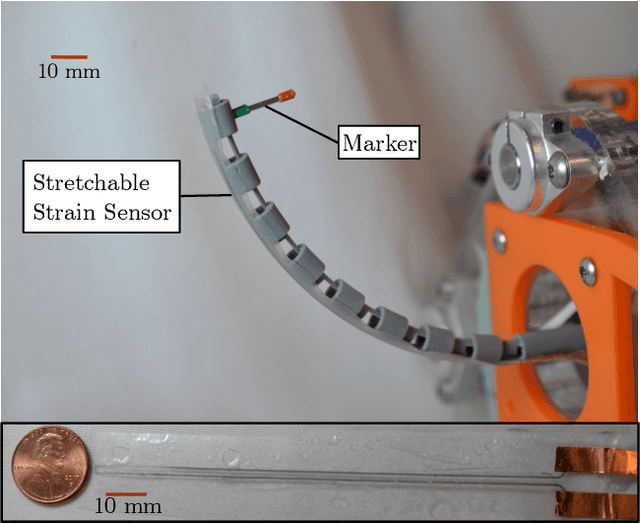
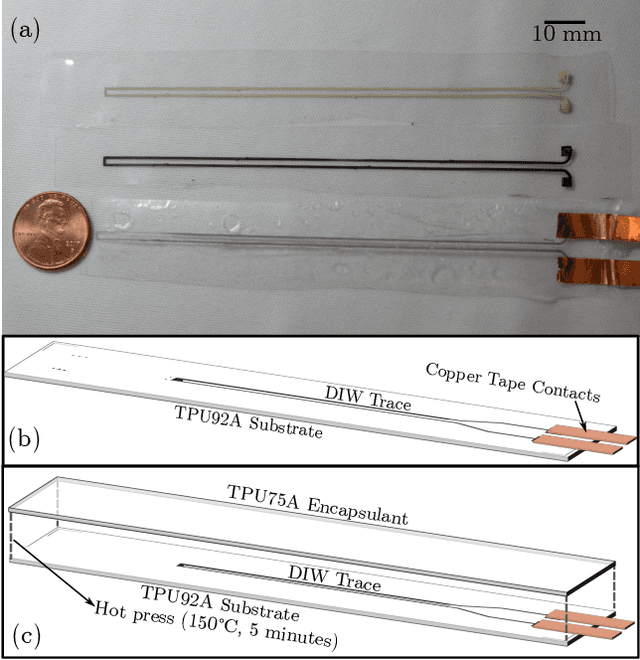
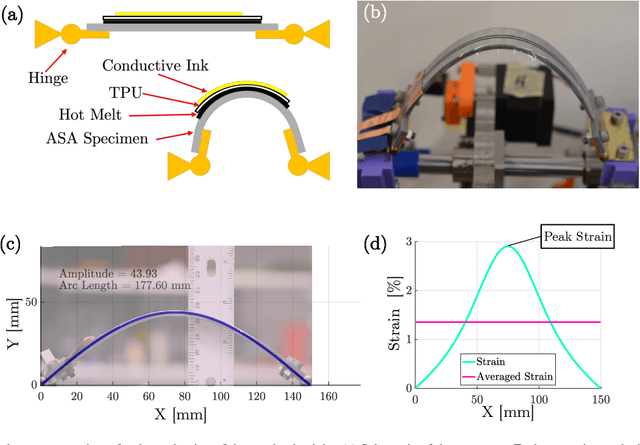
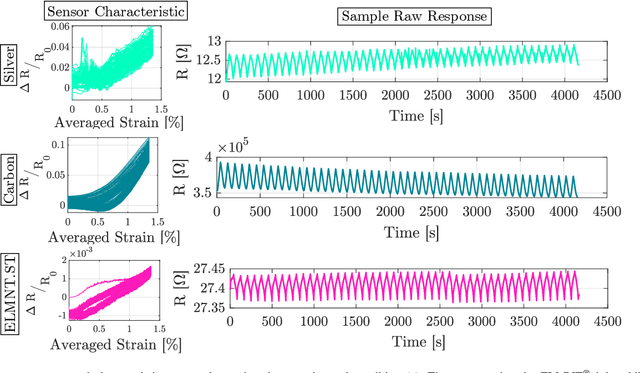
This letter describes the manufacturing and experimental characterization of novel stretchable strain sensors for continuum robots. The overarching goal of this research is to provide a new solution for the shape sensing of these devices. The sensors are fabricated via direct ink writing, an extrusion-based additive manufacturing technique. Electrically conductive material (i.e., the \textit{ink}) is printed into traces whose electrical resistance varies in response to mechanical deformation. The principle of operation of stretchable strain sensors is analogous to that of conventional strain gauges, but with a significantly larger operational window thanks to their ability to withstand larger strain. Among the different conductive materials considered for this study, we opted to fabricate the sensors with a high-viscosity eutectic Gallium-Indium ink, which in initial testing exhibited high linearity ($R^2 \approx$ 0.99), gauge factor $\approx$ 1, and negligible drift. Benefits of the proposed sensors include (i) ease of fabrication, as they can be conveniently printed in a matter of minutes; (ii) ease of installation, as they can simply be glued to the outside body of a robot; (iii) ease of miniaturization, which enables integration into millimiter-sized continuum robots.
Tractography with T1-weighted MRI and associated anatomical constraints on clinical quality diffusion MRI
Mar 27, 2024Diffusion MRI (dMRI) streamline tractography, the gold standard for in vivo estimation of brain white matter (WM) pathways, has long been considered indicative of macroscopic relationships with WM microstructure. However, recent advances in tractography demonstrated that convolutional recurrent neural networks (CoRNN) trained with a teacher-student framework have the ability to learn and propagate streamlines directly from T1 and anatomical contexts. Training for this network has previously relied on high-resolution dMRI. In this paper, we generalize the training mechanism to traditional clinical resolution data, which allows generalizability across sensitive and susceptible study populations. We train CoRNN on a small subset of the Baltimore Longitudinal Study of Aging (BLSA), which better resembles clinical protocols. Then, we define a metric, termed the epsilon ball seeding method, to compare T1 tractography and traditional diffusion tractography at the streamline level. Under this metric, T1 tractography generated by CoRNN reproduces diffusion tractography with approximately two millimeters of error.