 Add to Chrome
 Add to Firefox
 Add to Edge
Learning Object Detectors from Scratch with Gated Recurrent Feature Pyramids
Dec 04, 2017
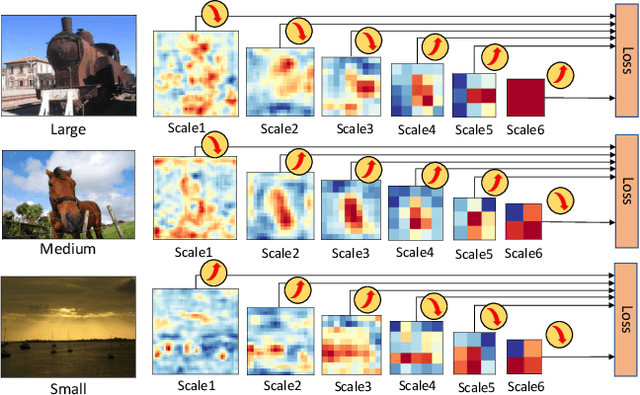
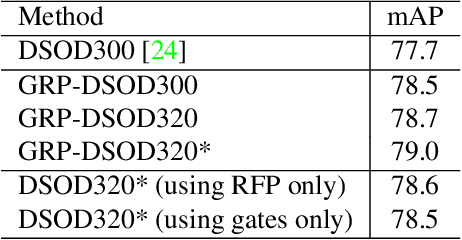
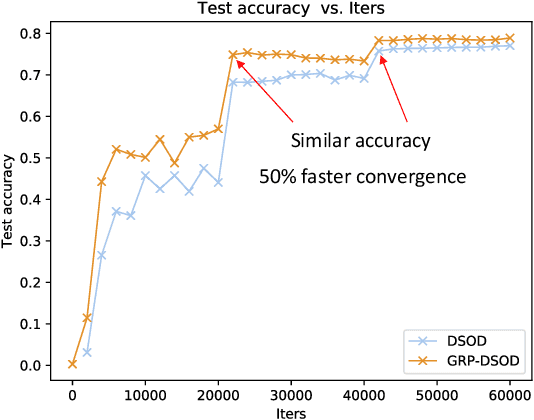
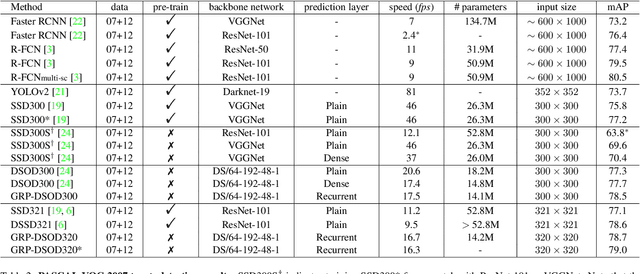
In this paper, we propose gated recurrent feature pyramid for the problem of learning object detection from scratch. Our approach is motivated by the recent work of deeply supervised object detector (DSOD), but explores new network architecture that dynamically adjusts the supervision intensities of intermediate layers for various scales in object detection. The benefits of the proposed method are two-fold: First, we propose a recurrent feature-pyramid structure to squeeze rich spatial and semantic features into a single prediction layer that further reduces the number of parameters to learn (DSOD need learn 1/2, but our method need only 1/3). Thus our new model is more fit for learning from scratch, and can converge faster than DSOD (using only 50% of iterations). Second, we introduce a novel gate-controlled prediction strategy to adaptively enhance or attenuate supervision at different scales based on the input object size. As a result, our model is more suitable for detecting small objects. To the best of our knowledge, our study is the best performed model of learning object detection from scratch. Our method in the PASCAL VOC 2012 comp3 leaderboard (which compares object detectors that are trained only with PASCAL VOC data) demonstrates a significant performance jump, from previous 64% to our 77% (VOC 07++12) and 72.5% (VOC 12). We also evaluate the performance of our method on PASCAL VOC 2007, 2012 and MS COCO datasets, and find that the accuracy of our learning from scratch method can even beat a lot of the state-of-the-art detection methods which use pre-trained models from ImageNet. Code is available at: https://github.com/szq0214/GRP-DSOD .

Dilated Recurrent Neural Networks
Nov 02, 2017
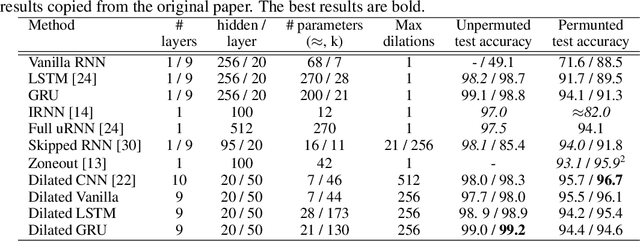
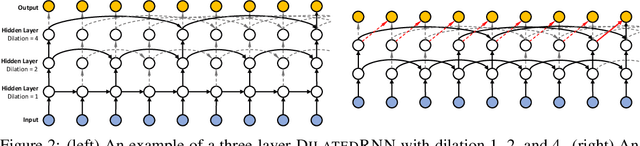
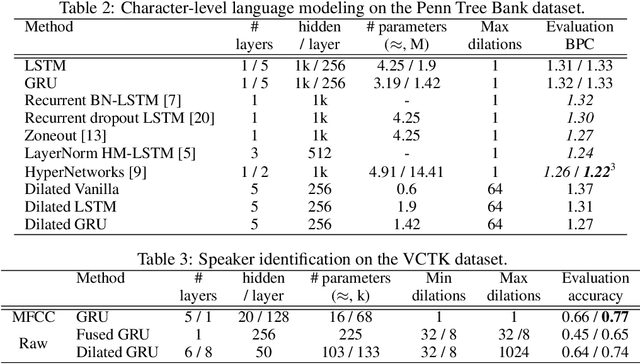
Learning with recurrent neural networks (RNNs) on long sequences is a notoriously difficult task. There are three major challenges: 1) complex dependencies, 2) vanishing and exploding gradients, and 3) efficient parallelization. In this paper, we introduce a simple yet effective RNN connection structure, the DilatedRNN, which simultaneously tackles all of these challenges. The proposed architecture is characterized by multi-resolution dilated recurrent skip connections and can be combined flexibly with diverse RNN cells. Moreover, the DilatedRNN reduces the number of parameters needed and enhances training efficiency significantly, while matching state-of-the-art performance (even with standard RNN cells) in tasks involving very long-term dependencies. To provide a theory-based quantification of the architecture's advantages, we introduce a memory capacity measure, the mean recurrent length, which is more suitable for RNNs with long skip connections than existing measures. We rigorously prove the advantages of the DilatedRNN over other recurrent neural architectures. The code for our method is publicly available at https://github.com/code-terminator/DilatedRNN
Robust Emotion Recognition from Low Quality and Low Bit Rate Video: A Deep Learning Approach
Sep 10, 2017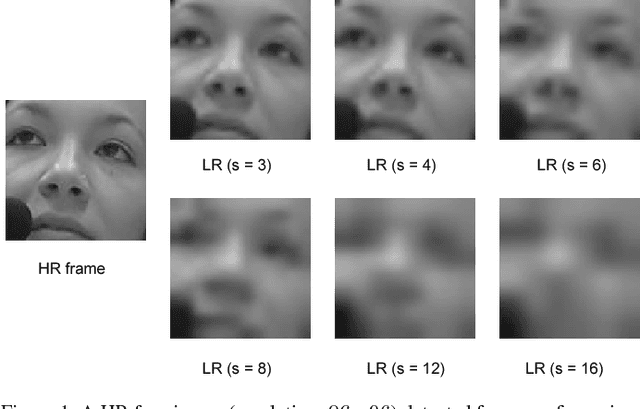
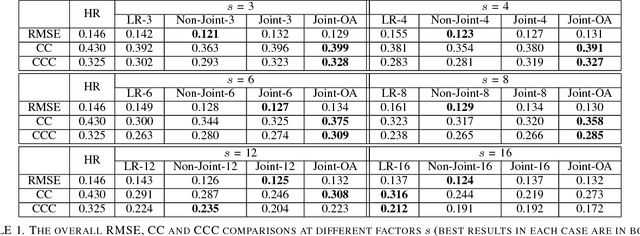
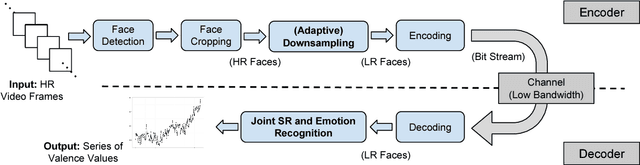
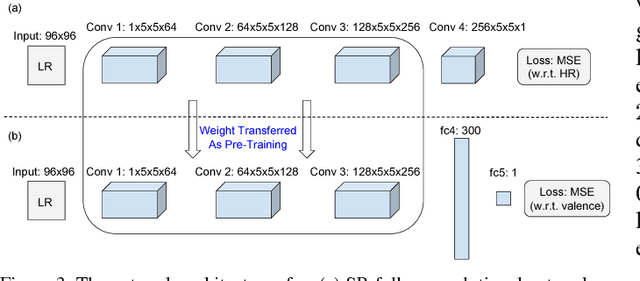
Emotion recognition from facial expressions is tremendously useful, especially when coupled with smart devices and wireless multimedia applications. However, the inadequate network bandwidth often limits the spatial resolution of the transmitted video, which will heavily degrade the recognition reliability. We develop a novel framework to achieve robust emotion recognition from low bit rate video. While video frames are downsampled at the encoder side, the decoder is embedded with a deep network model for joint super-resolution (SR) and recognition. Notably, we propose a novel max-mix training strategy, leading to a single "One-for-All" model that is remarkably robust to a vast range of downsampling factors. That makes our framework well adapted for the varied bandwidths in real transmission scenarios, without hampering scalability or efficiency. The proposed framework is evaluated on the AVEC 2016 benchmark, and demonstrates significantly improved stand-alone recognition performance, as well as rate-distortion (R-D) performance, than either directly recognizing from LR frames, or separating SR and recognition.
Discriminative Similarity for Clustering and Semi-Supervised Learning
Sep 05, 2017Similarity-based clustering and semi-supervised learning methods separate the data into clusters or classes according to the pairwise similarity between the data, and the pairwise similarity is crucial for their performance. In this paper, we propose a novel discriminative similarity learning framework which learns discriminative similarity for either data clustering or semi-supervised learning. The proposed framework learns classifier from each hypothetical labeling, and searches for the optimal labeling by minimizing the generalization error of the learned classifiers associated with the hypothetical labeling. Kernel classifier is employed in our framework. By generalization analysis via Rademacher complexity, the generalization error bound for the kernel classifier learned from hypothetical labeling is expressed as the sum of pairwise similarity between the data from different classes, parameterized by the weights of the kernel classifier. Such pairwise similarity serves as the discriminative similarity for the purpose of clustering and semi-supervised learning, and discriminative similarity with similar form can also be induced by the integrated squared error bound for kernel density classification. Based on the discriminative similarity induced by the kernel classifier, we propose new clustering and semi-supervised learning methods.
On the Suboptimality of Proximal Gradient Descent for $\ell^{0}$ Sparse Approximation
Sep 05, 2017We study the proximal gradient descent (PGD) method for $\ell^{0}$ sparse approximation problem as well as its accelerated optimization with randomized algorithms in this paper. We first offer theoretical analysis of PGD showing the bounded gap between the sub-optimal solution by PGD and the globally optimal solution for the $\ell^{0}$ sparse approximation problem under conditions weaker than Restricted Isometry Property widely used in compressive sensing literature. Moreover, we propose randomized algorithms to accelerate the optimization by PGD using randomized low rank matrix approximation (PGD-RMA) and randomized dimension reduction (PGD-RDR). Our randomized algorithms substantially reduces the computation cost of the original PGD for the $\ell^{0}$ sparse approximation problem, and the resultant sub-optimal solution still enjoys provable suboptimality, namely, the sub-optimal solution to the reduced problem still has bounded gap to the globally optimal solution to the original problem.
Fast Generation for Convolutional Autoregressive Models
Apr 20, 2017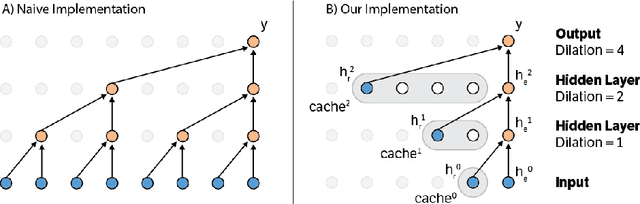
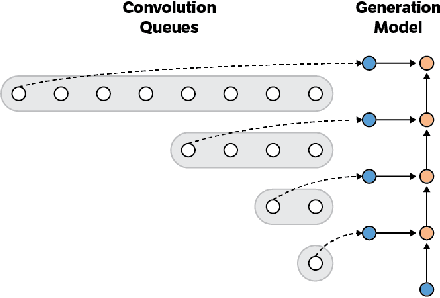
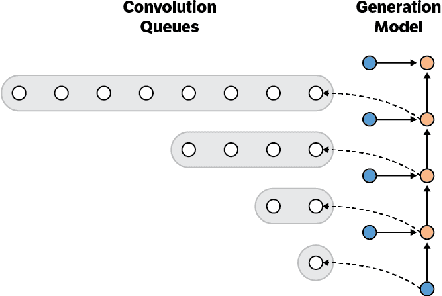
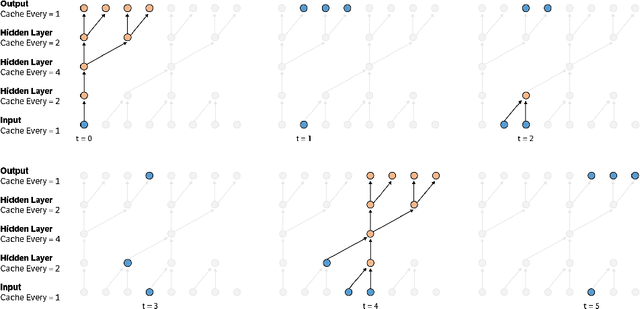
Convolutional autoregressive models have recently demonstrated state-of-the-art performance on a number of generation tasks. While fast, parallel training methods have been crucial for their success, generation is typically implemented in a na\"{i}ve fashion where redundant computations are unnecessarily repeated. This results in slow generation, making such models infeasible for production environments. In this work, we describe a method to speed up generation in convolutional autoregressive models. The key idea is to cache hidden states to avoid redundant computation. We apply our fast generation method to the Wavenet and PixelCNN++ models and achieve up to $21\times$ and $183\times$ speedups respectively.
Do Deep Neural Networks Learn Facial Action Units When Doing Expression Recognition?
Mar 16, 2017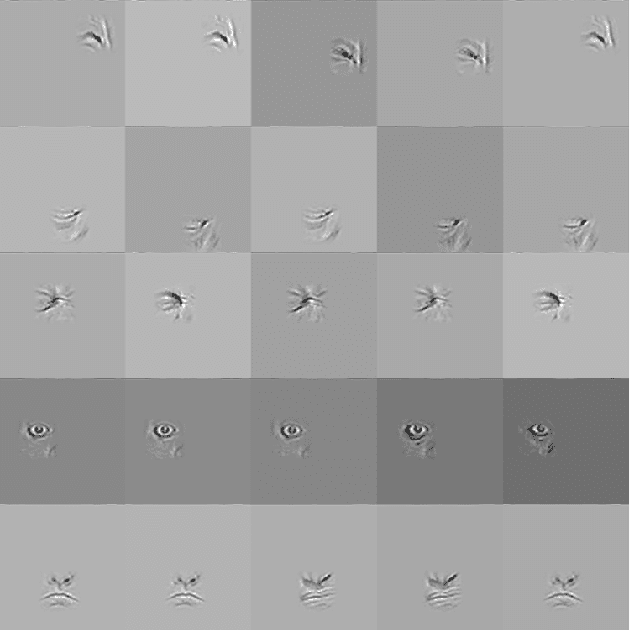
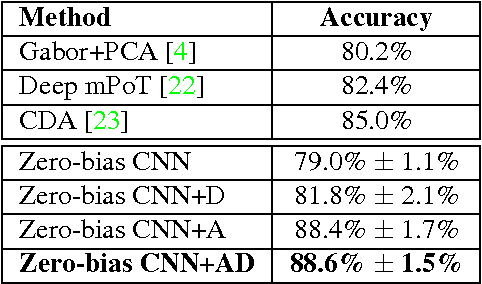
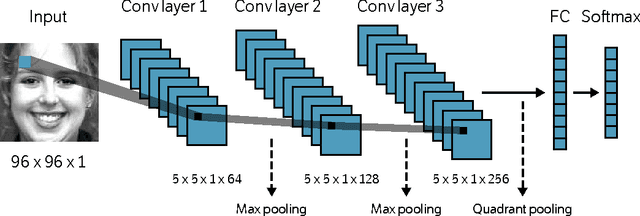
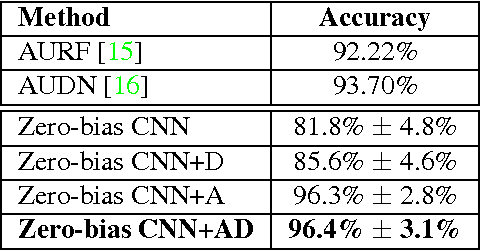
Despite being the appearance-based classifier of choice in recent years, relatively few works have examined how much convolutional neural networks (CNNs) can improve performance on accepted expression recognition benchmarks and, more importantly, examine what it is they actually learn. In this work, not only do we show that CNNs can achieve strong performance, but we also introduce an approach to decipher which portions of the face influence the CNN's predictions. First, we train a zero-bias CNN on facial expression data and achieve, to our knowledge, state-of-the-art performance on two expression recognition benchmarks: the extended Cohn-Kanade (CK+) dataset and the Toronto Face Dataset (TFD). We then qualitatively analyze the network by visualizing the spatial patterns that maximally excite different neurons in the convolutional layers and show how they resemble Facial Action Units (FAUs). Finally, we use the FAU labels provided in the CK+ dataset to verify that the FAUs observed in our filter visualizations indeed align with the subject's facial movements.
How Deep Neural Networks Can Improve Emotion Recognition on Video Data
Jan 10, 2017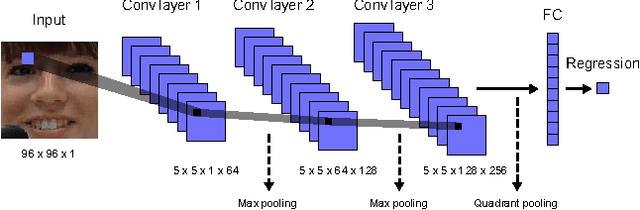
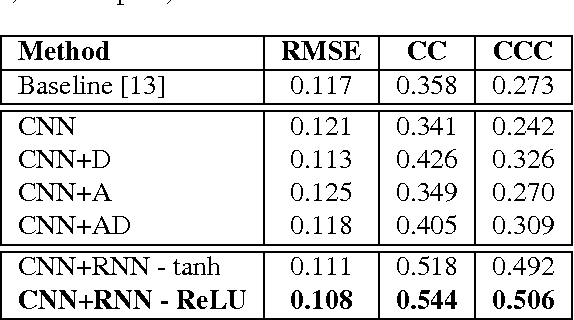
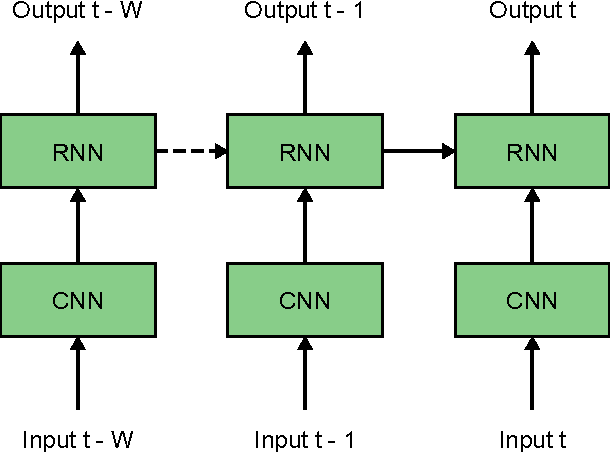
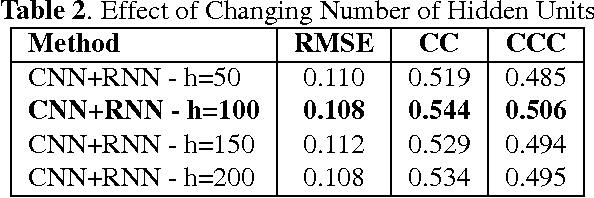
We consider the task of dimensional emotion recognition on video data using deep learning. While several previous methods have shown the benefits of training temporal neural network models such as recurrent neural networks (RNNs) on hand-crafted features, few works have considered combining convolutional neural networks (CNNs) with RNNs. In this work, we present a system that performs emotion recognition on video data using both CNNs and RNNs, and we also analyze how much each neural network component contributes to the system's overall performance. We present our findings on videos from the Audio/Visual+Emotion Challenge (AV+EC2015). In our experiments, we analyze the effects of several hyperparameters on overall performance while also achieving superior performance to the baseline and other competing methods.
Feedback Neural Network for Weakly Supervised Geo-Semantic Segmentation
Dec 08, 2016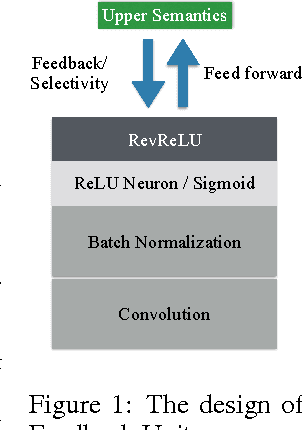
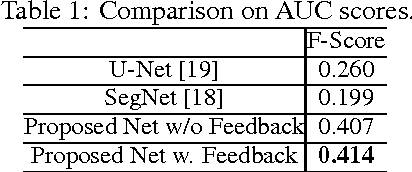
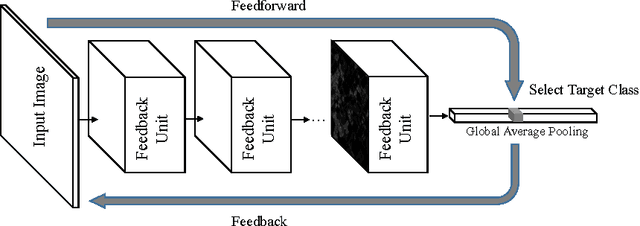
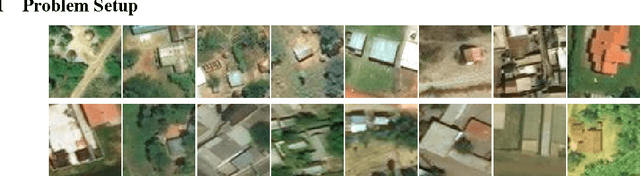
Learning from weakly-supervised data is one of the main challenges in machine learning and computer vision, especially for tasks such as image semantic segmentation where labeling is extremely expensive and subjective. In this paper, we propose a novel neural network architecture to perform weakly-supervised learning by suppressing irrelevant neuron activations. It localizes objects of interest by learning from image-level categorical labels in an end-to-end manner. We apply this algorithm to a practical challenge of transforming satellite images into a map of settlements and individual buildings. Experimental results show that the proposed algorithm achieves superior performance and efficiency when compared with various baseline models.
Fast Wavenet Generation Algorithm
Nov 29, 2016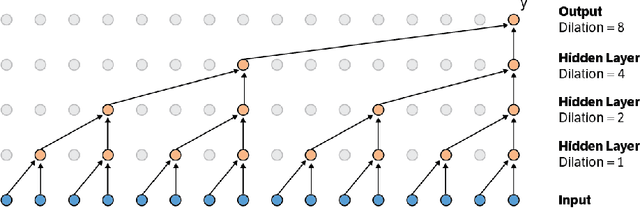
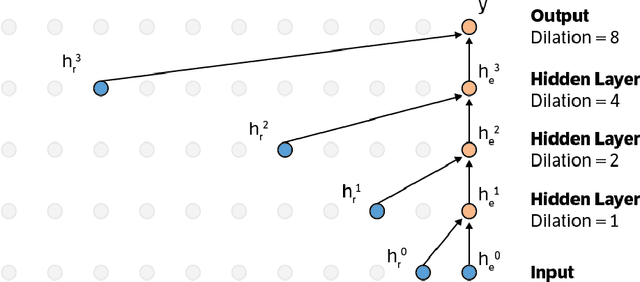
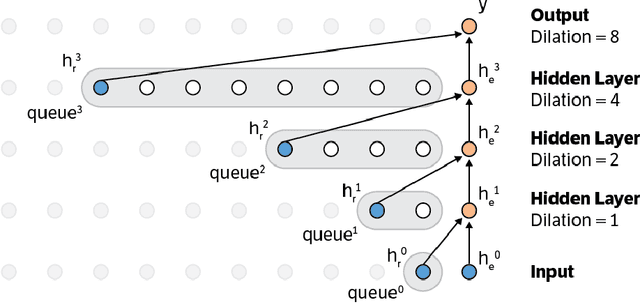
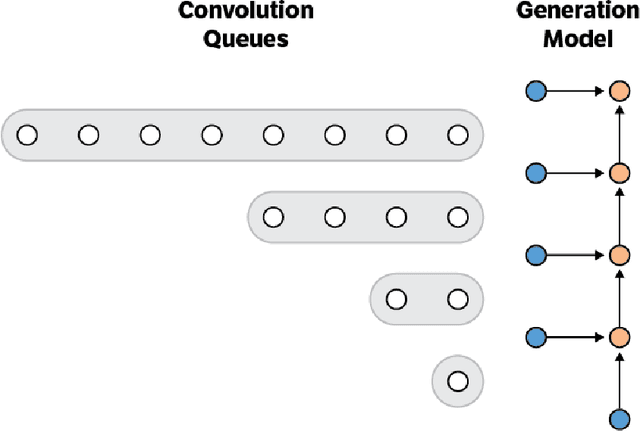
This paper presents an efficient implementation of the Wavenet generation process called Fast Wavenet. Compared to a naive implementation that has complexity O(2^L) (L denotes the number of layers in the network), our proposed approach removes redundant convolution operations by caching previous calculations, thereby reducing the complexity to O(L) time. Timing experiments show significant advantages of our fast implementation over a naive one. While this method is presented for Wavenet, the same scheme can be applied anytime one wants to perform autoregressive generation or online prediction using a model with dilated convolution layers. The code for our method is publicly available.