 Add to Chrome
 Add to Firefox
 Add to Edge
HyperLoader: Integrating Hypernetwork-Based LoRA and Adapter Layers into Multi-Task Transformers for Sequence Labelling
Jul 02, 2024
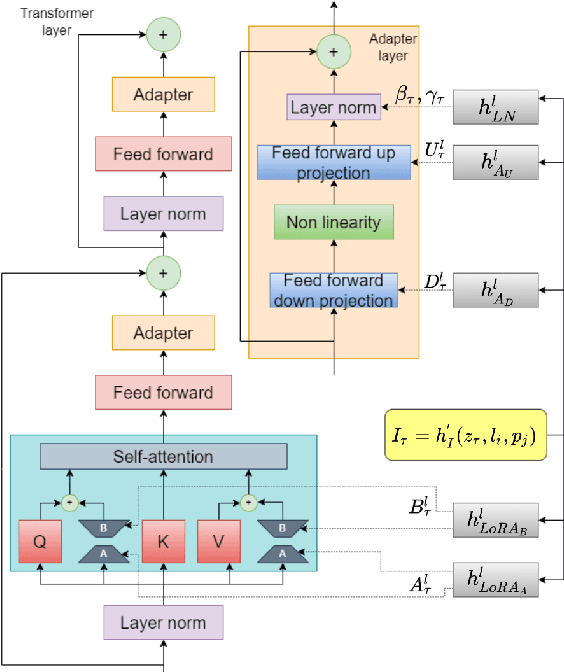

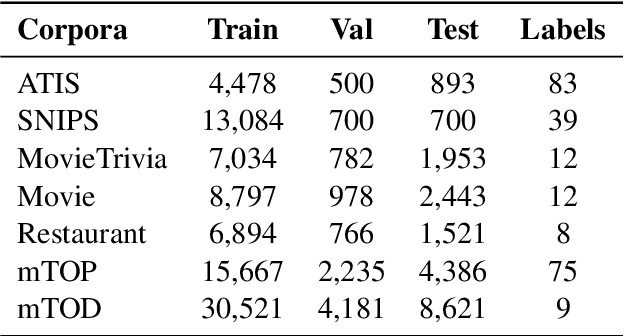
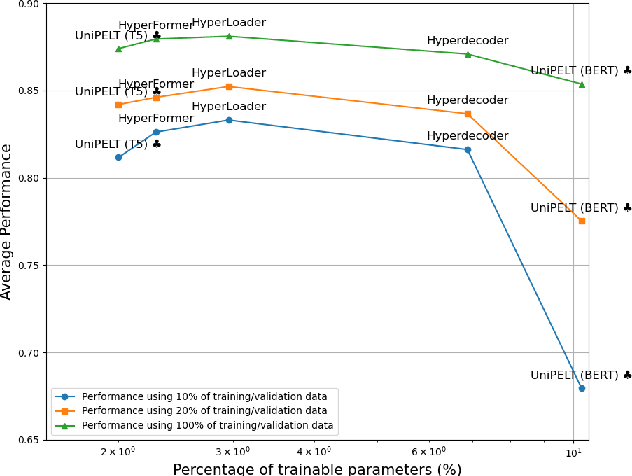
We present HyperLoader, a simple approach that combines different parameter-efficient fine-tuning methods in a multi-task setting. To achieve this goal, our model uses a hypernetwork to generate the weights of these modules based on the task, the transformer layer, and its position within this layer. Our method combines the benefits of multi-task learning by capturing the structure of all tasks while reducing the task interference problem by encapsulating the task-specific knowledge in the generated weights and the benefits of combining different parameter-efficient methods to outperform full-fine tuning. We provide empirical evidence that HyperLoader outperforms previous approaches in most datasets and obtains the best average performance across tasks in high-resource and low-resource scenarios.

The Privileged Students: On the Value of Initialization in Multilingual Knowledge Distillation
Jun 24, 2024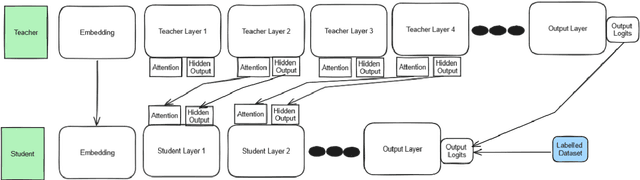
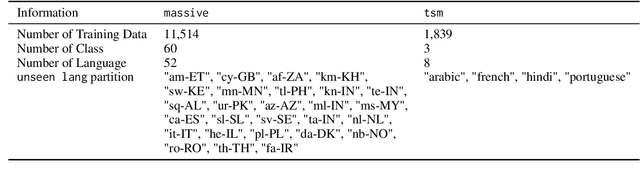
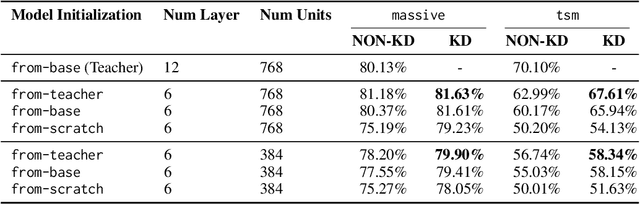
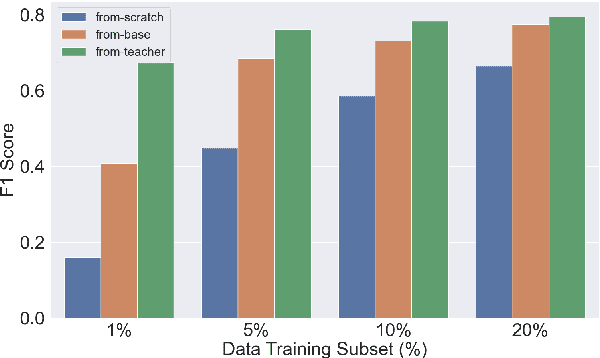
Knowledge distillation (KD) has proven to be a successful strategy to improve the performance of a smaller model in many NLP tasks. However, most of the work in KD only explores monolingual scenarios. In this paper, we investigate the value of KD in multilingual settings. We find the significance of KD and model initialization by analyzing how well the student model acquires multilingual knowledge from the teacher model. Our proposed method emphasizes copying the teacher model's weights directly to the student model to enhance initialization. Our finding shows that model initialization using copy-weight from the fine-tuned teacher contributes the most compared to the distillation process itself across various multilingual settings. Furthermore, we demonstrate that efficient weight initialization preserves multilingual capabilities even in low-resource scenarios.
Labeling Comic Mischief Content in Online Videos with a Multimodal Hierarchical-Cross-Attention Model
Jun 12, 2024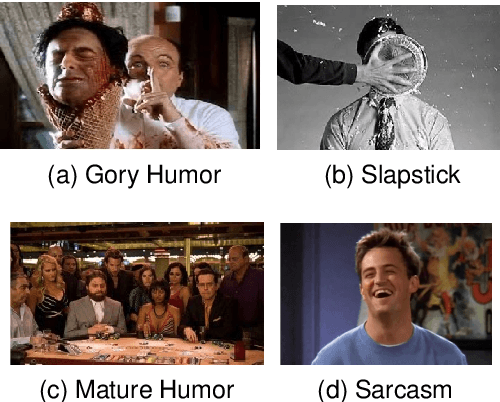

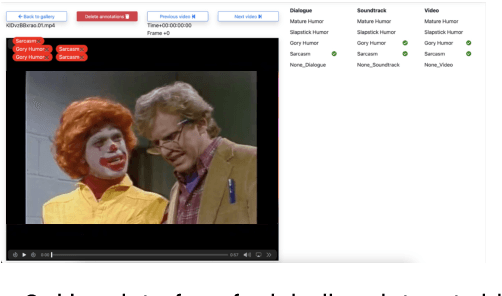

We address the challenge of detecting questionable content in online media, specifically the subcategory of comic mischief. This type of content combines elements such as violence, adult content, or sarcasm with humor, making it difficult to detect. Employing a multimodal approach is vital to capture the subtle details inherent in comic mischief content. To tackle this problem, we propose a novel end-to-end multimodal system for the task of comic mischief detection. As part of this contribution, we release a novel dataset for the targeted task consisting of three modalities: video, text (video captions and subtitles), and audio. We also design a HIerarchical Cross-attention model with CAPtions (HICCAP) to capture the intricate relationships among these modalities. The results show that the proposed approach makes a significant improvement over robust baselines and state-of-the-art models for comic mischief detection and its type classification. This emphasizes the potential of our system to empower users, to make informed decisions about the online content they choose to see. In addition, we conduct experiments on the UCF101, HMDB51, and XD-Violence datasets, comparing our model against other state-of-the-art approaches showcasing the outstanding performance of our proposed model in various scenarios.
CVQA: Culturally-diverse Multilingual Visual Question Answering Benchmark
Jun 10, 2024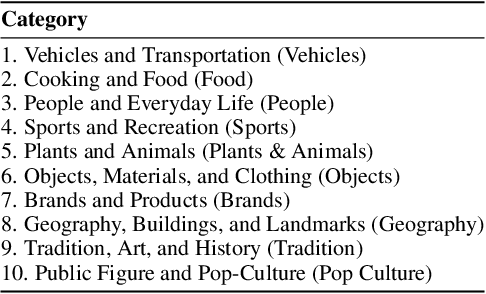
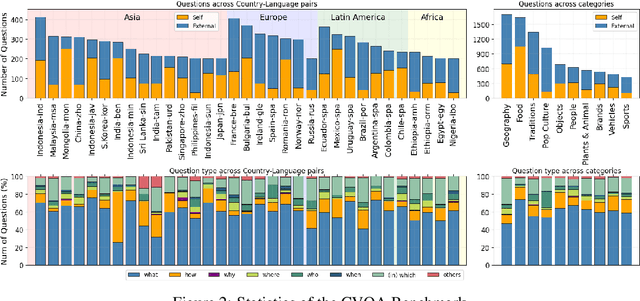
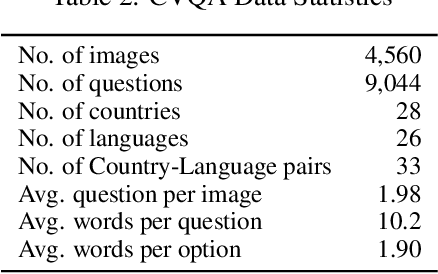

Visual Question Answering (VQA) is an important task in multimodal AI, and it is often used to test the ability of vision-language models to understand and reason on knowledge present in both visual and textual data. However, most of the current VQA models use datasets that are primarily focused on English and a few major world languages, with images that are typically Western-centric. While recent efforts have tried to increase the number of languages covered on VQA datasets, they still lack diversity in low-resource languages. More importantly, although these datasets often extend their linguistic range via translation or some other approaches, they usually keep images the same, resulting in narrow cultural representation. To address these limitations, we construct CVQA, a new Culturally-diverse multilingual Visual Question Answering benchmark, designed to cover a rich set of languages and cultures, where we engage native speakers and cultural experts in the data collection process. As a result, CVQA includes culturally-driven images and questions from across 28 countries on four continents, covering 26 languages with 11 scripts, providing a total of 9k questions. We then benchmark several Multimodal Large Language Models (MLLMs) on CVQA, and show that the dataset is challenging for the current state-of-the-art models. This benchmark can serve as a probing evaluation suite for assessing the cultural capability and bias of multimodal models and hopefully encourage more research efforts toward increasing cultural awareness and linguistic diversity in this field.
ROAST: Review-level Opinion Aspect Sentiment Target Joint Detection
May 30, 2024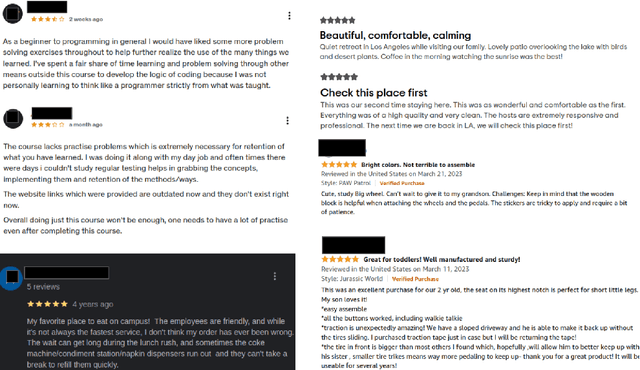
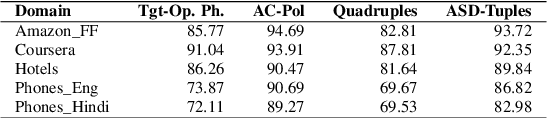
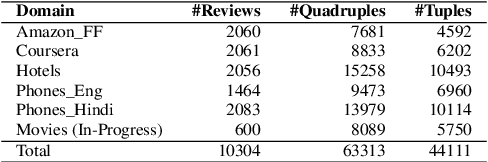
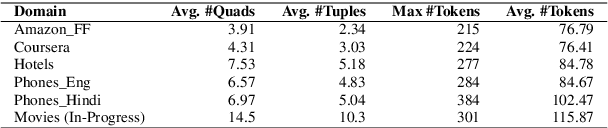
Aspect-Based Sentiment Analysis (ABSA) has experienced tremendous expansion and diversity due to various shared tasks spanning several languages and fields and organized via SemEval workshops and Germeval. Nonetheless, a few shortcomings still need to be addressed, such as the lack of low-resource language evaluations and the emphasis on sentence-level analysis. To thoroughly assess ABSA techniques in the context of complete reviews, this research presents a novel task, Review-Level Opinion Aspect Sentiment Target (ROAST). ROAST seeks to close the gap between sentence-level and text-level ABSA by identifying every ABSA constituent at the review level. We extend the available datasets to enable ROAST, addressing the drawbacks noted in previous research by incorporating low-resource languages, numerous languages, and a variety of topics. Through this effort, ABSA research will be able to cover more ground and get a deeper comprehension of the task and its practical application in a variety of languages and domains (https://github.com/RiTUAL-UH/ROAST-ABSA).
What Can Natural Language Processing Do for Peer Review?
May 10, 2024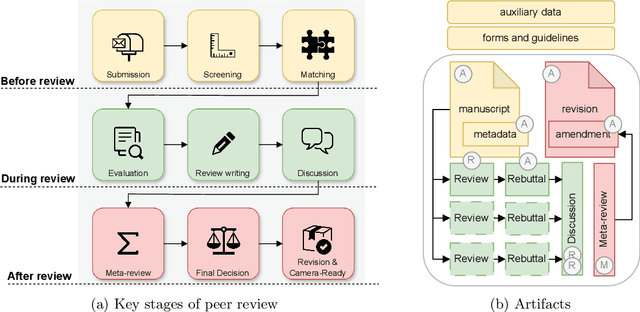
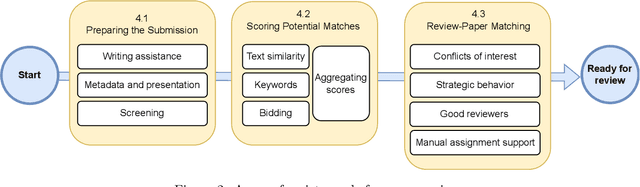

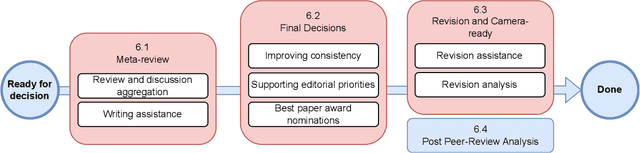
The number of scientific articles produced every year is growing rapidly. Providing quality control over them is crucial for scientists and, ultimately, for the public good. In modern science, this process is largely delegated to peer review -- a distributed procedure in which each submission is evaluated by several independent experts in the field. Peer review is widely used, yet it is hard, time-consuming, and prone to error. Since the artifacts involved in peer review -- manuscripts, reviews, discussions -- are largely text-based, Natural Language Processing has great potential to improve reviewing. As the emergence of large language models (LLMs) has enabled NLP assistance for many new tasks, the discussion on machine-assisted peer review is picking up the pace. Yet, where exactly is help needed, where can NLP help, and where should it stand aside? The goal of our paper is to provide a foundation for the future efforts in NLP for peer-reviewing assistance. We discuss peer review as a general process, exemplified by reviewing at AI conferences. We detail each step of the process from manuscript submission to camera-ready revision, and discuss the associated challenges and opportunities for NLP assistance, illustrated by existing work. We then turn to the big challenges in NLP for peer review as a whole, including data acquisition and licensing, operationalization and experimentation, and ethical issues. To help consolidate community efforts, we create a companion repository that aggregates key datasets pertaining to peer review. Finally, we issue a detailed call for action for the scientific community, NLP and AI researchers, policymakers, and funding bodies to help bring the research in NLP for peer review forward. We hope that our work will help set the agenda for research in machine-assisted scientific quality control in the age of AI, within the NLP community and beyond.
NLP Progress in Indigenous Latin American Languages
Apr 08, 2024


The paper focuses on the marginalization of indigenous language communities in the face of rapid technological advancements. We highlight the cultural richness of these languages and the risk they face of being overlooked in the realm of Natural Language Processing (NLP). We aim to bridge the gap between these communities and researchers, emphasizing the need for inclusive technological advancements that respect indigenous community perspectives. We show the NLP progress of indigenous Latin American languages and the survey that covers the status of indigenous languages in Latin America, their representation in NLP, and the challenges and innovations required for their preservation and development. The paper contributes to the current literature in understanding the need and progress of NLP for indigenous communities of Latin America, specifically low-resource and indigenous communities in general.
Interpreting Themes from Educational Stories
Apr 08, 2024Reading comprehension continues to be a crucial research focus in the NLP community. Recent advances in Machine Reading Comprehension (MRC) have mostly centered on literal comprehension, referring to the surface-level understanding of content. In this work, we focus on the next level - interpretive comprehension, with a particular emphasis on inferring the themes of a narrative text. We introduce the first dataset specifically designed for interpretive comprehension of educational narratives, providing corresponding well-edited theme texts. The dataset spans a variety of genres and cultural origins and includes human-annotated theme keywords with varying levels of granularity. We further formulate NLP tasks under different abstractions of interpretive comprehension toward the main idea of a story. After conducting extensive experiments with state-of-the-art methods, we found the task to be both challenging and significant for NLP research. The dataset and source code have been made publicly available to the research community at https://github.com/RiTUAL-UH/EduStory.
SemEval Task 1: Semantic Textual Relatedness for African and Asian Languages
Apr 04, 2024


We present the first shared task on Semantic Textual Relatedness (STR). While earlier shared tasks primarily focused on semantic similarity, we instead investigate the broader phenomenon of semantic relatedness across 14 languages: Afrikaans, Algerian Arabic, Amharic, English, Hausa, Hindi, Indonesian, Kinyarwanda, Marathi, Moroccan Arabic, Modern Standard Arabic, Punjabi, Spanish, and Telugu. These languages originate from five distinct language families and are predominantly spoken in Africa and Asia -- regions characterised by the relatively limited availability of NLP resources. Each instance in the datasets is a sentence pair associated with a score that represents the degree of semantic textual relatedness between the two sentences. Participating systems were asked to rank sentence pairs by their closeness in meaning (i.e., their degree of semantic relatedness) in the 14 languages in three main tracks: (a) supervised, (b) unsupervised, and (c) crosslingual. The task attracted 163 participants. We received 70 submissions in total (across all tasks) from 51 different teams, and 38 system description papers. We report on the best-performing systems as well as the most common and the most effective approaches for the three different tracks.
Adaptive Cross-lingual Text Classification through In-Context One-Shot Demonstrations
Apr 03, 2024Zero-Shot Cross-lingual Transfer (ZS-XLT) utilizes a model trained in a source language to make predictions in another language, often with a performance loss. To alleviate this, additional improvements can be achieved through subsequent adaptation using examples in the target language. In this paper, we exploit In-Context Tuning (ICT) for One-Shot Cross-lingual transfer in the classification task by introducing In-Context Cross-lingual Transfer (IC-XLT). The novel concept involves training a model to learn from context examples and subsequently adapting it during inference to a target language by prepending a One-Shot context demonstration in that language. Our results show that IC-XLT successfully leverages target-language examples to improve the cross-lingual capabilities of the evaluated mT5 model, outperforming prompt-based models in the Zero and Few-shot scenarios adapted through fine-tuning. Moreover, we show that when source-language data is limited, the fine-tuning framework employed for IC-XLT performs comparably to prompt-based fine-tuning with significantly more training data in the source language.