 Add to Chrome
 Add to Firefox
 Add to Edge
LLM-HYPER: Generative CTR Modeling for Cold-Start Ad Personalization via LLM-Based Hypernetworks
Apr 13, 2026
On online advertising platforms, newly introduced promotional ads face the cold-start problem, as they lack sufficient user feedback for model training. In this work, we propose LLM-HYPER, a novel framework that treats large language models (LLMs) as hypernetworks to directly generate the parameters of the click-through rate (CTR) estimator in a training-free manner. LLM-HYPER uses few-shot Chain-of-Thought prompting over multimodal ad content (text and images) to infer feature-wise model weights for a linear CTR predictor. By retrieving semantically similar past campaigns via CLIP embeddings and formatting them into prompt-based demonstrations, the LLM learns to reason about customer intent, feature influence, and content relevance. To ensure numerical stability and serviceability, we introduce normalization and calibration techniques that align the generated weights with production-ready CTR distributions. Extensive offline experiments show that LLM-HYPER significantly outperforms cold-start baselines in NDCG$@10$ by 55.9\%. Our real-world online A/B test on one of the top e-commerce platforms in the U.S. demonstrates the strong performance of LLM-HYPER, which drastically reduces the cold-start period and achieves competitive performance. LLM-HYPER has been successfully deployed in production.

CRAB: Codebook Rebalancing for Bias Mitigation in Generative Recommendation
Apr 06, 2026Generative recommendation (GeneRec) has introduced a new paradigm that represents items as discrete semantic tokens and predicts items in a generative manner. Despite its strong performance across multiple recommendation tasks, existing GeneRec approaches still suffer from severe popularity bias and may even exacerbate it. In this work, we conduct a comprehensive empirical analysis to uncover the root causes of this phenomenon, yielding two core insights: 1) imbalanced tokenization inherits and can further amplify popularity bias from historical item interactions; 2) current training procedures disproportionately favor popular tokens while neglecting semantic relationships among tokens, thereby intensifying popularity bias. Building on these insights, we propose CRAB, a post-hoc debiasing strategy for GeneRec that alleviates popularity bias by mitigating frequency imbalance among semantic tokens. Specifically, given a well-trained model, we first rebalance the codebook by splitting over-popular tokens while preserving their hierarchical semantic structure. Based on the adjusted codebook, we further introduce a tree-structured regularizer to enhance semantic consistency, encouraging more informative representations for unpopular tokens during training. Experiments on real-world datasets demonstrate that CRAB significantly improves recommendation performance by effectively alleviating popularity bias.
Latent Customer Segmentation and Value-Based Recommendation Leveraging a Two-Stage Model with Missing Labels
Feb 12, 2026The success of businesses depends on their ability to convert consumers into loyal customers. A customer's value proposition is a primary determinant in this process, requiring a balance between affordability and long-term brand equity. Broad marketing campaigns can erode perceived brand value and reduce return on investment, while existing economic algorithms often misidentify highly engaged customers as ideal targets, leading to inefficient engagement and conversion outcomes. This work introduces a two-stage multi-model architecture employing Self-Paced Loss to improve customer categorization. The first stage uses a multi-class neural network to distinguish customers influenced by campaigns, organically engaged customers, and low-engagement customers. The second stage applies a binary label correction model to identify true campaign-driven intent using a missing-label framework, refining customer segmentation during training. By separating prompted engagement from organic behavior, the system enables more precise campaign targeting, reduces exposure costs, and improves conversion efficiency. A/B testing demonstrates over 100 basis points improvement in key success metrics, highlighting the effectiveness of intent-aware segmentation for value-driven marketing strategies.
Campaign-2-PT-RAG: LLM-Guided Semantic Product Type Attribution for Scalable Campaign Ranking
Feb 11, 2026E-commerce campaign ranking models require large-scale training labels indicating which users purchased due to campaign influence. However, generating these labels is challenging because campaigns use creative, thematic language that does not directly map to product purchases. Without clear product-level attribution, supervised learning for campaign optimization remains limited. We present \textbf{Campaign-2-PT-RAG}, a scalable label generation framework that constructs user--campaign purchase labels by inferring which product types (PTs) each campaign promotes. The framework first interprets campaign content using large language models (LLMs) to capture implicit intent, then retrieves candidate PTs through semantic search over the platform taxonomy. A structured LLM-based classifier evaluates each PT's relevance, producing a campaign-specific product coverage set. User purchases matching these PTs generate positive training labels for downstream ranking models. This approach reframes the ambiguous attribution problem into a tractable semantic alignment task, enabling scalable and consistent supervision for downstream tasks such as campaign ranking optimization in production e-commerce environments. Experiments on internal and synthetic datasets, validated against expert-annotated campaign--PT mappings, show that our LLM-assisted approach generates high-quality labels with 78--90% precision while maintaining over 99% recall.
Is More Context Always Better? Examining LLM Reasoning Capability for Time Interval Prediction
Jan 15, 2026Large Language Models (LLMs) have demonstrated impressive capabilities in reasoning and prediction across different domains. Yet, their ability to infer temporal regularities from structured behavioral data remains underexplored. This paper presents a systematic study investigating whether LLMs can predict time intervals between recurring user actions, such as repeated purchases, and how different levels of contextual information shape their predictive behavior. Using a simple but representative repurchase scenario, we benchmark state-of-the-art LLMs in zero-shot settings against both statistical and machine-learning models. Two key findings emerge. First, while LLMs surpass lightweight statistical baselines, they consistently underperform dedicated machine-learning models, showing their limited ability to capture quantitative temporal structure. Second, although moderate context can improve LLM accuracy, adding further user-level detail degrades performance. These results challenge the assumption that "more context leads to better reasoning". Our study highlights fundamental limitations of today's LLMs in structured temporal inference and offers guidance for designing future context-aware hybrid models that integrate statistical precision with linguistic flexibility.
To See or To Read: User Behavior Reasoning in Multimodal LLMs
Nov 05, 2025Multimodal Large Language Models (MLLMs) are reshaping how modern agentic systems reason over sequential user-behavior data. However, whether textual or image representations of user behavior data are more effective for maximizing MLLM performance remains underexplored. We present \texttt{BehaviorLens}, a systematic benchmarking framework for assessing modality trade-offs in user-behavior reasoning across six MLLMs by representing transaction data as (1) a text paragraph, (2) a scatter plot, and (3) a flowchart. Using a real-world purchase-sequence dataset, we find that when data is represented as images, MLLMs next-purchase prediction accuracy is improved by 87.5% compared with an equivalent textual representation without any additional computational cost.
MetaSynth: Multi-Agent Metadata Generation from Implicit Feedback in Black-Box Systems
Oct 01, 2025Meta titles and descriptions strongly shape engagement in search and recommendation platforms, yet optimizing them remains challenging. Search engine ranking models are black box environments, explicit labels are unavailable, and feedback such as click-through rate (CTR) arrives only post-deployment. Existing template, LLM, and retrieval-augmented approaches either lack diversity, hallucinate attributes, or ignore whether candidate phrasing has historically succeeded in ranking. This leaves a gap in directly leveraging implicit signals from observable outcomes. We introduce MetaSynth, a multi-agent retrieval-augmented generation framework that learns from implicit search feedback. MetaSynth builds an exemplar library from top-ranked results, generates candidate snippets conditioned on both product content and exemplars, and iteratively refines outputs via evaluator-generator loops that enforce relevance, promotional strength, and compliance. On both proprietary e-commerce data and the Amazon Reviews corpus, MetaSynth outperforms strong baselines across NDCG, MRR, and rank metrics. Large-scale A/B tests further demonstrate 10.26% CTR and 7.51% clicks. Beyond metadata, this work contributes a general paradigm for optimizing content in black-box systems using implicit signals.
Scalable Permutation-Aware Modeling for Temporal Set Prediction
Apr 23, 2025Temporal set prediction involves forecasting the elements that will appear in the next set, given a sequence of prior sets, each containing a variable number of elements. Existing methods often rely on intricate architectures with substantial computational overhead, which hampers their scalability. In this work, we introduce a novel and scalable framework that leverages permutation-equivariant and permutation-invariant transformations to efficiently model set dynamics. Our approach significantly reduces both training and inference time while maintaining competitive performance. Extensive experiments on multiple public benchmarks show that our method achieves results on par with or superior to state-of-the-art models across several evaluation metrics. These results underscore the effectiveness of our model in enabling efficient and scalable temporal set prediction.
LLM-driven Constrained Copy Generation through Iterative Refinement
Apr 14, 2025Crafting a marketing message (copy), or copywriting is a challenging generation task, as the copy must adhere to various constraints. Copy creation is inherently iterative for humans, starting with an initial draft followed by successive refinements. However, manual copy creation is time-consuming and expensive, resulting in only a few copies for each use case. This limitation restricts our ability to personalize content to customers. Contrary to the manual approach, LLMs can generate copies quickly, but the generated content does not consistently meet all the constraints on the first attempt (similar to humans). While recent studies have shown promise in improving constrained generation through iterative refinement, they have primarily addressed tasks with only a few simple constraints. Consequently, the effectiveness of iterative refinement for tasks such as copy generation, which involves many intricate constraints, remains unclear. To address this gap, we propose an LLM-based end-to-end framework for scalable copy generation using iterative refinement. To the best of our knowledge, this is the first study to address multiple challenging constraints simultaneously in copy generation. Examples of these constraints include length, topics, keywords, preferred lexical ordering, and tone of voice. We demonstrate the performance of our framework by creating copies for e-commerce banners for three different use cases of varying complexity. Our results show that iterative refinement increases the copy success rate by $16.25-35.91$% across use cases. Furthermore, the copies generated using our approach outperformed manually created content in multiple pilot studies using a multi-armed bandit framework. The winning copy improved the click-through rate by $38.5-45.21$%.
Adaptive Object Detection for Indoor Navigation Assistance: A Performance Evaluation of Real-Time Algorithms
Jan 30, 2025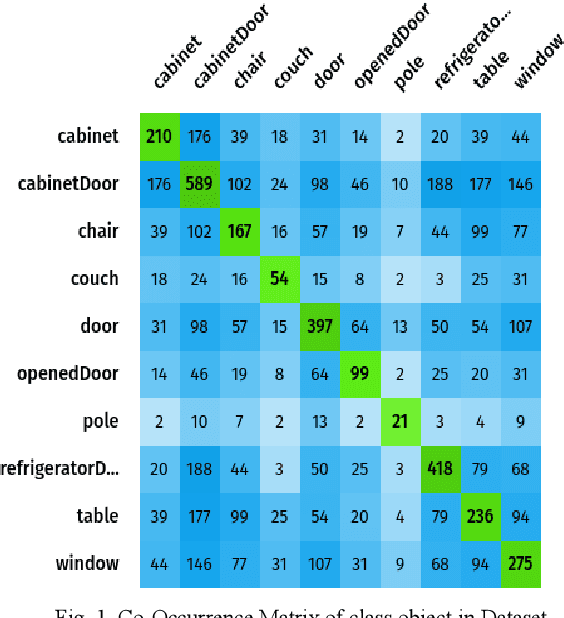
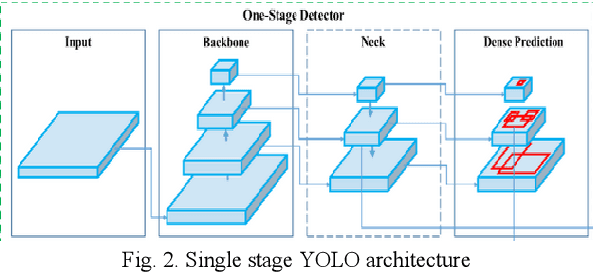
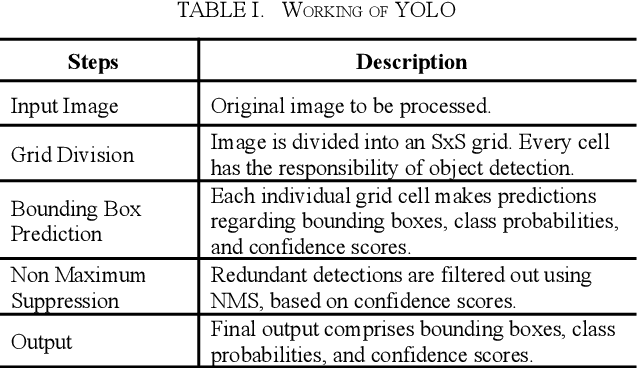
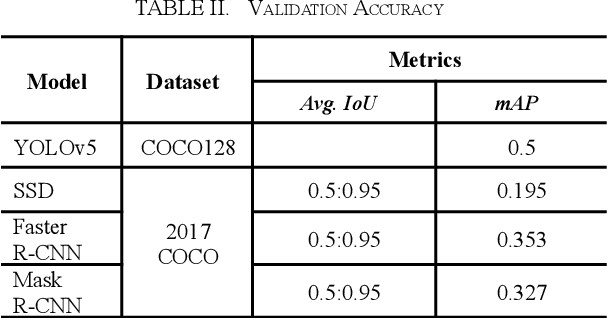
This study addresses the need for accurate and efficient object detection in assistive technologies for visually impaired individuals. We evaluate four real-time object detection algorithms YOLO, SSD, Faster R-CNN, and Mask R-CNN within the context of indoor navigation assistance. Using the Indoor Objects Detection dataset, we analyze detection accuracy, processing speed, and adaptability to indoor environments. Our findings highlight the trade-offs between precision and efficiency, offering insights into selecting optimal algorithms for realtime assistive navigation. This research advances adaptive machine learning applications, enhancing indoor navigation solutions for the visually impaired and promoting accessibility.