 Add to Chrome
 Add to Firefox
 Add to Edge
Campaign-2-PT-RAG: LLM-Guided Semantic Product Type Attribution for Scalable Campaign Ranking
Feb 11, 2026
E-commerce campaign ranking models require large-scale training labels indicating which users purchased due to campaign influence. However, generating these labels is challenging because campaigns use creative, thematic language that does not directly map to product purchases. Without clear product-level attribution, supervised learning for campaign optimization remains limited. We present \textbf{Campaign-2-PT-RAG}, a scalable label generation framework that constructs user--campaign purchase labels by inferring which product types (PTs) each campaign promotes. The framework first interprets campaign content using large language models (LLMs) to capture implicit intent, then retrieves candidate PTs through semantic search over the platform taxonomy. A structured LLM-based classifier evaluates each PT's relevance, producing a campaign-specific product coverage set. User purchases matching these PTs generate positive training labels for downstream ranking models. This approach reframes the ambiguous attribution problem into a tractable semantic alignment task, enabling scalable and consistent supervision for downstream tasks such as campaign ranking optimization in production e-commerce environments. Experiments on internal and synthetic datasets, validated against expert-annotated campaign--PT mappings, show that our LLM-assisted approach generates high-quality labels with 78--90% precision while maintaining over 99% recall.

AnoFPDM: Anomaly Segmentation with Forward Process of Diffusion Models for Brain MRI
Apr 24, 2024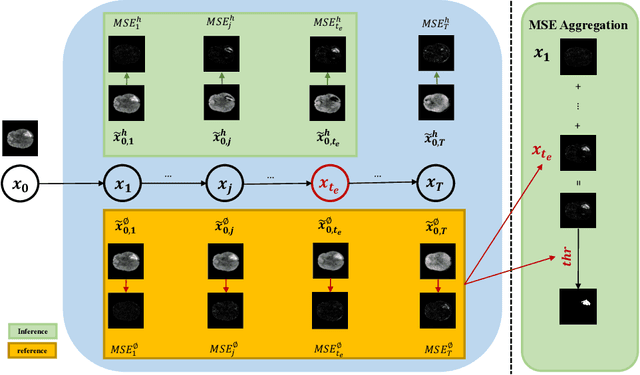
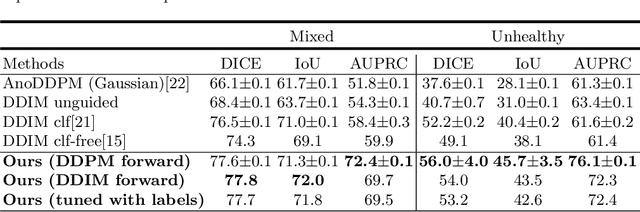
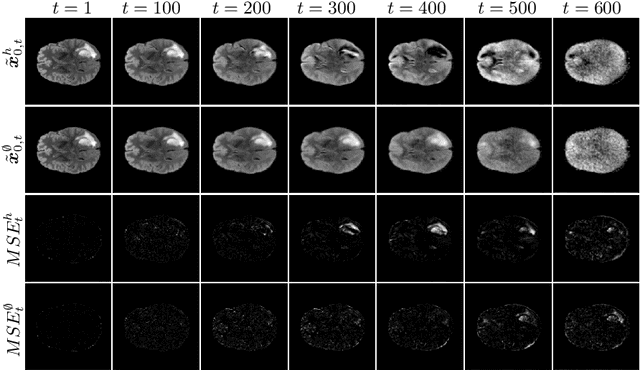
Weakly-supervised diffusion models (DM) in anomaly segmentation, leveraging image-level labels, have attracted significant attention for their superior performance compared to unsupervised methods. It eliminates the need for pixel-level labels in training, offering a more cost-effective alternative to supervised methods. However, existing methods are not fully weakly-supervised because they heavily rely on costly pixel-level labels for hyperparameter tuning in inference. To tackle this challenge, we introduce Anomaly Segmentation with Forward Process of Diffusion Models (AnoFPDM), a fully weakly-supervised framework that operates without the need for pixel-level labels. Leveraging the unguided forward process as a reference, we identify suitable hyperparameters, i.e., noise scale and threshold, for each input image. We aggregate anomaly maps from each step in the forward process, enhancing the signal strength of anomalous regions. Remarkably, our proposed method outperforms recent state-of-the-art weakly-supervised approaches, even without utilizing pixel-level labels.