 Add to Chrome
 Add to Firefox
 Add to Edge
LLM-HYPER: Generative CTR Modeling for Cold-Start Ad Personalization via LLM-Based Hypernetworks
Apr 13, 2026
On online advertising platforms, newly introduced promotional ads face the cold-start problem, as they lack sufficient user feedback for model training. In this work, we propose LLM-HYPER, a novel framework that treats large language models (LLMs) as hypernetworks to directly generate the parameters of the click-through rate (CTR) estimator in a training-free manner. LLM-HYPER uses few-shot Chain-of-Thought prompting over multimodal ad content (text and images) to infer feature-wise model weights for a linear CTR predictor. By retrieving semantically similar past campaigns via CLIP embeddings and formatting them into prompt-based demonstrations, the LLM learns to reason about customer intent, feature influence, and content relevance. To ensure numerical stability and serviceability, we introduce normalization and calibration techniques that align the generated weights with production-ready CTR distributions. Extensive offline experiments show that LLM-HYPER significantly outperforms cold-start baselines in NDCG$@10$ by 55.9\%. Our real-world online A/B test on one of the top e-commerce platforms in the U.S. demonstrates the strong performance of LLM-HYPER, which drastically reduces the cold-start period and achieves competitive performance. LLM-HYPER has been successfully deployed in production.

Object-sensitive Deep Reinforcement Learning
Sep 17, 2018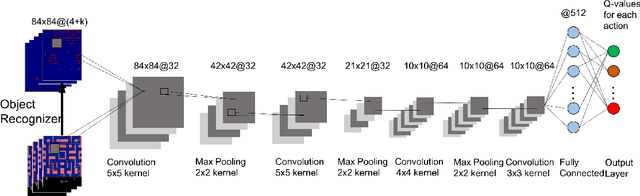

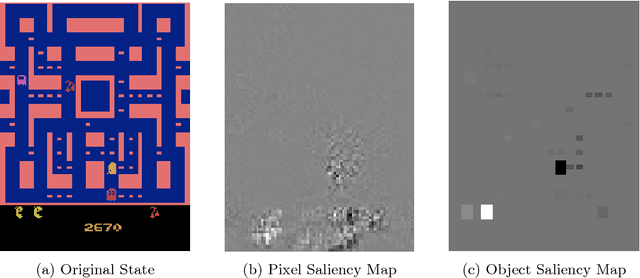

Deep reinforcement learning has become popular over recent years, showing superiority on different visual-input tasks such as playing Atari games and robot navigation. Although objects are important image elements, few work considers enhancing deep reinforcement learning with object characteristics. In this paper, we propose a novel method that can incorporate object recognition processing to deep reinforcement learning models. This approach can be adapted to any existing deep reinforcement learning frameworks. State-of-the-art results are shown in experiments on Atari games. We also propose a new approach called "object saliency maps" to visually explain the actions made by deep reinforcement learning agents.
Transparency and Explanation in Deep Reinforcement Learning Neural Networks
Sep 17, 2018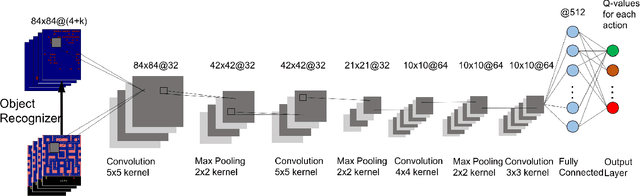
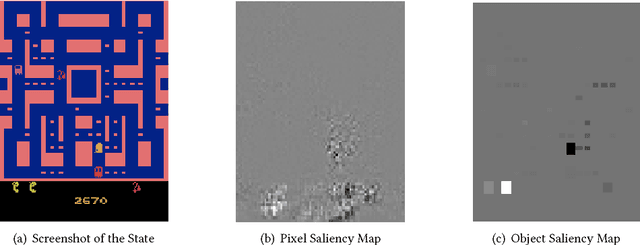

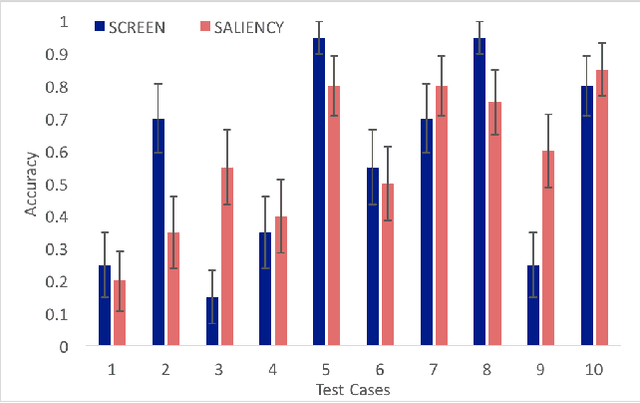
Autonomous AI systems will be entering human society in the near future to provide services and work alongside humans. For those systems to be accepted and trusted, the users should be able to understand the reasoning process of the system, i.e. the system should be transparent. System transparency enables humans to form coherent explanations of the system's decisions and actions. Transparency is important not only for user trust, but also for software debugging and certification. In recent years, Deep Neural Networks have made great advances in multiple application areas. However, deep neural networks are opaque. In this paper, we report on work in transparency in Deep Reinforcement Learning Networks (DRLN). Such networks have been extremely successful in accurately learning action control in image input domains, such as Atari games. In this paper, we propose a novel and general method that (a) incorporates explicit object recognition processing into deep reinforcement learning models, (b) forms the basis for the development of "object saliency maps", to provide visualization of internal states of DRLNs, thus enabling the formation of explanations and (c) can be incorporated in any existing deep reinforcement learning framework. We present computational results and human experiments to evaluate our approach.
Photorealistic Style Transfer for Videos
Jul 01, 2018Photorealistic style transfer is a technique which transfers colour from one reference domain to another domain by using deep learning and optimization techniques. Here, we present a technique which we use to transfer style and colour from a reference image to a video.
Joint Embedding of Hierarchical Categories and Entities for Concept Categorization and Dataless Classification
Jul 27, 2016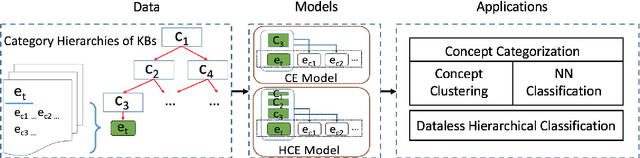
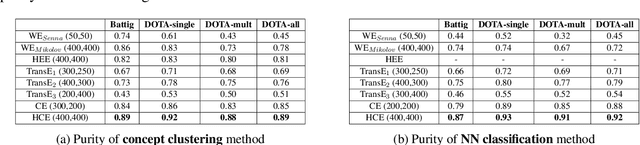
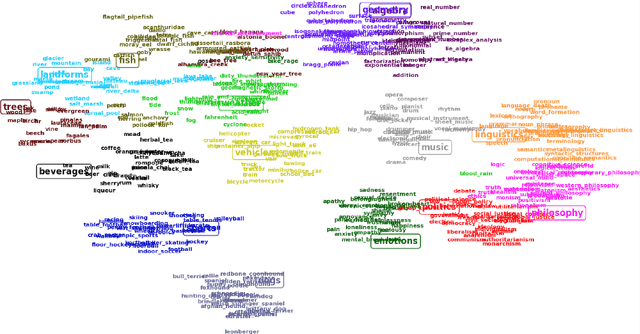
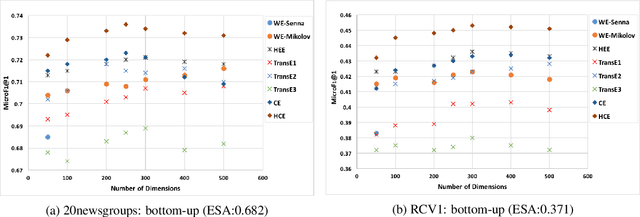
Due to the lack of structured knowledge applied in learning distributed representation of cate- gories, existing work cannot incorporate category hierarchies into entity information. We propose a framework that embeds entities and categories into a semantic space by integrating structured knowledge and taxonomy hierarchy from large knowledge bases. The framework allows to com- pute meaningful semantic relatedness between entities and categories. Our framework can han- dle both single-word concepts and multiple-word concepts with superior performance on concept categorization and yield state of the art results on dataless hierarchical classification.
Joint Embeddings of Hierarchical Categories and Entities
May 13, 2016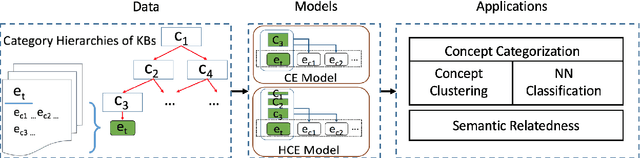
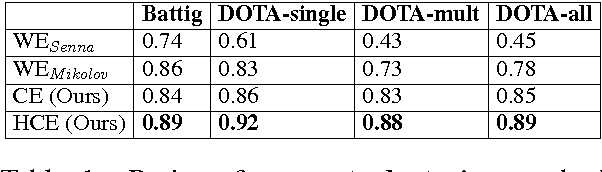
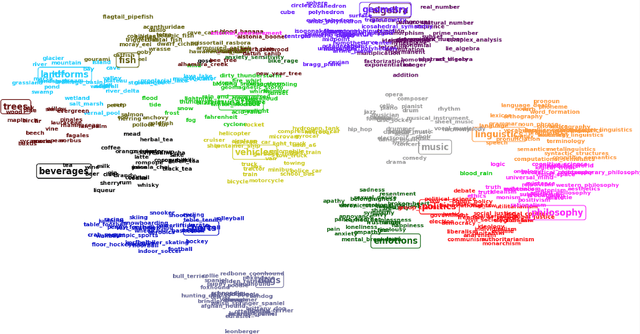
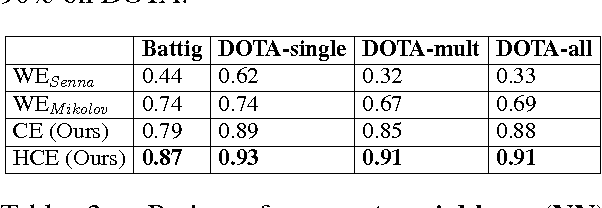
Due to the lack of structured knowledge applied in learning distributed representation of categories, existing work cannot incorporate category hierarchies into entity information.~We propose a framework that embeds entities and categories into a semantic space by integrating structured knowledge and taxonomy hierarchy from large knowledge bases. The framework allows to compute meaningful semantic relatedness between entities and categories.~Compared with the previous state of the art, our framework can handle both single-word concepts and multiple-word concepts with superior performance in concept categorization and semantic relatedness.