 Add to Chrome
 Add to Firefox
 Add to Edge
SOLAR 10.7B: Scaling Large Language Models with Simple yet Effective Depth Up-Scaling
Dec 29, 2023
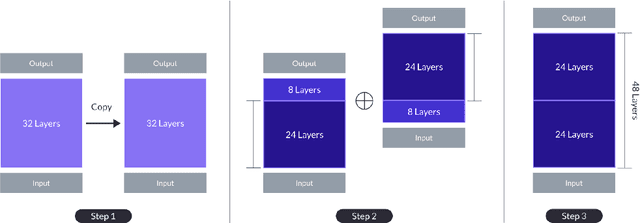

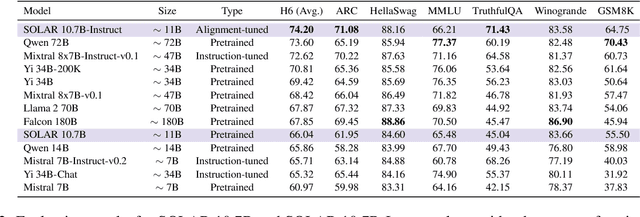

We introduce SOLAR 10.7B, a large language model (LLM) with 10.7 billion parameters, demonstrating superior performance in various natural language processing (NLP) tasks. Inspired by recent efforts to efficiently up-scale LLMs, we present a method for scaling LLMs called depth up-scaling (DUS), which encompasses depthwise scaling and continued pretraining. In contrast to other LLM up-scaling methods that use mixture-of-experts, DUS does not require complex changes to train and inference efficiently. We show experimentally that DUS is simple yet effective in scaling up high-performance LLMs from small ones. Building on the DUS model, we additionally present SOLAR 10.7B-Instruct, a variant fine-tuned for instruction-following capabilities, surpassing Mixtral-8x7B-Instruct. SOLAR 10.7B is publicly available under the Apache 2.0 license, promoting broad access and application in the LLM field.

Can Transformer and GNN Help Each Other?
Aug 28, 2023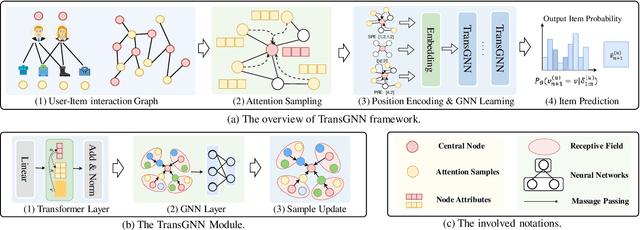


Although Transformer has achieved great success in natural language process and computer vision, it has difficulty generalizing to medium and large-scale graph data for two important reasons: (i) High complexity. (ii) Failing to capture the complex and entangled structure information. In graph representation learning, Graph Neural Networks(GNNs) can fuse the graph structure and node attributes but have limited receptive fields. Therefore, we question whether can we combine Transformers and GNNs to help each other. In this paper, we propose a new model named TransGNN where the Transformer layer and GNN layer are used alternately to improve each other. Specifically, to expand the receptive field and disentangle the information aggregation from edges, we propose using Transformer to aggregate more relevant nodes' information to improve the message passing of GNNs. Besides, to capture the graph structure information, we utilize positional encoding and make use of the GNN layer to fuse the structure into node attributes, which improves the Transformer in graph data. We also propose to sample the most relevant nodes for Transformer and two efficient samples update strategies to lower the complexity. At last, we theoretically prove that TransGNN is more expressive than GNNs only with extra linear complexity. The experiments on eight datasets corroborate the effectiveness of TransGNN on node and graph classification tasks.
Foundation Model-oriented Robustness: Robust Image Model Evaluation with Pretrained Models
Aug 23, 2023
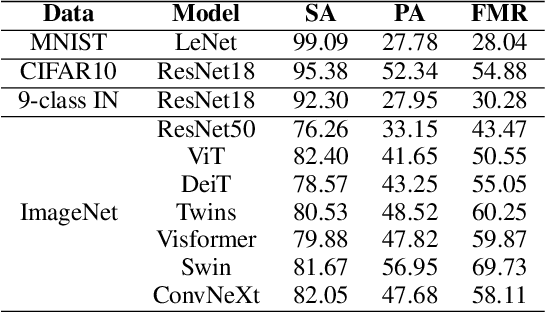
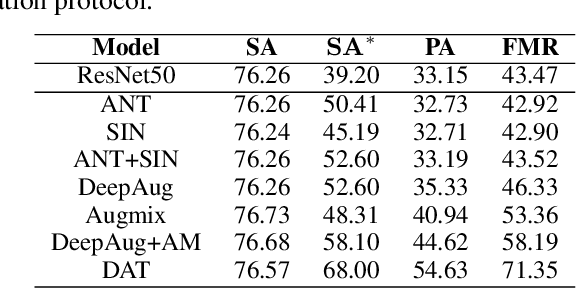

Machine learning has demonstrated remarkable performance over finite datasets, yet whether the scores over the fixed benchmarks can sufficiently indicate the model's performance in the real world is still in discussion. In reality, an ideal robust model will probably behave similarly to the oracle (e.g., the human users), thus a good evaluation protocol is probably to evaluate the models' behaviors in comparison to the oracle. In this paper, we introduce a new robustness measurement that directly measures the image classification model's performance compared with a surrogate oracle (i.e., a foundation model). Besides, we design a simple method that can accomplish the evaluation beyond the scope of the benchmarks. Our method extends the image datasets with new samples that are sufficiently perturbed to be distinct from the ones in the original sets, but are still bounded within the same image-label structure the original test image represents, constrained by a foundation model pretrained with a large amount of samples. As a result, our new method will offer us a new way to evaluate the models' robustness performance, free of limitations of fixed benchmarks or constrained perturbations, although scoped by the power of the oracle. In addition to the evaluation results, we also leverage our generated data to understand the behaviors of the model and our new evaluation strategies.
Attention Calibration for Transformer-based Sequential Recommendation
Aug 18, 2023
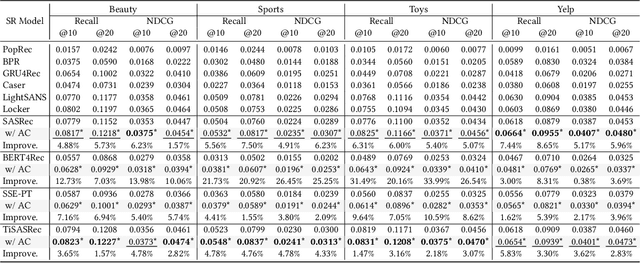

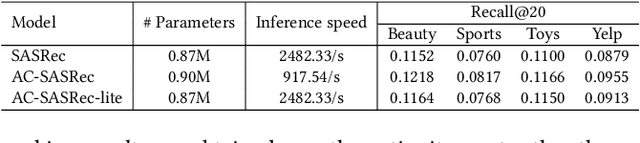
Transformer-based sequential recommendation (SR) has been booming in recent years, with the self-attention mechanism as its key component. Self-attention has been widely believed to be able to effectively select those informative and relevant items from a sequence of interacted items for next-item prediction via learning larger attention weights for these items. However, this may not always be true in reality. Our empirical analysis of some representative Transformer-based SR models reveals that it is not uncommon for large attention weights to be assigned to less relevant items, which can result in inaccurate recommendations. Through further in-depth analysis, we find two factors that may contribute to such inaccurate assignment of attention weights: sub-optimal position encoding and noisy input. To this end, in this paper, we aim to address this significant yet challenging gap in existing works. To be specific, we propose a simple yet effective framework called Attention Calibration for Transformer-based Sequential Recommendation (AC-TSR). In AC-TSR, a novel spatial calibrator and adversarial calibrator are designed respectively to directly calibrates those incorrectly assigned attention weights. The former is devised to explicitly capture the spatial relationships (i.e., order and distance) among items for more precise calculation of attention weights. The latter aims to redistribute the attention weights based on each item's contribution to the next-item prediction. AC-TSR is readily adaptable and can be seamlessly integrated into various existing transformer-based SR models. Extensive experimental results on four benchmark real-world datasets demonstrate the superiority of our proposed ACTSR via significant recommendation performance enhancements. The source code is available at https://github.com/AIM-SE/AC-TSR.
Continual Learning on Dynamic Graphs via Parameter Isolation
May 23, 2023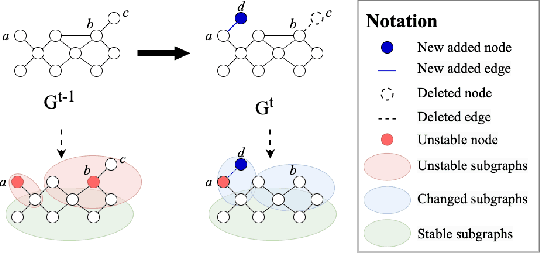
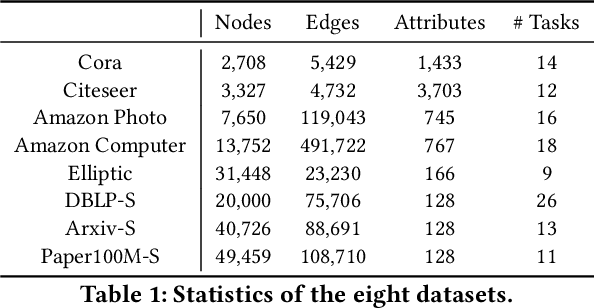
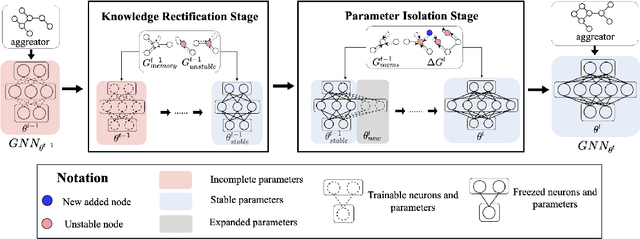
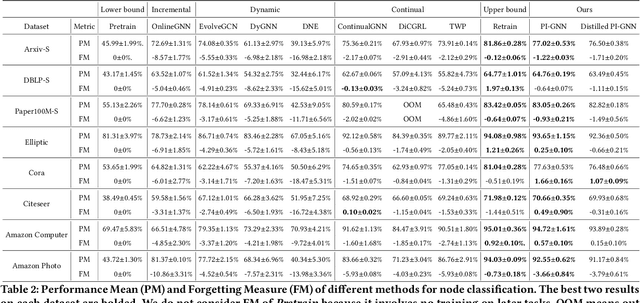
Many real-world graph learning tasks require handling dynamic graphs where new nodes and edges emerge. Dynamic graph learning methods commonly suffer from the catastrophic forgetting problem, where knowledge learned for previous graphs is overwritten by updates for new graphs. To alleviate the problem, continual graph learning methods are proposed. However, existing continual graph learning methods aim to learn new patterns and maintain old ones with the same set of parameters of fixed size, and thus face a fundamental tradeoff between both goals. In this paper, we propose Parameter Isolation GNN (PI-GNN) for continual learning on dynamic graphs that circumvents the tradeoff via parameter isolation and expansion. Our motivation lies in that different parameters contribute to learning different graph patterns. Based on the idea, we expand model parameters to continually learn emerging graph patterns. Meanwhile, to effectively preserve knowledge for unaffected patterns, we find parameters that correspond to them via optimization and freeze them to prevent them from being rewritten. Experiments on eight real-world datasets corroborate the effectiveness of PI-GNN compared to state-of-the-art baselines.
A Survey on Incremental Update for Neural Recommender Systems
Mar 06, 2023Recommender Systems (RS) aim to provide personalized suggestions of items for users against consumer over-choice. Although extensive research has been conducted to address different aspects and challenges of RS, there still exists a gap between academic research and industrial applications. Specifically, most of the existing models still work in an offline manner, in which the recommender is trained on a large static training set and evaluated on a very restrictive testing set in a one-time process. RS will stay unchanged until the next batch retrain is performed. We frame such RS as Batch Update Recommender Systems (BURS). In reality, they have to face the challenges where RS are expected to be instantly updated with new data streaming in, and generate updated recommendations for current user activities based on the newly arrived data. We frame such RS as Incremental Update Recommender Systems (IURS). In this article, we offer a systematic survey of incremental update for neural recommender systems. We begin the survey by introducing key concepts and formulating the task of IURS. We then illustrate the challenges in IURS compared with traditional BURS. Afterwards, we detail the introduction of existing literature and evaluation issues. We conclude the survey by outlining some prominent open research issues in this area.
Rethinking Multi-Interest Learning for Candidate Matching in Recommender Systems
Feb 28, 2023Existing research efforts for multi-interest candidate matching in recommender systems mainly focus on improving model architecture or incorporating additional information, neglecting the importance of training schemes. This work revisits the training framework and uncovers two major problems hindering the expressiveness of learned multi-interest representations. First, the current training objective (i.e., uniformly sampled softmax) fails to effectively train discriminative representations in a multi-interest learning scenario due to the severe increase in easy negative samples. Second, a routing collapse problem is observed where each learned interest may collapse to express information only from a single item, resulting in information loss. To address these issues, we propose the REMI framework, consisting of an Interest-aware Hard Negative mining strategy (IHN) and a Routing Regularization (RR) method. IHN emphasizes interest-aware hard negatives by proposing an ideal sampling distribution and developing a Monte-Carlo strategy for efficient approximation. RR prevents routing collapse by introducing a novel regularization term on the item-to-interest routing matrices. These two components enhance the learned multi-interest representations from both the optimization objective and the composition information. REMI is a general framework that can be readily applied to various existing multi-interest candidate matching methods. Experiments on three real-world datasets show our method can significantly improve state-of-the-art methods with easy implementation and negligible computational overhead. The source code will be released.
DYNAFED: Tackling Client Data Heterogeneity with Global Dynamics
Nov 20, 2022The Federated Learning (FL) paradigm is known to face challenges under heterogeneous client data. Local training on non-iid distributed data results in deflected local optimum, which causes the client models drift further away from each other and degrades the aggregated global model's performance. A natural solution is to gather all client data onto the server, such that the server has a global view of the entire data distribution. Unfortunately, this reduces to regular training, which compromises clients' privacy and conflicts with the purpose of FL. In this paper, we put forth an idea to collect and leverage global knowledge on the server without hindering data privacy. We unearth such knowledge from the dynamics of the global model's trajectory. Specifically, we first reserve a short trajectory of global model snapshots on the server. Then, we synthesize a small pseudo dataset such that the model trained on it mimics the dynamics of the reserved global model trajectory. Afterward, the synthesized data is used to help aggregate the deflected clients into the global model. We name our method Dynafed, which enjoys the following advantages: 1) we do not rely on any external on-server dataset, which requires no additional cost for data collection; 2) the pseudo data can be synthesized in early communication rounds, which enables Dynafed to take effect early for boosting the convergence and stabilizing training; 3) the pseudo data only needs to be synthesized once and can be directly utilized on the server to help aggregation in subsequent rounds. Experiments across extensive benchmarks are conducted to showcase the effectiveness of Dynafed. We also provide insights and understanding of the underlying mechanism of our method.
Robust Federated Learning against both Data Heterogeneity and Poisoning Attack via Aggregation Optimization
Nov 20, 2022Non-IID data distribution across clients and poisoning attacks are two main challenges in real-world federated learning (FL) systems. While both of them have attracted great research interest with specific strategies developed, no known solution manages to address them in a unified framework. To universally overcome both challenges, we propose SmartFL, a generic approach that optimizes the server-side aggregation process with a small amount of proxy data collected by the service provider itself via a subspace training technique. Specifically, the aggregation weight of each participating client at each round is optimized using the server-collected proxy data, which is essentially the optimization of the global model in the convex hull spanned by client models. Since at each round, the number of tunable parameters optimized on the server side equals the number of participating clients (thus independent of the model size), we are able to train a global model with massive parameters using only a small amount of proxy data (e.g., around one hundred samples). With optimized aggregation, SmartFL ensures robustness against both heterogeneous and malicious clients, which is desirable in real-world FL where either or both problems may occur. We provide theoretical analyses of the convergence and generalization capacity for SmartFL. Empirically, SmartFL achieves state-of-the-art performance on both FL with non-IID data distribution and FL with malicious clients. The source code will be released.
Equivariant Contrastive Learning for Sequential Recommendation
Nov 18, 2022Contrastive learning (CL) benefits the training of sequential recommendation models with informative self-supervision signals. Existing solutions apply general sequential data augmentation strategies to generate positive pairs and encourage their representations to be invariant. However, due to the inherent properties of user behavior sequences, some augmentation strategies, such as item substitution, can lead to changes in user intent. Learning indiscriminately invariant representations for all augmentation strategies might be sub-optimal. Therefore, we propose Equivariant Contrastive Learning for Sequential Recommendation (ECL-SR), which endows SR models with great discriminative power, making the learned user behavior representations sensitive to invasive augmentations (e.g., item substitution) and insensitive to mild augmentations (e.g., feature-level dropout masking). In detail, we use the conditional discriminator to capture differences in behavior due to item substitution, which encourages the user behavior encoder to be equivariant to invasive augmentations. Comprehensive experiments on four benchmark datasets show that the proposed ECL-SR framework achieves competitive performance compared to state-of-the-art SR models. The source code will be released.