 Add to Chrome
 Add to Firefox
 Add to Edge
Scaling Storm-Resolving Atmospheric AI Simulation to the Entire Planet
Jun 30, 2026
Kilometer-scale convection shapes precipitation extremes, tropical organization, and cloud feedbacks, but most global atmospheric models approximate these processes at 25-100 km resolution. Global storm-resolving physics models resolve convective systems explicitly, but at a cost -- roughly one MWh per simulated day on exascale supercomputers -- that limits long-duration simulation. We introduce STRATA (Storm-resolving Tile-based autoRegressive Atmosphere Transformer Architecture), the first autoregressive AI emulator for global storm-resolving atmospheric dynamics. STRATA is trained on the highest-resolution atmospheric dataset yet used for global AI emulation: 17 days of SCREAM physics-model output at 4.9-km resolution (~25 million grid cells) sampled every 10 minutes. Our central premise is that on 10-minute timescales atmospheric dynamics are predominantly local, so training on small spatial tiles trades scarce global temporal samples for abundant local spatial samples and enables global rollout via overlapping-tile blending. STRATA combines 3D patch embedding and local 3D neighborhood attention, a novel Stereographic Rotary Position Embedding (StereoRoPE) for grid-invariant encoding, and a pixel-space de-aliasing decoder that suppresses patch-scale rollout artifacts. An iso-FLOP scaling study reveals that km-scale emulation requires ~10x more FLOPs per grid point than coarse-resolution AI weather models, consistent with the higher information density of convective-scale dynamics. Trained on only 17 days of data, STRATA produces stable 24-hour global rollouts with realistic km-scale dynamics across diverse regimes, though large-scale biases develop with lead time. It achieves 48 simulation days per megawatt-hour -- about 50 times better energy efficiency than the SCREAM physics model -- and 741 simulated days per wall-clock day at 512 H100 GPUs. Code and dataset are publicly available.

Demystifying Data-Driven Probabilistic Medium-Range Weather Forecasting
Jan 26, 2026The recent revolution in data-driven methods for weather forecasting has lead to a fragmented landscape of complex, bespoke architectures and training strategies, obscuring the fundamental drivers of forecast accuracy. Here, we demonstrate that state-of-the-art probabilistic skill requires neither intricate architectural constraints nor specialized training heuristics. We introduce a scalable framework for learning multi-scale atmospheric dynamics by combining a directly downsampled latent space with a history-conditioned local projector that resolves high-resolution physics. We find that our framework design is robust to the choice of probabilistic estimator, seamlessly supporting stochastic interpolants, diffusion models, and CRPS-based ensemble training. Validated against the Integrated Forecasting System and the deep learning probabilistic model GenCast, our framework achieves statistically significant improvements on most of the variables. These results suggest scaling a general-purpose model is sufficient for state-of-the-art medium-range prediction, eliminating the need for tailored training recipes and proving effective across the full spectrum of probabilistic frameworks.
Machine learning emulation of precipitation from km-scale regional climate simulations using a diffusion model
Jul 19, 2024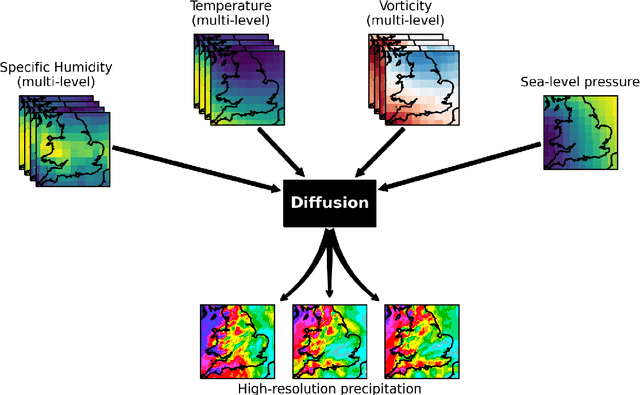



High-resolution climate simulations are very valuable for understanding climate change impacts and planning adaptation measures. This has motivated use of regional climate models at sufficiently fine resolution to capture important small-scale atmospheric processes, such as convective storms. However, these regional models have very high computational costs, limiting their applicability. We present CPMGEM, a novel application of a generative machine learning model, a diffusion model, to skilfully emulate precipitation simulations from such a high-resolution model over England and Wales at much lower cost. This emulator enables stochastic generation of high-resolution (8.8km), daily-mean precipitation samples conditioned on coarse-resolution (60km) weather states from a global climate model. The output is fine enough for use in applications such as flood inundation modelling. The emulator produces precipitation predictions with realistic intensities and spatial structures and captures most of the 21st century climate change signal. We show evidence that the emulator has skill for extreme events up to and including 1-in-100 year intensities. Potential applications include producing high-resolution precipitation predictions for large-ensemble climate simulations and downscaling different climate models and climate change scenarios to better sample uncertainty in climate changes at local-scale.
Neural Compression of Atmospheric States
Jul 16, 2024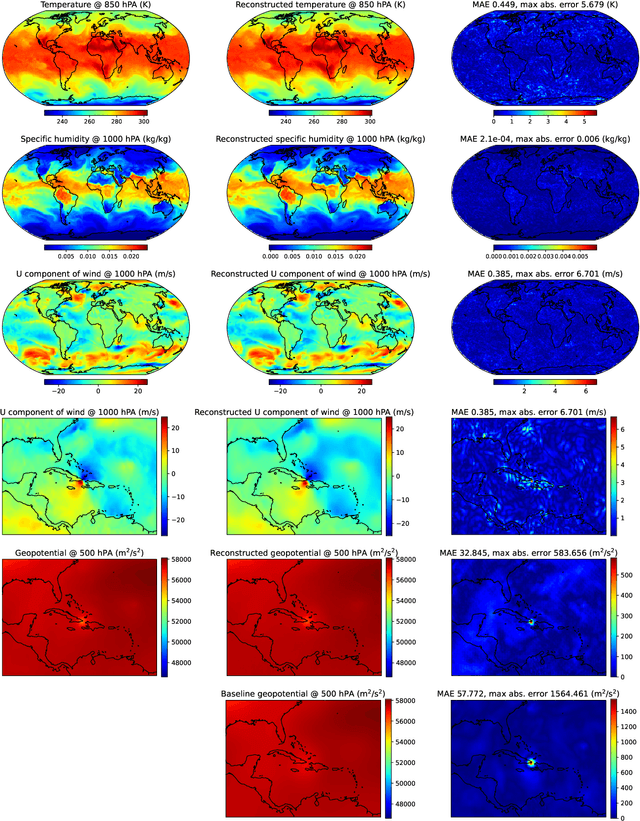
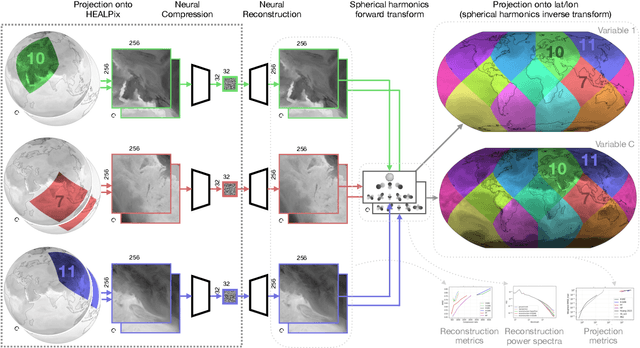


Atmospheric states derived from reanalysis comprise a substantial portion of weather and climate simulation outputs. Many stakeholders -- such as researchers, policy makers, and insurers -- use this data to better understand the earth system and guide policy decisions. Atmospheric states have also received increased interest as machine learning approaches to weather prediction have shown promising results. A key issue for all audiences is that dense time series of these high-dimensional states comprise an enormous amount of data, precluding all but the most well resourced groups from accessing and using historical data and future projections. To address this problem, we propose a method for compressing atmospheric states using methods from the neural network literature, adapting spherical data to processing by conventional neural architectures through the use of the area-preserving HEALPix projection. We investigate two model classes for building neural compressors: the hyperprior model from the neural image compression literature and recent vector-quantised models. We show that both families of models satisfy the desiderata of small average error, a small number of high-error reconstructed pixels, faithful reproduction of extreme events such as hurricanes and heatwaves, preservation of the spectral power distribution across spatial scales. We demonstrate compression ratios in excess of 1000x, with compression and decompression at a rate of approximately one second per global atmospheric state.
Understanding Deep Generative Models with Generalized Empirical Likelihoods
Jun 16, 2023Understanding how well a deep generative model captures a distribution of high-dimensional data remains an important open challenge. It is especially difficult for certain model classes, such as Generative Adversarial Networks and Diffusion Models, whose models do not admit exact likelihoods. In this work, we demonstrate that generalized empirical likelihood (GEL) methods offer a family of diagnostic tools that can identify many deficiencies of deep generative models (DGMs). We show, with appropriate specification of moment conditions, that the proposed method can identify which modes have been dropped, the degree to which DGMs are mode imbalanced, and whether DGMs sufficiently capture intra-class diversity. We show how to combine techniques from Maximum Mean Discrepancy and Generalized Empirical Likelihood to create not only distribution tests that retain per-sample interpretability, but also metrics that include label information. We find that such tests predict the degree of mode dropping and mode imbalance up to 60% better than metrics such as improved precision/recall.
GraphCast: Learning skillful medium-range global weather forecasting
Dec 24, 2022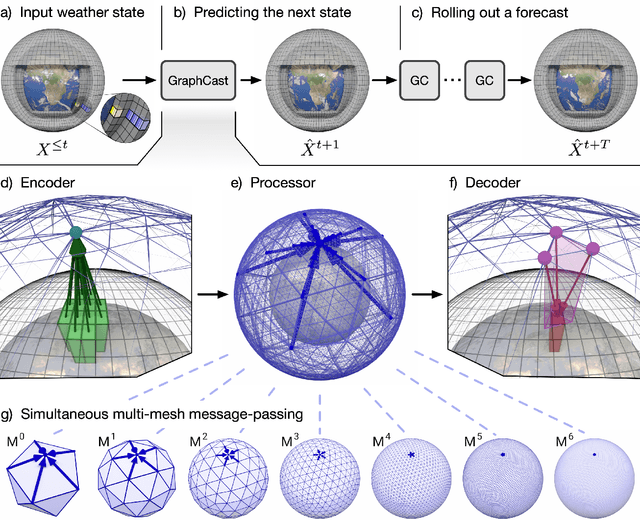
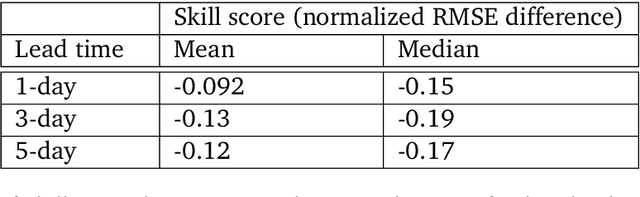
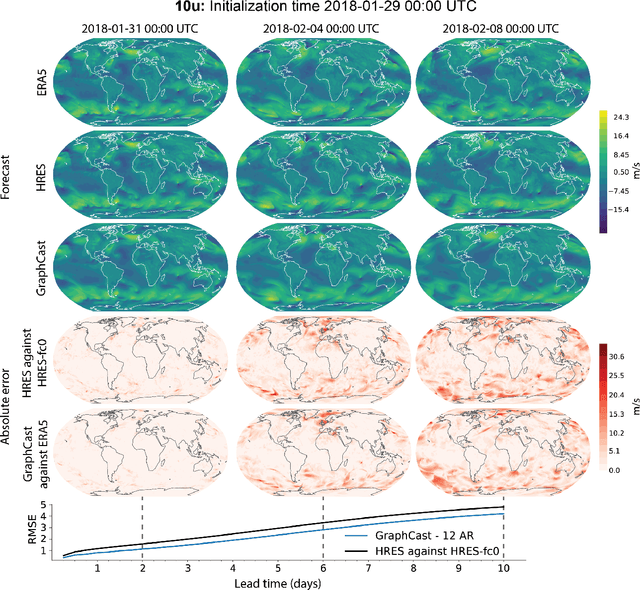

We introduce a machine-learning (ML)-based weather simulator--called "GraphCast"--which outperforms the most accurate deterministic operational medium-range weather forecasting system in the world, as well as all previous ML baselines. GraphCast is an autoregressive model, based on graph neural networks and a novel high-resolution multi-scale mesh representation, which we trained on historical weather data from the European Centre for Medium-Range Weather Forecasts (ECMWF)'s ERA5 reanalysis archive. It can make 10-day forecasts, at 6-hour time intervals, of five surface variables and six atmospheric variables, each at 37 vertical pressure levels, on a 0.25-degree latitude-longitude grid, which corresponds to roughly 25 x 25 kilometer resolution at the equator. Our results show GraphCast is more accurate than ECMWF's deterministic operational forecasting system, HRES, on 90.0% of the 2760 variable and lead time combinations we evaluated. GraphCast also outperforms the most accurate previous ML-based weather forecasting model on 99.2% of the 252 targets it reported. GraphCast can generate a 10-day forecast (35 gigabytes of data) in under 60 seconds on Cloud TPU v4 hardware. Unlike traditional forecasting methods, ML-based forecasting scales well with data: by training on bigger, higher quality, and more recent data, the skill of the forecasts can improve. Together these results represent a key step forward in complementing and improving weather modeling with ML, open new opportunities for fast, accurate forecasting, and help realize the promise of ML-based simulation in the physical sciences.
Machine learning emulation of a local-scale UK climate model
Nov 29, 2022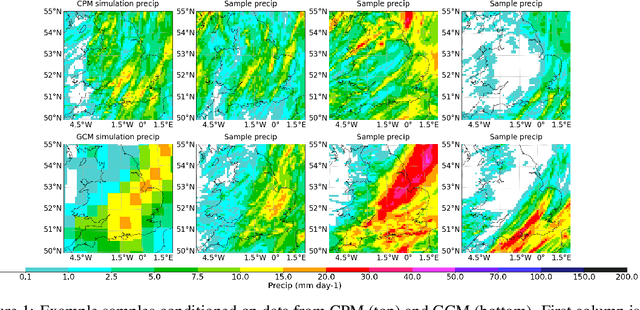
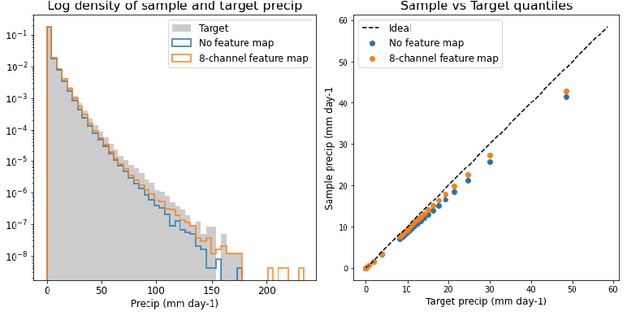
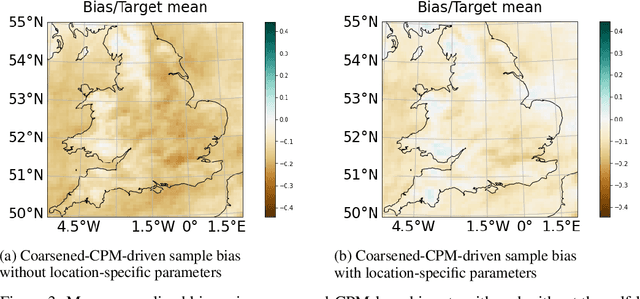
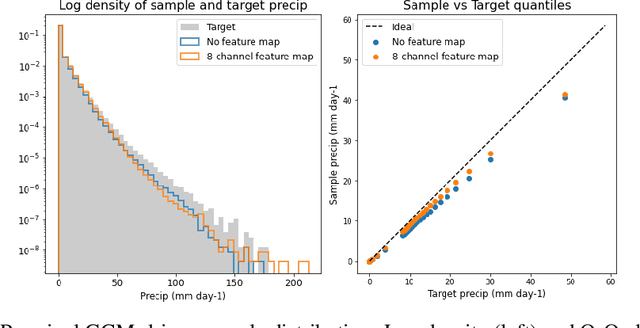
Climate change is causing the intensification of rainfall extremes. Precipitation projections with high spatial resolution are important for society to prepare for these changes, e.g. to model flooding impacts. Physics-based simulations for creating such projections are very computationally expensive. This work demonstrates the effectiveness of diffusion models, a form of deep generative models, for generating much more cheaply realistic high resolution rainfall samples for the UK conditioned on data from a low resolution simulation. We show for the first time a machine learning model that is able to produce realistic samples of high-resolution rainfall based on a physical model that resolves atmospheric convection, a key process behind extreme rainfall. By adding self-learnt, location-specific information to low resolution relative vorticity, quantiles and time-mean of the samples match well their counterparts from the high-resolution simulation.
Skillful Precipitation Nowcasting using Deep Generative Models of Radar
Apr 02, 2021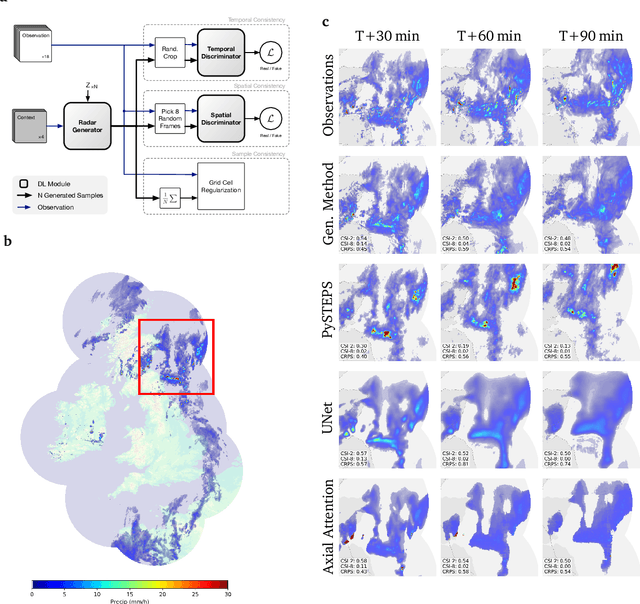
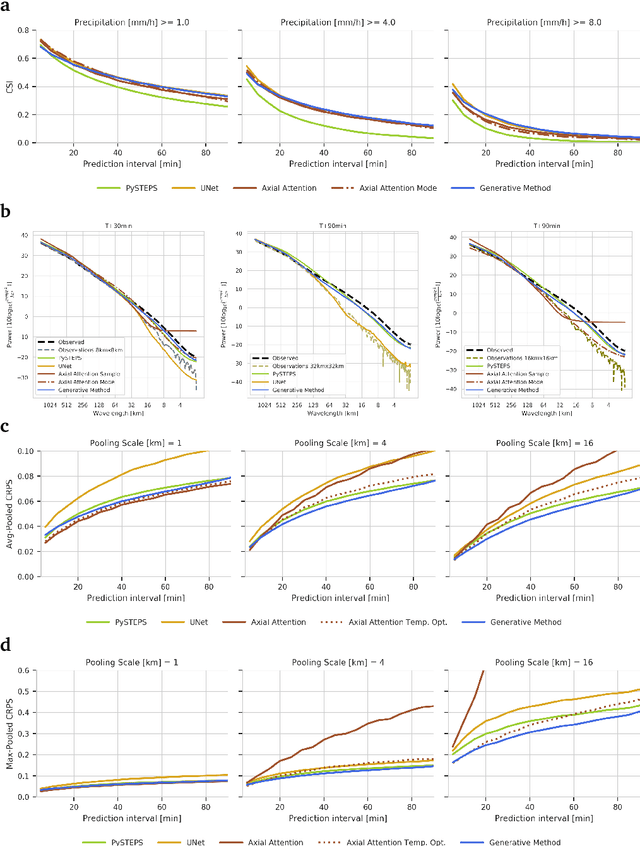
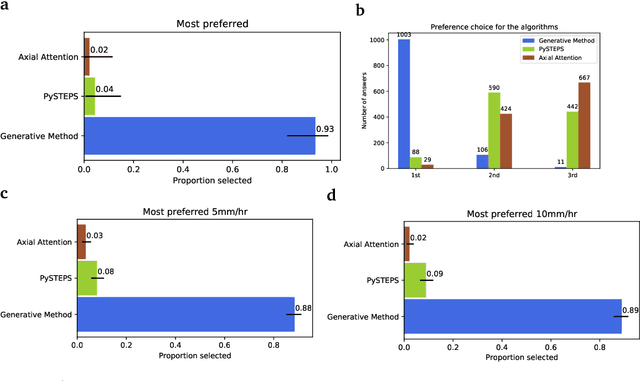
Precipitation nowcasting, the high-resolution forecasting of precipitation up to two hours ahead, supports the real-world socio-economic needs of many sectors reliant on weather-dependent decision-making. State-of-the-art operational nowcasting methods typically advect precipitation fields with radar-based wind estimates, and struggle to capture important non-linear events such as convective initiations. Recently introduced deep learning methods use radar to directly predict future rain rates, free of physical constraints. While they accurately predict low-intensity rainfall, their operational utility is limited because their lack of constraints produces blurry nowcasts at longer lead times, yielding poor performance on more rare medium-to-heavy rain events. To address these challenges, we present a Deep Generative Model for the probabilistic nowcasting of precipitation from radar. Our model produces realistic and spatio-temporally consistent predictions over regions up to 1536 km x 1280 km and with lead times from 5-90 min ahead. In a systematic evaluation by more than fifty expert forecasters from the Met Office, our generative model ranked first for its accuracy and usefulness in 88% of cases against two competitive methods, demonstrating its decision-making value and ability to provide physical insight to real-world experts. When verified quantitatively, these nowcasts are skillful without resorting to blurring. We show that generative nowcasting can provide probabilistic predictions that improve forecast value and support operational utility, and at resolutions and lead times where alternative methods struggle.
A review of radar-based nowcasting of precipitation and applicable machine learning techniques
May 11, 2020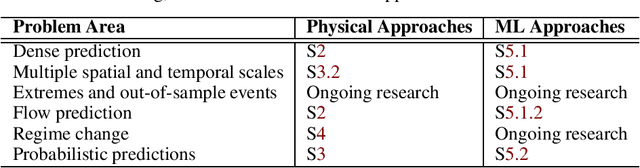
A 'nowcast' is a type of weather forecast which makes predictions in the very short term, typically less than two hours - a period in which traditional numerical weather prediction can be limited. This type of weather prediction has important applications for commercial aviation; public and outdoor events; and the construction industry, power utilities, and ground transportation services that conduct much of their work outdoors. Importantly, one of the key needs for nowcasting systems is in the provision of accurate warnings of adverse weather events, such as heavy rain and flooding, for the protection of life and property in such situations. Typical nowcasting approaches are based on simple extrapolation models applied to observations, primarily rainfall radar. In this paper we review existing techniques to radar-based nowcasting from environmental sciences, as well as the statistical approaches that are applicable from the field of machine learning. Nowcasting continues to be an important component of operational systems and we believe new advances are possible with new partnerships between the environmental science and machine learning communities.
Classification Accuracy Score for Conditional Generative Models
May 26, 2019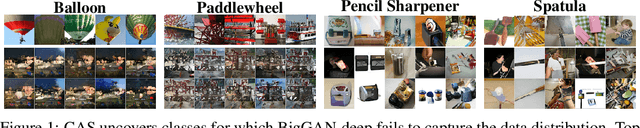
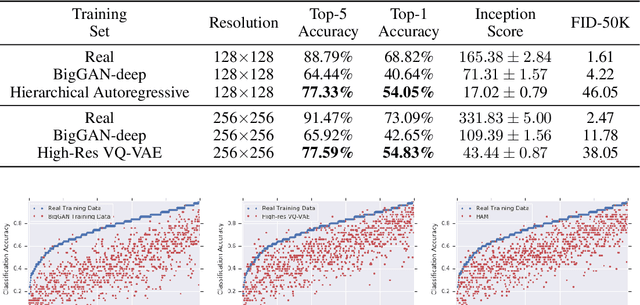
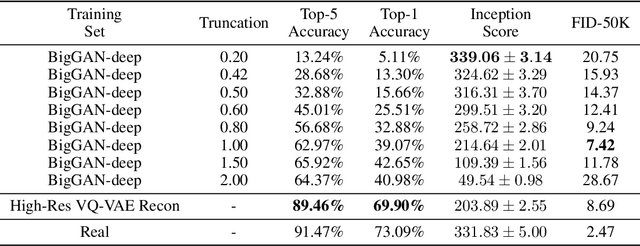
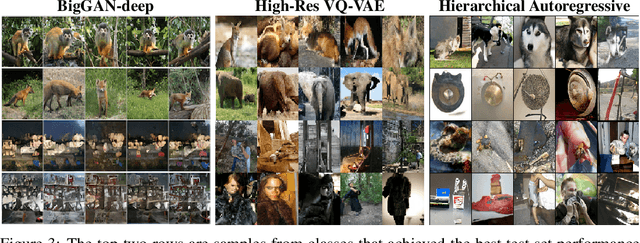
Deep generative models (DGMs) of images are now sufficiently mature that they produce nearly photorealistic samples and obtain scores similar to the data distribution on heuristics such as Frechet Inception Distance. These results, especially on large-scale datasets such as ImageNet, suggest that DGMs are learning the data distribution in a perceptually meaningful space, and can be used in downstream tasks. To test this latter hypothesis, we use class-conditional generative models from a number of model classes---variational autoencoder, autoregressive models, and generative adversarial networks---to infer the class labels of real data. We perform this inference by training the image classifier using only synthetic data, and using the classifier to predict labels on real data. The performance on this task, which we call Classification Accuracy Score (CAS), highlights some surprising results not captured by traditional metrics and comprise our contributions. First, when using a state-of-the-art GAN (BigGAN), Top-5 accuracy decreases by 41.6% compared to the original data and conditional generative models from other model classes, such as high-resolution VQ-VAE and Hierarchical Autoregressive Models, substantially outperform GANs on this benchmark. Second, CAS automatically surfaces particular classes for which generative models failed to capture the data distribution, and were previously unknown in the literature. Third, we find traditional GAN metrics such as Frechet Inception Distance neither predictive of CAS nor useful when evaluating non-GAN models. Finally, we introduce Naive Augmentation Score, a variant of CAS where the image classifier is trained on both real and synthetic data, to demonstrate that naive augmentation improves classification performance in limited circumstances. In order to facilitate better diagnoses of generative models, we open-source the proposed metric.