 Add to Chrome
 Add to Firefox
 Add to Edge
TESSERA v2: Scaling Pixel-wise Earth Foundation Models
Jul 04, 2026
Pixel-wise Earth-observation (EO) foundation models are now achieving state-of-the-art performance via generated spatial embeddings. However, how these models scale and how best to spend a pretraining budget remain poorly understood. We present the largest controlled scaling study for EO to date: 395 training runs on 1,024 GH200 superchips within a fixed pixel-wise Barlow Twins family, each evaluated on 15 downstream tasks. We find that pretraining loss barely predicts downstream performance (|Pearson r| < 0.2), so selecting models by loss wastes a large share of the compute. We also find that, as the training budget grows, the encoder and the data should grow together while the projector stays fixed, which gives a simple rule for allocating compute. Using this rule, we train a family of pixel-wise models (0.5B and 1B, with a 2B model in training) and distill them into compact students for embeddings-as-data deployment. The 21-million-parameter distilled TESSERA v2-1B-M in aggregate outperforms all open and proprietary models tested, some of which are orders of magnitude larger. These students produce Matryoshka representations that are inexpensive to serve: a 16-dimensional prefix keeps 92% of the full 128-dimensional performance at 1/8 of the storage. Upon completion of training we plan to release v2 global embeddings covering 2017-2025. Together, these results give a concrete, empirically grounded recipe for scaling pixel-wise EO foundation models: train large encoders, select by downstream performance, and distil into flexible student models. All code will be released at https://github.com/ucam-eo/tessera.

Skillful Precipitation Nowcasting using Deep Generative Models of Radar
Apr 02, 2021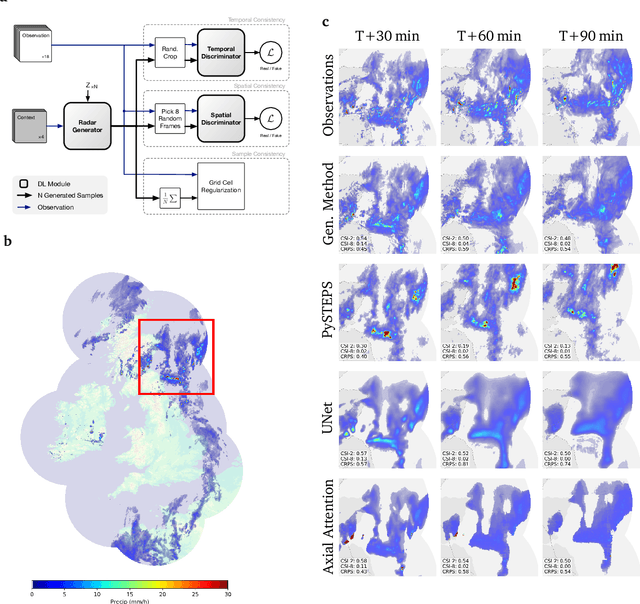
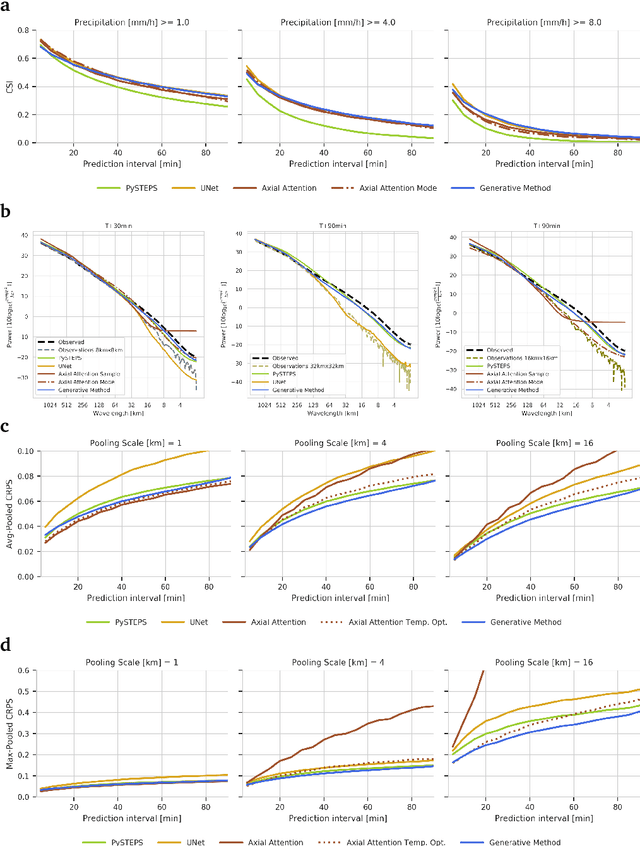
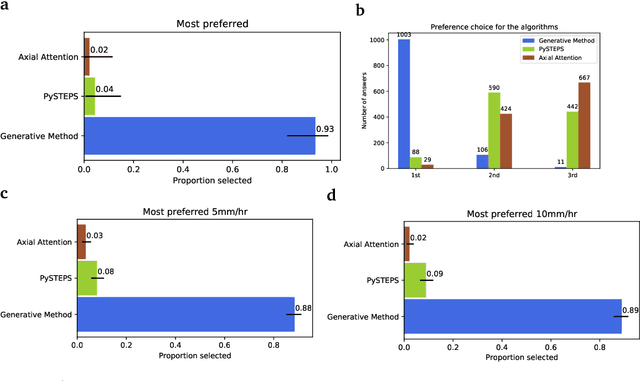
Precipitation nowcasting, the high-resolution forecasting of precipitation up to two hours ahead, supports the real-world socio-economic needs of many sectors reliant on weather-dependent decision-making. State-of-the-art operational nowcasting methods typically advect precipitation fields with radar-based wind estimates, and struggle to capture important non-linear events such as convective initiations. Recently introduced deep learning methods use radar to directly predict future rain rates, free of physical constraints. While they accurately predict low-intensity rainfall, their operational utility is limited because their lack of constraints produces blurry nowcasts at longer lead times, yielding poor performance on more rare medium-to-heavy rain events. To address these challenges, we present a Deep Generative Model for the probabilistic nowcasting of precipitation from radar. Our model produces realistic and spatio-temporally consistent predictions over regions up to 1536 km x 1280 km and with lead times from 5-90 min ahead. In a systematic evaluation by more than fifty expert forecasters from the Met Office, our generative model ranked first for its accuracy and usefulness in 88% of cases against two competitive methods, demonstrating its decision-making value and ability to provide physical insight to real-world experts. When verified quantitatively, these nowcasts are skillful without resorting to blurring. We show that generative nowcasting can provide probabilistic predictions that improve forecast value and support operational utility, and at resolutions and lead times where alternative methods struggle.
A review of radar-based nowcasting of precipitation and applicable machine learning techniques
May 11, 2020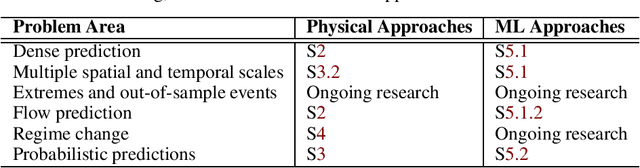
A 'nowcast' is a type of weather forecast which makes predictions in the very short term, typically less than two hours - a period in which traditional numerical weather prediction can be limited. This type of weather prediction has important applications for commercial aviation; public and outdoor events; and the construction industry, power utilities, and ground transportation services that conduct much of their work outdoors. Importantly, one of the key needs for nowcasting systems is in the provision of accurate warnings of adverse weather events, such as heavy rain and flooding, for the protection of life and property in such situations. Typical nowcasting approaches are based on simple extrapolation models applied to observations, primarily rainfall radar. In this paper we review existing techniques to radar-based nowcasting from environmental sciences, as well as the statistical approaches that are applicable from the field of machine learning. Nowcasting continues to be an important component of operational systems and we believe new advances are possible with new partnerships between the environmental science and machine learning communities.