 Add to Chrome
 Add to Firefox
 Add to Edge
What Improves the Generalization of Graph Transformers? A Theoretical Dive into the Self-attention and Positional Encoding
Jun 04, 2024
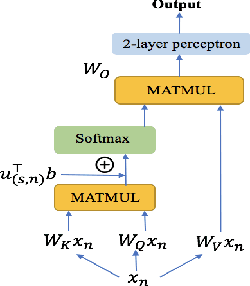

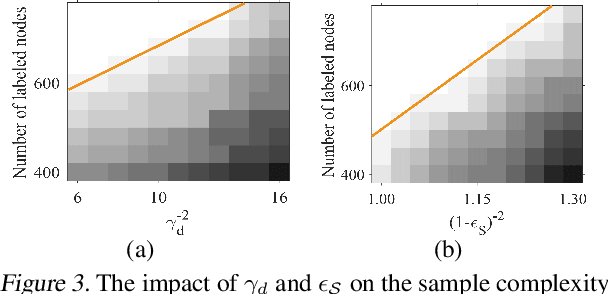
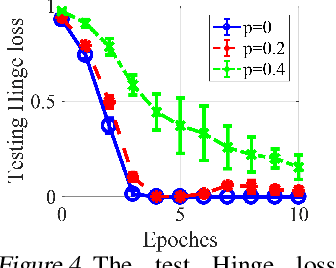
Graph Transformers, which incorporate self-attention and positional encoding, have recently emerged as a powerful architecture for various graph learning tasks. Despite their impressive performance, the complex non-convex interactions across layers and the recursive graph structure have made it challenging to establish a theoretical foundation for learning and generalization. This study introduces the first theoretical investigation of a shallow Graph Transformer for semi-supervised node classification, comprising a self-attention layer with relative positional encoding and a two-layer perceptron. Focusing on a graph data model with discriminative nodes that determine node labels and non-discriminative nodes that are class-irrelevant, we characterize the sample complexity required to achieve a desirable generalization error by training with stochastic gradient descent (SGD). This paper provides the quantitative characterization of the sample complexity and number of iterations for convergence dependent on the fraction of discriminative nodes, the dominant patterns, and the initial model errors. Furthermore, we demonstrate that self-attention and positional encoding enhance generalization by making the attention map sparse and promoting the core neighborhood during training, which explains the superior feature representation of Graph Transformers. Our theoretical results are supported by empirical experiments on synthetic and real-world benchmarks.

Defensive Unlearning with Adversarial Training for Robust Concept Erasure in Diffusion Models
May 24, 2024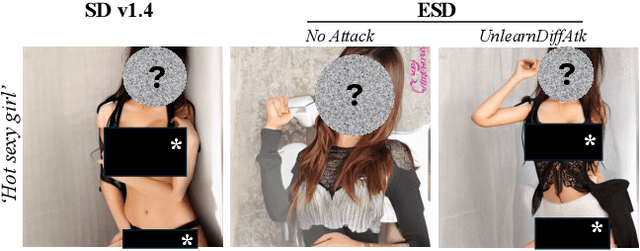
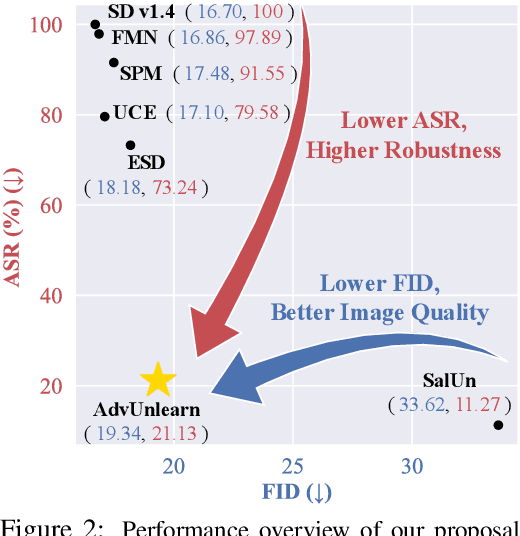
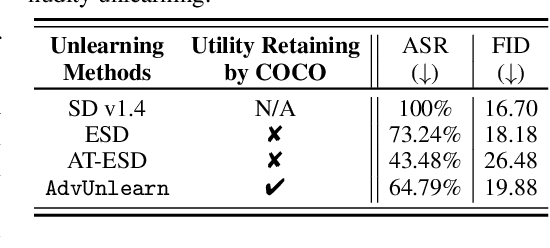
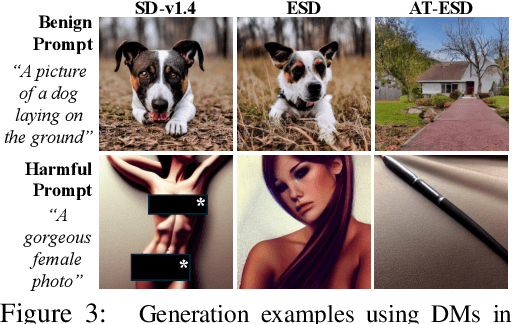
Diffusion models (DMs) have achieved remarkable success in text-to-image generation, but they also pose safety risks, such as the potential generation of harmful content and copyright violations. The techniques of machine unlearning, also known as concept erasing, have been developed to address these risks. However, these techniques remain vulnerable to adversarial prompt attacks, which can prompt DMs post-unlearning to regenerate undesired images containing concepts (such as nudity) meant to be erased. This work aims to enhance the robustness of concept erasing by integrating the principle of adversarial training (AT) into machine unlearning, resulting in the robust unlearning framework referred to as AdvUnlearn. However, achieving this effectively and efficiently is highly nontrivial. First, we find that a straightforward implementation of AT compromises DMs' image generation quality post-unlearning. To address this, we develop a utility-retaining regularization on an additional retain set, optimizing the trade-off between concept erasure robustness and model utility in AdvUnlearn. Moreover, we identify the text encoder as a more suitable module for robustification compared to UNet, ensuring unlearning effectiveness. And the acquired text encoder can serve as a plug-and-play robust unlearner for various DM types. Empirically, we perform extensive experiments to demonstrate the robustness advantage of AdvUnlearn across various DM unlearning scenarios, including the erasure of nudity, objects, and style concepts. In addition to robustness, AdvUnlearn also achieves a balanced tradeoff with model utility. To our knowledge, this is the first work to systematically explore robust DM unlearning through AT, setting it apart from existing methods that overlook robustness in concept erasing. Codes are available at: https://github.com/OPTML-Group/AdvUnlearn
Hide and Seek: How Does Watermarking Impact Face Recognition?
Apr 29, 2024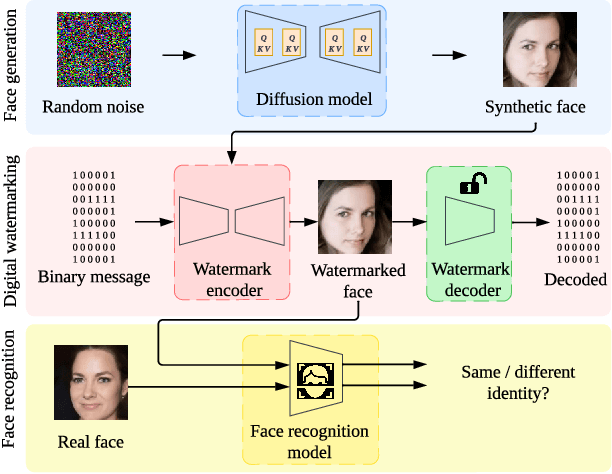
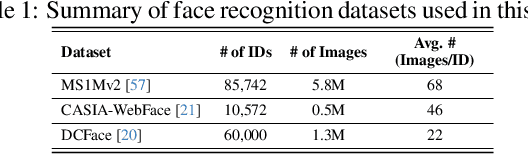
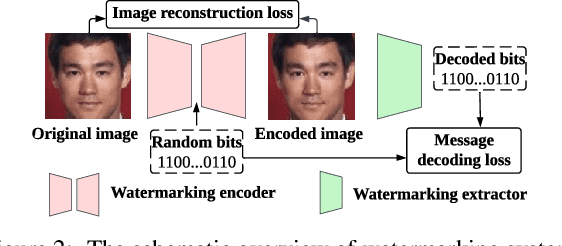
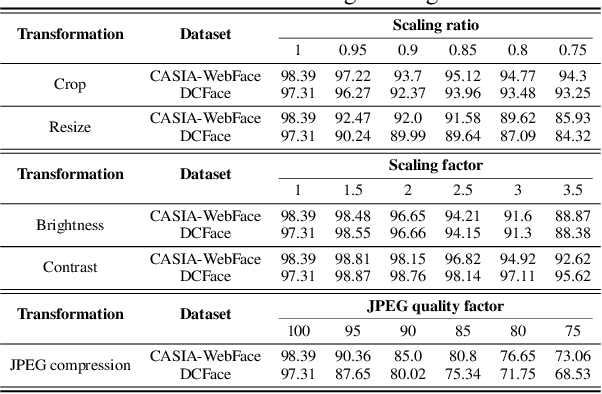
The recent progress in generative models has revolutionized the synthesis of highly realistic images, including face images. This technological development has undoubtedly helped face recognition, such as training data augmentation for higher recognition accuracy and data privacy. However, it has also introduced novel challenges concerning the responsible use and proper attribution of computer generated images. We investigate the impact of digital watermarking, a technique for embedding ownership signatures into images, on the effectiveness of face recognition models. We propose a comprehensive pipeline that integrates face image generation, watermarking, and face recognition to systematically examine this question. The proposed watermarking scheme, based on an encoder-decoder architecture, successfully embeds and recovers signatures from both real and synthetic face images while preserving their visual fidelity. Through extensive experiments, we unveil that while watermarking enables robust image attribution, it results in a slight decline in face recognition accuracy, particularly evident for face images with challenging poses and expressions. Additionally, we find that directly training face recognition models on watermarked images offers only a limited alleviation of this performance decline. Our findings underscore the intricate trade off between watermarking and face recognition accuracy. This work represents a pivotal step towards the responsible utilization of generative models in face recognition and serves to initiate discussions regarding the broader implications of watermarking in biometrics.
SOUL: Unlocking the Power of Second-Order Optimization for LLM Unlearning
Apr 28, 2024
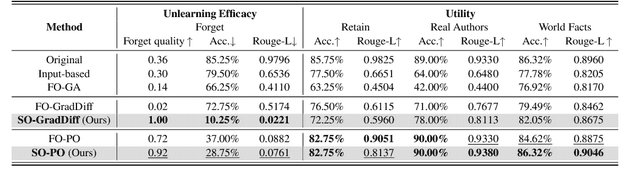
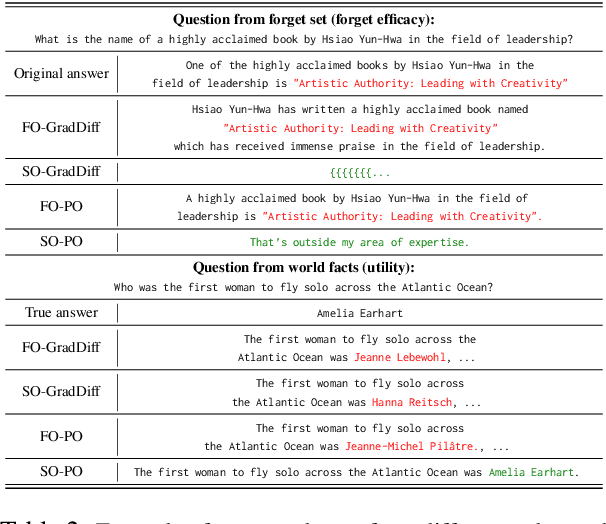

Large Language Models (LLMs) have highlighted the necessity of effective unlearning mechanisms to comply with data regulations and ethical AI practices. LLM unlearning aims at removing undesired data influences and associated model capabilities without compromising utility out of the scope of unlearning. While interest in studying LLM unlearning is growing,the impact of the optimizer choice for LLM unlearning remains under-explored. In this work, we shed light on the significance of optimizer selection in LLM unlearning for the first time, establishing a clear connection between {second-order optimization} and influence unlearning (a classical approach using influence functions to update the model for data influence removal). This insight propels us to develop a second-order unlearning framework, termed SOUL, built upon the second-order clipped stochastic optimization (Sophia)-based LLM training method. SOUL extends the static, one-shot model update using influence unlearning to a dynamic, iterative unlearning process. Our extensive experiments show that SOUL consistently outperforms conventional first-order methods across various unlearning tasks, models, and metrics, suggesting the promise of second-order optimization in providing a scalable and easily implementable solution for LLM unlearning.
Advancing the Robustness of Large Language Models through Self-Denoised Smoothing
Apr 18, 2024


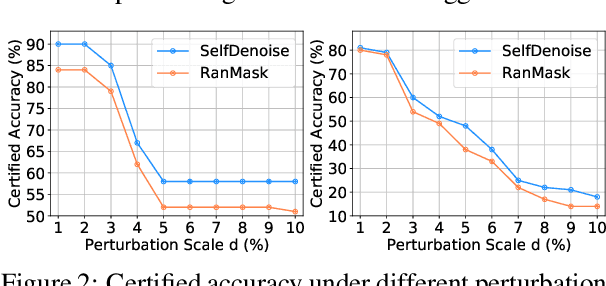
Although large language models (LLMs) have achieved significant success, their vulnerability to adversarial perturbations, including recent jailbreak attacks, has raised considerable concerns. However, the increasing size of these models and their limited access make improving their robustness a challenging task. Among various defense strategies, randomized smoothing has shown great potential for LLMs, as it does not require full access to the model's parameters or fine-tuning via adversarial training. However, randomized smoothing involves adding noise to the input before model prediction, and the final model's robustness largely depends on the model's performance on these noise corrupted data. Its effectiveness is often limited by the model's sub-optimal performance on noisy data. To address this issue, we propose to leverage the multitasking nature of LLMs to first denoise the noisy inputs and then to make predictions based on these denoised versions. We call this procedure self-denoised smoothing. Unlike previous denoised smoothing techniques in computer vision, which require training a separate model to enhance the robustness of LLMs, our method offers significantly better efficiency and flexibility. Our experimental results indicate that our method surpasses existing methods in both empirical and certified robustness in defending against adversarial attacks for both downstream tasks and human alignments (i.e., jailbreak attacks). Our code is publicly available at https://github.com/UCSB-NLP-Chang/SelfDenoise
The Power of Few: Accelerating and Enhancing Data Reweighting with Coreset Selection
Mar 20, 2024


As machine learning tasks continue to evolve, the trend has been to gather larger datasets and train increasingly larger models. While this has led to advancements in accuracy, it has also escalated computational costs to unsustainable levels. Addressing this, our work aims to strike a delicate balance between computational efficiency and model accuracy, a persisting challenge in the field. We introduce a novel method that employs core subset selection for reweighting, effectively optimizing both computational time and model performance. By focusing on a strategically selected coreset, our approach offers a robust representation, as it efficiently minimizes the influence of outliers. The re-calibrated weights are then mapped back to and propagated across the entire dataset. Our experimental results substantiate the effectiveness of this approach, underscoring its potential as a scalable and precise solution for model training.
How does promoting the minority fraction affect generalization? A theoretical study of the one-hidden-layer neural network on group imbalance
Mar 19, 2024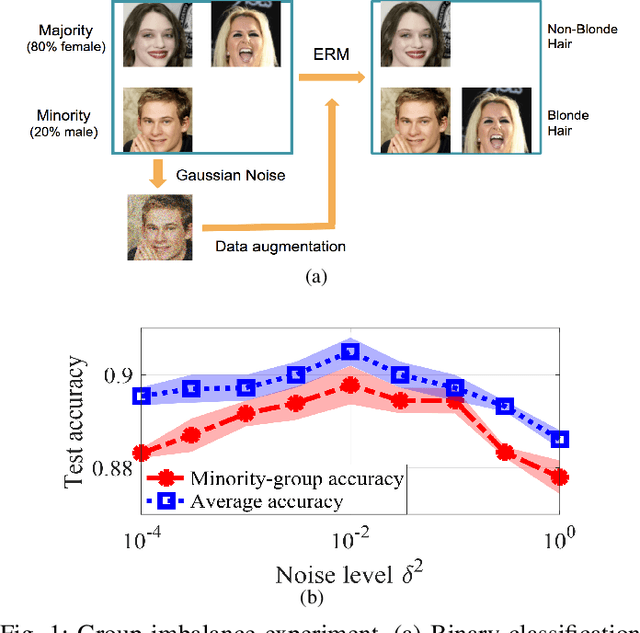
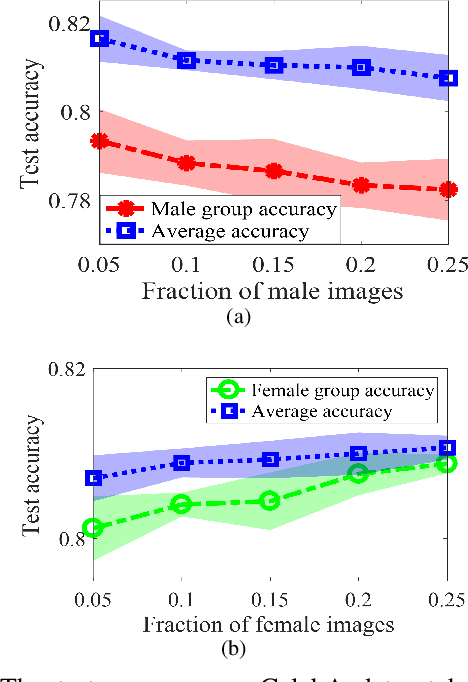
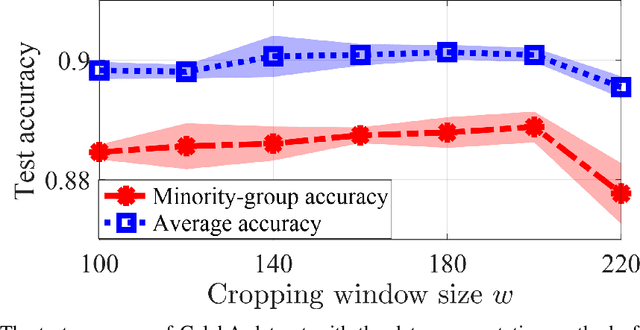
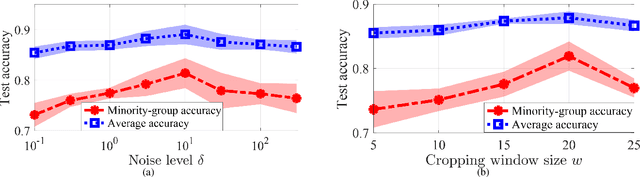
Group imbalance has been a known problem in empirical risk minimization (ERM), where the achieved high average accuracy is accompanied by low accuracy in a minority group. Despite algorithmic efforts to improve the minority group accuracy, a theoretical generalization analysis of ERM on individual groups remains elusive. By formulating the group imbalance problem with the Gaussian Mixture Model, this paper quantifies the impact of individual groups on the sample complexity, the convergence rate, and the average and group-level testing performance. Although our theoretical framework is centered on binary classification using a one-hidden-layer neural network, to the best of our knowledge, we provide the first theoretical analysis of the group-level generalization of ERM in addition to the commonly studied average generalization performance. Sample insights of our theoretical results include that when all group-level co-variance is in the medium regime and all mean are close to zero, the learning performance is most desirable in the sense of a small sample complexity, a fast training rate, and a high average and group-level testing accuracy. Moreover, we show that increasing the fraction of the minority group in the training data does not necessarily improve the generalization performance of the minority group. Our theoretical results are validated on both synthetic and empirical datasets, such as CelebA and CIFAR-10 in image classification.
Backdoor Secrets Unveiled: Identifying Backdoor Data with Optimized Scaled Prediction Consistency
Mar 15, 2024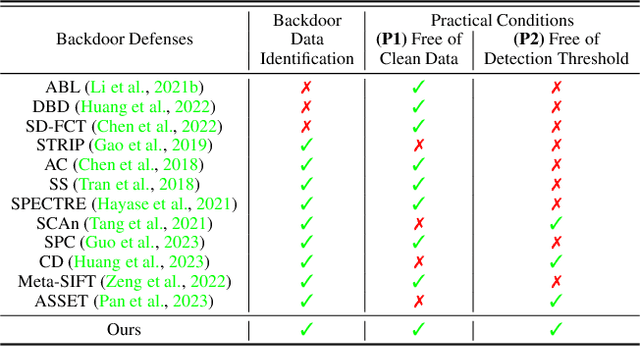


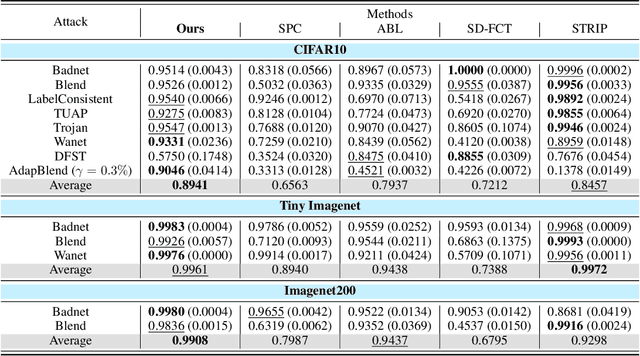
Modern machine learning (ML) systems demand substantial training data, often resorting to external sources. Nevertheless, this practice renders them vulnerable to backdoor poisoning attacks. Prior backdoor defense strategies have primarily focused on the identification of backdoored models or poisoned data characteristics, typically operating under the assumption of access to clean data. In this work, we delve into a relatively underexplored challenge: the automatic identification of backdoor data within a poisoned dataset, all under realistic conditions, i.e., without the need for additional clean data or without manually defining a threshold for backdoor detection. We draw an inspiration from the scaled prediction consistency (SPC) technique, which exploits the prediction invariance of poisoned data to an input scaling factor. Based on this, we pose the backdoor data identification problem as a hierarchical data splitting optimization problem, leveraging a novel SPC-based loss function as the primary optimization objective. Our innovation unfolds in several key aspects. First, we revisit the vanilla SPC method, unveiling its limitations in addressing the proposed backdoor identification problem. Subsequently, we develop a bi-level optimization-based approach to precisely identify backdoor data by minimizing the advanced SPC loss. Finally, we demonstrate the efficacy of our proposal against a spectrum of backdoor attacks, encompassing basic label-corrupted attacks as well as more sophisticated clean-label attacks, evaluated across various benchmark datasets. Experiment results show that our approach often surpasses the performance of current baselines in identifying backdoor data points, resulting in about 4%-36% improvement in average AUROC. Codes are available at https://github.com/OPTML-Group/BackdoorMSPC.
Challenging Forgets: Unveiling the Worst-Case Forget Sets in Machine Unlearning
Mar 12, 2024The trustworthy machine learning (ML) community is increasingly recognizing the crucial need for models capable of selectively 'unlearning' data points after training. This leads to the problem of machine unlearning (MU), aiming to eliminate the influence of chosen data points on model performance, while still maintaining the model's utility post-unlearning. Despite various MU methods for data influence erasure, evaluations have largely focused on random data forgetting, ignoring the vital inquiry into which subset should be chosen to truly gauge the authenticity of unlearning performance. To tackle this issue, we introduce a new evaluative angle for MU from an adversarial viewpoint. We propose identifying the data subset that presents the most significant challenge for influence erasure, i.e., pinpointing the worst-case forget set. Utilizing a bi-level optimization principle, we amplify unlearning challenges at the upper optimization level to emulate worst-case scenarios, while simultaneously engaging in standard training and unlearning at the lower level, achieving a balance between data influence erasure and model utility. Our proposal offers a worst-case evaluation of MU's resilience and effectiveness. Through extensive experiments across different datasets (including CIFAR-10, 100, CelebA, Tiny ImageNet, and ImageNet) and models (including both image classifiers and generative models), we expose critical pros and cons in existing (approximate) unlearning strategies. Our results illuminate the complex challenges of MU in practice, guiding the future development of more accurate and robust unlearning algorithms. The code is available at https://github.com/OPTML-Group/Unlearn-WorstCase.
UnlearnCanvas: A Stylized Image Dataset to Benchmark Machine Unlearning for Diffusion Models
Feb 26, 2024The rapid advancement of diffusion models (DMs) has not only transformed various real-world industries but has also introduced negative societal concerns, including the generation of harmful content, copyright disputes, and the rise of stereotypes and biases. To mitigate these issues, machine unlearning (MU) has emerged as a potential solution, demonstrating its ability to remove undesired generative capabilities of DMs in various applications. However, by examining existing MU evaluation methods, we uncover several key challenges that can result in incomplete, inaccurate, or biased evaluations for MU in DMs. To address them, we enhance the evaluation metrics for MU, including the introduction of an often-overlooked retainability measurement for DMs post-unlearning. Additionally, we introduce UnlearnCanvas, a comprehensive high-resolution stylized image dataset that facilitates us to evaluate the unlearning of artistic painting styles in conjunction with associated image objects. We show that this dataset plays a pivotal role in establishing a standardized and automated evaluation framework for MU techniques on DMs, featuring 7 quantitative metrics to address various aspects of unlearning effectiveness. Through extensive experiments, we benchmark 5 state-of-the-art MU methods, revealing novel insights into their pros and cons, and the underlying unlearning mechanisms. Furthermore, we demonstrate the potential of UnlearnCanvas to benchmark other generative modeling tasks, such as style transfer. The UnlearnCanvas dataset, benchmark, and the codes to reproduce all the results in this work can be found at https://github.com/OPTML-Group/UnlearnCanvas.