 Add to Chrome
 Add to Firefox
 Add to Edge
RbtAct: Rebuttal as Supervision for Actionable Review Feedback Generation
Mar 10, 2026
Large language models (LLMs) are increasingly used across the scientific workflow, including to draft peer-review reports. However, many AI-generated reviews are superficial and insufficiently actionable, leaving authors without concrete, implementable guidance and motivating the gap this work addresses. We propose RbtAct, which targets actionable review feedback generation and places existing peer review rebuttal at the center of learning. Rebuttals show which reviewer comments led to concrete revisions or specific plans, and which were only defended. Building on this insight, we leverage rebuttal as implicit supervision to directly optimize a feedback generator for actionability. To support this objective, we propose a new task called perspective-conditioned segment-level review feedback generation, in which the model is required to produce a single focused comment based on the complete paper and a specified perspective such as experiments and writing. We also build a large dataset named RMR-75K that maps review segments to the rebuttal segments that address them, with perspective labels and impact categories that order author uptake. We then train the Llama-3.1-8B-Instruct model with supervised fine-tuning on review segments followed by preference optimization using rebuttal derived pairs. Experiments with human experts and LLM-as-a-judge show consistent gains in actionability and specificity over strong baselines while maintaining grounding and relevance.

Deconstructing Multimodal Mathematical Reasoning: Towards a Unified Perception-Alignment-Reasoning Paradigm
Mar 09, 2026Multimodal Mathematical Reasoning (MMR) has recently attracted increasing attention for its capability to solve mathematical problems that involve both textual and visual modalities. However, current models still face significant challenges in real-world visual math tasks. They often misinterpret diagrams, fail to align mathematical symbols with visual evidence, and produce inconsistent reasoning steps. Moreover, existing evaluations mainly focus on checking final answers rather than verifying the correctness or executability of each intermediate step. To address these limitations, a growing body of recent research addresses these issues by integrating structured perception, explicit alignment, and verifiable reasoning within unified frameworks. To establish a clear roadmap for understanding and comparing different MMR approaches, we systematically study them around four fundamental questions: (1) What to extract from multimodal inputs, (2) How to represent and align textual and visual information, (3) How to perform the reasoning, and (4) How to evaluate the correctness of the overall reasoning process. Finally, we discuss open challenges and offer perspectives on promising directions for future research.
SciArena: An Open Evaluation Platform for Foundation Models in Scientific Literature Tasks
Jul 01, 2025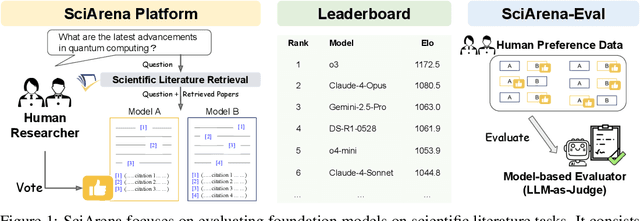
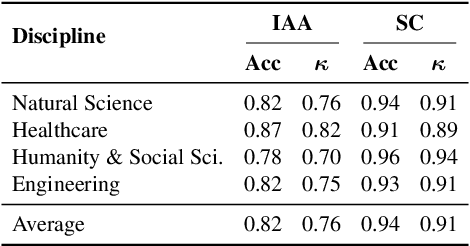
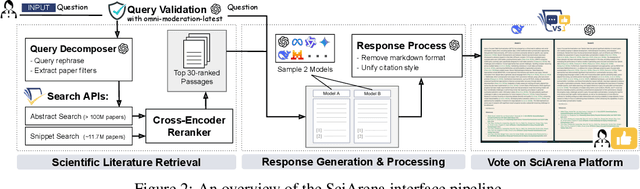
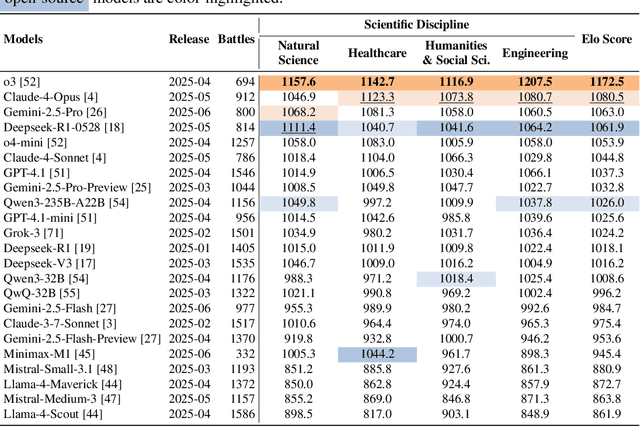
We present SciArena, an open and collaborative platform for evaluating foundation models on scientific literature tasks. Unlike traditional benchmarks for scientific literature understanding and synthesis, SciArena engages the research community directly, following the Chatbot Arena evaluation approach of community voting on model comparisons. By leveraging collective intelligence, SciArena offers a community-driven evaluation of model performance on open-ended scientific tasks that demand literature-grounded, long-form responses. The platform currently supports 23 open-source and proprietary foundation models and has collected over 13,000 votes from trusted researchers across diverse scientific domains. We analyze the data collected so far and confirm that the submitted questions are diverse, aligned with real-world literature needs, and that participating researchers demonstrate strong self-consistency and inter-annotator agreement in their evaluations. We discuss the results and insights based on the model ranking leaderboard. To further promote research in building model-based automated evaluation systems for literature tasks, we release SciArena-Eval, a meta-evaluation benchmark based on our collected preference data. The benchmark measures the accuracy of models in judging answer quality by comparing their pairwise assessments with human votes. Our experiments highlight the benchmark's challenges and emphasize the need for more reliable automated evaluation methods.
Comprehensive Multi-Modal Prototypes are Simple and Effective Classifiers for Vast-Vocabulary Object Detection
Dec 23, 2024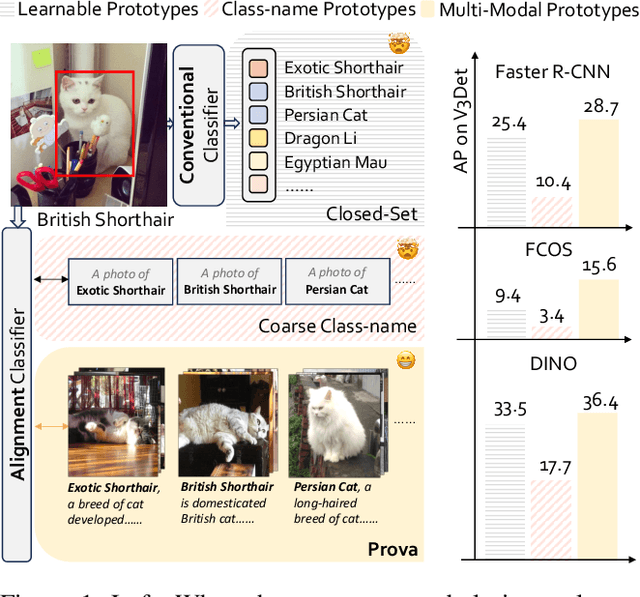
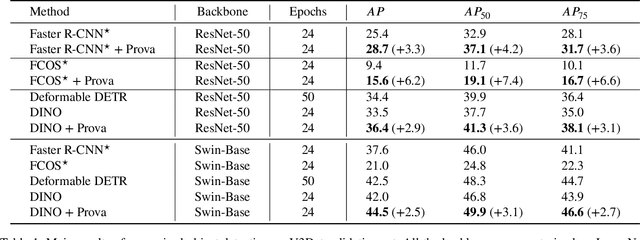
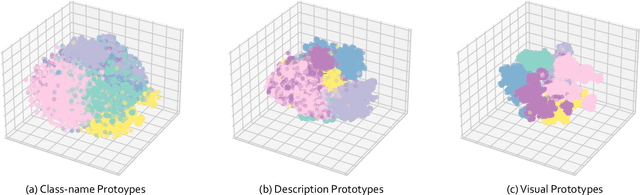

Enabling models to recognize vast open-world categories has been a longstanding pursuit in object detection. By leveraging the generalization capabilities of vision-language models, current open-world detectors can recognize a broader range of vocabularies, despite being trained on limited categories. However, when the scale of the category vocabularies during training expands to a real-world level, previous classifiers aligned with coarse class names significantly reduce the recognition performance of these detectors. In this paper, we introduce Prova, a multi-modal prototype classifier for vast-vocabulary object detection. Prova extracts comprehensive multi-modal prototypes as initialization of alignment classifiers to tackle the vast-vocabulary object recognition failure problem. On V3Det, this simple method greatly enhances the performance among one-stage, two-stage, and DETR-based detectors with only additional projection layers in both supervised and open-vocabulary settings. In particular, Prova improves Faster R-CNN, FCOS, and DINO by 3.3, 6.2, and 2.9 AP respectively in the supervised setting of V3Det. For the open-vocabulary setting, Prova achieves a new state-of-the-art performance with 32.8 base AP and 11.0 novel AP, which is of 2.6 and 4.3 gain over the previous methods.
V3Det Challenge 2024 on Vast Vocabulary and Open Vocabulary Object Detection: Methods and Results
Jun 17, 2024
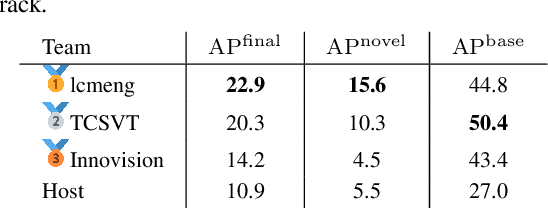
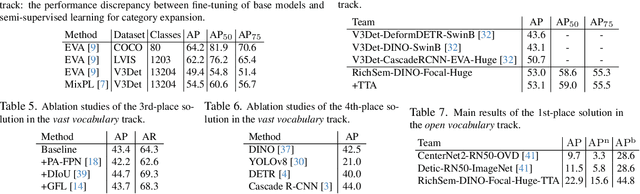
Detecting objects in real-world scenes is a complex task due to various challenges, including the vast range of object categories, and potential encounters with previously unknown or unseen objects. The challenges necessitate the development of public benchmarks and challenges to advance the field of object detection. Inspired by the success of previous COCO and LVIS Challenges, we organize the V3Det Challenge 2024 in conjunction with the 4th Open World Vision Workshop: Visual Perception via Learning in an Open World (VPLOW) at CVPR 2024, Seattle, US. This challenge aims to push the boundaries of object detection research and encourage innovation in this field. The V3Det Challenge 2024 consists of two tracks: 1) Vast Vocabulary Object Detection: This track focuses on detecting objects from a large set of 13204 categories, testing the detection algorithm's ability to recognize and locate diverse objects. 2) Open Vocabulary Object Detection: This track goes a step further, requiring algorithms to detect objects from an open set of categories, including unknown objects. In the following sections, we will provide a comprehensive summary and analysis of the solutions submitted by participants. By analyzing the methods and solutions presented, we aim to inspire future research directions in vast vocabulary and open-vocabulary object detection, driving progress in this field. Challenge homepage: https://v3det.openxlab.org.cn/challenge