 Add to Chrome
 Add to Firefox
 Add to Edge
Beyond the Embedding Bottleneck: Adaptive Retrieval-Augmented 3D CT Report Generation
Mar 16, 2026
Automated radiology report generation from 3D CT volumes often suffers from incomplete pathology coverage. We provide empirical evidence that this limitation stems from a representational bottleneck: contrastive 3D CT embeddings encode discriminative pathology signals, yet exhibit severe dimensional concentration, with as few as 2 effective dimensions out of 512. Corroborating this, scaling the language model yields no measurable improvement, suggesting that the bottleneck lies in the visual representation rather than the generator. This bottleneck limits both generation and retrieval; naive static retrieval fails to improve clinical efficacy and can even degrade performance. We propose \textbf{AdaRAG-CT}, an adaptive augmentation framework that compensates for this visual bottleneck by introducing supplementary textual information through controlled retrieval and selectively integrating it during generation. On the CT-RATE benchmark, AdaRAG-CT achieves state-of-the-art clinical efficacy, improving Clinical F1 from 0.420 (CT-Agent) to 0.480 (+6 points); ablation studies confirm that both the retrieval and generation components contribute to the improvement. Code is available at https://github.com/renjie-liang/Adaptive-RAG-for-3DCT-Report-Generation.

RbtAct: Rebuttal as Supervision for Actionable Review Feedback Generation
Mar 10, 2026Large language models (LLMs) are increasingly used across the scientific workflow, including to draft peer-review reports. However, many AI-generated reviews are superficial and insufficiently actionable, leaving authors without concrete, implementable guidance and motivating the gap this work addresses. We propose RbtAct, which targets actionable review feedback generation and places existing peer review rebuttal at the center of learning. Rebuttals show which reviewer comments led to concrete revisions or specific plans, and which were only defended. Building on this insight, we leverage rebuttal as implicit supervision to directly optimize a feedback generator for actionability. To support this objective, we propose a new task called perspective-conditioned segment-level review feedback generation, in which the model is required to produce a single focused comment based on the complete paper and a specified perspective such as experiments and writing. We also build a large dataset named RMR-75K that maps review segments to the rebuttal segments that address them, with perspective labels and impact categories that order author uptake. We then train the Llama-3.1-8B-Instruct model with supervised fine-tuning on review segments followed by preference optimization using rebuttal derived pairs. Experiments with human experts and LLM-as-a-judge show consistent gains in actionability and specificity over strong baselines while maintaining grounding and relevance.
Low-Light Image and Video Enhancement: A Comprehensive Survey and Beyond
Dec 21, 2022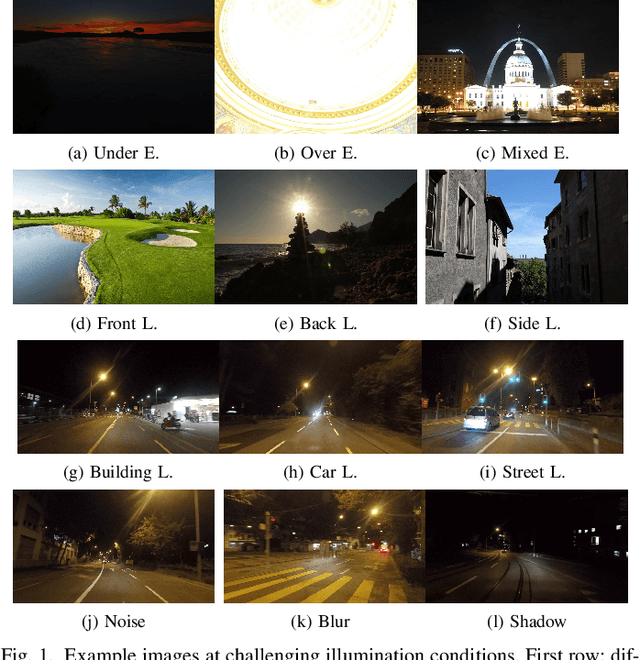
This paper presents a comprehensive survey of low-light image and video enhancement. We begin with the challenging mixed over-/under-exposed images, which are under-performed by existing methods. To this end, we propose two variants of the SICE dataset named SICE_Grad and SICE_Mix. Next, we introduce Night Wenzhou, a large-scale, high-resolution video dataset, to address the issue of the lack of a low-light video dataset that discount the use of low-light image enhancement (LLIE) to videos. The Night Wenzhou dataset is challenging since it consists of fast-moving aerial scenes and streetscapes with varying illuminations and degradation. We conduct extensive key technique analysis and experimental comparisons for representative LLIE approaches using these newly proposed datasets and the current benchmark datasets. Finally, we address unresolved issues and propose future research topics for the LLIE community.