 Add to Chrome
 Add to Firefox
 Add to Edge
RbtAct: Rebuttal as Supervision for Actionable Review Feedback Generation
Mar 10, 2026
Large language models (LLMs) are increasingly used across the scientific workflow, including to draft peer-review reports. However, many AI-generated reviews are superficial and insufficiently actionable, leaving authors without concrete, implementable guidance and motivating the gap this work addresses. We propose RbtAct, which targets actionable review feedback generation and places existing peer review rebuttal at the center of learning. Rebuttals show which reviewer comments led to concrete revisions or specific plans, and which were only defended. Building on this insight, we leverage rebuttal as implicit supervision to directly optimize a feedback generator for actionability. To support this objective, we propose a new task called perspective-conditioned segment-level review feedback generation, in which the model is required to produce a single focused comment based on the complete paper and a specified perspective such as experiments and writing. We also build a large dataset named RMR-75K that maps review segments to the rebuttal segments that address them, with perspective labels and impact categories that order author uptake. We then train the Llama-3.1-8B-Instruct model with supervised fine-tuning on review segments followed by preference optimization using rebuttal derived pairs. Experiments with human experts and LLM-as-a-judge show consistent gains in actionability and specificity over strong baselines while maintaining grounding and relevance.

SAGE: Benchmarking and Improving Retrieval for Deep Research Agents
Feb 05, 2026Deep research agents have emerged as powerful systems for addressing complex queries. Meanwhile, LLM-based retrievers have demonstrated strong capability in following instructions or reasoning. This raises a critical question: can LLM-based retrievers effectively contribute to deep research agent workflows? To investigate this, we introduce SAGE, a benchmark for scientific literature retrieval comprising 1,200 queries across four scientific domains, with a 200,000 paper retrieval corpus.We evaluate six deep research agents and find that all systems struggle with reasoning-intensive retrieval. Using DR Tulu as backbone, we further compare BM25 and LLM-based retrievers (i.e., ReasonIR and gte-Qwen2-7B-instruct) as alternative search tools. Surprisingly, BM25 significantly outperforms LLM-based retrievers by approximately 30%, as existing agents generate keyword-oriented sub-queries. To improve performance, we propose a corpus-level test-time scaling framework that uses LLMs to augment documents with metadata and keywords, making retrieval easier for off-the-shelf retrievers. This yields 8% and 2% gains on short-form and open-ended questions, respectively.
SciRAG: Adaptive, Citation-Aware, and Outline-Guided Retrieval and Synthesis for Scientific Literature
Nov 18, 2025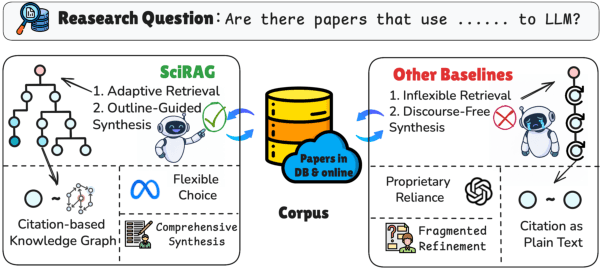
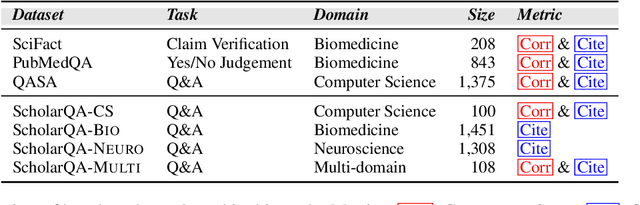
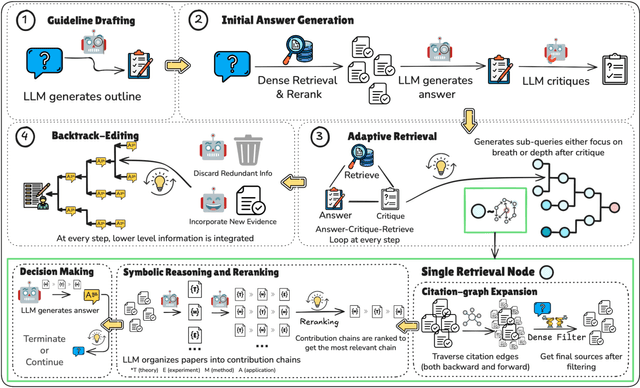
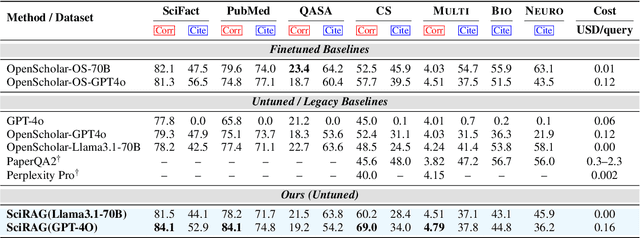
The accelerating growth of scientific publications has intensified the need for scalable, trustworthy systems to synthesize knowledge across diverse literature. While recent retrieval-augmented generation (RAG) methods have improved access to scientific information, they often overlook citation graph structure, adapt poorly to complex queries, and yield fragmented, hard-to-verify syntheses. We introduce SciRAG, an open-source framework for scientific literature exploration that addresses these gaps through three key innovations: (1) adaptive retrieval that flexibly alternates between sequential and parallel evidence gathering; (2) citation-aware symbolic reasoning that leverages citation graphs to organize and filter supporting documents; and (3) outline-guided synthesis that plans, critiques, and refines answers to ensure coherence and transparent attribution. Extensive experiments across multiple benchmarks such as QASA and ScholarQA demonstrate that SciRAG outperforms prior systems in factual accuracy and synthesis quality, establishing a new foundation for reliable, large-scale scientific knowledge aggregation.
SciArena: An Open Evaluation Platform for Foundation Models in Scientific Literature Tasks
Jul 01, 2025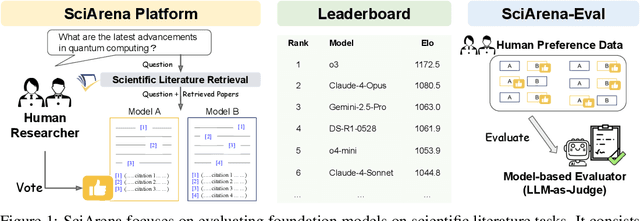
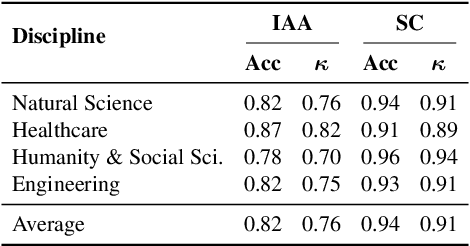
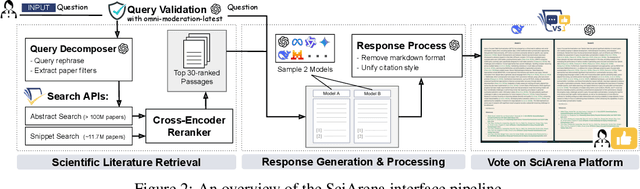
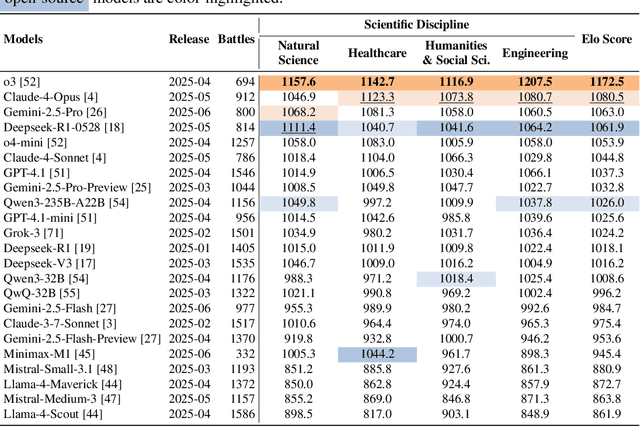
We present SciArena, an open and collaborative platform for evaluating foundation models on scientific literature tasks. Unlike traditional benchmarks for scientific literature understanding and synthesis, SciArena engages the research community directly, following the Chatbot Arena evaluation approach of community voting on model comparisons. By leveraging collective intelligence, SciArena offers a community-driven evaluation of model performance on open-ended scientific tasks that demand literature-grounded, long-form responses. The platform currently supports 23 open-source and proprietary foundation models and has collected over 13,000 votes from trusted researchers across diverse scientific domains. We analyze the data collected so far and confirm that the submitted questions are diverse, aligned with real-world literature needs, and that participating researchers demonstrate strong self-consistency and inter-annotator agreement in their evaluations. We discuss the results and insights based on the model ranking leaderboard. To further promote research in building model-based automated evaluation systems for literature tasks, we release SciArena-Eval, a meta-evaluation benchmark based on our collected preference data. The benchmark measures the accuracy of models in judging answer quality by comparing their pairwise assessments with human votes. Our experiments highlight the benchmark's challenges and emphasize the need for more reliable automated evaluation methods.