 Add to Chrome
 Add to Firefox
 Add to Edge
SEA-Eval: A Benchmark for Evaluating Self-Evolving Agents Beyond Episodic Assessment
Apr 14, 2026
Current LLM-based agents demonstrate strong performance in episodic task execution but remain constrained by static toolsets and episodic amnesia, failing to accumulate experience across task boundaries. This paper presents the first formal definition of the Self-Evolving Agent (SEA), formalizes the Evolutionary Flywheel as its minimal sufficient architecture, and introduces SEA-Eval -- the first benchmark designed specifically for evaluating SEAs. Grounded in Flywheel theory, SEA-Eval establishes $SR$ and $T$ as primary metrics and enables through sequential task stream design the independent quantification of evolutionary gain, evolutionary stability, and implicit alignment convergence. Empirical evaluation reveals that under identical success rates, token consumption differs by up to 31.2$\times$ across frameworks, with divergent evolutionary trajectories under sequential analysis -- demonstrating that success rate alone creates a capability illusion and that the sequential convergence of $T$ is the key criterion for distinguishing genuine evolution from pseudo-evolution.

SCAResNet: A ResNet Variant Optimized for Tiny Object Detection in Transmission and Distribution Towers
Apr 05, 2024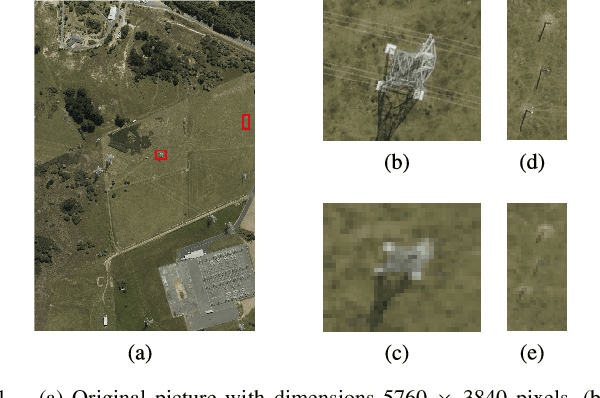
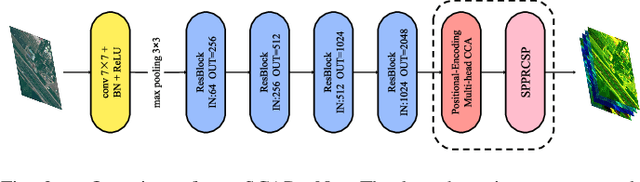
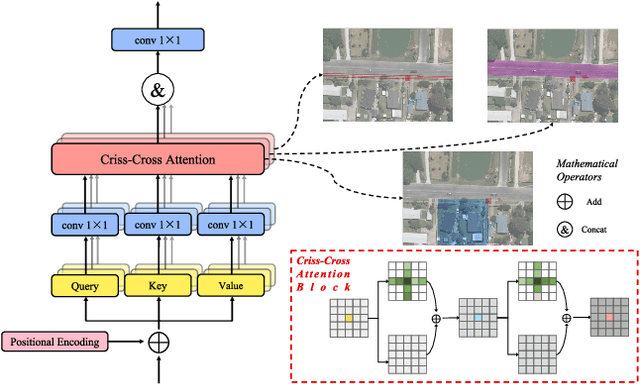
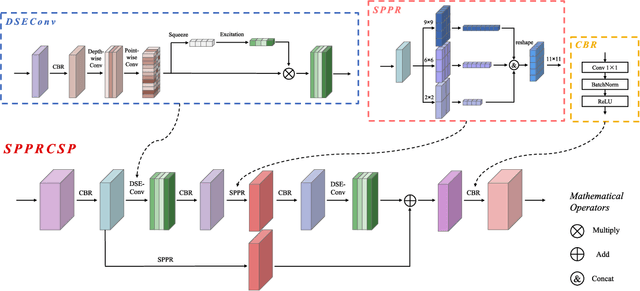
Traditional deep learning-based object detection networks often resize images during the data preprocessing stage to achieve a uniform size and scale in the feature map. Resizing is done to facilitate model propagation and fully connected classification. However, resizing inevitably leads to object deformation and loss of valuable information in the images. This drawback becomes particularly pronounced for tiny objects like distribution towers with linear shapes and few pixels. To address this issue, we propose abandoning the resizing operation. Instead, we introduce Positional-Encoding Multi-head Criss-Cross Attention. This allows the model to capture contextual information and learn from multiple representation subspaces, effectively enriching the semantics of distribution towers. Additionally, we enhance Spatial Pyramid Pooling by reshaping three pooled feature maps into a new unified one while also reducing the computational burden. This approach allows images of different sizes and scales to generate feature maps with uniform dimensions and can be employed in feature map propagation. Our SCAResNet incorporates these aforementioned improvements into the backbone network ResNet. We evaluated our SCAResNet using the Electric Transmission and Distribution Infrastructure Imagery dataset from Duke University. Without any additional tricks, we employed various object detection models with Gaussian Receptive Field based Label Assignment as the baseline. When incorporating the SCAResNet into the baseline model, we achieved a 2.1% improvement in mAPs. This demonstrates the advantages of our SCAResNet in detecting transmission and distribution towers and its value in tiny object detection. The source code is available at https://github.com/LisavilaLee/SCAResNet_mmdet.