 Add to Chrome
 Add to Firefox
 Add to Edge
PathScale-R1: Cross-scale Reasoning for Pathological Image Analysis
Jul 26, 2026
Pathological diagnosis is inherently multi-scale, requiring the integration of global tissue architecture at low magnification with cellular morphology at higher magnification. However, existing pathology benchmarks and vision-language models (VLMs) are still largely developed under single-scale settings, limiting their ability to learn clinically meaningful multi-magnification reasoning. Moreover, naively constructed visual question answering (VQA) tasks may be susceptible to text-only or superficial visual shortcuts, leading to unreliable assessments of visual understanding. To address these limitations, we introduce a benchmark and training framework for shortcut-resistant cross-scale pathology reasoning. We design an Adversarial Text-only Screening strategy for semantic reasoning questions and a Structure-controlled Distractor Sampling strategy for visual grounding questions, encouraging models to rely on cross-scale visual evidence. Based on this pipeline, we construct PathScale-VQA, a high-quality cross-scale pathology VQA benchmark with 10,373 multiple-choice questions grounded in 1,368 diagnostic paths across multiple magnification levels. Building on the semantic reasoning set, PathScale-R1 is optimized through Difficulty-driven Reasoning Distillation supervised fine-tuning followed by reinforcement learning with a Scale-aware Reasoning Structure reward, which encourages the use of evidence across magnifications. Extensive experiments demonstrate state-of-the-art performance of PathScale-R1 on cross-scale reasoning tasks and effective transfer to conventional single-scale pathology VQA. Our code is available at https://github.com/iMVR-PL/PathScale-R1.

PathAgentBench: Benchmarking Evidence-Seeking Vision-Language Models on Whole-Slide Pathology Image
Jul 21, 2026Whole-slide image (WSI) diagnosis requires identifying diagnostically relevant regions, examining them across magnifications, and integrating multi-scale evidence. However, most existing pathology benchmarks evaluate models on pre-cropped patches or pre-extracted slide features, leaving their ability to acquire evidence directly from gigapixel WSIs largely untested. We introduce PathAgentBench, a benchmark for evaluating evidence-seeking vision-language models (VLMs) across four complementary capabilities: image-to-text matching for evidence interpretation, text-to-image retrieval for evidence verification, diagnostic-region localization for evidence acquisition, and multi-scale reasoning for evidence integration. The benchmark is organized as a diagnostic tree that links nested regions across magnifications with scale-specific findings and path-level diagnoses. It contains 1,822 TCGA WSIs and 17,135 diagnostic paths annotated by ten board-certified pathologists. An additional private cohort of 190 breast cancer WSIs with detailed annotations is used to evaluate autonomous whole-slide exploration. We evaluate 20 general-purpose, medical, and pathology-specialized models. Leading open-weight models achieve over 93% accuracy in multi-scale reasoning and over 50% accuracy in both cross-modal matching tasks. In contrast, diagnostic-region localization remains challenging: the best text-guided mean intersection-over-union is below 0.09, underperforming a simple center-based heuristic. During autonomous exploration, the unconditional hit rate decreases from 0.522 at low magnification to 0.185 at intermediate magnification and 0.020 at high magnification. These results reveal a pronounced gap between reasoning over curated evidence and acquiring that evidence directly from WSIs. PathAgentBench provides a unified framework for measuring and improving evidence-seeking pathology models.
Enhancing Pathological VLMs with Cross-scale Reasoning
Jun 17, 2026Pathological images are inherently multi-scale, requiring pathologists to integrate evidence from global tissue architecture at low magnification to cellular morphology at higher magnification for accurate diagnosis. While existing pathological datasets for vision-language model (VLM) include various scales, they often lack an explicit cross-scale reasoning objective. This limitation prevents VLMs from capturing essential cross-scale representations and learning evidence-based reasoning. To bridge this gap, we introduce the first cross-scale training and evaluation paradigm that formulates pathology interpretation as multi-magnification reasoning. However, creating such a task reveals a critical challenge: multi-image visual question answering (VQA) is prone to text-only shortcuts, which allow models to guess answers using magnification-dependent artifacts rather than visual evidence. To address this, we propose a leakage-aware curation pipeline that combines adversarial text-only screening with constraint-guided question design. Using this pipeline, we construct Scale-VQA, a high-quality benchmark with 4,685 multiple-choice questions grounded in 2,537 pathology images across multiple magnification levels. Finally, we present ScaleReasoner-R1, a model trained via reinforcement learning to optimize performance on the cross-scale VQA task. ScaleReasoner-R1 achieves state-of-the-art performance on our cross-scale reasoning benchmark and generalizes to SOTA performance on established single-scale benchmarks. Findings suggest that even the limited cross-scale supervision can significantly improve pathological understanding. The code and demos will be open-sourced.
OminiControl2: Efficient Conditioning for Diffusion Transformers
Mar 11, 2025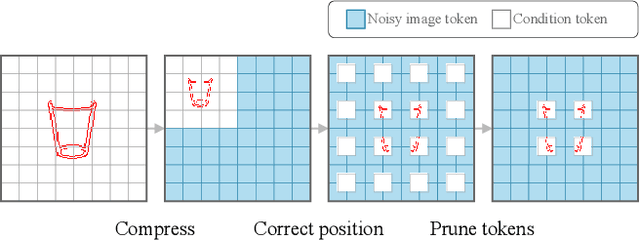
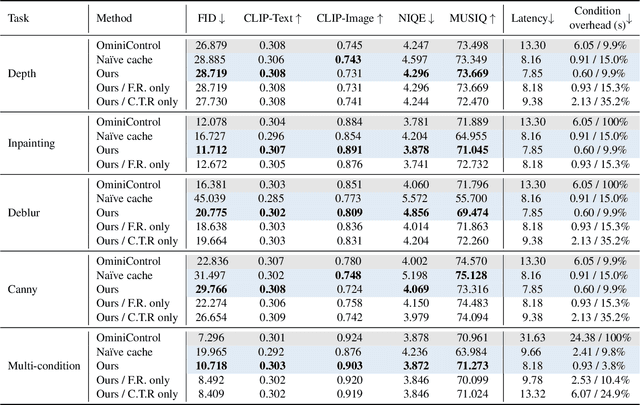
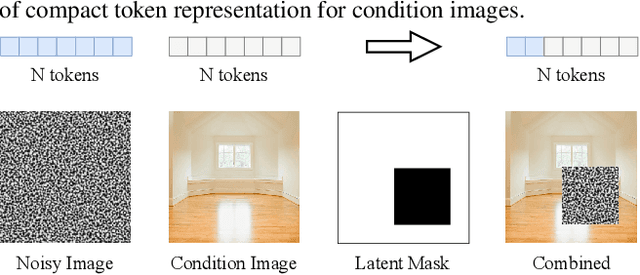
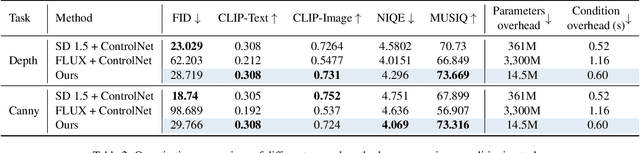
Fine-grained control of text-to-image diffusion transformer models (DiT) remains a critical challenge for practical deployment. While recent advances such as OminiControl and others have enabled a controllable generation of diverse control signals, these methods face significant computational inefficiency when handling long conditional inputs. We present OminiControl2, an efficient framework that achieves efficient image-conditional image generation. OminiControl2 introduces two key innovations: (1) a dynamic compression strategy that streamlines conditional inputs by preserving only the most semantically relevant tokens during generation, and (2) a conditional feature reuse mechanism that computes condition token features only once and reuses them across denoising steps. These architectural improvements preserve the original framework's parameter efficiency and multi-modal versatility while dramatically reducing computational costs. Our experiments demonstrate that OminiControl2 reduces conditional processing overhead by over 90% compared to its predecessor, achieving an overall 5.9$\times$ speedup in multi-conditional generation scenarios. This efficiency enables the practical implementation of complex, multi-modal control for high-quality image synthesis with DiT models.
UnPuzzle: A Unified Framework for Pathology Image Analysis
Mar 05, 2025Pathology image analysis plays a pivotal role in medical diagnosis, with deep learning techniques significantly advancing diagnostic accuracy and research. While numerous studies have been conducted to address specific pathological tasks, the lack of standardization in pre-processing methods and model/database architectures complicates fair comparisons across different approaches. This highlights the need for a unified pipeline and comprehensive benchmarks to enable consistent evaluation and accelerate research progress. In this paper, we present UnPuzzle, a novel and unified framework for pathological AI research that covers a broad range of pathology tasks with benchmark results. From high-level to low-level, upstream to downstream tasks, UnPuzzle offers a modular pipeline that encompasses data pre-processing, model composition,taskconfiguration,andexperimentconduction.Specifically, it facilitates efficient benchmarking for both Whole Slide Images (WSIs) and Region of Interest (ROI) tasks. Moreover, the framework supports variouslearningparadigms,includingself-supervisedlearning,multi-task learning,andmulti-modallearning,enablingcomprehensivedevelopment of pathology AI models. Through extensive benchmarking across multiple datasets, we demonstrate the effectiveness of UnPuzzle in streamlining pathology AI research and promoting reproducibility. We envision UnPuzzle as a cornerstone for future advancements in pathology AI, providing a more accessible, transparent, and standardized approach to model evaluation. The UnPuzzle repository is publicly available at https://github.com/Puzzle-AI/UnPuzzle.
OminiControl: Minimal and Universal Control for Diffusion Transformer
Nov 25, 2024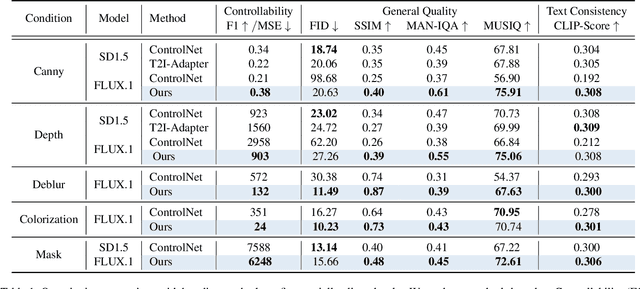

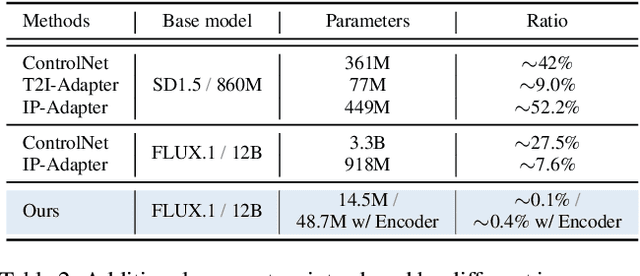

In this paper, we introduce OminiControl, a highly versatile and parameter-efficient framework that integrates image conditions into pre-trained Diffusion Transformer (DiT) models. At its core, OminiControl leverages a parameter reuse mechanism, enabling the DiT to encode image conditions using itself as a powerful backbone and process them with its flexible multi-modal attention processors. Unlike existing methods, which rely heavily on additional encoder modules with complex architectures, OminiControl (1) effectively and efficiently incorporates injected image conditions with only ~0.1% additional parameters, and (2) addresses a wide range of image conditioning tasks in a unified manner, including subject-driven generation and spatially-aligned conditions such as edges, depth, and more. Remarkably, these capabilities are achieved by training on images generated by the DiT itself, which is particularly beneficial for subject-driven generation. Extensive evaluations demonstrate that OminiControl outperforms existing UNet-based and DiT-adapted models in both subject-driven and spatially-aligned conditional generation. Additionally, we release our training dataset, Subjects200K, a diverse collection of over 200,000 identity-consistent images, along with an efficient data synthesis pipeline to advance research in subject-consistent generation.