 Add to Chrome
 Add to Firefox
 Add to Edge
GeniWorld: A Generalizable Interactive World Model for Robotic Manipulation via Visual Actions
Aug 06, 2026
Generalist robot policies exhibit strong capabilities, but their robustness in complex and unseen environments remains limited. Scaling robot learning and evaluation in diverse real-world environments remains costly and challenging. Action-conditioned world models offer a promising alternative, but they often suffer from limited action controllability and poor generalization to out-of-distribution (OOD) scenarios. To this end, we present GeniWorld, an interactive world model for robots that generalizes robustly across unseen scenarios. Building on pretrained video generative models, we use URDF-based rendering to transform numerical actions into visual action representations, enabling spatially grounded action control. By explicitly decoupling embodiment kinematics from environmental dynamics, our model mitigates scene overfitting and facilitates modeling of robot-environment interactions. To achieve closed-loop control, we construct an autoregressive video prediction model integrated with high-frequency robot kinematic control, enabling interaction with both robot policies and human teleoperators. In our experiments, even when trained solely on limited fixed-scene data, our model achieves superior in-domain performance and robust zero-shot generalization to highly randomized, unseen environments. For downstream applications, GeniWorld serves as a scalable policy evaluator that remains reliable under environmental perturbations. Furthermore, even with limited real-world demonstrations, GeniWorld generates diverse manipulation trajectories within the world model, improving downstream policy performance and robustness in complex environments.

TAU-Bench: From Anomaly Instance Tracking to Fine-Grained Video Anomaly Understanding
Aug 06, 2026Humans understand anomalous events through a coherent perceptual process in which they identify the focal instance, follow its behavior as the event unfolds, and interpret why it violates the expectations of the surrounding scene. Video anomaly understanding (VAU) seeks to endow models with a similar capability, moving beyond deciding whether a video is anomalous toward explaining how the event develops and why it matters. Although recent vision--language models (VLMs) can generate detailed and plausible anomaly descriptions, their semantic fluency does not ensure that these interpretations remain grounded in the correct anomaly instance over time. Existing benchmarks typically evaluate tracking and semantic understanding through separate protocols, leaving such instance--semantic inconsistency largely unmeasured. We therefore introduce TAU-Bench, a track-centric benchmark for jointly evaluating anomaly instance tracking and fine-grained anomaly understanding. TAU-Bench contains 1,118 videos, 1,454 tracks, and 202,438 pixel-level masks spanning 49 event and 45 scene categories, together with track-centric annotations that connect instance-level identification, event-level understanding, and scene-level reasoning. To build TAU-Bench at scale, we developed an automated data engine integrating anomaly suitability filtering, anomaly instance track construction, hierarchical caption annotation, and human quality control. Evaluations across representative VLM families show that models producing plausible anomaly interpretations may still fail to localize and track the correct instance reliably, revealing a persistent gap between semantic reasoning and visual grounding. These findings therefore highlight instance-grounded evaluation as an important step toward more faithful and reliable VAU systems.
DynTrace: Tracking Dynamic Object Evidence for 4D Spatio-Temporal Reasoning in MLLMs
Jul 14, 20264D spatio-temporal reasoning, jointly modeling 3D spatial structure and temporal evolution, is essential for understanding dynamic worlds and enabling embodied interaction. While current Multimodal Large Language Models (MLLMs) show strong capabilities in static scene understanding and coarse-grained 4D tasks, they still have notable limitations in continuous dynamic scene perception, especially in tracking dynamic object evidence for coherent 4D spatio-temporal reasoning. This shortcoming stems mainly from relying on sparse frame-level observations, fragmenting continuous dynamic cues and leaving models unable to disentangle genuine object dynamics from camera-induced apparent motion. Inspired by humans tracking dynamic cues while compensating for viewpoint changes, we propose DynTrace, a training-free framework for 4D spatio-temporal reasoning with two complementary components. Dynamic Trajectory Visualization (DTV) reprojects world-coordinate trajectories onto the image plane, providing geometry-informed visual priors that disentangle genuine object dynamics from camera-induced apparent motion. Meanwhile, the Dynamic Trace Token (DT-Token), organized into a Dynamic Trace Graph (DTG), tracks object-level dynamic cues, trace evolution, and key moments, maintaining continuous dynamic object evidence for coherent 4D reasoning. Together, these two components equip MLLMs with continuously tracked dynamic object evidence, grounded in geometry-informed visual priors and structured spatio-temporal traces. DynTrace consistently improves open-source MLLMs, achieving state-of-the-art results on Dyn-Bench, VLM4D, and DSI-Bench, validating the importance of tracking dynamic object evidence for robust 4D spatio-temporal reasoning.
HDSL: A Hierarchical Domain-Specific Language for Structured 3D Indoor Scene Generation and Localized Editing with LLM Agents
Jun 08, 2026Text-driven indoor scene generation and editing require an intermediate representation that language models can both produce and revise. Existing LLM-based systems often rely on scene graphs or global constraint lists, which are compact but underspecify local geometry and make instruction-based edits difficult to localize. We frame this problem as structured program generation and local program repair, and propose Hierarchical Descriptive Scene Language (HDSL), an XML/CSS-style domain-specific language for structured 3D indoor scenes. HDSL represents rooms, regions, objects, and support surfaces as a tree with local coordinates, making complex scenes easier to plan recursively and easier to retrieve for editing. Our pipeline uses LLM agents to generate HDSL subtrees with bounded verification, grounds non-virtual nodes through multimodal asset retrieval, and applies force-directed layout optimization to repair boundary and collision errors. For editing, Hierarchical Retrieval-Augmented Generation retrieves the relevant subtree, asks the LLM to rewrite only that local context, and merges the result back through a deterministic three-way merge. In our reproduced benchmark, HDSL improves average object coverage, text-scene alignment, and generation time over full text-to-scene baselines while remaining competitive with recent layout-only reproductions on geometry metrics; for editing, HRAG reduces token use by $5.22\times$ and runtime by $6.19\times$, produces valid DSL for all eight paired edits, and better preserves unrelated scene objects.
RoboStream: Weaving Spatio-Temporal Reasoning with Memory in Vision-Language Models for Robotics
Mar 13, 2026Enabling reliable long-horizon robotic manipulation is a crucial step toward open-world embodied intelligence. However, VLM-based planners treat each step as an isolated observation-to-action mapping, forcing them to reinfer scene geometry from raw pixels at every decision point while remaining unaware of how prior actions have reshaped the environment. Despite strong short-horizon performance, these systems lack the spatio-temporal reasoning required for persistent geometric anchoring and memory of action-triggered state transitions. Without persistent state tracking, perceptual errors accumulate across the execution horizon, temporarily occluded objects are catastrophically forgotten, and these compounding failures lead to precondition violations that cascade through subsequent steps. In contrast, humans maintain a persistent mental model that continuously tracks spatial relations and action consequences across interactions rather than reconstructing them at each instant. Inspired by this human capacity for causal spatio-temporal reasoning with persistent memory, we propose RoboStream, a training-free framework that achieves geometric anchoring through Spatio-Temporal Fusion Tokens (STF-Tokens), which bind visual evidence to 3D geometric attributes for persistent object grounding, and maintains causal continuity via a Causal Spatio-Temporal Graph (CSTG) that records action-triggered state transitions across steps. This design enables the planner to trace causal chains and preserve object permanence under occlusion without additional training or fine-tuning. RoboStream achieves 90.5% on long-horizon RLBench and 44.4% on challenging real-world block-building tasks, where both SoFar and VoxPoser score 11.1%, demonstrating that spatio-temporal reasoning and causal memory are critical missing components for reliable long-horizon manipulation.
Tail-Aware Post-Training Quantization for 3D Geometry Models
Feb 02, 2026The burgeoning complexity and scale of 3D geometry models pose significant challenges for deployment on resource-constrained platforms. While Post-Training Quantization (PTQ) enables efficient inference without retraining, conventional methods, primarily optimized for 2D Vision Transformers, fail to transfer effectively to 3D models due to intricate feature distributions and prohibitive calibration overhead. To address these challenges, we propose TAPTQ, a Tail-Aware Post-Training Quantization pipeline specifically engineered for 3D geometric learning. Our contribution is threefold: (1) To overcome the data-scale bottleneck in 3D datasets, we develop a progressive coarse-to-fine calibration construction strategy that constructs a highly compact subset to achieve both statistical purity and geometric representativeness. (2) We reformulate the quantization interval search as an optimization problem and introduce a ternary-search-based solver, reducing the computational complexity from $\mathcal{O}(N)$ to $\mathcal{O}(\log N)$ for accelerated deployment. (3) To mitigate quantization error accumulation, we propose TRE-Guided Module-wise Compensation, which utilizes a Tail Relative Error (TRE) metric to adaptively identify and rectify distortions in modules sensitive to long-tailed activation outliers. Extensive experiments on the VGGT and Pi3 benchmarks demonstrate that TAPTQ consistently outperforms state-of-the-art PTQ methods in accuracy while significantly reducing calibration time. The code will be released soon.
Splatwizard: A Benchmark Toolkit for 3D Gaussian Splatting Compression
Dec 31, 2025The recent advent of 3D Gaussian Splatting (3DGS) has marked a significant breakthrough in real-time novel view synthesis. However, the rapid proliferation of 3DGS-based algorithms has created a pressing need for standardized and comprehensive evaluation tools, especially for compression task. Existing benchmarks often lack the specific metrics necessary to holistically assess the unique characteristics of different methods, such as rendering speed, rate distortion trade-offs memory efficiency, and geometric accuracy. To address this gap, we introduce Splatwizard, a unified benchmark toolkit designed specifically for benchmarking 3DGS compression models. Splatwizard provides an easy-to-use framework to implement new 3DGS compression model and utilize state-of-the-art techniques proposed by previous work. Besides, an integrated pipeline that automates the calculation of key performance indicators, including image-based quality metrics, chamfer distance of reconstruct mesh, rendering frame rates, and computational resource consumption is included in the framework as well. Code is available at https://github.com/splatwizard/splatwizard
SD-GS: Structured Deformable 3D Gaussians for Efficient Dynamic Scene Reconstruction
Jul 10, 2025Current 4D Gaussian frameworks for dynamic scene reconstruction deliver impressive visual fidelity and rendering speed, however, the inherent trade-off between storage costs and the ability to characterize complex physical motions significantly limits the practical application of these methods. To tackle these problems, we propose SD-GS, a compact and efficient dynamic Gaussian splatting framework for complex dynamic scene reconstruction, featuring two key contributions. First, we introduce a deformable anchor grid, a hierarchical and memory-efficient scene representation where each anchor point derives multiple 3D Gaussians in its local spatiotemporal region and serves as the geometric backbone of the 3D scene. Second, to enhance modeling capability for complex motions, we present a deformation-aware densification strategy that adaptively grows anchors in under-reconstructed high-dynamic regions while reducing redundancy in static areas, achieving superior visual quality with fewer anchors. Experimental results demonstrate that, compared to state-of-the-art methods, SD-GS achieves an average of 60\% reduction in model size and an average of 100\% improvement in FPS, significantly enhancing computational efficiency while maintaining or even surpassing visual quality.
Lungmix: A Mixup-Based Strategy for Generalization in Respiratory Sound Classification
Dec 29, 2024Respiratory sound classification plays a pivotal role in diagnosing respiratory diseases. While deep learning models have shown success with various respiratory sound datasets, our experiments indicate that models trained on one dataset often fail to generalize effectively to others, mainly due to data collection and annotation \emph{inconsistencies}. To address this limitation, we introduce \emph{Lungmix}, a novel data augmentation technique inspired by Mixup. Lungmix generates augmented data by blending waveforms using loudness and random masks while interpolating labels based on their semantic meaning, helping the model learn more generalized representations. Comprehensive evaluations across three datasets, namely ICBHI, SPR, and HF, demonstrate that Lungmix significantly enhances model generalization to unseen data. In particular, Lungmix boosts the 4-class classification score by up to 3.55\%, achieving performance comparable to models trained directly on the target dataset.
DragScene: Interactive 3D Scene Editing with Single-view Drag Instructions
Dec 18, 2024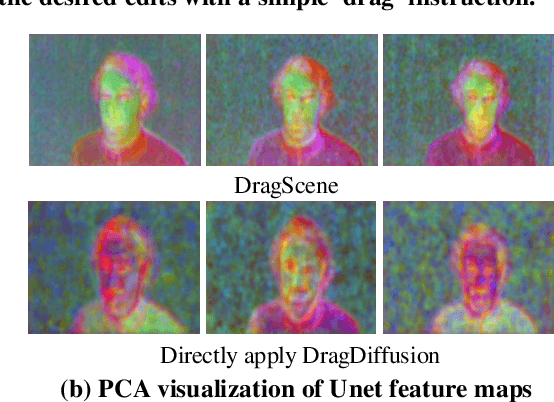

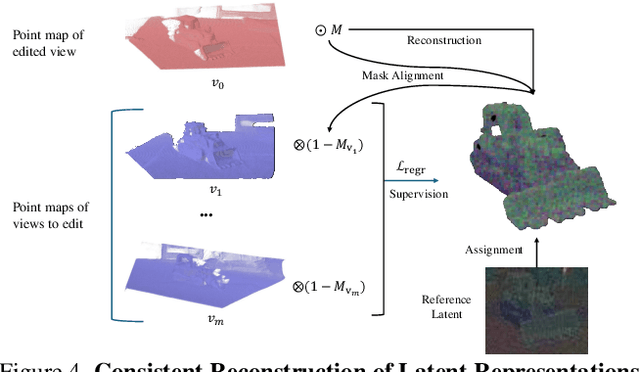
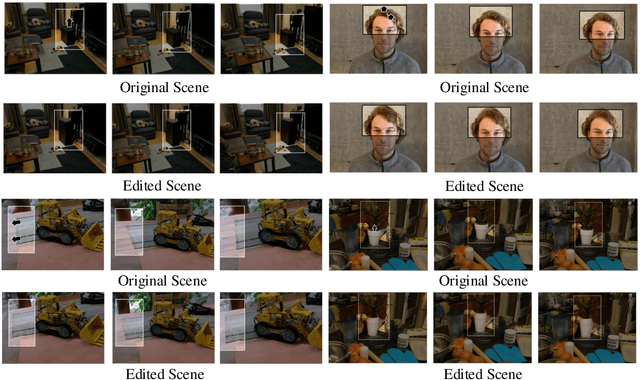
3D editing has shown remarkable capability in editing scenes based on various instructions. However, existing methods struggle with achieving intuitive, localized editing, such as selectively making flowers blossom. Drag-style editing has shown exceptional capability to edit images with direct manipulation instead of ambiguous text commands. Nevertheless, extending drag-based editing to 3D scenes presents substantial challenges due to multi-view inconsistency. To this end, we introduce DragScene, a framework that integrates drag-style editing with diverse 3D representations. First, latent optimization is performed on a reference view to generate 2D edits based on user instructions. Subsequently, coarse 3D clues are reconstructed from the reference view using a point-based representation to capture the geometric details of the edits. The latent representation of the edited view is then mapped to these 3D clues, guiding the latent optimization of other views. This process ensures that edits are propagated seamlessly across multiple views, maintaining multi-view consistency. Finally, the target 3D scene is reconstructed from the edited multi-view images. Extensive experiments demonstrate that DragScene facilitates precise and flexible drag-style editing of 3D scenes, supporting broad applicability across diverse 3D representations.